
Chongqing Rural Commercial Bank(601077)

Search documents
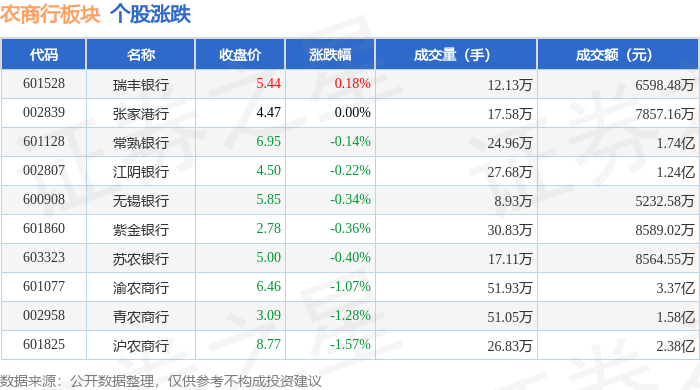
农商行板块1月16日跌0.64%,渝农商行领跌,主力资金净流出617.66万元
Zheng Xing Xing Ye Ri Bao· 2026-01-16 08:56
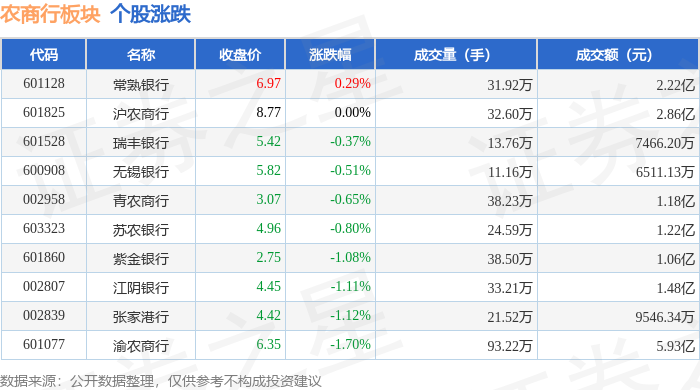
Group 1 - The agricultural commercial bank sector experienced a decline of 0.64% on January 16, with Yunnan Agricultural Commercial Bank leading the drop [1] - The Shanghai Composite Index closed at 4101.91, down 0.26%, while the Shenzhen Component Index closed at 14281.08, down 0.18% [1] - The trading volume and turnover for various agricultural commercial banks are detailed, with Changshu Bank closing at 6.97, up 0.29%, and Yunnan Agricultural Commercial Bank closing at 6.35, down 1.70% [1] Group 2 - The net outflow of main funds from the agricultural commercial bank sector was 6.1766 million yuan, while retail funds saw a net outflow of 12.6 million yuan [1] - The table shows the net inflow and outflow of funds for individual banks, with notable figures such as 14.69% net inflow for Shanghai Agricultural Commercial Bank from main funds [2] - Jiangyin Bank had a significant net outflow of 30.1445 million yuan from main funds, indicating a 20.35% decrease [2]



银行行业点评报告:企业信贷超季节性增长,信贷投放前置趋势或延续
KAIYUAN SECURITIES· 2026-01-16 05:44
Investment Rating - Investment rating: Positive (maintained) [2] Core Viewpoints - In December, corporate credit experienced a seasonal growth, with expectations that the credit issuance in Q1 2026 may reach the highest level in history [4] - The report highlights that while the year-end credit issuance slowed down, the impact of debt reduction policies has weakened, allowing for stable credit growth [4] - The report indicates that the demand for corporate loans has shown signs of recovery, with a year-on-year increase of 5.8 trillion yuan in December, although the overall demand still requires further observation [4] - The report notes that the new issuance rates for corporate and personal housing loans have stabilized at 3.10%, reflecting a shift in bank lending strategies [5][6] Summary by Sections Credit Market Analysis - December saw a new issuance of 910 billion yuan in RMB loans, a year-on-year decrease of 80 billion yuan, with a balance growth rate of 6.4% [4] - The corporate loan structure improved, with short-term and medium-to-long-term loans increasing by 3.9 trillion yuan and 2.9 trillion yuan respectively [4] - The report emphasizes that the overall credit demand from residents remains weak, with a year-on-year decrease of 441.6 billion yuan in December [4] Social Financing and Government Bonds - In December, social financing increased by 2.2 trillion yuan, a year-on-year decrease of 646.2 billion yuan, with a stock growth rate of 8.3% [5] - The slowdown in government bond issuance has been identified as a drag on social financing, with new government bonds issued at 683.3 billion yuan, one of the lowest levels of the year [5] Monetary Supply and Deposits - M2 growth in December was 8.5%, while M1 growth fell to 3.8% [6] - The report notes that the increase in fiscal deposits may indicate a weaker year-end fiscal spending compared to the previous year [6] Investment Recommendations - The report suggests that banks with strong wealth management businesses and active financial environments in key regions will benefit from the stable growth policies [7] - Recommended banks include CITIC Bank, with beneficiaries including Agricultural Bank of China, China Merchants Bank, and others [7]




银行行业点评报告:政策支撑稳增长,关注Q1银行景气度修复行情
KAIYUAN SECURITIES· 2026-01-16 03:11
Investment Rating - The investment rating for the banking industry is "Positive" (maintained) [2] Core Viewpoints - The report emphasizes that policy support is crucial for stabilizing growth, with a focus on the recovery of banking sector sentiment in Q1 [4][7] - The People's Bank of China (PBOC) has indicated the feasibility of further interest rate cuts and reserve requirement ratio (RRR) reductions due to high current levels of RRR and a stable exchange rate environment [4] - Structural monetary policy tools have been introduced to lower the overall financing costs in society, with specific interest rate cuts for various loans [5] - The resumption of government bond trading operations by the PBOC is aimed at enhancing the monetary policy toolkit and ensuring smooth issuance of government bonds [6] Summary by Sections Monetary Policy and Economic Recovery - The PBOC's recent measures include a potential for 1-2 interest rate cuts within the year, with a possible reduction of 10 basis points each time, with the earliest cut expected in Q1 [4] - The report notes that the core Consumer Price Index (CPI) has shown positive growth, indicating effective policy collaboration [7] Banking Sector Performance - The banking sector is expected to benefit from improved economic conditions, with a significant increase in credit issuance anticipated in January, potentially the highest in history [7] - Banks with strong wealth management capabilities and those in active financial environments are likely to gain more from the supportive policy landscape [7] Recommendations - The report recommends focusing on banks such as CITIC Bank, Construction Bank, Agricultural Bank, and others, which are expected to benefit from the current economic recovery and policy support [7]

农商行板块1月15日跌0.94%,沪农商行领跌,主力资金净流出4296.1万元
Zheng Xing Xing Ye Ri Bao· 2026-01-15 08:59
Group 1 - The agricultural commercial bank sector experienced a decline of 0.94% on January 15, with Hu Nong Commercial Bank leading the drop [1] - The Shanghai Composite Index closed at 4112.6, down 0.33%, while the Shenzhen Component Index closed at 14306.73, up 0.41% [1] - The trading volume and turnover for various agricultural commercial banks are detailed in a table, showing mixed performance among individual stocks [1] Group 2 - The net outflow of main funds from the agricultural commercial bank sector was 42.961 million yuan, while retail funds saw a net outflow of 56.997 million yuan [1] - The table of fund flows indicates that some banks, like Changshu Bank and Zhangjiagang Bank, had positive net inflows from retail and speculative funds, while others like Yunnan Agricultural Bank and Jiangyin Bank faced significant outflows [2] - Specific data shows that Changshu Bank had a main fund net inflow of 8.1314 million yuan, while Yunnan Agricultural Bank had a net outflow of 25.5857 million yuan [2]

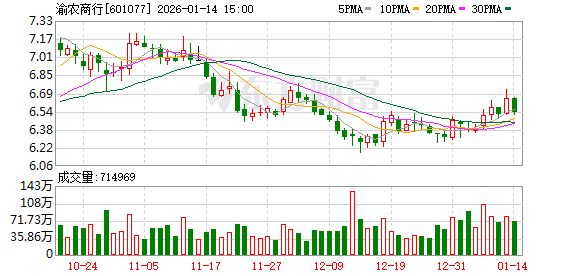
重庆农商行获董事、高管增持,资产总额已超1.65万亿
Jing Ji Guan Cha Bao· 2026-01-15 04:32
Core Viewpoint - Chongqing Rural Commercial Bank (CRCB) has demonstrated strong growth and resilience, with key executives and board members increasing their shareholdings, reflecting confidence in the bank's future prospects and strategic direction [2][7]. Group 1: Financial Performance - As of the end of Q3 2025, CRCB's total assets reached 1.65 trillion yuan, a 9.3% increase from the previous year, surpassing the average growth rates of A-share listed banks and rural commercial banks [3]. - The bank's deposit scale exceeded 1 trillion yuan, making it the first bank in the Chongqing region to achieve this milestone, while its loan balance approached 780 billion yuan, maintaining a leading position in growth rates among listed banks [3]. - For the first three quarters of 2025, CRCB reported operating income of 21.7 billion yuan, a 0.7% year-on-year increase, with net interest income rising by 6.9%, showcasing strong profitability despite a challenging interest rate environment [3]. Group 2: Asset Quality and Risk Management - CRCB's non-performing loan ratio decreased to 1.12% by the end of Q3 2025, down 0.06 percentage points from the previous year, which is lower than the average for A-share listed banks [4]. - The bank's provision coverage ratio improved to 365%, providing a solid risk buffer, while its core Tier 1 capital adequacy ratio stood at 12.98% and total capital adequacy ratio at 14.77%, indicating robust capital strength [4]. Group 3: Strategic Development - Under the leadership of Chairman Liu Xiaojun, CRCB has set clear strategic goals focusing on "technology-driven, industry-driven, and ecosystem-driven" transformations, aiming for a breakthrough in rural and urban financial services over the next five years [5]. - The bank has established a comprehensive financial service system, serving over 29.5 million personal customers and nearly 2 million merchants in Chongqing, enhancing local consumption through community-focused financial services [5]. - CRCB is also focusing on major strategic initiatives in the Chengdu-Chongqing economic circle and the new western land-sea corridor, integrating resources from universities and investment institutions to support technology enterprises [5]. Group 4: Governance and Market Confidence - CRCB has a well-defined governance structure and has recently optimized its board composition, receiving recognition for its governance practices [6]. - The increase in shareholdings by executives and board members signals strong confidence in the bank's operational fundamentals and long-term growth potential, aligning with positive institutional ratings received since March 2025 [7]. - The bank's commitment to high-quality transformation and innovation is expected to enhance its market recognition and support its ongoing reforms and business expansion [7][8].
分红早知道|最近24小时内,渝农商行、博杰股份等2家A股上市公司发布分红派息实施公告
Mei Ri Jing Ji Xin Wen· 2026-01-15 02:12
Group 1 - The Low Volatility Dividend Index (H30269.CSI) includes 50 securities with good liquidity, continuous dividends, moderate payout ratios, positive growth in dividends per share, high dividend yields, and low volatility. As of January 14, the index has a one-year dividend yield of 4.57% [1] - The Low Volatility Dividend ETF (华夏 159547) is the ETF with the lowest comprehensive fee tracking this index, with quarterly evaluations for dividends. The linked funds are Class A (021482) and Class C (021483) [1] - The Dividend Quality Index (931468.CSI) consists of 50 listed companies that provide continuous cash dividends, have high payout ratios, and exhibit high profitability. As of January 14, this index has a one-year dividend yield of 3.49% [1] - The only ETF tracking the Dividend Quality Index is the Dividend Quality ETF (159758), with linked funds being Class A (016440), Class C (016441), and Class D (024263) [1] Group 2 - Chongqing Rural Commercial Bank (渝农商行) announced a cash dividend of RMB 0.20336 per share (tax included), with the record date on January 22, 2026, and the ex-dividend date on January 23, 2026. It is a component of the Low Volatility Dividend Index (H30269.CSI) but not part of the Dividend Quality Index (931468.CSI) [1] - Bojie Co., Ltd. (博杰股份) declared a cash dividend of RMB 0.940663 per 10 shares (tax included), with the record date on January 21, 2026, and the ex-dividend date on January 22, 2026. It is not included in either the Low Volatility Dividend Index (H30269.CSI) or the Dividend Quality Index (931468.CSI) [2]
渝农商行:2025年半年度A股权益分派实施公告
Zheng Quan Ri Bao· 2026-01-14 13:17
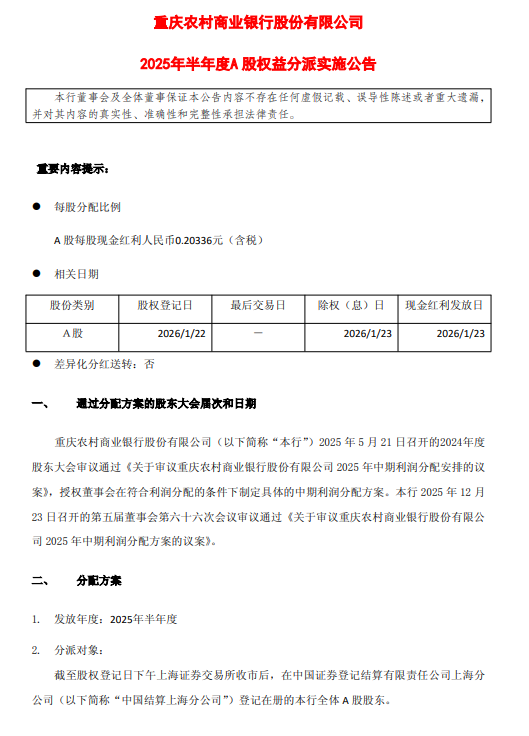
Group 1 - The company announced a cash dividend distribution plan for the first half of 2025, with a payout of 0.20336 yuan per share (including tax) [2] - The record date for the dividend distribution is set for January 22, 2026, with the ex-dividend date and payment date both on January 23, 2026 [2]
重庆农商行:2025年半年度A股拟派发现金红利17.98亿元
Jin Rong Jie· 2026-01-14 09:38
Core Viewpoint - Chongqing Rural Commercial Bank announced a cash dividend distribution plan for the first half of 2025, with a total cash dividend of 2.31 billion RMB, of which 1.80 billion RMB is allocated to A-shareholders [1][6]. Dividend Distribution Details - The total share capital for the dividend distribution is 11.36 billion shares, with 8.84 billion shares being A-shares [6]. - The cash dividend per A-share is set at 0.20336 RMB (including tax) [3][6]. - The total cash dividend to be distributed amounts to 2.31 billion RMB (including tax), with A-share dividends totaling 1.80 billion RMB (including tax) [1][6]. Important Dates - The record date for shareholders is January 22, 2026 [3][7]. - The ex-dividend date and cash dividend payment date is January 23, 2026 [1][3][7]. Approval and Implementation - The dividend distribution plan was approved at the annual general meeting held on May 21, 2025, and further confirmed at the board meeting on December 23, 2025 [3][4]. - The cash dividends for A-shareholders will be distributed through China Securities Depository and Clearing Corporation Limited, Shanghai Branch [8].
重庆农村商业银行(03618) - 海外监管公告
2026-01-14 09:26
香港交易及結算所有限公司及香港聯合交易所有限公司對本公告的內容概不負責,對其 準確性或完整性亦不發表任何聲明,並明確表示,概不對因本公告全部或任何部分內容 而產生或因倚賴該等內容而引致的任何損失承擔任何責任。 Chongqing Rural Commercial Bank Co., Ltd. * * : 3618 海外監管公告 本公告乃重慶農村商業銀行股份有限公司Chongqing Rural Commercial Bank Co., Ltd.* (「本行」)根據香港聯合交易所有限公司證券上市規則第13.10B條而作出。 茲載列本行在上海證券交易所網站刊發之《重慶農村商業銀行股份有限公司2025年半年度 A股權益分派實施公告》,謹供參閱。 承董事會命 重慶農村商業銀行股份有限公司* Chongqing Rural Commercial Bank Co., Ltd.* 董事長兼執行董事 劉小軍 中國 • 重慶,2026年1月14日 於本公告日期,本行執行董事為劉小軍先生及隋軍先生;本行非執行董事為馬寶先生、 董斌先生、袁剛先生及彭玉龍先生;及本行獨立非執行董事為李明豪先生、李嘉明先生 及畢茜女士。 * 本行經中 ...
渝农商行(601077) - 重庆农村商业银行股份有限公司2025年半年度A股权益分派实施公告
2026-01-14 09:15
证券代码:601077 证券简称:渝农商行 公告编号:2026-003 重庆农村商业银行股份有限公司 2025年半年度A 股权益分派实施公告 本行董事会及全体董事保证本公告内容不存在任何虚假记载、误导性陈述或者重大遗漏, 并对其内容的真实性、准确性和完整性承担法律责任。 重要内容提示: 每股分配比例 A 股每股现金红利人民币0.20336元(含税) 相关日期 | 股份类别 | 股权登记日 | 最后交易日 | 除权(息)日 | 现金红利发放日 | | --- | --- | --- | --- | --- | | A股 | 2026/1/22 | - | 2026/1/23 | 2026/1/23 | 差异化分红送转:否 一、 通过分配方案的股东大会届次和日期 重庆农村商业银行股份有限公司(以下简称"本行")2025 年 5 月 21 日召开的2024年度 股东大会审议通过《关于审议重庆农村商业银行股份有限公司 2025 年中期利润分配安排的议 案》,授权董事会在符合利润分配的条件下制定具体的中期利润分配方案。本行 2025 年 12 月 23 日召开的第五届董事会第六十六次会议审议通过《关于审议重庆农村商业银 ...