
Caitong Securities(601108)

Search documents
ETF盘中资讯|资本市场高景气催生券商ROE持续提升!顶流券商ETF(512000)上探逾1%,财通证券涨超3%
Sou Hu Cai Jing· 2026-01-22 03:11
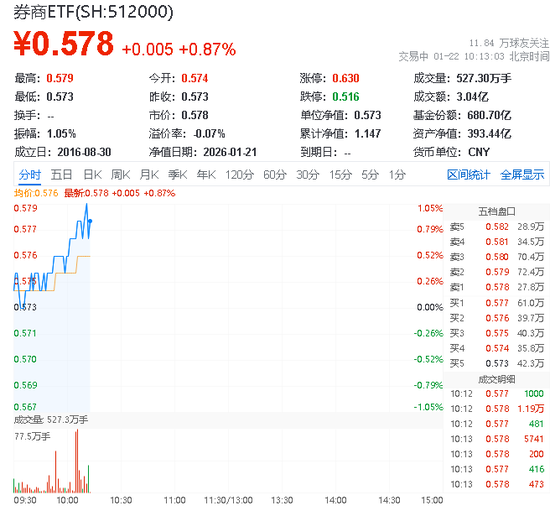
Group 1 - The brokerage sector is currently active, with notable stock price increases for firms such as Caitong Securities (up over 3%), Guotai Junan, Pacific Securities, and Dongfang Securities (each up over 1%) [1] - The top brokerage ETF (512000) saw an intraday price increase of over 1%, currently up 0.87%, with real-time transaction volume exceeding 300 million yuan [1] Group 2 - Ping An Securities indicates that the non-bank financial industry is currently undervalued, with brokerage sector valuation at 1.38 times PB, below the historical median of the past decade [3] - The China Securities Regulatory Commission (CSRC) has emphasized a "stability" approach in its work deployment, with adjustments to the minimum margin ratio for financing, which is expected to help reduce leverage and promote market stability in the long term [3] - According to Founder Securities, the brokerage sector is still experiencing a "lag," but ROE is on the rise, suggesting that the sector's market performance, although delayed, will eventually improve [3] - By 2025, the capital market is expected to maintain high prosperity, with average daily stock fund transaction volume projected at 2.08 trillion yuan, a year-on-year increase of 70.2%, and average margin financing balance also at 2.08 trillion yuan, up 32.7% year-on-year [3] - The A-share IPO scale is anticipated to reach 130.8 billion yuan, reflecting a year-on-year growth of 97.4% [3] - The brokerage ETF (512000) and its linked funds are efficient investment tools that passively track the CSI All Share Securities Companies Index, encompassing 49 listed brokerage stocks [3]


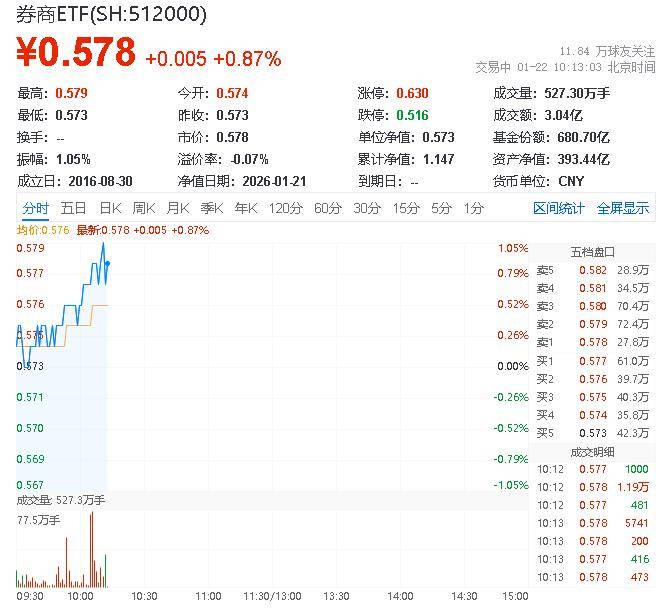
资本市场高景气催生券商ROE持续提升!顶流券商ETF(512000)上探逾1%,财通证券涨超3%
Xin Lang Cai Jing· 2026-01-22 02:55
方正证券指出,券商仍"滞涨"、ROE处于上升通道,板块行情虽迟但到。2025年资本市场持续高景气, 全年日均股基成交额2.08万亿,同比增长70.2%,日均两融余额2.08万亿,同比增长32.7%,A股IPO规模 1308亿,同比增长97.4%。核心指标改善趋势下,看好券商板块2025全年利润同比高增,ROE改善。 布局工具上,公开资料显示,券商ETF(512000)及其联接基金(A类 006098;C类007531)被动跟踪 中证全指证券公司指数,一键囊括49只上市券商股,是集中布局头部券商、同时兼顾中小券商的高效率 投资工具。 数据来源于沪深交易所、 Wind 等。 注:ETF费用相关说明:投资者在申购或赎回基金份额时,申购赎回代理机构可按照不超过0.5%的标准 收取佣金,其中包含证券交易所、登记机构等收取的相关费用。联接基金费用相关说明:华宝中证全指 证券公司ETF联接基金(A类)申购费率(前收费)为申购金额200万元(含)以上时1000元/笔,100万 元(含)~200万元时0.6%,100万元以下时1%;赎回费率为持有天数7日以下时1.5%,持有天数7日 (含)~180日时0.5%,持有天数180日 ...
财通证券资产管理有限公司旗下部分基金2025年第4季度报告提示性公告
Xin Lang Cai Jing· 2026-01-21 20:33
本公司董事会及董事保证基金季度报告所载资料不存在虚假记载、误导性陈述或重大遗漏,并对其内容 的真实性、准确性和完整性承担个别及连带责任。 财通证券资产管理有限公司旗下 财通资管积极收益债券型发起式证券投资基金 财通资管鑫管家货币市场基金 财通资管鑫逸回报混合型证券投资基金 财通资管鑫锐回报混合型证券投资基金 财通资管睿智6个月定期开放债券型发起式证券投资基金 财通资管消费精选灵活配置混合型证券投资基金 财通资管鑫盛6个月定期开放混合型证券投资基金 财通资管瑞享12个月定期开放混合型证券投资基金 财通资管价值成长混合型证券投资基金 财通资管鸿福短债债券型证券投资基金 财通资管丰和两年定期开放债券型证券投资基金 财通资管鸿睿12个月定期开放债券型证券投资基金 财通资管鸿益中短债债券型证券投资基金 财通资管鸿利中短债债券型证券投资基金 财通资管鸿达纯债债券型证券投资基金 财通资管鸿运中短债债券型证券投资基金 财通资管价值发现混合型证券投资基金 财通资管行业精选混合型证券投资基金 财通资管鸿盛12个月定期开放债券型证券投资基金 财通资管科技创新一年定期开放混合型证券投资基金 财通资管丰乾39个月定期开放债券型证券投资 ...
财通证券:发行15亿元短期融资券,票面利率为1.72%
Bei Jing Shang Bao· 2026-01-21 09:48
北京商报讯(记者 刘宇阳 实习生 姚榕琰)1月21日,财通证券发布公告称,2026年度第一期短期融资券已于1月19日缴款完毕。公告显示,本期短期融资 券,实际发行总额为15亿元,期限365天,票面利率为1.72%,起息日为2026年1月19日,兑付日为2027年1月19日。 | 短期融资券名称 | 财通证券股份有限公司 2026年度第一期 | | | --- | --- | --- | | 短期融资券简称 | 26 财通证券 CP001 | 短期融资券代码 | | 发行日 | 2026年1月16日 | 起息日期 | | 兑付日期 | 2027 年 1 月 19 日 | 期限 | | 计划发行总额 | 15 亿元人民币 | 实际发行总额 | | 发行价格 | 100 元/张 | 票面利率 | ...
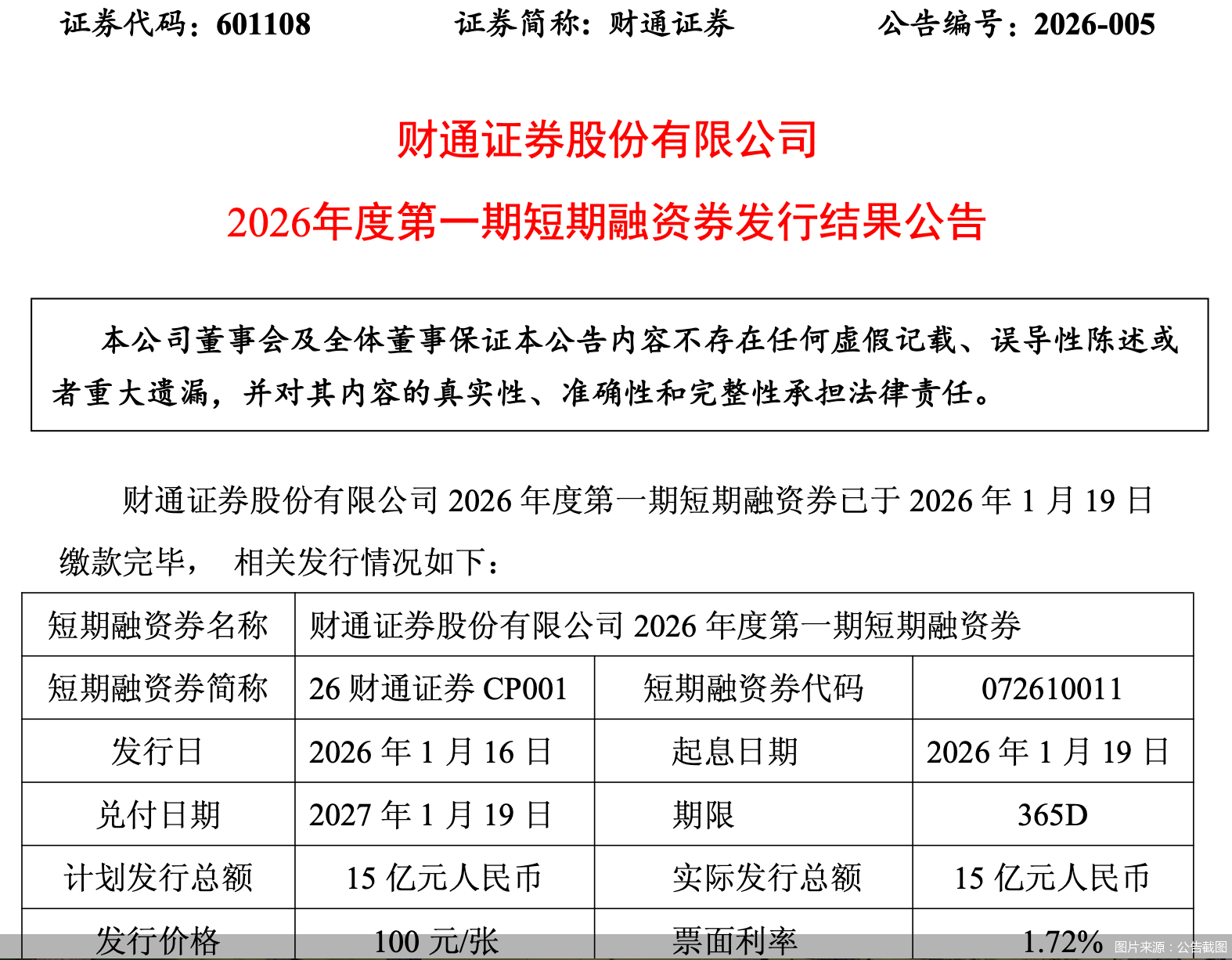
财通证券(601108) - 2026年度第一期短期融资券发行结果公告
2026-01-21 08:16
1、中国货币网,http://www.chinamoney.com.cn; 证券代码:601108 证券简称: 财通证券 公告编号:2026-005 2、上海清算所网站,http://www.shclearing.com。 特此公告。 财通证券股份有限公司 2026年度第一期短期融资券发行结果公告 本公司董事会及全体董事保证本公告内容不存在任何虚假记载、误导性陈述或 者重大遗漏,并对其内容的真实性、准确性和完整性承担法律责任。 财通证券股份有限公司 2026 年度第一期短期融资券已于 2026 年 1 月 19 日 缴款完毕, 相关发行情况如下: | 短期融资券名称 | | | 财通证券股份有限公司 | | 年度第一期短期融资券 2026 | | | | | --- | --- | --- | --- | --- | --- | --- | --- | --- | | 短期融资券简称 | 26 | 财通证券 | | CP001 | 短期融资券代码 | | 072610011 | | | 发行日 | 2026 | 年 1 | 月 | 16 日 | 起息日期 | 2026 | 年 1 月 | 19 日 | | 兑 ...
美国债基规模为何持续扩张?
CAITONG SECURITIES· 2026-01-20 13:09
1. Report Industry Investment Rating No information provided regarding the industry investment rating in the report. 2. Core Views - Since the first open - ended fund was launched in the US in 1924, the US public fund industry has evolved over a century. The bond - type funds entered the growth stage in the 1980s and have experienced multiple interest - rate cycles. The long - term low - interest environment from 2011 - 2016 provides a historical model for analyzing China's current bond investment path [3]. - The US low - interest rate evolved in four steps: rapid decline (2011.1 - 2011.9), low - level fluctuation (2011.10 - 2013.6), interest - rate recovery (2013.7 - 2013.12), and return to decline (2014.1 - 2016.9). Each stage had different impacts on bond - type funds' performance, scale, and asset allocation [3]. - The US bond - type funds could continuously expand due to factors such as the relative attractiveness of US interest rates globally, the expansion of the US asset - management industry, the tool - based and passive nature of bond - type funds in a low - interest environment, and investors' "Reaching for Yield" behavior [3]. - US bond - type funds did not continuously increase duration in the low - interest period because the spread was extremely compressed, interest - rate fluctuations were large, and there were more investment tools and a wider investment scope [3]. 3. Summary by Relevant Catalog 3.1 US Bond - type Fund Development History and Classification 3.1.1 US Bond - type Fund Development History - The US fund industry's development can be divided into three stages: traditional mutual - fund development (1924 - 1980) dominated by stock and hybrid funds; the rise of pension - based asset allocation (1980 - 2000) forming the buyer's investment - advisor model; and the shift to passive investment (2000 - present) with fund companies transforming into investment - advisory services [7]. - For bond - type funds, the period from 1980 to the present can be further divided into three stages: a stable growth period (1980 - 2007) when the US interest rate declined for nearly 30 years, and the bond - type fund scale grew from $46.24 billion in 1984 to $1.68 trillion in 2007, also benefiting from the 401(k) plan and product innovation; a rapid development period (2008 - 2020) after the 2008 financial crisis, with bond - type funds rebounding in scale due to Fed's policies and the stock - bond rebalancing strategy; a recovery growth period (2020 - present) with fluctuations caused by the public - health event and Fed's interest - rate hikes [9][12]. 3.1.2 US Bond - type Fund Classification - Classified by tax, US bond - type funds are divided into taxable bond funds and municipal bond funds. If the proportion of municipal bonds in bond assets exceeds 67%, it is defined as a municipal bond fund; otherwise, it is a taxable bond fund. The median remaining term of municipal bond funds from 2010 - 2024 was 15.79 years, with a median credit score of 7.49 (A -) and a median quarterly return of 0.88%. Taxable bond funds, accounting for 84% of the total bond - type funds in 2024, mainly invest in non - municipal bonds and have a more complex composition [14]. - Taxable bond funds can be further divided into investment - grade, high - yield, global, federal - government, and mixed - bond types. Municipal bond funds can be divided into state - and - local - municipal and national - municipal bond types [15]. 3.2 How Did US Bond - type Funds Respond During the Long - term Low - interest Period? 3.2.1 Four - step Deduction of Low Interest Rates - Rapid decline stage (2011.1 - 2011.9): Bond - type fund scale increased, credit grade rose slightly, government - bond fund duration decreased, and high - yield bond funds' returns declined significantly due to the European debt crisis and the US debt - ceiling crisis [23]. - Low - level fluctuation stage (2011.10 - 2013.6): Government - bond fund scale declined after reaching a peak, corporate - bond fund scale growth slowed, credit grades declined, and bond - type fund performance declined after reaching a peak [23]. - Interest - rate recovery stage (2013.7 - 2013.12): Government - bond fund scale declined sharply, investment - grade bond fund scale remained stable, high - yield bond fund scale increased, and bond - type fund performance declined comprehensively [24]. - Return to decline stage (2014.1 - 2016.9): Government - bond and investment - grade bond fund scales increased, high - yield bond fund scale first increased then decreased, credit grades rose, and bond - type fund returns first increased then decreased [24]. 3.2.2 Reasons for the Continuous Expansion of US Bond - type Funds - Globally, US interest rates were still attractive compared to other developed countries from 2011 - 2016 [34]. - Macroeconomically, the US asset - management industry was in an expansion period, benefiting from stock - bond balanced allocation and population aging and pension plans. The stock - bond rebalancing strategy led to the expansion of bond - type funds during the stock - market boom, and pension plans brought continuous capital inflows [34][35]. - In the long - term low - interest environment, bond - type funds became more tool - based and passive. Indexed bond funds had advantages such as low fees, transparent investment strategies, diversified risks, and high liquidity [36]. - In the low - interest environment, US investors' "Reaching for Yield" behavior was more prominent. Bond - type funds used credit - sinking strategies and increased overseas investment to pursue returns and maintain scale expansion [39]. 3.3 US Bond - type Fund Fee Issues - US mutual funds mainly charge operating fees and sales commissions. Currently, commission - free funds are mainstream in the US fund market. Operating fees include fund management fees, 12b - 1 fees, and other operating costs [44]. - The fee rate of bond - type funds is slightly lower than that of stock - type funds. In 2024, the asset - weighted average fee rate of US bond - type funds was 0.38%. The fee rate of bond - type funds has decreased significantly from 1996 - 2024, mainly due to the indexation trend [45]. 3.4 Appendix I: US Bond - type Fund Data Processing - A relatively complete US bond - type fund database was constructed based on the CRSP database combined with other data. The database contains about 550,000 quarterly samples of US bond - type funds since 2000 [50]. - SEC data is authoritative and discloses monthly data. In the first quarter of 2025, the total scale of US bond - type funds (excluding ETFs and closed - end funds) in mutual funds was $5.45 trillion, including $4.63 trillion in taxable bond funds and $0.82 trillion in municipal bond funds [52]. - ICI data has a longer time span and more detailed classification. In 2024, the scale of US bond - type mutual funds was $5.07 trillion according to ICI statistics [58]. - Morningstar classifies US bond - type funds into nearly 50 unique categories, providing more data dimensions that investors are concerned about [59]. 3.5 Appendix II: "Reaching for Yield" Behavior in a Low - interest Environment - In the US fund market, investors generally chase returns, but in China, there is a redemption anomaly where fund performance and capital flow are inversely related, which can be explained by the prospect theory and the disposition effect [63][64]. - In the low - interest era, corporate - bond funds optimize asset allocation and performance through "risk - taking/chasing returns," but the risk - adjusted alpha is not stable, and the tail risk increases [67]. - The "Reaching for Yield" index (RFY) can be decomposed into "credit sinking" (RFR), "lengthening duration" (RFM), and "selecting higher - yield bonds within the same rating and maturity bucket" (RFY_WRM). Higher RFY corresponds to higher nominal returns but no stable alpha after risk adjustment [68]. - Fixed - income funds can use interest - rate derivatives (IRDs) to increase duration exposure, but when interest rates reverse, losses are significantly magnified [70]. - The positive feedback between capital flow and yield strengthens the universality and importance of "Reaching for Yield" in a low - interest environment [74]. - When interest rates decline, capital not only re - distributes within bond funds but also flows to the stock market, especially high - dividend stock funds. In an ultra - long - term low - interest environment, the motivation of bond - type funds to deviate actively decreases [75][77].
财通证券:汽车销量走弱来自政策的不及预期 关注高端化智能化主线
智通财经网· 2026-01-20 03:53
Core Viewpoint - The passenger car market and new energy vehicle market are showing weak performance due to market policies, but the overall vehicle sector is believed to have bottomed out after multiple adjustments. The company maintains its existing vehicle strategy and suggests focusing on three structural directions: high-end, intelligent, and overseas expansion [1][3]. Market Performance - From January 1 to 11, 2026, nationwide retail sales of passenger cars reached 328,000 units, representing a year-on-year and month-on-month decline of 32% and 42%, respectively. Among these, new energy vehicle sales were 117,000 units, with a year-on-year and month-on-month drop of 38% and 67%. The penetration rate of new energy vehicles stands at 35.5% [2]. Demand Weakness Analysis - The decline in sales is attributed to policies falling short of expectations. The reduction in purchase tax and the proportional subsidy have increased costs for consumers in the mid-to-low-end market, leading to a stronger wait-and-see sentiment among buyers. This has resulted in a shift back to traditional fuel vehicles, with anticipated demand in January not materializing. The effectiveness of the subsidy policy appears weak at this time [3]. Market Dynamics - Weak demand for passenger cars may not necessarily be negative, as it could clarify the competitive landscape in the mid-to-low-end market. The current market is characterized by a high preference for cost-effectiveness, and the focus remains on the new car cycle. The market is currently in a low season with fewer new car launches, but a wave of new car releases is expected around late April during the Beijing Auto Show [4]. Investment Recommendations - High-end Focus: Given the weak performance in the mid-to-low-end market, the company recommends selecting firms with structural beta and a clear high-end path, such as Jianghuai Automobile and Xiaomi Group, while paying attention to the new car cycle of BAIC Blue Valley [5]. - Intelligent Development: Intelligent technology is seen as a necessary path for the next phase of the automotive industry, with a core recommendation for XPeng Motors, focusing on opportunities related to new valuations [5]. - Overseas Expansion: Although the process of overseas expansion is lengthy, opportunities still exist, with BYD being a key recommendation, particularly regarding its overseas progress and potential profit contributions [5].
财通证券(601108)披露2025年度第五期短期融资券兑付完成公告,1月19日股价上涨0.92%
Sou Hu Cai Jing· 2026-01-19 14:31
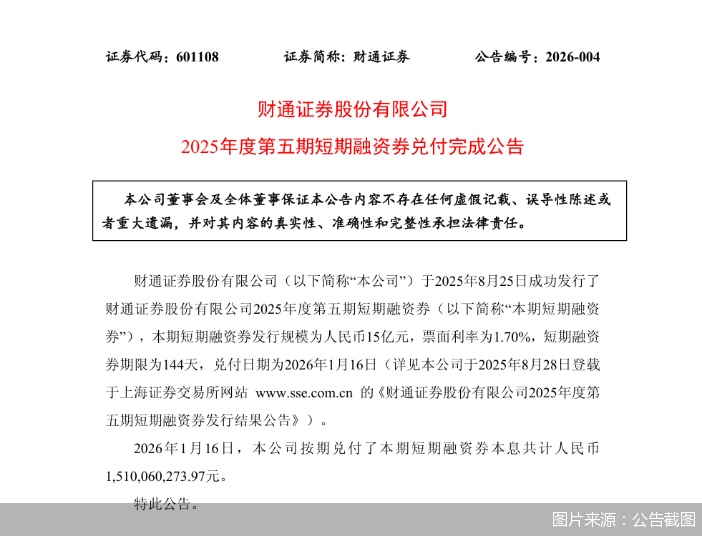
Group 1 - The core point of the article is that Caitong Securities has successfully completed the repayment of its fifth short-term financing bond for the year 2025, which was issued on August 25, 2025, with a total issuance size of 1.5 billion RMB and a maturity of 144 days [1][2] - As of January 19, 2026, Caitong Securities' stock closed at 8.74 RMB, reflecting a 0.92% increase from the previous trading day, with a total market capitalization of 40.586 billion RMB [1] - The company reported a trading volume of 4.02 billion RMB on the same day, with a turnover rate of 0.99% [1]
财通证券:第五期短期融资券兑付完成,本息共计约15.1亿元
Bei Jing Shang Bao· 2026-01-19 12:00
公告指出,2026年1月16日,财通证券按期兑付了本期短期融资券本息共计人民币约15.1亿元。 北京商报讯(记者 刘宇阳 实习生 岳雯艳)1月19日,财通证券发布公告称,于2025年8月25日成功发行 了财通证券2025年度第五期短期融资券(以下简称"本期短期融资券"),本期短期融资券发行规模为人 民币15亿元,票面利率为1.7%,短期融资券期限为144天,兑付日期为2026年1月16日。 ...
研报掘金丨财通证券:首予星宸科技“增持”评级,新产品逐步进入放量新阶段
Ge Long Hui· 2026-01-19 09:34
Core Viewpoint - Xingchen Technology is a leading SOC supplier in the AI vision chip field in China, with strong market recognition in traditional security and rapid expansion in smart IoT, smart automotive, and 3D perception sectors [1] Group 1: Market Position and Product Development - The company has a high market recognition in the traditional security sector and is accelerating its expansion into emerging product forms such as AI robots and AI glasses in the AIoT field [1] - The demand for intelligent edge devices is increasing, leading to a greater emphasis on visual perception and computing capabilities in the AI SoC market [1] Group 2: Product Matrix and Future Growth - The company has established a comprehensive product matrix covering external perception, in-cabin vision, and 3D perception in the automotive intelligent vision and ADAS fields [1] - New products are gradually entering a stage of volume production, which is expected to open a new round of performance growth [1] - The company is maintaining its technological advantages in the general security field while continuing to invest in R&D for niche markets [1]