INDUSTRIAL BANK(601166)

Search documents
多家银行宣布对“沉睡账户”开展清理,账户里的余额还能取吗?
Yang Guang Wang· 2025-10-19 06:52
Core Viewpoint - Recent actions by multiple banks to manage or clean up "long-term inactive accounts" aim to prevent misuse by criminals and combat risks such as money laundering and fraud [1][5]. Group 1: Bank Actions - Several banks have announced the initiation of cleanup actions for long-term inactive accounts, which include both personal and corporate accounts [2]. - The criteria for identifying "long-term inactive accounts" vary among banks, but generally focus on accounts with low balances and no user-initiated transactions for an extended period [2][3]. - Banks have set specific thresholds, such as balances below 10 RMB and no transactions for three years, to classify accounts as inactive [3]. Group 2: Customer Concerns - Many customers reported not receiving prior notifications from banks regarding the potential cleanup of their accounts, leading to confusion about how to proceed [2]. - Customers expressed concerns about the implications of account cleanup, such as the potential impact on their business operations and the need for clear communication from banks regarding timelines and procedures [2][4]. Group 3: Regulatory and Security Implications - Experts highlight that cleaning up long-term inactive accounts can mitigate risks associated with forgotten funds, personal information leaks, and illegal activities [5]. - The initiative is seen as a proactive measure to enhance financial security and resource efficiency within the banking system, with statistics indicating a significant correlation between inactive accounts and fraud cases [5]. - Recommendations for banks include improving customer communication and providing guidance on managing inactive accounts to enhance consumer awareness and security [5].


因质押合同纠纷,兴业银行起诉上海红星美凯龙置业有限公司
Zhong Guo Neng Yuan Wang· 2025-10-19 04:04
Core Viewpoint - Recently, Industrial Bank Co., Ltd. has initiated a court case regarding a "pledge contract dispute" against Shanghai Hongxing Meikailong Real Estate Co., Ltd. [1] Group 1 - The plaintiff in the case is Industrial Bank Co., Ltd. [1] - The defendant in the case is Shanghai Hongxing Meikailong Real Estate Co., Ltd. [1]
银行密集清理低余额长期不动户
Nan Fang Du Shi Bao· 2025-10-18 23:09
Core Viewpoint - Multiple banks are initiating the cleanup of long-term inactive accounts, which include both personal and corporate accounts, to mitigate risks associated with money laundering and fraud, as well as to optimize resource management [2][3][4]. Group 1: Reasons for Cleanup - Long-term inactive accounts are susceptible to misuse by criminals for activities such as money laundering and telecom fraud, necessitating their removal to reduce gray areas [3]. - These accounts consume system resources and increase data storage and maintenance costs, thus cleaning them can enhance backend management and service response efficiency [3]. - Regulatory requirements mandate banks to perform customer identity verification and manage accounts that cannot be verified or have been inactive for long periods, aligning with anti-money laundering and account real-name management efforts [3]. Group 2: Consumer Risks - Long-term inactive accounts can incur management fees and annual fees, leading to gradual depletion of small balances if not monitored [4]. - Inactive accounts may be exploited by criminals, posing legal risks and credit vulnerabilities for consumers [5]. Group 3: Standards for Inactive Accounts - Different banks have varying criteria for defining "long-term inactive accounts," with examples including: - Industrial Bank defines it as accounts with a balance of 10 yuan or less and no transactions for over 365 days [6]. - New Feng Rural Commercial Bank considers accounts inactive if there have been no transactions for over three years and the balance is zero [6]. - Bank of China (Hainan branch) identifies accounts with no transactions in three years and a balance of 10 yuan or less as inactive [6]. - Jiuquan Rural Commercial Bank sets the threshold at two years of inactivity with a balance of 100 yuan or less [6]. Group 4: Variability in Standards - The differences in standards among banks stem from their autonomy in execution and varying risk preferences, with larger banks often adopting more cautious approaches compared to smaller banks [7]. - Some banks are extending the cleanup to corporate accounts and online channels, indicating a broader scope of the initiative [7]. Group 5: Regulatory Evolution - The current cleanup initiative reflects a shift from focusing on physical cards to managing account behaviors, indicating a deeper regulatory approach to account lifecycle management [8][9]. - The emphasis has transitioned from merely addressing card redundancy to ensuring the authenticity, activity, and traceability of accounts, highlighting an upgrade in regulatory requirements [9].




多家银行宣布!长期不动账户将被清理
财联社· 2025-10-18 14:05
Core Viewpoint - Multiple banks are cleaning up long-term inactive accounts to enhance financial security and operational efficiency, while also preventing risks such as telecom fraud and money laundering [1][3]. Group 1: Bank Announcements - On October 16, Hubei Yuanan Rural Commercial Bank announced a cleanup of personal bank accounts, including long-term inactive accounts and those with missing or expired identity information [2]. - Various banks have released similar announcements, with criteria for identifying long-term inactive accounts varying across institutions. For instance, Guian Development Village Bank will clean accounts that have had no transactions for a year, excluding interest accruals [2]. - Industrial Bank has adjusted its criteria for long-term inactive accounts from a balance of 100 yuan to 10 yuan, with a requirement of no transactions for 365 days [2]. Group 2: Risk Prevention - The ongoing cleanup of long-term inactive accounts is aimed at strengthening account management and safeguarding customer funds against telecom fraud risks [3]. - Long-term inactive accounts can lead to wasted financial resources and expose consumers to risks of fraud, as sensitive information may be compromised [3]. - The initiative is seen as beneficial for customers, allowing them to better understand their account status and manage their funds effectively [3]. Group 3: Consumer Recommendations - Consumers are advised to regularly review and manage their bank accounts, including timely cancellation of unused cards [4]. - Banks recommend that customers perform at least one transaction on accounts identified as long-term inactive to avoid restrictions [4]. - Customers should verify with their banks if they are unsure whether their accounts fall under the cleanup criteria [4]. Group 4: Security Measures - Banks have assured that during the cleanup process, they will not request sensitive information such as passwords or verification codes through SMS or calls [5]. - Customers are warned against phishing attempts related to account cleanup and should be cautious of unsolicited communications [5].

因信用卡等业务违规两家大行被罚
Xin Lang Cai Jing· 2025-10-18 09:03
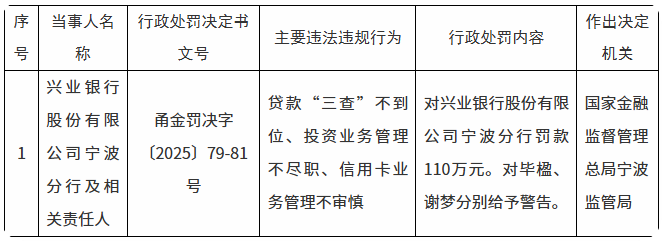
Group 1: Xinyey Bank - Xinyey Bank's Ningbo branch was penalized for multiple violations in credit card business, including inadequate loan checks and imprudent management [2][3] - The total fine imposed on Xinyey Bank's Ningbo branch is 1.1 million yuan, with warnings issued to two responsible individuals [3][4] - The violations included insufficient risk control and lack of internal management mechanisms in credit card operations, potentially leading to financial risks [4] Group 2: Industrial and Commercial Bank of China (ICBC) - ICBC's Guizhou province and Guiyang branches were fined for illegal handling of credit card auto installment business, with a total fine of 900,000 yuan [5][6] - The penalties included 450,000 yuan for the Guizhou branch and 400,000 yuan for the Guiyang branch, along with fines for several responsible individuals [7] - The credit card installment business is crucial for financial services, and improper operations can lead to high interest rates and non-transparent fees for consumers [8]
银行陆续下线电话银行部分功能,业内:符合金融服务线上化、智能化发展趋势
Mei Ri Jing Ji Xin Wen· 2025-10-18 06:05
Core Viewpoint - The trend of banks discontinuing certain functions of telephone banking is part of a broader digital transformation strategy aimed at enhancing security, reducing operational costs, and adapting to changing customer behaviors [1][3][4]. Group 1: Bank Announcements - Zhejiang Commercial Bank announced it will discontinue personal deposit transaction services via telephone banking on November 14, 2025, including various types of fund transfers [1]. - Other banks, such as Industrial Bank, China Merchants Bank, Minsheng Bank, and Agricultural Bank, have also phased out various telephone banking functions in recent years, including fund transfers and loan services [2]. Group 2: Industry Trends - The shift away from telephone banking is driven by the increasing prevalence of digital channels like mobile banking, which are seen as more secure and efficient for managing financial transactions [3]. - According to the "2024 China Digital Banking Survey Report," the usage rate of telephone banking has decreased to 25%, down 3% year-on-year, while mobile banking usage has risen to 88%, an increase of 2 percentage points from the previous year [3][4].


银行清理个人长期不动户:部分认定标准调至10元,取出需到柜台
Xin Jing Bao· 2025-10-18 03:00
Core Viewpoint - Multiple banks are implementing stricter measures to clean up long-dormant personal bank accounts, with standards for inactivity being lowered significantly, reflecting a response to regulatory requirements and a need for risk management in the financial sector [1][2][5]. Summary by Sections Bank Actions - Banks like Industrial Bank have reduced the threshold for identifying long-dormant accounts from 100 yuan to 10 yuan and extended the inactivity period from 180 days to 365 days [3][5]. - Other banks, such as Bank of China, are also implementing restrictions on transactions for accounts that meet the new criteria [2][3]. Variability in Standards - Different banks have varying criteria for identifying long-dormant accounts, with inactivity periods ranging from 1 to 3 years and balance thresholds from 10 yuan to 100 yuan [2][4]. - The lack of uniformity in standards is attributed to banks' autonomy in execution and differing risk appetites [4]. Regulatory Context - The cleanup of long-dormant accounts is part of a broader regulatory effort to combat financial crimes such as money laundering and telecom fraud [5][6]. - Regulatory bodies like the People's Bank of China and the Ministry of Public Security have issued guidelines mandating banks to manage dormant accounts more effectively [6][7]. Resource Management - The existence of numerous long-dormant accounts leads to resource wastage for banks, as these accounts still require server storage and system maintenance [7]. - Cleaning up these accounts is seen as a way to optimize financial infrastructure and align with compliance requirements [7]. Customer Guidance - Customers with frozen accounts can reactivate them by visiting bank branches with proper identification [8][9]. - Banks emphasize that they will not request sensitive information via phone or text during this process, urging customers to protect their personal information [9][10].
上海开开实业股份有限公司关于使用闲置自有资金购买银行理财产品的公告
Shang Hai Zheng Quan Bao· 2025-10-17 19:27
Core Viewpoint - The company plans to invest a total of RMB 50 million in low-risk financial products, specifically structured deposits, to enhance the efficiency and yield of its idle funds while ensuring that daily operations are not affected [2][4][9]. Summary by Sections Investment Overview - The company will invest a total of RMB 50 million, with RMB 20 million in structured deposits from Industrial Bank and RMB 30 million from Shanghai Bank [2][4]. - The investment aims to utilize idle funds prudently, ensuring liquidity and safety while improving returns [4][5]. Investment Details - The structured deposit products include those from Industrial Bank and Shanghai Bank, both of which are reputable listed commercial banks in Shanghai [6][8]. - The investment periods are 98 days for Industrial Bank and 181 days for Shanghai Bank [2]. Approval Process - The investment was approved during the 25th meeting of the 10th Board of Directors on April 28, 2025, with unanimous support [2][6]. - The company is authorized to use up to RMB 180 million for low-risk financial products over the next year, with the ability to roll over funds [2][6]. Risk Management - The company will select financial institutions based on their qualifications, prioritizing large, state-owned or publicly listed banks [7]. - The management team will monitor the investment closely, with the audit department overseeing the use and custody of funds [7][9]. Impact on the Company - The investment will not interfere with the company's main business operations and is expected to enhance the efficiency of fund usage [9]. - The financial products will be recorded as trading financial assets on the balance sheet, with related gains or losses reflected in the income statement [9].


宁波金融监管局出手,3家银行被罚
Zhong Guo Ji Jin Bao· 2025-10-17 16:16
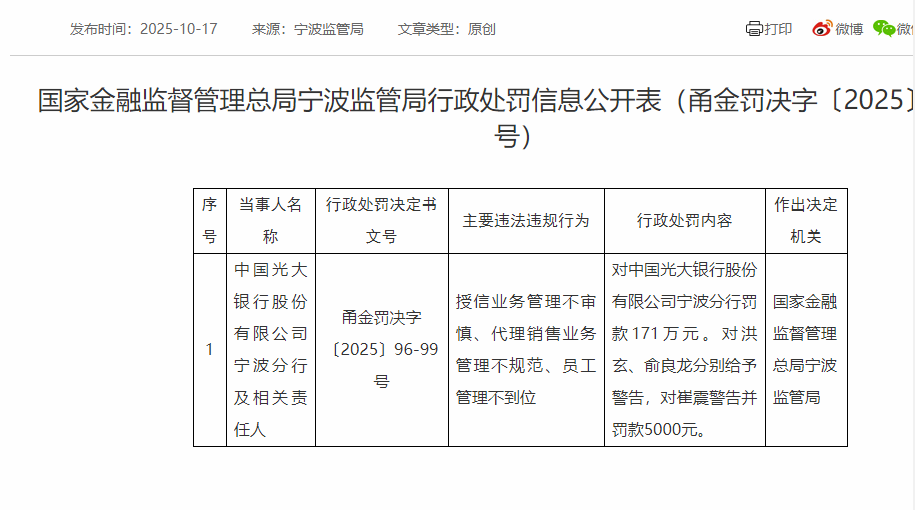
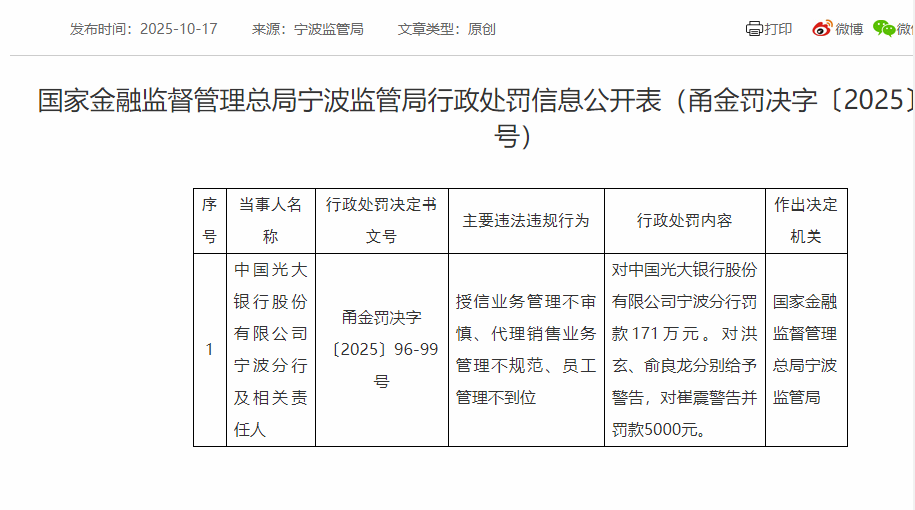
Core Points - Three banks in Ningbo, China, including China Everbright Bank, Industrial Bank, and Ningbo Donghai Bank, were fined a total of 5.215 million yuan for various regulatory violations [1][2][4][6] - The regulatory actions reflect a trend of increasing scrutiny and significant penalties within the banking sector, particularly targeting regional and local banks [6] Group 1: China Everbright Bank - China Everbright Bank's Ningbo branch was fined 1.71 million yuan for three violations: imprudent credit management, non-compliance in agency sales, and inadequate employee management [1][2] - Specific individuals, including Hong and Yu, received warnings, while another individual, Cui, was fined 5,000 yuan [1][2] Group 2: Industrial Bank - Industrial Bank's Ningbo branch faced a fine of 1.1 million yuan due to inadequate loan checks, lack of diligence in investment management, and imprudent credit card management [3][6] - Related individuals, Bi and Xie, were also issued warnings [3] Group 3: Ningbo Donghai Bank - Ningbo Donghai Bank was penalized 2.4 million yuan for six violations, including failure to rectify identified issues, non-compliance in performance assessment, and imprudent management of both corporate and personal credit [4][5] - Individuals such as Kong, Chen, Mao, and Shi received warnings for their roles in the violations [4][5] Group 4: Regulatory Environment - The banking sector is experiencing intensified regulatory scrutiny, with significant penalties becoming more common, particularly for regional banks [6] - Recent penalties include 87.25 million yuan against Huaxia Bank and 61.5 million yuan against Hengfeng Bank for various management failures [6]

宁波金融监管局出手 3家银行被罚
Zhong Guo Ji Jin Bao· 2025-10-17 16:13
Core Viewpoint - The National Financial Supervision Administration's Ningbo Regulatory Bureau has issued multiple administrative penalties against Everbright Bank, Industrial Bank, and Ningbo Donghai Bank, totaling 5.215 million yuan, highlighting ongoing regulatory scrutiny in the banking sector [1][3]. Summary by Category Everbright Bank - Everbright Bank's Ningbo branch was fined 1.71 million yuan for three violations: imprudent credit business management, non-compliant agency sales management, and inadequate employee management. Warnings were issued to individuals Hong and Yu, while Cui received a warning and a fine of 5,000 yuan [1][2]. Industrial Bank - Industrial Bank's Ningbo branch faced a fine of 1.1 million yuan due to violations including inadequate loan "three checks," lack of diligence in investment business management, and imprudent credit card business management. Warnings were issued to responsible individuals Bi and Xie [3][4]. Ningbo Donghai Bank - Ningbo Donghai Bank was penalized 2.4 million yuan for six violations, including failure to rectify identified issues, non-compliance in performance assessment indicators and payment delays, employee misconduct, improper deposit solicitation, imprudent public credit business management, and imprudent personal credit business management. Warnings were issued to individuals Kong, Chen, Mao, and Shi [3][4]. Regulatory Trends - The banking sector is experiencing intensified regulatory scrutiny, with a trend of large and concentrated penalties. In April, Ningbo Donghai Bank was previously fined 2.271 million yuan for five violations, and in September, Huaxia Bank was fined 87.25 million yuan for various management deficiencies. Hengfeng Bank was also fined 61.5 million yuan for similar issues [5][6].