BOB(601169)

Search documents
知名经济学家邓海清离任,下一站拟加盟中加基金
21世纪经济报道· 2025-11-14 09:16
Core Viewpoint - The article discusses the resignation of Deng Haiqing from the position of Deputy General Manager at AVIC Fund due to personal reasons, and his potential transition to a larger public fund platform, Zhongjia Fund, which aligns with his macro research background [1][2][4]. Group 1: Management Changes - Deng Haiqing resigned as Deputy General Manager of AVIC Fund on November 13, 2023, and will not take on any other roles within the company [1][2]. - Deng Haiqing has a diverse career background, having worked at various financial institutions, including Guojin Securities and Ant Financial Research Institute, before joining AVIC Fund in December 2020 [2][3]. Group 2: Fund Management and Performance - During his tenure, Deng Haiqing managed the AVIC Mixed Reform Selected Fund, which saw a significant shift in its portfolio towards real estate, with 90% of holdings concentrated in this sector by the end of 2023 [3][4]. - The fund's performance under Deng Haiqing was subpar, with a return of -13.45% over nearly one and a half years, ranking in the bottom 10% among similar funds [4]. Group 3: Future Outlook - Deng Haiqing has expressed optimism about the A-share market, citing potential improvements in profitability across multiple sectors supported by policy changes [4]. - He has highlighted investment opportunities in artificial intelligence and its infrastructure, suggesting that these areas could drive significant economic growth and demand [4][5].



重磅信号!高股息资产逆市爆发,银行股集体拉升!
Xin Lang Ji Jin· 2025-11-14 05:24
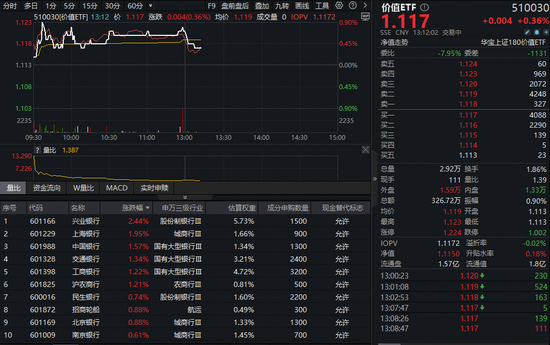
Core Viewpoint - High dividend stocks are experiencing a rise in the market, particularly focusing on "high dividend + low valuation" large-cap blue-chip stocks, as indicated by the performance of the value ETF (510030) [1][4]. Market Performance - The value ETF (510030) opened with a slight increase, showing a gain of 0.36% as of the report time, with a peak increase of nearly 1% during the trading session [1][2]. - Major banks such as Industrial Bank saw a rise of over 2%, while other banks like Bank of China, Bank of Communications, and Industrial and Commercial Bank of China also experienced gains exceeding 1% [1][3]. Investment Strategy - Analysts from CITIC Securities suggest that the domestic banking sector is stabilizing, with a focus on high dividend strategies and low valuation stocks as attractive investment options [3]. - Galaxy Securities notes that while the banking sector's performance was temporarily affected by non-interest income fluctuations, the overall growth in scale supports earnings, with net interest income showing improvement [3]. - Huayuan Securities emphasizes the value of high dividend, low valuation stocks in a context of loose liquidity and low interest rates, suggesting that investors should prioritize companies with stable dividends and reasonable valuations [3]. Index and Composition - The value ETF (510030) closely tracks the Shanghai Stock Exchange 180 Value Index, which selects the top 60 stocks based on value factor scores from the 180 Index, including 20 bank stocks [4]. - The components of the index are characterized by "low valuation + high dividend" large-cap blue-chip stocks, which include leading financial stocks like Ping An Insurance and China Merchants Bank, providing defensive attributes in volatile markets [4].





124股连续5日或5日以上获主力资金净买入
Zheng Quan Shi Bao Wang· 2025-11-14 03:40
Core Viewpoint - As of November 13, a total of 124 stocks in the Shanghai and Shenzhen markets have experienced net buying from major funds for five consecutive days or more, indicating strong investor interest in these stocks [1] Group 1: Stocks with Significant Net Buying - The stock with the longest consecutive net buying days is Beijing Bank, which has seen net buying for 13 consecutive trading days [1] - Other notable stocks with significant net buying days include Xidi Micro, CITIC Bank, Dingyang Technology, Yindu Co., Galaxy Microelectronics, Xingyu Co., Shihua Technology, and Xinke Mobile [1]




银行研思录25:银行股息率排名与中期分红进度梳理-20251114
CMS· 2025-11-14 03:02
Investment Rating - The report does not explicitly state an investment rating for the banking sector, but it provides detailed insights into dividend yields and distribution processes, which can inform investment decisions. Core Insights - The report outlines the latest dividend yields and mid-term dividend processes for A and H shares of listed banks, emphasizing the importance of accurately calculating dynamic dividend yields to avoid discrepancies across periods [1][2]. - It details the two processes for mid-term dividends following the 2023 revision of the regulatory guidelines, highlighting the conventional and simplified processes for implementing mid-term dividends [2]. - The report provides a comprehensive overview of key dates related to dividend distribution for both A and H shares, including the importance of purchasing shares before the ex-dividend date to qualify for dividends [3][4]. Summary by Sections Dynamic Dividend Yield Calculation - A simplified yet accurate method for calculating dynamic dividend yield is introduced, defined as "rolling 12-month EPS * cash dividend rate / share price," which helps avoid issues related to overlapping or missing annual and mid-term dividends [1]. - The report calculates the cash dividend rate using a standardized approach across different banks, resulting in a clear comparison of dividend yields as of November 13, 2025 [1]. Mid-Term Dividend Processes - The report explains the two processes for mid-term dividends: the conventional process requiring shareholder approval and a simplified process allowing for quicker implementation [2]. - The simplified process is designed to enhance flexibility for companies in distributing mid-term dividends, thereby improving shareholder returns [2]. Dividend Distribution Key Dates - For A shares, investors must purchase shares before the ex-dividend date to receive dividends on the same day, while H shares typically see a delay of about one month for dividend payments [3][4]. - The report outlines the differences in the dividend distribution timeline between A and H shares, emphasizing the need for investors to be aware of these timelines to maximize their returns [3][4]. Mid-Term Dividend Progress - As of November 13, 2025, 31 A-share banks have confirmed mid-term dividends, while 11 H-share banks have also confirmed their dividend distributions [9][11]. - The report categorizes banks based on their dividend status, detailing those that have implemented dividends, those that are pending, and those that have opted not to distribute dividends [9][10][11]. - It highlights that the end of 2025 and early 2026 is expected to be a peak period for mid-term dividend distributions, suggesting potential investment opportunities for dividend-seeking investors [11].




这些银行,悄悄发力理财代销
3 6 Ke· 2025-11-14 01:09
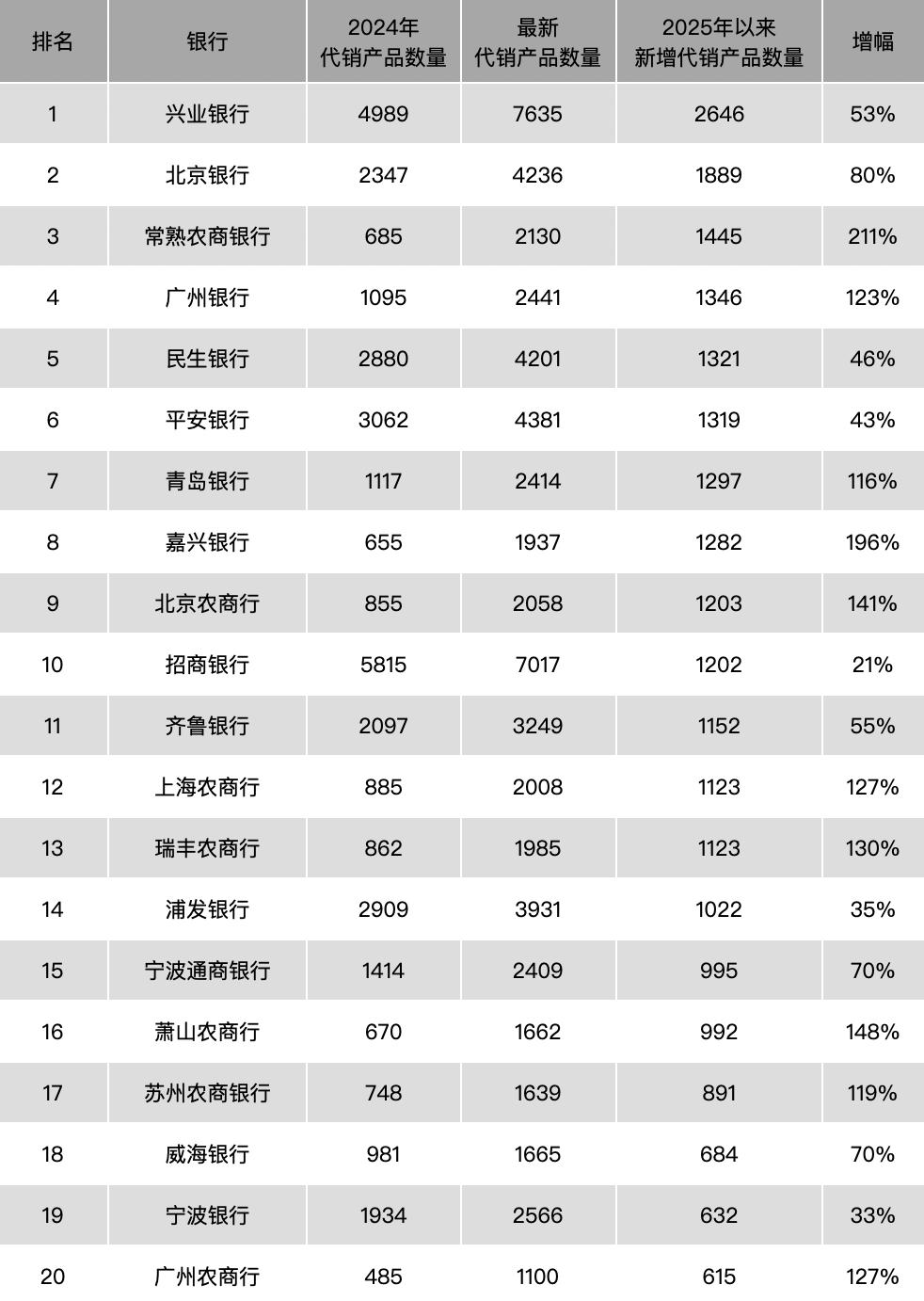
Core Insights - The banking wealth management distribution market has seen significant growth since 2025, with many banks rapidly increasing the number of wealth management products they distribute [2][3]. Distribution Growth - From the top 20 banks by incremental growth, at least 14 banks have added over 1,000 new wealth management products, with 10 banks doubling their product offerings compared to the end of last year, and some even exceeding a 200% increase [3][4]. - Notable banks include: - Industrial Bank: 7,635 products, a 53% increase [4] - Beijing Bank: 4,236 products, an 80% increase [4] - Changshu Rural Commercial Bank: 2,130 products, a 211% increase [4]. Performance Metrics - The wealth management distribution revenue for major banks has also increased significantly: - China Merchants Bank reported a wealth management distribution income of 7.014 billion yuan, an 18.14% year-on-year increase [8]. - Beijing Bank's distribution scale has exceeded last year's total, with a fee income growth of over 10% [8]. - Changshu Rural Commercial Bank's commission income grew over 57% in the third quarter, attributed to increased fees from agency wealth management services [8]. Market Dynamics - The wealth management distribution market has reached a new high, surpassing 32 trillion yuan, with 139 million investors holding wealth management products, a 12.7% year-on-year increase [10]. - The average annualized yield for cash management products is 1.33%, while fixed-income products yield 2.42%, indicating a competitive advantage over traditional savings [11]. Regulatory Changes - The implementation of the "Commercial Bank Agency Sales Business Management Measures" on October 1 has clarified standards and processes for distribution business [16]. - The market is witnessing a shift as many banks, especially smaller ones, are aggressively entering the wealth management distribution space to capture market opportunities amid narrowing interest margins [9][10]. Future Trends - The demand for retirement wealth management products is expected to grow, especially following the recent expansion of pilot programs for retirement financial products across the country [24][27]. - The market is preparing for increased competition as banks look to enhance their service capabilities and product offerings in response to evolving customer needs [23][24].



北京银行大宗交易成交296.10万元
Zheng Quan Shi Bao Wang· 2025-11-13 13:58
Group 1 - Beijing Bank executed a block trade on November 13, with a transaction volume of 470,000 shares and a transaction amount of 2.961 million yuan, at a price of 6.30 yuan, representing a premium of 10.33% over the closing price of the day [2][4] - In the last three months, Beijing Bank has recorded a total of five block trades, with a cumulative transaction amount of 23.192 million yuan [3] - The closing price of Beijing Bank on the day of the block trade was 5.71 yuan, down 0.35%, with a daily turnover rate of 0.85% and a total transaction amount of 1.028 billion yuan, indicating a net outflow of 110 million yuan in main funds for the day [3] Group 2 - The latest margin financing balance for Beijing Bank is 3.271 billion yuan, which has decreased by 42.309 million yuan over the past five days, reflecting a decline of 1.28% [4] - Beijing Bank was established on January 29, 1996, with a registered capital of 21.14298 billion yuan [4]

基本面选股组合月报:AEG估值潜力组合今年实现6.46%超额收益-20251113
Minsheng Securities· 2025-11-13 10:53
Quantitative Models and Construction Methods Models and Construction Methods 1. Model Name: Competitive Advantage Portfolio - **Model Construction Idea**: This model incorporates the competitive environment and strategic factors of enterprises into the stock selection logic, providing a value quantification perspective different from traditional factor investing[12] - **Model Construction Process**: The framework identifies four types of industries: "Barrier Shield", "Intense Competition", "Steady Progress", and "Seeking Breakthrough". The strategy focuses on identifying "dominant" companies in the "Barrier Shield" industries and "cooperative win-win" companies in industries without clear leaders. For non-"Barrier Shield" industries, the strategy targets "efficient operation" companies that perform well even in competitive environments[12][13] - **Model Evaluation**: This model has been effective in identifying companies with significant management competitive advantages and maintaining market leadership positions[12] 2. Model Name: Margin of Safety Portfolio - **Model Construction Idea**: The core of competitive advantage lies in creating entry barriers for enterprises, ensuring their unique position and sustainable profitability in the market[17] - **Model Construction Process**: The model calculates the intrinsic value of a company based on its profitability value, selecting the top 50 stocks with the highest margin of safety from a pool of stocks with comprehensive competitive advantages. The portfolio is weighted by dividend yield to maximize the margin of safety[17][19] - **Model Evaluation**: This model effectively identifies companies with significant intrinsic value gaps, providing a reliable reflection of the actual value of enterprises[17] 3. Model Name: Dividend Low Volatility Adjusted Portfolio - **Model Construction Idea**: The model aims to avoid the "high dividend trap" by considering the sustainability of company earnings and long-term value, rather than solely chasing high dividend yields[23] - **Model Construction Process**: The model predicts dividend yields and excludes stocks with extreme price performance or abnormal debt ratios, optimizing the dividend strategy[23] - **Model Evaluation**: This model effectively balances dividend yield and company stability, avoiding the pitfalls of high dividend traps[23] 4. Model Name: AEG Valuation Potential Portfolio - **Model Construction Idea**: The model focuses on the abnormal earnings growth (AEG) to determine the value of investments based on expected total returns, including dividend reinvestment[27] - **Model Construction Process**: The model selects the top 100 stocks using the AEG_EP factor, then narrows down to the top 50 stocks with high dividend reinvestment/P ratios[31] - **Model Evaluation**: This model targets companies with growth potential not yet fully recognized by the market, providing significant investment opportunities[27][31] 5. Model Name: Cash Cow Portfolio - **Model Construction Idea**: The model introduces free cash flow (FCF) and cash flow return on investment (CFOR) as key analysis dimensions to evaluate the profitability and cash generation efficiency of enterprises[35] - **Model Construction Process**: The CFOR system dissects cash flow return rates, revealing how companies convert operating cash flows into net profits, and evaluates the stability of free cash profit ratios and operating asset return rates[35][36] - **Model Evaluation**: This model provides a comprehensive assessment of a company's operational performance and financial stability[35] 6. Model Name: Distress Reversal Portfolio - **Model Construction Idea**: The model captures short-term valuation fluctuations to gain from valuation improvements, complementing the long-term effectiveness of prosperity investment[42] - **Model Construction Process**: The model uses inventory cycles to depict distress reversals, considering accelerated recovery and undervaluation, and constructs a top 50 portfolio based on valuation improvements[42] - **Model Evaluation**: This model effectively captures valuation-driven returns, providing continuous gains even when prosperity investment strategies fail[42] Model Backtest Results Competitive Advantage Portfolio - **Annualized Return**: 20.60%[16] - **Sharpe Ratio**: 0.97[16] - **IR**: 0.12[16] - **Max Drawdown**: -19.32%[16] - **Calmar Ratio**: 1.07[16] Margin of Safety Portfolio - **Annualized Return**: 23.45%[22] - **Sharpe Ratio**: 1.17[22] - **IR**: 0.16[22] - **Max Drawdown**: -16.89%[22] - **Calmar Ratio**: 1.39[22] Dividend Low Volatility Adjusted Portfolio - **Annualized Return**: 17.23%[24] - **Sharpe Ratio**: 1.01[24] - **IR**: 0.16[24] - **Max Drawdown**: -21.61%[24] - **Calmar Ratio**: 0.80[24] AEG Valuation Potential Portfolio - **Annualized Return**: 25.13%[33] - **Sharpe Ratio**: 1.14[33] - **IR**: 0.15[33] - **Max Drawdown**: -24.02%[33] - **Calmar Ratio**: 1.05[33] Cash Cow Portfolio - **Annualized Return**: 14.11%[40] - **Sharpe Ratio**: 0.71[40] - **IR**: 0.10[40] - **Max Drawdown**: -19.80%[40] - **Calmar Ratio**: 0.71[40] Distress Reversal Portfolio - **Annualized Return**: 25.02%[44] - **Sharpe Ratio**: 1.01[44] - **IR**: 0.15[44] - **Max Drawdown**: -33.73%[44] - **Calmar Ratio**: 0.74[44]



北京银行今日大宗交易溢价成交47万股,成交额296.1万元
Xin Lang Cai Jing· 2025-11-13 09:39
Core Viewpoint - On November 13, Beijing Bank executed a block trade of 470,000 shares, with a transaction value of 2.961 million yuan, representing 0.29% of the total trading volume for the day. The transaction price was 6.3 yuan, reflecting a premium of 10.33% over the market closing price of 5.71 yuan [1][2]. Group 1 - The block trade involved 470,000 shares of Beijing Bank [1][2] - The total transaction amount was 2.961 million yuan [1][2] - The transaction price was set at 6.3 yuan, which is a 10.33% premium compared to the market closing price of 5.71 yuan [1]

北京银行发生大宗交易 成交溢价率9.77%
Zheng Quan Shi Bao Wang· 2025-11-13 00:33
Summary of Key Points Core Viewpoint - Beijing Bank executed a block trade on November 12, with a transaction volume of 760,000 shares and a transaction value of 4.7804 million yuan, at a price of 6.29 yuan, representing a premium of 9.77% over the closing price of the day [2] Transaction Details - The block trade involved a total volume of 760,000 shares and a total transaction value of 4.7804 million yuan [2] - The transaction price was set at 6.29 yuan, which reflects a premium of 9.77% compared to the closing price on the same day [2] - Both the buyer and seller of the transaction were represented by the Shenzhen branch of CITIC Securities Co., Ltd [2] Recent Trading Activity - Over the past three months, Beijing Bank has recorded a total of four block trades, accumulating a total transaction value of 20.231 million yuan [2]
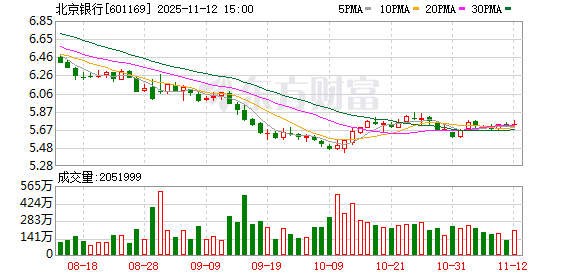
今日共66只个股发生大宗交易,总成交19.1亿元
Di Yi Cai Jing· 2025-11-12 10:00
Summary of Key Points Core Viewpoint - The A-share market experienced significant block trading activity on November 12, with a total transaction volume of 1.91 billion yuan across 66 stocks, indicating notable investor interest in specific companies [1]. Group 1: Trading Activity - The top three companies by transaction volume were Huali Group (974 million yuan), Century Huato (111 million yuan), and Chunfeng Power (77.24 million yuan) [1]. - A total of 10 stocks were traded at par value, 9 stocks at a premium, and 47 stocks at a discount [1]. Group 2: Premium and Discount Rates - The stocks with the highest premium rates were Tom Cat (18.6%), Beijing Bank (9.77%), and AVIC Chengfei (9.04%) [1]. - The stocks with the highest discount rates were Tengya Precision (23.88%), Lexin Technology (20.22%), and Wens Foodstuff (19.27%) [1]. Group 3: Institutional Buying and Selling - The ranking of institutional buying was led by Huali Group (974 million yuan), followed by Century Huato (111 million yuan) and Chunfeng Power (77.24 million yuan) [2]. - The top stocks sold by institutional investors included Century Huato (111 million yuan), followed by Hengrui Medicine (36.02 million yuan) and Haowei Group (26.44 million yuan) [2].