
Bank Of Shanghai(601229)

Search documents
上海多家银行宣布调整房贷利率
Zhong Guo Zheng Quan Bao· 2025-08-31 01:13
Core Viewpoint - The recent adjustments in Shanghai's housing policies aim to optimize the personal housing loan interest rate mechanism, impacting both new and existing loans, which is expected to enhance banks' flexibility in pricing and risk management [1][2]. Group 1: Policy Changes - On August 25, Shanghai's housing authorities issued a notice to adjust real estate policies, including reducing housing purchase restrictions and optimizing housing provident fund and personal housing credit policies, effective from August 26 [1]. - Multiple banks in Shanghai have announced adjustments to their commercial personal housing loan interest rate pricing mechanisms following the new policies [1]. Group 2: New Loan Interest Rate Mechanism - The new interest rate mechanism for commercial personal housing loans in Shanghai will no longer differentiate between first and second homes, with rates determined based on market conditions and individual bank assessments [2]. - The average interest rate for newly issued commercial personal housing loans in China was reported at 3.09% for Q2 2025, with the latest 5-year LPR at 3.5% [2]. Group 3: Existing Loan Adjustments - Existing loans can be adjusted based on the new rules, allowing for potential reductions in interest rates for second home loans, with specific conditions for applying for rate adjustments [3]. - Banks will offer two methods for customers to adjust their loan rates: self-application and proactive adjustments by the banks starting from September 1 [3].






上海银行(601229):业绩稳健增长 分红比例持续提升
Xin Lang Cai Jing· 2025-08-30 09:15
Core Viewpoint - Shanghai Bank reported a steady performance in the first half of 2025, with revenue and net profit showing modest growth, while maintaining a stable asset quality and optimizing funding costs [1][4]. Financial Performance - The company achieved a revenue of 27.34 billion yuan in 1H25, representing a year-on-year increase of 4.2%, with a slight acceleration from 1Q25 [1] - The net profit attributable to shareholders was 13.23 billion yuan, up 2.0% year-on-year, although the growth rate decreased by 0.3 percentage points compared to 1Q25 [1] - Net interest margin stood at 1.15%, down 4 basis points year-on-year, but the decline was less severe than the 17 basis points drop in 2024 [1][4] Income Sources - Net interest income reached 16.45 billion yuan, a year-on-year increase of 1.7%, driven by steady scale expansion [2] - Non-interest income showed mixed results, with net commission and fee income declining by 6.0% to 2.06 billion yuan, while net other non-interest income grew by 12.1% to 8.83 billion yuan [2] - The company faced a 16.26% increase in income tax expenses, which negatively impacted overall performance [2] Loan and Asset Quality - As of the end of 1H25, the loan balance was 1.437 trillion yuan, up 0.9% year-on-year, with corporate loans driving growth [3] - The non-performing loan (NPL) ratio remained stable at 1.18%, with a slight improvement in corporate loan quality [4] - Retail loans saw a net decrease of 24.4 billion yuan, reflecting a cautious approach to risk management [3] Cost Management - The company successfully optimized its funding costs, with the cost of interest-bearing liabilities decreasing by 40 basis points to 1.76% [4] - The yield on interest-earning assets fell by 50 basis points to 2.91%, influenced by lower LPR rates and weak loan demand [4] Shareholder Returns - The company announced a cash dividend of 0.30 yuan per share, with a payout ratio of 32.22%, an increase from 31.22% in 2024 [5] - The bank's strategic positioning in key regions and solid operational foundation are expected to support continued stable performance [5]

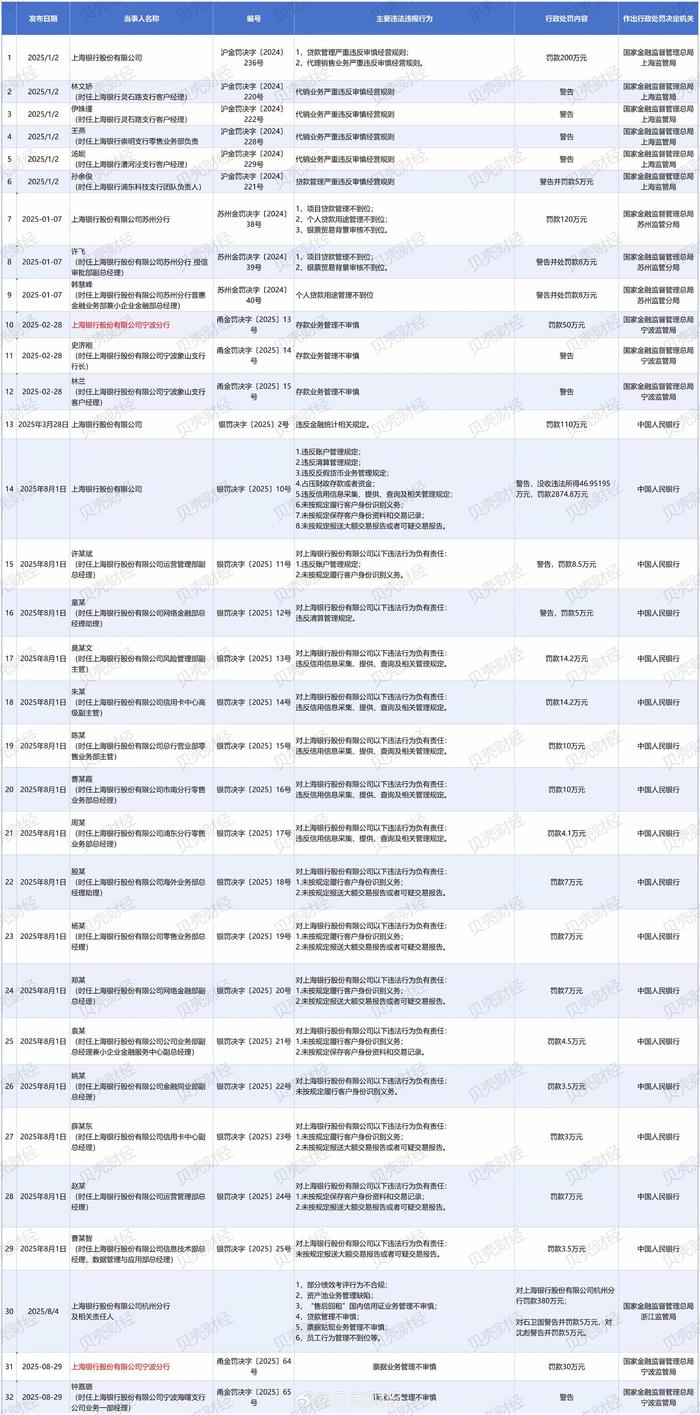
上海银行年内收32张罚单罚金近4000万,成城商行罚单罚金双冠王
Bei Ke Cai Jing· 2025-08-30 04:06
Core Viewpoint - Shanghai Bank has become the "penalty king" and "fine king" among city commercial banks in 2025, receiving a total of 32 penalties with fines amounting to nearly 40 million yuan, specifically 39.51 million yuan [1][2]. Group 1: Penalty Details - As of August 29, 2025, Shanghai Bank has received 32 penalties from regulatory authorities, with a total fine of 39.51 million yuan [1]. - In August 2025 alone, the bank received 19 penalties, including a recent fine of 300,000 yuan for improper management of its bill business [1][2]. - The bank's Ningbo branch has been penalized multiple times, including a fine of 500,000 yuan earlier in the year for imprudent deposit business management [2]. Group 2: Violations - The violations leading to penalties include issues such as improper credit information management, serious violations in agency sales, imprudent management of deposit and loan businesses, and inadequate employee behavior management [2]. - Specific branches, particularly in the Yangtze River Delta region, such as Ningbo, Suzhou, and Hangzhou, have been highlighted as frequent offenders [2].

上海大消息!20多家银行宣布:调整
Zhong Guo Ji Jin Bao· 2025-08-30 01:53
Core Viewpoint - Shanghai's new housing policy has led to a reduction in mortgage rates for existing loans and a minimum rate of 3.09% for new second-home loans, aligning them with first-home rates [1][3]. Group 1: New Mortgage Rates - The new policy eliminates the distinction between first and second home mortgage rates in Shanghai, with the specific rate determined by the market rate pricing mechanism and individual bank conditions [2][10]. - The minimum mortgage rate for new second-home loans in Shanghai is set at 3.09%, which is consistent with the first-home loan rate [3][2]. Group 2: Existing Mortgage Adjustments - Existing mortgage rates can be adjusted for eligible borrowers, particularly if their current rate exceeds the national average by more than 30 basis points [4][11]. - For example, a second-home loan with a current rate of 3.45% could potentially be reduced to 3.36% [6][4]. - The adjustment process will not incur any fees and will begin on September 1, 2025 [7][14]. Group 3: Implementation and Communication - Banks in Shanghai, including major institutions like ICBC and Bank of China, have issued announcements regarding the new mortgage rate adjustments [1][9]. - Borrowers can check their eligibility for rate adjustments through their respective banks starting September 1, 2025 [12][13].



上海银行业绩排位再生变数 新帅能否重启资产扩张正循环?
Nan Fang Du Shi Bao· 2025-08-30 01:13
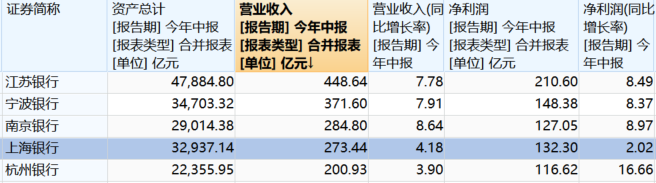
Core Viewpoint - Shanghai Bank's revenue and profit growth lag behind its peers in the Yangtze River Delta region, raising concerns about its competitive position and future growth potential [1][2][7]. Financial Performance - In the first half of 2025, Shanghai Bank achieved revenue of 27.344 billion yuan, a year-on-year increase of 4.18%, but was surpassed by Nanjing Bank, dropping to fourth place among five major city commercial banks in the Yangtze River Delta [1][2]. - The net profit for the same period was 13.23 billion yuan, reflecting a 2.02% year-on-year growth, which is the lowest growth rate among the five banks [2][3]. - The bank's non-performing loan ratio remained stable at 1.18% as of mid-2025, indicating ongoing efforts to manage credit risk [1]. Asset Quality and Capital Adequacy - As of mid-2025, Shanghai Bank's total assets reached 3.29 trillion yuan, with a year-on-year growth rate of only 2.18%, significantly lagging behind its competitors [7]. - The bank's core Tier 1 capital adequacy ratio was the highest among its peers at 10.78%, suggesting a strong capital position to support future growth [7][8]. Business Segmentation - Interest income for the first half of 2025 was 16.453 billion yuan, up 1.72% year-on-year, with a net interest margin of 1.15%, down 2 basis points from the previous year [3][4]. - Non-interest income, particularly from fees and commissions, decreased by 5.96% to 2.06 billion yuan, while other non-interest income grew by 12.05% to 8.831 billion yuan, driven by improved investment returns [5][6]. Strategic Outlook - The appointment of a new chairman, Gu Jianzhong, is seen as a pivotal moment for Shanghai Bank, with expectations for renewed focus on asset expansion and efficiency improvements [8]. - The bank aims to enhance its operational framework by targeting key sectors such as technology, green finance, and manufacturing, which may help in regaining competitive ground [8].
上海银行业绩排位再生变数,新帅能否重启资产扩张正循环?
Nan Fang Du Shi Bao· 2025-08-29 22:34
Core Viewpoint - Shanghai Bank's revenue and profit growth lag behind its peers in the Yangtze River Delta region, raising concerns about its competitive position and future growth potential [2][3][9]. Financial Performance - In the first half of 2025, Shanghai Bank reported revenue of 27.344 billion yuan, a year-on-year increase of 4.18%, but was surpassed by Nanjing Bank, dropping to fourth place among five major city commercial banks in the Yangtze River Delta [2][3]. - The net profit for the same period was 13.23 billion yuan, reflecting a 2.02% year-on-year growth, which is the lowest growth rate among the five banks [3][4]. - The bank's non-performing loan ratio remained stable at 1.18%, indicating ongoing efforts to manage credit risk effectively [2][9]. Asset Quality and Capital Adequacy - As of mid-2025, Shanghai Bank's total assets reached 3.29 trillion yuan, with a year-on-year growth rate of only 2.18%, significantly trailing behind its competitors [9][10]. - The bank's core Tier 1 capital adequacy ratio was the highest among its peers at 10.78%, suggesting a strong capital position to support future growth [9][10]. Business Segmentation - Interest income for the first half of 2025 was 16.453 billion yuan, up 1.72% year-on-year, while net interest margin decreased by 2 basis points to 1.15% [5][7]. - Non-interest income, particularly from fees and commissions, decreased by 5.96% to 2.06 billion yuan, although other non-interest income grew by 12.05% to 8.83 billion yuan, driven by improved investment returns [6][8]. Strategic Outlook - The appointment of a new chairman, Gu Jianzhong, is seen as a pivotal moment for Shanghai Bank, with expectations for renewed focus on asset expansion and operational efficiency [10][11]. - The bank aims to enhance its service offerings in key sectors such as technology, green finance, and manufacturing, which could potentially drive future growth [11].
上海银行: 上海银行2025年中期利润分配方案公告
Zheng Quan Zhi Xing· 2025-08-29 17:47
上海银行股份有限公司 上海银行股份有限公司(以下简称"公司")董事会及全体董事保证本公告 内容不存在任何虚假记载、误导性陈述或者重大遗漏,并对其内容的真实性、准 确性和完整性承担法律责任。 重要内容提示: 于母公司普通股股东的净利润人民币 13,230,678 千元;截至 2025 年 6 月 30 日, 母公司报表中期末未分配利润人民币 74,613,732 千元。经公司董事会 2025 年第 八次会议审议通过,2025 年中期利润分配方案如下: 证券代码:601229 证券简称:上海银行 公告编号:临2025-047 优先股代码:360029 优先股简称:上银优1 可转债代码:113042 可转债简称:上银转债 (一)董事会会议的召开、审议和表决情况 公司于 2025 年 8 月 28 日召开的董事会 2025 年第八次会议审议通过了《关 于 2025 年中期利润分配方案的议案》,符合公司章程规定的利润分配政策和公 司已披露的股东回报规划,全体董事一致同意该议案。 (二)监事会意见 公司于 2025 年 8 月 28 日召开的监事会 2025 年第五次会议审议通过了《关 于 2025 年中期利润分配方案的 ...
上海银行: 上海银行内部审计章程(2025年版)
Zheng Quan Zhi Xing· 2025-08-29 17:25
General Principles - The purpose of the internal audit charter is to enhance corporate governance, strengthen internal controls and risk management, and improve the independence and effectiveness of internal audits [1] - Internal audit is defined as an independent, objective assurance and consulting activity that evaluates and improves the effectiveness of governance, risk management, and control processes [1] Audit Objectives and Scope - The objectives of internal audit include ensuring compliance with laws and regulations, promoting effective risk management, and supporting the achievement of strategic goals [2] - The audit scope covers various entities including the head office, branches, and subsidiaries, focusing on governance, compliance, internal controls, risk management, and financial reporting [2] Audit Principles and Structure - Internal audit must operate independently from business operations and risk management, adhering to principles of independence and objectivity [2] - The internal audit system is established under the direct leadership of the board of directors, which is responsible for ensuring the independence and effectiveness of the audit function [4][5] Audit Committee and Leadership - The board of directors is ultimately responsible for the internal audit's independence and effectiveness, including the appointment of sufficient audit personnel and budget allocation [4] - An audit committee is established to review the internal audit charter, development plans, and annual audit plans, ensuring the execution of audit activities [4] Audit Personnel and Qualifications - Internal audit personnel should represent approximately 1% of the total workforce, with qualifications including a bachelor's degree and relevant experience in finance or auditing [7][8] - Continuous education and adherence to professional ethics are required for internal audit personnel to maintain their competency [8] Rights and Responsibilities - The internal audit function has the right to access all necessary information and to conduct investigations as needed [9][10] - Internal audit can propose corrective actions and recommend penalties for non-compliance, ensuring accountability within the organization [10] Audit Process and Reporting - The internal audit process is risk-oriented, with annual audit plans developed based on risk assessments and regulatory requirements [11][12] - Audit reports must include objectives, findings, conclusions, and recommendations, and should be communicated to the board and management [12][15] External Coordination and Accountability - Internal audit must coordinate with external auditors and regulatory bodies to ensure comprehensive oversight and compliance [16][19] - The results of internal audits are critical for performance evaluations and accountability of the audited entities [20][21]
上海银行: 国泰海通证券股份有限公司关于上海银行股份有限公司关联交易事项的专项核查意见
Zheng Quan Zhi Xing· 2025-08-29 17:25
Summary of Key Points Core Viewpoint - The report outlines the special verification opinions regarding related party transactions of Shanghai Bank Co., Ltd., confirming that the transactions do not constitute significant asset restructuring as per relevant regulations [1][2]. Group 1: Overview of Related Transactions - The company approved adjustments to the payment schedule for asset transfers to Up Silver International (Shenzhen) Co., Ltd., which is a related party [1]. - The company granted a credit limit of RMB 400 million to Shanghai Xinwei Technology Group Co., Ltd. for debt financing, which is also a related party [1]. Group 2: Related Party Information - Up Silver International (Shenzhen) is indirectly controlled by the company, with a board member serving as its chairman, thus qualifying as a related party [2]. - Shanghai Xinwei Technology Group is controlled by a major shareholder of the company, making it a related party as well [2]. Group 3: Transaction Pricing Policy - The transactions with both Up Silver International (Shenzhen) and Shanghai Xinwei Technology Group adhere to general commercial rules, ensuring that pricing and conditions are not more favorable than those offered to non-related parties [3]. Group 4: Purpose and Impact of Transactions - The adjustment of payment schedules with Up Silver International (Shenzhen) and the credit limit to Shanghai Xinwei Technology Group are considered normal business operations, with no significant impact on the company's financial status [3][4]. Group 5: Approval Procedures - The transactions require re-approval due to changes in the main terms of previously approved related party transactions [4]. Group 6: Verification Opinions - The sponsor institution found the transaction conditions to be fair and in line with market principles, confirming that the transactions do not harm the interests of the company or its shareholders [5][6].

金融践行“两山”理念 上海银行绿色金融样本:从垃圾处理到中国方案出海
Zhong Guo Jing Ying Bao· 2025-08-29 16:30
Core Viewpoint - The article emphasizes the transformation of waste management into a resource-driven industry, highlighting the role of financial support in achieving sustainable waste reduction, harmlessness, and resource utilization [1][2]. Group 1: Company Overview - Shanghai Kangheng Environment Co., Ltd. has evolved from a startup to the world's largest provider of waste incineration equipment and technology, as well as one of the top three operators of waste-to-energy projects globally [1][5]. - The company has supported over 300 waste incineration plants worldwide and has invested in 90 low-carbon resource recovery parks, processing 120,000 tons of municipal waste daily and serving over 100 million people [5]. Group 2: Financial Support and Innovation - Financial backing is crucial for the long-term, capital-intensive nature of the waste management industry, with projects often requiring investments in the hundreds of millions [2][3]. - Shanghai Bank has provided competitive financing solutions, including a 14-year project loan for Kangheng Environment's Yibin waste-to-energy project, alleviating financial pressure during long construction periods [2][3]. Group 3: Environmental and Technological Initiatives - Kangheng Environment promotes a "waste-to-energy + cogeneration" model, utilizing waste heat for heating and steam supply, thereby enhancing energy efficiency and increasing project revenue [4]. - The company integrates ESG principles into its operations, focusing on advanced incineration technologies to improve energy utilization and reduce carbon emissions, achieving a greenhouse gas reduction of 5.84 million tons per year [5]. Group 4: Strategic Goals and International Expansion - The company aims to invest $6 billion overseas in the next five years, targeting Southeast Asia, Central Asia, the Middle East, and Europe, promoting "Chinese solutions" in solid waste management [5]. - Shanghai Bank is committed to enhancing its green finance strategy, aligning with national "dual carbon" goals and focusing on sustainable financial services [6].