GAC GROUP(601238)

Search documents
广州汽车集团股份有限公司第七届董事会第16次会议决议公告
Xin Lang Cai Jing· 2025-12-19 19:25
广州汽车集团股份有限公司(下称"本公司"或"公司")第七届董事会第16次会议于2025年12月19日(星 期五)上午9:00在广州市番禺区金山大道东668号广汽集团番禺总部T2五楼会议室召开,本次会议应出席 董事10人,现场出席董事6人,肖胜方董事、周开荃董事、王亦伟董事、洪素丽董事以通讯方式参加本 次会议。本次会议由冯兴亚董事长主持,会议的召集、召开符合《中华人民共和国公司法》和《广州汽 车集团股份有限公司章程》的规定。 本次会议听取了《关于广汽集团2025年经营计划预计完成情况的报告》等报告事项,审议并通过了《关 于广汽集团2026年经营计划的议案》。2026年作为"十五五"开局之年,公司将聚焦"稳合资、强自主、 拓生态"三大重点,打好"用户需求、产品价值、服务体验"三大战役,重点推动改革攻坚举措加速落 地、聚焦主干车型实现产品突围、增强品牌引领加速营销变革、锻造技术长板实现弯道超车、深耕海外 打造第二增长曲线、深化生态赋能促进板块协同、实施精益管理改善经营质效、创新AI驱动建设数智 广汽、开展人才为本激发团队活力、坚持党建领航厚植发展根基等十大攻坚行动,确保"十五五"顺利开 局,开创高质量发展新局面。 ...
广汽集团:第七届董事会第16次会议决议公告
Zheng Quan Ri Bao· 2025-12-19 15:54
证券日报网讯 12月19日,广汽集团发布公告称,公司第七届董事会第16次会议审议通过《关于广汽集 团2026年经营计划的议案》。 (文章来源:证券日报) ...
广汽集团启动自主品牌BU改革,昊铂埃安率先整合
Zhong Guo Jing Ying Bao· 2025-12-19 14:38
Core Viewpoint - GAC Group has officially initiated the reform of its autonomous brand Business Units (BUs), starting with the integration of the Haobo and Aion brands into a single operational unit, aiming to enhance efficiency and competitiveness in the market [1][2] Group 1: Business Unit Reform - The Haobo and Aion brands will be managed under the same BU to break down resource barriers and release synergies [1] - The reform is expected to accelerate the pace of technological iteration and market response, providing institutional support for the continuous enhancement of the autonomous brand's competitiveness [1] Group 2: Channel Integration - The integration of the sales channels for Haobo and Aion will be executed in phases, with the first phase aiming for completion by January 31, 2026, where initial integrated sales and service points will be announced, covering over 30 cities [1] - The second phase is set to be completed by March 31, 2026, resulting in a fully integrated channel network of over 1,000 sales points across all cities at the fourth tier and above [1] Group 3: Network Expansion - The service network for the Haobo brand is projected to expand significantly from approximately 200 to 1,000 locations, enhancing channel efficiency and user reach [2] - This initiative is viewed as a critical step for GAC Group to strengthen its systematic operational capabilities in the new energy sector [2]


广汽集团推进自主品牌BU改革 昊铂埃安率先整合
Zhong Guo Jing Ying Bao· 2025-12-19 14:20
Core Viewpoint - GAC Group has officially launched a Business Unit (BU) reform for its self-owned brands, starting with the establishment of the Haobo and Aion BU, aiming to enhance operational efficiency and market responsiveness by breaking down resource barriers between brands [1][2] Group 1: BU Reform Implementation - The Haobo and Aion BU will integrate the operations of both brands under a single management structure to improve organizational efficiency and accelerate technology iteration [1] - The first phase of channel integration is set to be completed by January 31, 2026, with the initial sales and service points for both brands to be announced, covering over 30 cities nationwide [1] - The second phase aims for full channel integration by March 31, 2026, creating a sales network of over 1,000 locations across all tier-four cities and above in China [1] Group 2: Network Expansion and Efficiency - The service network for the Haobo brand is expected to expand significantly from approximately 200 to 1,000 locations, enhancing channel efficiency and customer reach [2] - This initiative is viewed as a critical step for GAC Group to strengthen its systematic operational capabilities in the new energy vehicle sector [2]
L3级自动驾驶商业化进程加速 小米汽车获路测牌照
Xin Lang Cai Jing· 2025-12-19 12:48
Core Insights - The Ministry of Industry and Information Technology has issued the first batch of L3 conditional autonomous driving vehicle permits, with Xiaomi Auto being the latest company to obtain an L3 road testing license in Beijing [1][14] - The report indicates that by September 2025, 23 companies, including Xiaomi, have accumulated over 60.27 million kilometers of operation with 750 autonomous passenger vehicles [1][14] - The L3 autonomous driving permit process follows a structured pathway, and companies are categorized into those with official "entry permits" and those with "road licenses" for internal testing [1][14] Company Developments - Changan Automobile's "Deep Blue SL03" has received L3 permit for operation in specific congested areas in Chongqing [2][15] - BAIC Blue Valley's "ARCFOX Alpha S" has been granted L3 permit for operation on specific highways in Beijing [2][15] - BYD was the first to obtain an L3 road testing license in July 2023 and has begun large-scale road validation [3][16] - Seres (Wenjie) has obtained L3 testing permits primarily in Chongqing and Shenzhen for its Wenjie M9 model [4][17] - SAIC Group has received two L3 road permits, making it one of the companies with the most licenses [4][17] - NIO has been selected for the first batch of L3/L4 autonomous driving permits and road testing trials [5][17] - GAC Group has made progress in L3 autonomous driving technology [6][18] - JAC Motors has obtained L3 road testing permits [7][19] - Foton Motor has completed the development and acceptance of L3 autonomous driving prototypes [8][20] - Yutong Bus is the first in the bus industry to enter the L3 autonomous driving pilot program [9][21] - FAW Jiefang's high-level autonomous driving truck J7 L3 has completed road testing [10][22] Industry Trends - The transition to L3 autonomous driving represents a significant technological milestone, shifting driving control and accident liability from the driver to the system itself [10][22] - Multiple institutions emphasize the hardware upgrade logic due to the increased safety and reliability requirements associated with L3 [11][23] - The regulatory framework for L3 permits indicates a closed loop in product safety, network security, and accident liability, alleviating long-standing compliance concerns for automakers [12][23] - The commercialization of L3 is expected to drive the mass application of intelligent chassis technologies, including active suspension, electronic brake-by-wire (EMB), and steer-by-wire (SBW) systems [12][23][24] - Specific components benefiting from this trend include active suspension systems from companies like Baolong Technology and Top Group, EMB systems from Bertel and Asia Pacific Holdings, and SBW systems from companies like Nexperia [12][24]





广汽集团(02238) - 海外监管公告
2025-12-19 09:21
香港交易及結算所有限公司及香港聯合交易所有限公司對本公告的內容概不負責,對其準確 性或完整性亦不發表任何聲明,並明確表示,概不對因本公告全部或任何部分內容而產生或 因依賴該等內容而引致的任何損失承擔任何責任。 GUANGZHOU AUTOMOBILE GROUP CO., LTD. 廣州汽車集團股份有限公司 ( 於中華人民共和國註冊成立的股份有限公司 ) (股份編號: 2238) A股代码:601238 A股简称:广汽集团 公告编号:2025-078 H股代码:02238 H 股简称:广汽集团 隨附之文件乃本公司於二零二五年十二月十九日在中華人民共和國上海證券交 易所網頁登載之《廣州汽車集團股份有限公司第七屆董事會第 16 次會議決議公 告》,僅供參閱。 承董事會命 廣州汽車集團股份有限公司 馮興亞 董事長 中國廣州,二零二五年十二月十九日 於本公告日期,本公司的執行董事為馮興亞,本公司的非執行董事為陳小沐、鄧蕾、 周開荃、王亦偉及洪素麗,以及本公司的獨立非執行董事為趙福全、肖勝方、王克 勤及宋鐵波。 广州汽车集团股份有限公司 海外監管公告 本公告乃廣州汽車集團股份有限公司(「本公司」)按香港聯合交易所有限公 ...
广汽集团(601238) - 广汽集团第七届董事会第16次会议决议公告
2025-12-19 09:15
广州汽车集团股份有限公司 A股代码:601238 A股简称:广汽集团 公告编号:2025-078 H股代码:02238 H 股简称:广汽集团 第七届董事会第 16 次会议决议公告 广州汽车集团股份有限公司董事会 2025 年 12 月 19 日 广州汽车集团股份有限公司(下称"本公司"或"公司")第七届董事会第 16 次会议于 2025 年 12 月 19 日(星期五)上午 9:00 在广州市番禺区金山大道东 668 号广汽集团番禺总部 T2 五楼会议室召开,本次会议应出席董事 10 人,现场 出席董事 6 人,肖胜方董事、周开荃董事、王亦伟董事、洪素丽董事以通讯方式 参加本次会议。本次会议由冯兴亚董事长主持,会议的召集、召开符合《中华人 民共和国公司法》和《广州汽车集团股份有限公司章程》的规定。 本次会议听取了《关于广汽集团 2025 年经营计划预计完成情况的报告》等 报告事项,审议并通过了《关于广汽集团 2026 年经营计划的议案》。2026 年作 为"十五五"开局之年,公司将聚焦"稳合资、强自主、拓生态"三大重点,打 好"用户需求、产品价值、服务体验"三大战役,重点推动改革攻坚举措加速落 地、聚焦主干车 ...
广汽集团:12月19日召开董事会会议
Mei Ri Jing Ji Xin Wen· 2025-12-19 09:12
Group 1 - GAC Group held its 16th board meeting on December 19, 2025, to review the expected completion of its 2025 business plan [1] - For the first half of 2025, GAC Group's revenue composition is as follows: vehicle manufacturing accounts for 57.85%, trade services for 30.82%, others for 6.39%, and parts manufacturing for 4.94% [1] - As of the report date, GAC Group's market capitalization is 83.9 billion yuan [1]
数据简报 | 2025年1-11月前十位汽车生产企业(集团)销售情况简析
中汽协会数据· 2025-12-19 09:04
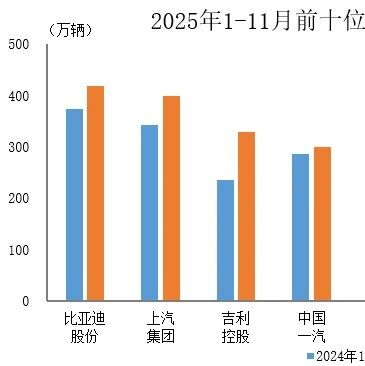
据中国汽车工业协会统计 分析 , 2025 年 1- 11 月 , 汽车销量排名前十位的企业(集团)共销售 2618.4 万辆,占汽车销售总量的 84.1% 。 来源: 中汽协会行业信息部 在上述十 家 企 业 中, 与去年同期相比,东风公司和广汽集团销量呈不同程度下降,其他企业销量均呈不 同程度增长 。 ...

汽车行业重点企业2025年四季度经济运行会暨2026年市场预测交流会在厦门召开
中汽协会数据· 2025-12-19 09:04
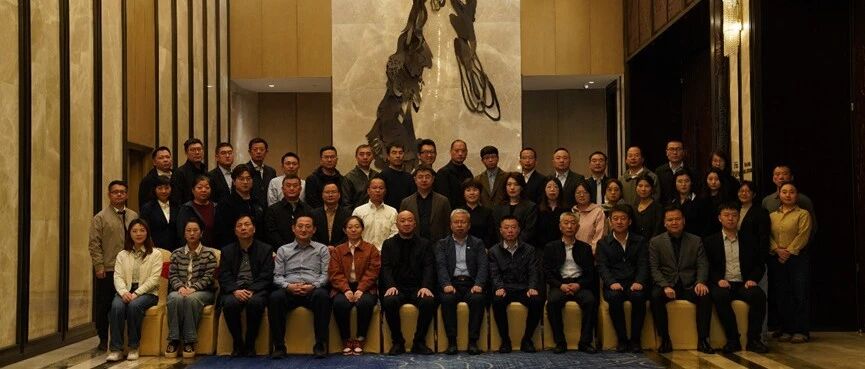
Core Viewpoint - The meeting organized by the China Automobile Industry Association (CAIA) focused on the current operational status of the automotive industry and future market predictions, emphasizing the importance of collaboration and innovation among industry players to navigate global competition and achieve high-quality development [1][3][9]. Group 1: Meeting Overview - The meeting took place from December 15-17, 2025, in Xiamen, organized by CAIA and supported by Xiamen Golden Dragon Bus Co., Ltd, with participation from representatives of 27 key automotive enterprises [1]. - CAIA's Deputy Secretary-General Chen Shihua highlighted the meeting as a crucial platform for industry communication and addressing operational challenges [3]. Group 2: Industry Insights - During the meeting, participants discussed the current state of the automotive industry, key issues, and policy recommendations, focusing on the implementation of "two new" policies, expanding automotive consumption, quality and after-sales service, and the development of both new energy and fuel vehicles [7]. - The meeting also included a market forecast session where CAIA's Industry Information Department shared preliminary insights on market trends for the upcoming year [7]. Group 3: Future Directions - Chen Shihua emphasized the importance of enterprises being close to the market and consumers for accurate analysis and predictions, which will support CAIA's future work [9]. - The automotive industry is recognized as a vital pillar of the national economy, with the government placing significant importance on its healthy development, and CAIA plans to continue self-regulation and standardization efforts in the industry [9].