AGRICULTURAL BANK OF CHINA(601288)

Search documents
中国农业银行与山西省政府举行工作会谈
Ge Long Hui· 2025-11-22 13:13
格隆汇11月22日|11月20日,中国农业银行党委书记、董事长谷澍在山西太原拜会山西省委书记唐登 杰、省长卢东亮,就全方位深化金融合作,更好发挥金融服务山西转型发展作用等进行深入交流。20日 下午,谷澍与卢东亮举行工作会谈。谷澍表示,农业银行将加大对能源转型、产业升级等重点领域的金 融支持,强化综合金融服务。发挥农业银行在"三农"普惠领域的独特优势,助力山西特优农业发展和乡 村全面振兴。卢东亮表示,希望双方加强"十五五"谋划衔接,聚焦重点领域深化政银合作,打造央地合 作新典范,为山西高质量发展和现代化建设提供更加有力的金融服务支撑。 ...

农行上海市分行开启普惠数智新篇章
Zhong Guo Jin Rong Xin Xi Wang· 2025-11-22 03:33
近年来,农行上海市分行始终坚持科技赋能普惠金融,致力于破解小微企业融资中的"流程长、放款 慢"核心痛点。通过整合工商、纳税、征信等多维数据,打造普惠特色数据底座,构建小微企业专属模 型体系,实现对小微企业精准"画像"和风险智能识别。 转自:新华财经 "太不可思议了!刚刚在手机银行上提交申请,就立刻就收到了审批额度,还可根据需要选择不同产 品,资金实时到账。"深意信息科技负责人张鼎国在操作了农业银行小微融资产品后,发出了由衷的赞 叹。 张先生体验的正是农行上海市分行最新升级的"申担e贷"2.0和新推出的"申微e贷"1.0两款小微企业融资 产品。两款产品深度融合了大数据与人工智能技术,通过系统模型的自动化决策,对小微企业的贷款申 请进行智能审批,实现了从申请、审批、签约到提款的全流程线上化快速响应,将小微企业融资效率推 向了全新高度。 据悉,两款产品精准覆盖了不同小微企业客户的融资需求。其中,"申担e贷"由市融资担保中心提供担 保增信,面向融资需求稍高的小微企业,本次产品升级后大幅提升了客户体验。而"申微e贷"则主要服 务于融资需求更为灵活、用款更为频繁的小微企业,为客户提供纯信用的线上融资服务。 "我们园区里大 ...
热点追踪周报:由创新高个股看市场投资热点(第 220 期)-20251121
Guoxin Securities· 2025-11-21 12:41
- The report introduces a quantitative model named "250-day new high distance" to track market trends and identify hot spots. The model is based on momentum and trend-following strategies, emphasizing stocks that consistently hit new highs. The calculation formula is: $ 250\text{-day new high distance} = 1 - \frac{Close_{t}}{ts\_max(Close, 250)} $ where $ Close_{t} $ represents the latest closing price, and $ ts\_max(Close, 250) $ is the maximum closing price over the past 250 trading days. If the latest closing price reaches a new high, the distance equals 0; otherwise, it is a positive value indicating the degree of fallback [11][12][13] - The report evaluates the model positively, citing its ability to capture market leaders and trends effectively. It references studies by George (2004), William O'Neil, and Mark Minervini, which highlight the importance of tracking stocks near their 52-week highs for superior returns [11][18] - The report provides backtesting results for the "250-day new high distance" model across major indices as of November 21, 2025. The distances are: - Shanghai Composite Index: 4.83% - Shenzhen Component Index: 8.65% - CSI 300: 6.20% - CSI 500: 9.69% - CSI 1000: 7.59% - CSI 2000: 7.40% - ChiNext Index: 12.16% - STAR 50 Index: 16.45% [12][13][32] - The report introduces a factor named "Stable New High Stocks" to identify stocks with smooth price paths and sustained momentum. The factor construction involves: - Analyst attention: At least five buy or overweight ratings in the past three months - Relative strength: Top 20% in 250-day price change - Price stability: Ranking top 50% based on metrics like price displacement ratio and smoothness of 250-day new high distance over the past 120 days - Trend continuation: Ranking top 50 stocks based on the average 250-day new high distance over the past five days [24][27][28] - The report evaluates the "Stable New High Stocks" factor positively, citing research by Turan G Bali et al. (2011) and Da et al. (2012), which demonstrate the superior returns of stocks with smooth momentum paths compared to those with jumpy price movements [24][27] - Backtesting results for the "Stable New High Stocks" factor show 15 selected stocks, including Heertai, Sray New Materials, and Zangge Mining. These stocks are distributed across manufacturing and cyclical sectors, with manufacturing focusing on construction and cyclical sectors on non-ferrous metals [28][31][33]



热点追踪周报:由创新高个股看市场投资热点(第220期)-20251121
Guoxin Securities· 2025-11-21 11:03
Quantitative Models and Construction Methods 1. Model Name: 250-Day New High Distance Model - **Model Construction Idea**: This model tracks the distance of stock prices or indices from their 250-day high to monitor market trends and identify potential market leaders. It is based on the momentum and trend-following strategy, which has been proven effective in various studies[11][18]. - **Model Construction Process**: The 250-day new high distance is calculated as follows: $ 250 \text{-day new high distance} = 1 - \frac{\text{Close}_{t}}{\text{ts\_max(Close, 250)}} $ Where: - $\text{Close}_{t}$ represents the latest closing price - $\text{ts\_max(Close, 250)}$ represents the maximum closing price over the past 250 trading days If the latest closing price reaches a new high, the distance is 0. If the price has fallen from the high, the distance is a positive value, indicating the degree of decline[11]. - **Model Evaluation**: The model effectively identifies market trends and highlights stocks or indices that are leading the market, aligning with the principles of momentum and trend-following strategies[11][18]. 2. Model Name: Stable New High Stock Selection Model - **Model Construction Idea**: This model focuses on selecting stocks that exhibit stable price paths and consistent momentum, as smoother price trajectories are associated with stronger momentum effects[24][27]. - **Model Construction Process**: The selection process involves the following criteria: - **Analyst Attention**: At least 5 buy or overweight ratings in the past 3 months - **Relative Strength**: 250-day price change in the top 20% of the market - **Price Stability**: Stocks are ranked based on: - **Price Path Smoothness**: Ratio of price displacement to the total price path - **Sustainability of New Highs**: Average 250-day new high distance over the past 120 days - **Trend Continuity**: Average 250-day new high distance over the past 5 days The top 50 stocks based on these criteria are selected[24][27]. - **Model Evaluation**: The model emphasizes the importance of smooth price paths and consistent momentum, which are less likely to attract excessive attention and thus yield stronger returns[24][27]. --- Model Backtesting Results 1. 250-Day New High Distance Model - **Indices' 250-Day New High Distance**: - Shanghai Composite Index: 4.83% - Shenzhen Component Index: 8.65% - CSI 300: 6.20% - CSI 500: 9.69% - CSI 1000: 7.59% - CSI 2000: 7.40% - ChiNext Index: 12.16% - STAR 50 Index: 16.45%[12][13][32] 2. Stable New High Stock Selection Model - **Selected Stocks**: 15 stocks were identified, including Heertai, Sray New Materials, and Zangge Mining. - **Sector Distribution**: - Manufacturing: 5 stocks (e.g., construction industry) - Cyclical: 5 stocks (e.g., non-ferrous metals industry)[28][33] --- Quantitative Factors and Construction Methods 1. Factor Name: 250-Day New High Distance - **Factor Construction Idea**: This factor measures the relative distance of a stock's price from its 250-day high, serving as an indicator of momentum and trend strength[11]. - **Factor Construction Process**: The formula is: $ 250 \text{-day new high distance} = 1 - \frac{\text{Close}_{t}}{\text{ts\_max(Close, 250)}} $ Where: - $\text{Close}_{t}$ is the latest closing price - $\text{ts\_max(Close, 250)}$ is the maximum closing price over the past 250 trading days[11]. - **Factor Evaluation**: The factor effectively captures momentum and trend-following characteristics, making it a reliable indicator for identifying market leaders[11]. 2. Factor Name: Price Path Smoothness - **Factor Construction Idea**: This factor evaluates the smoothness of a stock's price trajectory, as smoother paths are associated with stronger momentum effects[24]. - **Factor Construction Process**: - Calculate the ratio of price displacement to the total price path over a specified period - Rank stocks based on this ratio and select the top performers[24]. - **Factor Evaluation**: The factor highlights stocks with stable momentum, which are less likely to attract excessive attention and thus yield stronger returns[24]. --- Factor Backtesting Results 1. 250-Day New High Distance Factor - **Indices' 250-Day New High Distance**: - Shanghai Composite Index: 4.83% - Shenzhen Component Index: 8.65% - CSI 300: 6.20% - CSI 500: 9.69% - CSI 1000: 7.59% - CSI 2000: 7.40% - ChiNext Index: 12.16% - STAR 50 Index: 16.45%[12][13][32] 2. Price Path Smoothness Factor - **Selected Stocks**: 15 stocks were identified, including Heertai, Sray New Materials, and Zangge Mining. - **Sector Distribution**: - Manufacturing: 5 stocks (e.g., construction industry) - Cyclical: 5 stocks (e.g., non-ferrous metals industry)[28][33]


国有大型银行板块11月21日跌0.55%,邮储银行领跌,主力资金净流出3.94亿元
Zheng Xing Xing Ye Ri Bao· 2025-11-21 09:33
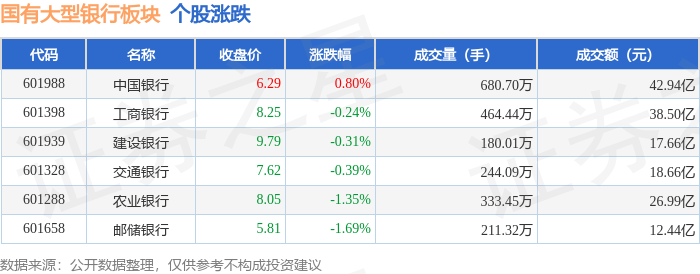
Core Insights - The state-owned large bank sector experienced a decline of 0.55% on November 21, with Postal Savings Bank leading the drop [1] - The Shanghai Composite Index closed at 3834.89, down 2.45%, while the Shenzhen Component Index closed at 12538.07, down 3.41% [1] Bank Performance Summary - China Bank (601988) closed at 6.29, up 0.80% with a trading volume of 6.807 million shares and a transaction value of 4.294 billion [1] - Industrial and Commercial Bank of China (601398) closed at 8.25, down 0.24% with a trading volume of 4.644 million shares [1] - China Construction Bank (601939) closed at 9.79, down 0.31% with a trading volume of 1.800 million shares [1] - Bank of Communications (601328) closed at 7.62, down 0.39% with a trading volume of 2.440 million shares [1] - Agricultural Bank of China (601288) closed at 8.05, down 1.35% with a trading volume of 3.334 million shares [1] - Postal Savings Bank (601658) closed at 5.81, down 1.69% with a trading volume of 2.113 million shares [1] Fund Flow Analysis - The state-owned large bank sector saw a net outflow of 394 million yuan from institutional investors, while retail investors had a net inflow of 308 million yuan [1] - The fund flow for individual banks shows that: - Bank of Communications had a net inflow of 49.743 million yuan from institutional investors [2] - Industrial and Commercial Bank had a net inflow of 2.533 million yuan from institutional investors [2] - China Bank experienced a net outflow of 14.801 million yuan from institutional investors [2] - China Construction Bank had a net outflow of 46.069 million yuan from institutional investors [2] - Postal Savings Bank saw a significant net outflow of 125 million yuan from institutional investors [2] - Agricultural Bank of China had a net outflow of 261 million yuan from institutional investors [2]





由创新高个股看市场投资热点
量化藏经阁· 2025-11-21 09:18
Group 1 - The report tracks stocks, industries, and sectors that are reaching new highs, indicating market trends and hotspots [1][4][24] - As of November 21, 2025, the distance to the 250-day new high for major indices is as follows: Shanghai Composite Index 4.83%, Shenzhen Component Index 8.65%, CSI 300 6.20%, CSI 500 9.69%, CSI 1000 7.59%, CSI 2000 7.40%, ChiNext Index 12.16%, and STAR 50 Index 16.45% [5][24] - Among the CITIC primary industry indices, the sectors closest to their 250-day new highs include petroleum and petrochemicals, textiles and apparel, basic chemicals, home appliances, and steel [8][24] Group 2 - A total of 1,127 stocks reached a 250-day new high in the past 20 trading days, with the highest number of new highs in the basic chemicals, machinery, and power equipment and new energy sectors [2][13][24] - The highest proportion of new high stocks is found in the textiles and apparel, coal, and non-ferrous metals sectors, with respective proportions of 41.41%, 38.89%, and 38.71% [13][24] - The cyclical and manufacturing sectors had the most new high stocks this week, with 364 and 315 stocks respectively [15][24] Group 3 - The report identifies 15 stocks that have shown stable new highs, including Heertai, Sry New Materials, and Cangge Mining, with the manufacturing and cyclical sectors contributing the most stocks [3][20][25] - The construction industry had the highest number of new highs within the manufacturing sector, while the non-ferrous metals industry led in the cyclical sector [20][25]

银行们,正在批量撤回“免费午餐”
Sou Hu Cai Jing· 2025-11-21 08:03
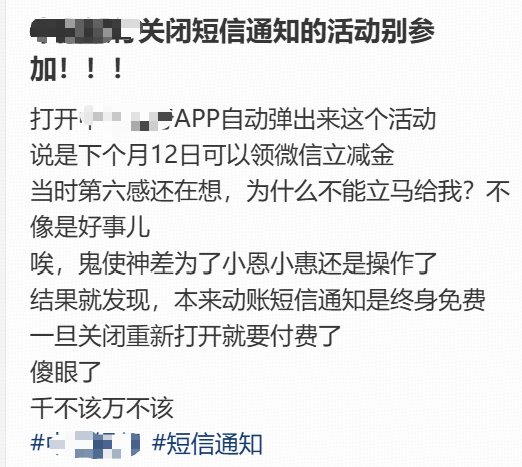
Core Viewpoint - Banks are increasingly charging for services that were previously free, such as transaction SMS notifications, as they face declining profits and need to find new revenue sources [1][3][9]. Group 1: Changes in Banking Services - Users have reported that banks are inviting them to participate in activities that lead to charges for services that were once free, such as SMS notifications for account transactions [1]. - Many banks have raised the threshold for free SMS notifications, with China Bank increasing the trigger amount from 0 to 100 yuan, and Hunan Rural Credit raising it from 200 to 500 yuan [3]. - Some banks, like Guizhou Rural Credit, have started charging for SMS services, while Minsheng Bank has ended free SMS notifications for transactions over 300 yuan, now charging 2 yuan per month [3][6]. Group 2: Broader Trends in Banking Fees - The trend of banks withdrawing free services is not limited to SMS notifications; many banks are adjusting various service fees, including ATM withdrawal fees and card delivery fees [4][6]. - For example, China Agricultural Bank has canceled free cash withdrawal policies for certain credit cards and increased fees for cross-bank withdrawals [6]. - Local banks, such as Lujiang Rural Commercial Bank, have also begun charging for ATM withdrawals, previously free [8]. Group 3: Reasons Behind Fee Increases - The banking industry is facing pressure on profits due to reduced loan demand and lower interest rates, leading to a decline in net interest margins [9][11]. - The net interest margin for commercial banks dropped from 1.69% in Q1 2024 to 1.43% in Q1 2025, significantly below the historical average of 2.44% [11]. - As banks look to cut costs, they are reducing the number of physical branches and staff, which has led to a focus on previously overlooked fees like SMS and delivery charges [11][12]. Group 4: Financial Implications of Fee Changes - Charging for SMS notifications can provide significant profit margins for banks, with a potential net profit margin of 87.5% based on the cost of sending messages [13]. - The shift from free to paid services is seen as a necessary measure for banks to maintain profitability in a challenging economic environment [14]. Group 5: User Adaptation Strategies - Users are encouraged to adapt to these changes by utilizing remaining free services and considering alternative notification methods, such as app notifications instead of SMS [15]. - Planning transactions to maximize free services and opting for electronic statements can help users mitigate the impact of these fee increases [15].

深耕长三角,这场活动见证金融赋能科创的“农行样本”
Zhong Guo Jin Rong Xin Xi Wang· 2025-11-21 06:54
转自:新华财经 新华财经上海11月21日电(记者 王淑娟)在长三角这片创新沃土上,科技金融正成为连接"实验 室"与"大市场"的关键桥梁。中国农业银行始终以服务国家战略为使命担当,持续完善金融支持科技创 新体系,致力于为金融赋能新质生产力发展探索可行路径。立足上海、辐射长三角,据悉,中国农业银 行长三角创新发展协同会暨"123+"金融赋能科技创新专项活动将于11月25日在上海举办,集中展现农行 服务长三角一体化高质量发展,在科技金融领域的创新实践与协同成效,成为观察其澎湃发展动能的重 要"窗口"。 区域协同"凝心聚力",共绘一体化发展新画卷 作为我国经济发展最活跃、开放程度最高、创新能力最强的区域之一,长三角以不到全国4%的土地面 积,创造了全国近四分之一的经济总量,区域集成电路、生物医药、人工智能产业规模分别占全国 3/5、1/3和1/3,"一体化"和"高质量"成为区域发展的关键引擎。 此前,农行出台《关于服务长三角区域一体化发展的工作意见》,明确"5+2"金融服务重点,包括强化 一体化客户服务能力、优化一体化产品服务创新、提升一体化风险防控能力、做实一体化组织资源保障 等四个一体化建设,全力做好长三角区域一 ...
金融助力中国企业“走出去”报告
第一财经研究院· 2025-11-21 05:51
Investment Rating - The report indicates a positive investment outlook for Chinese enterprises going global, with a projected increase in foreign direct investment (FDI) to 1.16 trillion RMB in 2024, reflecting an 11.30% year-on-year growth [8]. Core Insights - Chinese enterprises are actively exploring new pathways for international expansion, adapting strategies in response to geopolitical challenges and evolving market conditions [4][8]. - The ASEAN region has emerged as a key destination for Chinese investment, with its share of China's outbound investment rising from 6.34% in 2014 to 17.88% in 2024 [8]. - The structure of China's outbound investment is shifting, with significant increases in the wholesale, retail, and manufacturing sectors, indicating a deeper integration into global value chains [8][52]. Summary by Sections Part A: Challenges and Pathways for Chinese Enterprises Going Global - The Chinese government is committed to high-quality outbound investment, emphasizing the importance of maintaining a stable international economic environment despite rising geopolitical tensions [18][19]. - The share of China's exports in global trade is projected to reach 14.64% in 2024, maintaining its position as the world's largest exporter [19][23]. - Chinese enterprises are increasingly focusing on the ASEAN region for investment, with a notable rise in direct investment since the implementation of the RCEP [44][52]. Part B: Financial Support for Outbound Expansion - Chinese financial institutions are enhancing their overseas presence, with major banks establishing branches in numerous countries to support outbound enterprises [9]. - There is a strong emphasis on integrating domestic and international resources, with banks providing cross-border credit and financing solutions for projects under the Belt and Road Initiative [9][11]. - Innovative financial products and services are being developed to support overseas investments, including specialized loans for infrastructure projects and comprehensive solutions for cross-border e-commerce [9][11]. Part C: Future Outlook and Recommendations - Recommendations include optimizing overseas network construction, enhancing multi-tiered financial service systems, and expanding the use of cross-border RMB [12][13]. - A comprehensive risk management system is suggested to help enterprises navigate geopolitical uncertainties and market volatility [12][13]. - Strengthening collaboration between financial institutions and industries is crucial for supporting enterprises in their global expansion efforts [12][13].


中资离岸债每日总结(11.20) | 农业银行(01288.HK)、三峡国际等发行
Sou Hu Cai Jing· 2025-11-21 02:59
Group 1 - The Federal Reserve's October FOMC meeting minutes reveal significant internal divisions regarding future interest rate cuts, with discussions covering inflation risks, labor market cooling, and economic growth uncertainties [2] - The Fed ultimately voted 10 to 2 to lower the federal funds rate by 25 basis points, bringing the target range to 3.75% to 4%, but the decision was reached after intense debate [2] - There is a notable split among Fed officials regarding the appropriateness of further rate cuts in December, with some advocating for cuts if economic conditions align with expectations, while many prefer to maintain current rates [2] Group 2 - Following the release of the minutes, market expectations shifted significantly, with the probability of a December rate cut dropping from nearly 50% to around 30%, while the likelihood of no change rose to nearly 70% [2] - The swap market adjusted the expected cut magnitude for December from 11 basis points to just 6 basis points [2] Group 3 - In the primary market, four companies issued bonds today, including a merger agreement between CICC and two other securities firms, which requires board and regulatory approvals [4] - China Great Wall Asset Management announced plans to dispose of its debt claims against Evergrande Group, totaling approximately 1.09 billion yuan, with a principal amount of about 959 million yuan [4] - Zhongjun Group is seeking court approval for a creditor meeting to discuss a restructuring plan, with a hearing scheduled for March 24, 2026 [4]