
AGRICULTURAL BANK OF CHINA(601288)

Search documents
银行股延续涨势,上海银行涨超2%
Mei Ri Jing Ji Xin Wen· 2025-11-04 11:38
Core Viewpoint - Bank stocks continue to rise, with Shanghai Bank increasing by over 2% and several other banks, including Chongqing Bank, CITIC Bank, Agricultural Bank, China Merchants Bank, Qilu Bank, and Postal Savings Bank, rising by over 1% [1] Group 1 - Shanghai Bank's stock price increased by more than 2% [1] - Chongqing Bank, CITIC Bank, Agricultural Bank, China Merchants Bank, Qilu Bank, and Postal Savings Bank each saw stock price increases of over 1% [1]



上市公司前三季度“成绩单”出炉!
Jin Rong Shi Bao· 2025-11-04 11:35
Core Insights - The overall performance of listed companies in China has shown continuous improvement in the first three quarters of 2025, with significant growth in both revenue and net profit [2][3] Group 1: Overall Performance - Total revenue for listed companies reached 53.46 trillion yuan, with a net profit of 4.70 trillion yuan, representing year-on-year growth of 1.36% and 5.50% respectively [2] - In the third quarter alone, revenue and net profit increased by 3.82% and 11.45% year-on-year, and by 2.40% and 14.12% quarter-on-quarter, indicating a solid upward trend [2] - Approximately 4183 companies reported profits, with nearly 80% of the market achieving positive earnings [2] Group 2: Industry Performance - The semiconductor and hardware equipment sectors experienced the fastest revenue growth at 20.9% and 16.8% respectively, while several other industries, including non-bank financials and automotive, saw growth rates above 7% [3] - In terms of net profit growth, the steel, software services, and semiconductor industries led with increases of 402.0%, 121.6%, and 46.6% respectively [3] Group 3: Major Companies - China National Petroleum Corporation topped the revenue list with 2.17 trillion yuan, followed closely by Sinopec at 2.11 trillion yuan and China State Construction at 1.56 trillion yuan [3] - Excluding financial and oil companies, China Mobile led with a net profit of 1154 billion yuan, followed by Kweichow Moutai with 646 billion yuan [3] Group 4: High-Quality Development - The role of technology innovation has become more prominent, with significant revenue and profit growth reported by companies in the ChiNext, STAR Market, and Beijing Stock Exchange [4] - The total market capitalization reached 107.32 trillion yuan, with the electronics sector leading, accounting for 12.42% of the total market [4] Group 5: R&D Investment - Listed companies collectively invested 1.16 trillion yuan in R&D, marking a year-on-year increase of 3.88%, with 168 companies investing over 1 billion yuan [6] - The overall R&D intensity across the market was 2.16%, with the ChiNext and STAR Market showing higher intensities of 4.54% and 11.22% respectively [6] Group 6: Shareholder Returns - A total of 1033 companies announced cash dividend plans, with a total cash dividend amounting to 734.9 billion yuan, an increase from the previous year [7] - The market has seen a total of 1525 share repurchase plans announced, with completed repurchases amounting to 92.3 billion yuan [7]





农业银行(601288) - 农业银行H股公告
2025-11-04 09:15
股份發行人及根據《上市規則》第十九B章上市的香港預託證券發行人的證券變動月報表 截至月份: 2025年10月31日 狀態: 新提交 致:香港交易及結算所有限公司 公司名稱: 中國農業銀行股份有限公司 呈交日期: 2025年11月4日 FF301 II. 已發行股份及/或庫存股份變動 | 1. 股份分類 | 普通股 | 股份類別 | H | | 於香港聯交所上市 (註1) | 是 | | | --- | --- | --- | --- | --- | --- | --- | --- | | 證券代號 (如上市) | 01288 | 說明 | | | | | | | | | 已發行股份(不包括庫存股份)數目 | | 庫存股份數目 | | 已發行股份總數 | | | 上月底結存 | | | 30,738,823,096 | | 0 | | 30,738,823,096 | | 增加 / 減少 (-) | | | 0 | | 0 | | | | 本月底結存 | | | 30,738,823,096 | | 0 | | 30,738,823,096 | I. 法定/註冊股本變動 | 1. 股份分類 | 普通股 | 股份 ...
【金融街发布】农行北京分行发布“京·研发贷”产品 精准匹配企业研发资金需求
Zhong Guo Jin Rong Xin Xi Wang· 2025-11-04 08:55
Core Viewpoint - Agricultural Bank of China (ABC) Beijing Branch prioritizes technology finance as a strategic business, focusing on the construction of the Beijing International Science and Technology Innovation Center, and actively innovating financial products and service models to support the development of new productive forces and cultivate new growth momentum [1][3]. Group 1: Product Innovation and Development - ABC Beijing Branch has iteratively upgraded the "Beijing R&D Loan" product to address the financing difficulties faced by technology enterprises, using technology projects and achievements as the basis for evaluating "future repayment ability" [1][2]. - The upgraded "Beijing R&D Loan" is designed to meet the flexible funding needs of technology enterprises in various scenarios, including technology innovation, project research and development, and technology achievement transformation [2]. - The bank has optimized the admission criteria by focusing on credit ratings, R&D investment, industry sectors, and research capabilities, moving away from traditional credit thinking that emphasizes financial statements and collateral [2]. Group 2: Financial Product Features - The credit limit can be flexibly calculated based on R&D investment, equity investment, operating income, and project needs [2]. - The maximum term for working capital loans can reach 5 years, while fixed asset loans for capitalized R&D projects can extend up to 10 years [2]. - The bank has expanded the types of collateral to include intellectual property, patent licensing income, and core professional equipment, enhancing credit options and supporting government risk compensation funds and guarantee insurance [2]. Group 3: Growth Metrics and Future Focus - As of September 2025, the loan growth rate for technology enterprises in Beijing reached 33%, with a compound annual growth rate of over 20% for strategic emerging industry loans in the past two years [3]. - ABC Beijing Branch will continue to focus on emerging pillar industries and future industry development layouts, innovating products and optimizing services to support modern industrial systems, agricultural technology enterprises, and key areas such as private and small technology enterprises [3].

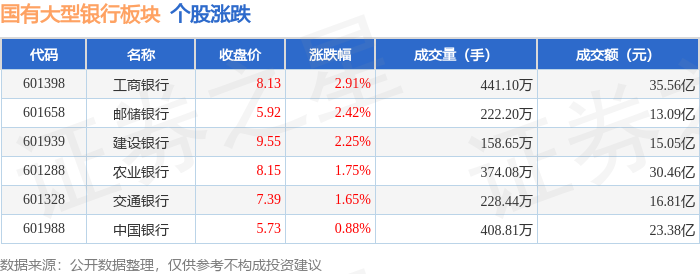
国有大型银行板块11月4日涨2.01%,工商银行领涨,主力资金净流入10.82亿元
Zheng Xing Xing Ye Ri Bao· 2025-11-04 08:48
Core Insights - The state-owned large bank sector experienced a 2.01% increase on November 4, with Industrial and Commercial Bank of China (ICBC) leading the gains [1] - The Shanghai Composite Index closed at 3960.19, down 0.41%, while the Shenzhen Component Index closed at 13175.22, down 1.71% [1] Bank Performance - ICBC's closing price was 8.13, up 2.91%, with a trading volume of 4.41 million shares and a transaction value of 35.56 billion [1] - Postal Savings Bank closed at 5.92, up 2.42%, with a trading volume of 2.22 million shares and a transaction value of 1.309 billion [1] - Construction Bank closed at 9.55, up 2.25%, with a trading volume of 1.5865 million shares and a transaction value of 15.05 billion [1] - Agricultural Bank closed at 8.15, up 1.75%, with a trading volume of 3.7408 million shares and a transaction value of 30.46 billion [1] - Bank of Communications closed at 7.39, up 1.65%, with a trading volume of 2.2844 million shares and a transaction value of 16.81 billion [1] - Bank of China closed at 5.73, up 0.88%, with a trading volume of 4.0881 million shares and a transaction value of 2.338 billion [1] Fund Flow Analysis - The state-owned large bank sector saw a net inflow of 1.082 billion in main funds, while retail funds experienced a net outflow of 565 million [1] - The main fund inflow for ICBC was 605 million, representing 17.00% of its total, while retail funds saw a net outflow of 274 million [2] - Agricultural Bank had a main fund inflow of 210 million, accounting for 6.88%, with retail funds experiencing a net outflow of 36.73 million [2] - Postal Savings Bank recorded a main fund inflow of 130 million, with retail funds seeing a net outflow of 74.73 million [2] - Construction Bank had a main fund inflow of 116 million, while retail funds experienced a net outflow of 122 million [2] - Bank of Communications saw a main fund inflow of 113 million, with retail funds experiencing a net outflow of 91.44 million [2] - Bank of China had a net outflow of 91.14 million in main funds, while retail funds saw a net inflow of 80.96 million [2]




农业银行(01288) - 截至二零二五年十月三十一日股份发行人的证券变动月报表
2025-11-04 08:32
股份發行人及根據《上市規則》第十九B章上市的香港預託證券發行人的證券變動月報表 本月底法定/註冊股本總額: RMB 349,983,033,873 截至月份: 2025年10月31日 狀態: 新提交 公司名稱: 中國農業銀行股份有限公司 呈交日期: 2025年11月4日 致:香港交易及結算所有限公司 FF301 I. 法定/註冊股本變動 | 1. 股份分類 | 普通股 | 股份類別 H | | | 於香港聯交所上市 (註1) | | 是 | | | --- | --- | --- | --- | --- | --- | --- | --- | --- | | 證券代號 (如上市) | 01288 | 說明 | | | | | | | | | | 法定/註冊股份數目 | | | 面值 | | 法定/註冊股本 | | | 上月底結存 | | | 30,738,823,096 | RMB | | 1 RMB | | 30,738,823,096 | | 增加 / 減少 (-) | | | 0 | | | RMB | | 0 | | 本月底結存 | | | 30,738,823,096 | RMB | | 1 RMB ...
大行评级丨中银国际:农业银行估值具备吸引力 上调H股目标价至6.95港元
Ge Long Hui· 2025-11-04 07:22
Core Viewpoint - Agricultural Bank of China demonstrated strong competitiveness in a complex economic environment, with positive growth in net profit for both the third quarter and the first three quarters of the year [1] Group 1: Financial Performance - In the third quarter, net profit increased by 3.7% year-on-year, accelerating from 3.2% in the second quarter and 2.2% in the first quarter [1] - The net interest margin for the first three quarters and the first half of the year was 1.3% and 1.32%, respectively, reflecting a decline of 12 and 10 basis points compared to the end of 2024 [1] Group 2: Valuation and Ratings - The bank's valuation is considered attractive, leading to an increase in the target price for H-shares from HKD 6.09 to HKD 6.95, which corresponds to a forecasted price-to-book ratio of 0.8 times for this year [1] - The bank maintains a "Buy" rating and anticipates an average return on equity of 10.1% by 2025 [1]
行业ESG周报:中国出台绿色贸易领域首个专项政策文件,上海发布银发友好型商场建设指引-20251104
GUOTAI HAITONG SECURITIES· 2025-11-04 07:16
Investment Rating - The report does not explicitly provide an investment rating for the industry Core Insights - The report highlights the strategic importance of green development in China's modernization efforts, emphasizing the need for a comprehensive green transformation in economic and social development [5][8] - The introduction of the first specialized policy document on green trade by the Ministry of Commerce aims to address weaknesses in China's green trade development and promote low-carbon capabilities among enterprises [10][11] - The report outlines China's commitment to climate governance, showcasing significant progress in areas such as carbon market development and regulatory frameworks [12][15] Policy Trends - The Central Committee of the Communist Party of China released guidelines for the 15th Five-Year Plan, emphasizing green transformation and ecological security [5][6] - The Ministry of Commerce issued implementation opinions to expand green trade, focusing on enhancing the green capabilities of foreign trade enterprises and optimizing the international environment for green trade [10][11] Industry Trends - The Ministry of Ecology and Environment published the 2025 Annual Report on China's Climate Change Policies and Actions, detailing the country's efforts in climate governance and its commitment to achieving carbon neutrality by 2035 [12][15] - Shanghai introduced guidelines for the construction of age-friendly shopping malls, addressing the needs of the elderly population in urban settings [17][20] - The 2025 World Animal Welfare and Sustainable Food Conference was held in Beijing, promoting sustainable agricultural practices and animal welfare standards [21][26] International Events - The 20th International Environmental Expo was held in Hong Kong, showcasing innovative environmental technologies and sustainable development solutions [27][28] - Officials from the US and Qatar warned that the EU's new climate law could threaten energy security and investment environments in Europe [29][30] Corporate Developments - Ping An Insurance achieved the highest MSCI ESG rating of AAA, maintaining its position as a leader in the Asia-Pacific region for four consecutive years [31][32] - The company has integrated sustainable development into its core strategy, focusing on green finance and responsible investment practices [33][34]

大行积存金业务暂停又恢复,已有银行金条价格含税上调
第一财经· 2025-11-04 07:04
Core Viewpoint - The recent changes in gold tax policies have led to multiple banks, including Industrial and Commercial Bank of China (ICBC), China Construction Bank, and Agricultural Bank of China, temporarily suspending their gold accumulation and physical exchange services, with some banks adjusting their product offerings and pricing in response to the new regulations [3][5][12]. Group 1: Impact of New Tax Policies - The new gold tax policy has prompted banks to pause gold accumulation services and adjust their product offerings, with ICBC and China Construction Bank announcing suspensions on November 3, 2025 [5][6]. - ICBC quickly resumed its gold accumulation services on the evening of the same day, indicating a rapid response to the regulatory changes [7][8]. - The adjustments made by banks are primarily due to system upgrades and the need to comply with the new tax regulations, rather than a significant impact on their gold business [12][14]. Group 2: Changes in Product Offerings - Banks like China Merchants Bank have shifted some of their self-operated gold products to a consignment model, reducing the range of physical gold products available for exchange [8][15]. - The new tax policy has led to an increase in the prices of physical gold products, with banks adjusting their pricing structures accordingly [12][15]. - The changes in tax regulations mean that banks will now face different invoicing rules, which could affect their cost structures and pricing strategies for gold products [13][14]. Group 3: Market Reactions and Future Outlook - The market for gold products has seen a tightening of inventory, with certain gold bars becoming unavailable for purchase [9][12]. - Industry experts suggest that while the immediate impact on banks' gold businesses may be limited, the overall product and operational structures will undergo adjustments in response to the new tax policies [14].

中金:升农业银行(01288)目标价至6.62港元 盈利增长持续改善
智通财经网· 2025-11-04 06:28
Core Viewpoint - Agricultural Bank of China (01288) reported its Q3 2025 performance, showing a 2% year-on-year revenue growth and a 3.3% year-on-year net profit growth, aligning with expectations from CICC [1] Financial Performance - Revenue for the first three quarters of the year increased by 2% year-on-year [1] - Net profit for the same period rose by 3.3% year-on-year [1] Analyst Ratings and Price Targets - CICC maintains a "Outperform" rating for Agricultural Bank of China [1] - The target price for A-shares (601288.SH) has been raised by 14.9% to RMB 8.87, reflecting a 1.1 times price-to-book ratio for 2025 and 1 time for 2026, indicating a 10% upside potential [1] - The target price for Hong Kong shares has also been increased by 14.7% to HKD 6.62, corresponding to 0.8 times price-to-book ratio for 2025 and 0.7 times for 2026, also suggesting a 10% upside potential [1]