AGRICULTURAL BANK OF CHINA(601288)

Search documents
银行行业2026年度投资策略:“稳健锚”与“增长帆”,从红利重估到能力定价
KAIYUAN SECURITIES· 2025-11-05 15:17
Core Views - The report emphasizes the importance of stable high-dividend assets in a low-interest-rate environment, highlighting the scarcity of such assets as a key investment opportunity [4][12] - It discusses the regulatory cycle and the reduction of potential credit risks through local debt resolution, reinforcing the concept of a "stable anchor" for banks [4][15] - The economic transformation from land credit to technology and consumption-driven growth is seen as providing a "growth sail" for banks, particularly in corporate deepening and wealth management [4][18] Policy Background and Investment Context - The low interest rate environment and asset scarcity highlight the attractiveness of stable high-dividend assets, with bank stocks favored for their strong performance stability and high dividend yields [4][12] - The ongoing resolution of local government debt is expected to reduce systemic credit risks, thereby solidifying banks' "stable anchor" [4][15] - The shift towards technology and consumption is anticipated to enhance banks' growth potential, particularly in wealth management and corporate services [4][18] Deep Revaluation of "Stable Anchor" - Bottom Line of Value - The report identifies the stability of earnings, attractiveness of dividends, and sustainability of payouts as key components of dividend value [5] - It notes that the expansion of bank balance sheets and the potential recovery of net interest margins are crucial for long-term value [5] - Enhanced investment capabilities in financial markets and asset circulation are highlighted as factors contributing to banks' stability [5] "Growth Sail" Capability Breakthrough - Elasticity of Value - The report emphasizes the importance of stable and high risk-adjusted return on capital (RAROC) for banks, which reflects their efficiency in capital usage [6] - It points out the advantages of wealth attributes and customer base, as well as strong non-performing asset management capabilities [6] - The ability to adjust and manage financial market investments effectively is seen as a significant strength for banks [6] Medium to Long-term Incremental Capital Drivers - Good Wind with Favorable Conditions - The report suggests a potential trend shift in insurance capital allocation towards bank equities, with a target dividend yield of 3.5%-4% seen as a reasonable baseline [7] - It notes that actively managed equity funds are currently underweight in bank stocks, while asset management companies (AMCs) are accelerating their investments in this sector [7] Investment Recommendations: Hold "Stable Anchor" and Raise "Growth Sail" - The report recommends a foundational allocation in large state-owned banks, with H-shares offering better value than A-shares, particularly for Agricultural Bank and Industrial and Commercial Bank [8] - Core allocations should focus on banks that combine stability with strong wealth management capabilities, such as China Merchants Bank and CITIC Bank [8] - For flexible allocations, it suggests high-quality regional banks with unique characteristics in specific areas or business lines, such as Jiangsu Bank and Chongqing Bank [8] Dividend Value Analysis - The report indicates that the operating income of listed banks grew by 0.91% year-on-year in the first three quarters of 2025, with net profit growth of 1.48% [28] - It highlights the significant performance differentiation among banks, with state-owned banks showing stable revenue growth while smaller banks face challenges [28][30] - The report notes that the dividend sustainability of banks is influenced by profitability, dividend policies, and capital considerations, with larger banks maintaining a more stable dividend distribution [41][43]




年末资金回流银行股?瑞银报告:不排除这种可能性!对防御性板块维持正面看法
Zhi Tong Cai Jing· 2025-11-05 13:20
Core Viewpoint - UBS maintains a positive outlook on defensive stocks due to the ongoing weak macroeconomic environment in China, expecting a continued recovery in revenue and net profit growth for state-owned banks, as well as regional banks outperforming their peers [1][2] Group 1: Banking Sector Outlook - The banking sector's fundamental outlook is improving, with signs of stabilization in net interest margins and overall asset quality remaining stable despite pressures on manufacturing and retail loan books [2] - Large state-owned and joint-stock banks are experiencing a sustained recovery in net profit growth, with UBS predicting this positive trend will continue into Q4 2025 [2] Group 2: Fund Flows and Market Dynamics - Fund flows are a key driver for bank stocks, with potential rotation towards defensive stocks as investors react to market conditions [3][4] - In early 2025, H-shares of Chinese banks listed in Hong Kong performed strongly, driven by increased allocations from insurance funds [3] - A significant outflow from bank stocks occurred in Q3 2025, with prices declining by 10%-15% due to a rapid rise in high-beta sectors, but a rebound was noted in October amid rising trade uncertainties [3] Group 3: Investor Sentiment and Key Stocks - Investors anticipate factors that could drive funds into the banking sector, including profit-taking from high-beta sectors and increased allocations from insurance funds around the "New Year" sales period in January 2026 [4] - Among large state-owned banks, Agricultural Bank of China is the most closely watched stock, with a year-to-date total return of 55.5% for A-shares and 41.1% for H-shares, significantly outperforming the MSCI China Banking Index [6] - Agricultural Bank's strong performance is attributed to increased holdings by Ping An Group, continuous buying by quantitative funds, and better-than-peer financial results [6] - Investors are also focused on China Merchants Bank, although expectations for short-term profit growth or dividend increases are low, while Ningbo Bank is viewed as having upside potential due to improving fundamentals and reasonable valuations [6] Group 4: Concerns in the Market - There is growing concern over declining real estate prices, particularly in first-tier cities, which could lead to potential defaults affecting mortgage and SME loans [5] - Current mortgage loan-to-value ratios are reported at around 50% for most national banks, with some joint-stock banks exceeding 70% [5] - The demand for consumer loans has not shown signs of recovery, and asset quality continues to weaken, raising investor concerns [5]
外资A股最新持仓曝光
第一财经· 2025-11-05 11:45
Core Viewpoint - The A-share market has shown significant recovery since the third quarter, with active trading and continued foreign investment, particularly in industry leaders and state-owned enterprises [3][5][14]. Group 1: Foreign Investment Trends - As of the end of September, major industry leaders such as Kweichow Moutai, China Ping An, and Wuliangye attracted over 80 foreign institutional investors each [6][5]. - The top three foreign-held A-shares by market value are CATL (265.66 billion), Kweichow Moutai (88.14 billion), and Midea Group (71.65 billion) [6][5]. - Foreign investment in "Chinese state-owned enterprises" has increased, with China Shipbuilding attracting 68 foreign investors, a rise of over 40% from the end of the first half [7][5]. Group 2: Sector Preferences - Foreign investors favor industry leaders, state-owned enterprises, and bank stocks, with seven of the top ten foreign-held A-shares being banks [6][5]. - Notable bank stocks include Nanjing Bank (2.36 billion shares held by 32 foreign investors) and Ningbo Bank (1.60 billion shares held by 42 foreign investors) [6][5]. Group 3: Individual Stock Movements - UBS significantly increased its stake in RuiNeng Technology, becoming the third-largest shareholder, while Goldman Sachs, JPMorgan, and Merrill Lynch entered the top ten shareholders [9][10]. - RuiNeng Technology's stock price has surged over 40% since mid-October, despite a 32.73% decline in net profit year-on-year [12][10]. Group 4: Market Outlook - UBS analysts remain optimistic about the medium-term outlook for the A-share market, citing a 12% year-on-year profit growth for all A-shares in the third quarter [15][14]. - Goldman Sachs predicts a 30% increase in major stock indices by the end of 2027, indicating a potential long-term bull market for A-shares [16][14].







10月6家银行收到超千万罚单,有行长任职资格罕见被否
21世纪经济报道· 2025-11-05 11:29
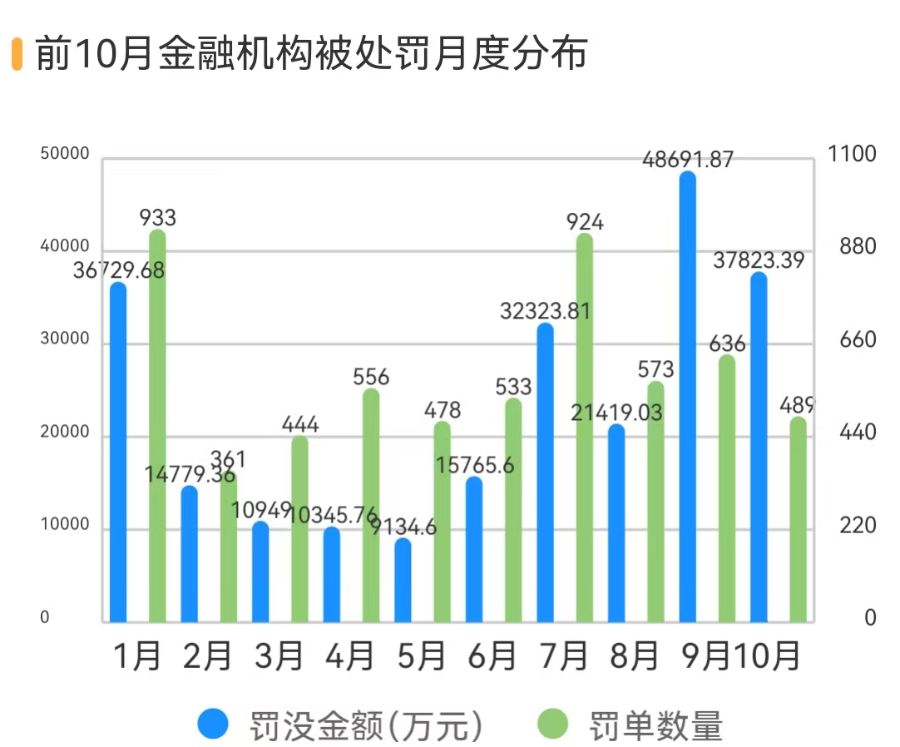
Core Viewpoint - In October, financial institutions received 489 fines, a year-on-year decrease of 2.59%, but the total penalty amount reached 378 million yuan, a significant increase of 223.08% compared to the previous year [2]. Group 1: Penalty Overview - The number of fines in October decreased significantly compared to the first three months of the year, but the total penalty amount remains high, with October being the second highest this year after September [4]. - Regulatory bodies such as the National Financial Supervision Administration, the People's Bank of China, the China Securities Regulatory Commission, and the State Administration of Foreign Exchange all issued fewer fines in October [7]. - Banks received a total of 310 fines, a month-on-month decrease of 24.39%, while insurance companies received 108 fines, down 16.92%, and securities firms received 16 fines, down 42.86% [9]. Group 2: Major Fines - In October, six fines exceeded 10 million yuan, with the largest fine against a bank for issues related to corporate governance, loans, interbank transactions, bills, asset quality, and non-performing asset management [12]. - The largest fine was against the Bank of China, amounting to 97.9 million yuan, for various management failures [13]. - Other significant fines included China Minsheng Bank (28.62 million yuan), Agricultural Bank of China (27.2 million yuan), and Ping An Bank (18.8 million yuan) for similar management issues [14]. Group 3: Compliance Cases - Five Mining Securities was criticized for publishing incorrect coupon rates and issuance results during a bond issuance process, failing to comply with relevant regulations [15][16]. - Tianjin Investment Futures was ordered to rectify its operations due to ineffective risk isolation between its brokerage and proprietary trading businesses, leading to significant losses [17]. - A rare case occurred where the qualification of a bank president was denied due to non-compliance with regulatory requirements, highlighting increased scrutiny on corporate governance in small and medium-sized banks [18]. Group 4: Compliance Characteristics - There was a more than double increase in fines for illegal loan issuance, with 19 fines issued in October, reflecting a year-on-year increase of 111.11% [21]. - Fines related to internal control management also increased, with 32 fines issued in October, a month-on-month increase of 52.38% [23]. Group 5: Penalty Rankings - China Agricultural Development Bank had the highest penalty amount in the third quarter and continued to lead in October [27]. - Zhongcheng Trust received the largest penalty among non-bank institutions in October, with a fine of 6.6 million yuan for various violations [29].
透视银行三季报:超30家净息差收窄 债市波动拖累非利息收入
Bei Ke Cai Jing· 2025-11-05 11:12
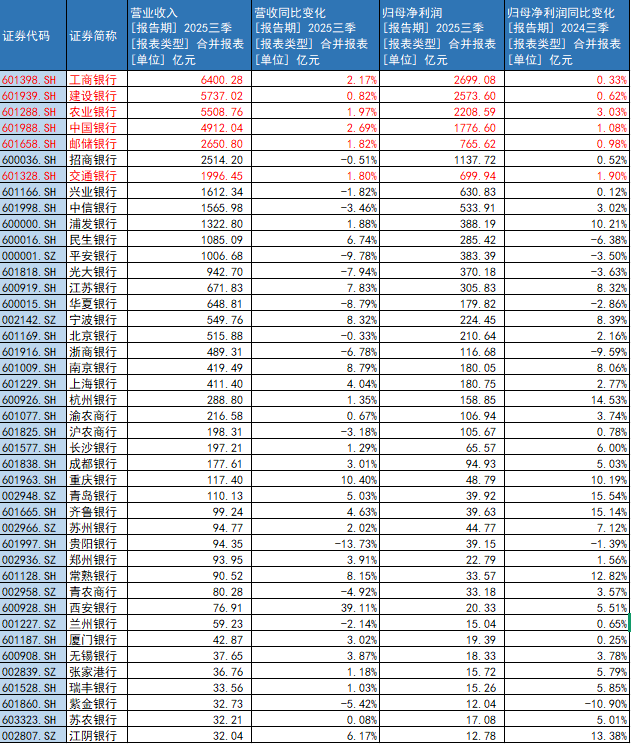
Core Insights - The overall performance of A-share listed banks in the first three quarters of the year is positive, with over 80% achieving year-on-year growth in net profit attributable to shareholders [2][3] - The growth in net profit is primarily driven by stable net interest income and improved asset quality, despite a decline in non-interest income due to bond market fluctuations [2][3] - The six major banks collectively reported over 1 trillion yuan in net profit, marking a significant milestone [3][4] Financial Performance - Among the 42 listed banks, 35 reported year-on-year growth in net profit, while only 7 experienced a decline [3][4] - The top four state-owned banks (Industrial and Commercial Bank of China, China Construction Bank, Agricultural Bank of China, and Bank of China) all achieved growth in both revenue and net profit [4][5] - Industrial and Commercial Bank of China led in revenue with 640.03 billion yuan, a 2.17% increase year-on-year, and a net profit growth of 0.33% [4][6] Non-Interest Income and Market Impact - Many banks faced a decline in non-interest income due to volatility in the bond market, with several banks reporting significant losses in fair value changes [9][10] - For instance, China Merchants Bank reported a fair value loss of 8.83 billion yuan, transitioning from profit to loss [10][12] - The decline in non-interest income is attributed to reduced earnings from bond and fund investments [10][13] Interest Income Trends - Some banks, particularly city commercial banks, saw substantial growth in interest income, with Xi'an Bank's interest income increasing over 60% [7][8] - Conversely, banks like Guiyang Bank and Capital Bank reported declines in interest income of 12.29% and 17.34%, respectively [8][9] Net Interest Margin - The overall net interest margin for listed banks has narrowed compared to the end of the previous year, although some banks have seen a recovery from the second quarter [16][20] - As of the end of the third quarter, Xi'an Bank's net interest margin was 1.79%, reflecting a 0.43% increase from the end of the previous year [16][17] - The stability of net interest margins in the fourth quarter will depend on the banks' ability to optimize their liability structures and find high-quality investment opportunities [20]




上市银行2025年三季报综述:盈利温和修复,利息与中收共振回暖
Ping An Securities· 2025-11-05 10:38
Investment Rating - The report maintains a "stronger than the market" rating for the banking sector [1][4]. Core Views - As of the end of October, 42 listed banks reported a 1.5% year-on-year increase in net profit for the first three quarters of 2025, an improvement of 0.7 percentage points compared to the first half of 2025 [4][9]. - The report highlights a continued recovery in profitability, driven by a rebound in interest income and non-interest income [4][10]. - The report anticipates that the positive signals from interest margin and non-interest income will persist into the fourth quarter of 2025, with a focus on the impact of policies aimed at reducing competition and the quality of retail assets [15][4]. Summary by Sections Profitability Analysis - The net interest income for the first three quarters of 2025 decreased by 0.6% year-on-year, while non-interest income from fees and commissions grew by 4.6% [10][6]. - The report notes that the profitability of individual banks varies, with some banks like Shanghai Pudong Development Bank and Agricultural Bank of China showing significant growth rates of 10.2% and 3.0% respectively [4][9]. Operational Breakdown - Total asset growth for the 42 listed banks was 9.3% year-on-year, with loan growth at 7.7% and deposit growth at 7.9% [22][4]. - The annualized net interest margin for the third quarter was stable at 1.36%, with a decrease in the cost of interest-bearing liabilities [4][6]. Investment Recommendations - The report suggests a shift towards reallocation rather than trading, emphasizing the importance of structural changes in funding flows that support valuation recovery in the banking sector [6][4]. - Specific banks such as Chengdu Bank, Jiangsu Bank, and Suzhou Bank are highlighted for their regional advantages and potential for continued profit growth [6][4].


社保基金最新重仓股揭晓!新进比亚迪、隆基绿能等226只个股!
Sou Hu Cai Jing· 2025-11-05 10:26
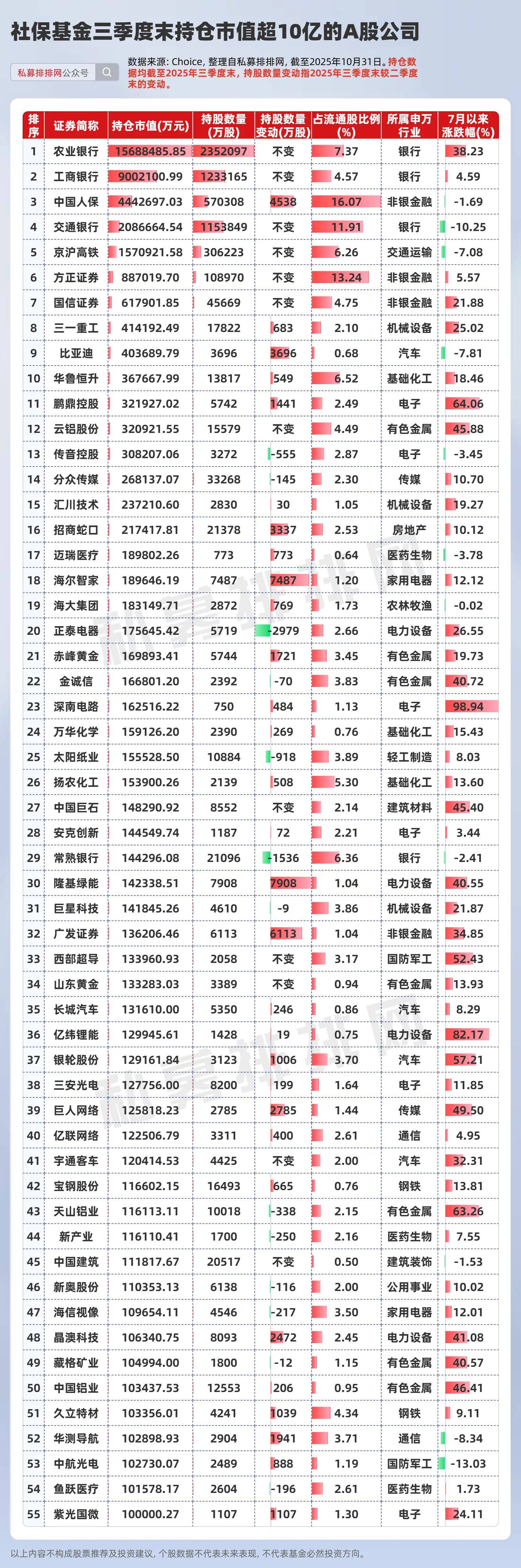
Core Viewpoint - The Social Security Fund's latest holdings in A-shares reveal significant investment activity, with a total market value of approximately 552.72 billion yuan, reflecting an increase of about 49.81 billion yuan from the previous quarter [1]. Holdings Overview - As of the end of Q3 2025, the Social Security Fund was listed among the top ten shareholders in 622 A-share companies, with a total holding value of approximately 552.72 billion yuan, up from 502.91 billion yuan at the end of Q2 2025 [1]. - The fund initiated positions in 226 new stocks, increased holdings in 153 stocks, reduced holdings in 135 stocks, and maintained positions in 108 stocks [1][19]. Sector Allocation - The majority of the fund's holdings were concentrated in the banking sector, with a market value of 270.06 billion yuan, followed by the non-bank financial sector at approximately 63.04 billion yuan [1]. - The electronics sector, which was ranked sixth in holdings at the end of Q2, moved up to third place by the end of Q3, indicating a shift in investment focus [1]. Major Holdings - Among the 622 companies, 55 had a holding value exceeding 1 billion yuan, accounting for approximately 76.67% of the total holdings [2]. - The top five stocks with holdings exceeding 10 billion yuan were primarily financial stocks, including Agricultural Bank of China, Industrial and Commercial Bank of China, China Life Insurance, and Bank of Communications [2][3]. Performance Insights - The banking sector has shown strong performance in the first half of the year, with Agricultural Bank of China leading with a 38.23% increase [2]. - The Social Security Fund's holdings in the insurance sector saw an increase in shares for China Life Insurance, with a market value of 44.43 billion yuan, despite a slight decline in stock price since July [3]. New Energy Sector Focus - The fund has maintained a significant allocation to the new energy sector, particularly in lithium battery and photovoltaic companies, with 20 new energy companies having a market value exceeding 300 million yuan [9]. - Stocks such as Yiwei Lithium Energy and Sanyuan Electric have seen substantial price increases, with average gains of 45.92% since July [9]. Notable Stock Movements - The fund's adjustments included significant increases in holdings for companies like Guangxin Co., with a 277.97% increase in shares, reflecting a strategic focus on traditional industries [23]. - The fund's new investments included companies in the AI computing and lithium battery supply chain, with some stocks experiencing over 100% price increases since July [13].




五家银行跻身绿色信贷“万亿俱乐部”,绿色债券存量规模近2万亿
2 1 Shi Ji Jing Ji Bao Dao· 2025-11-05 09:41
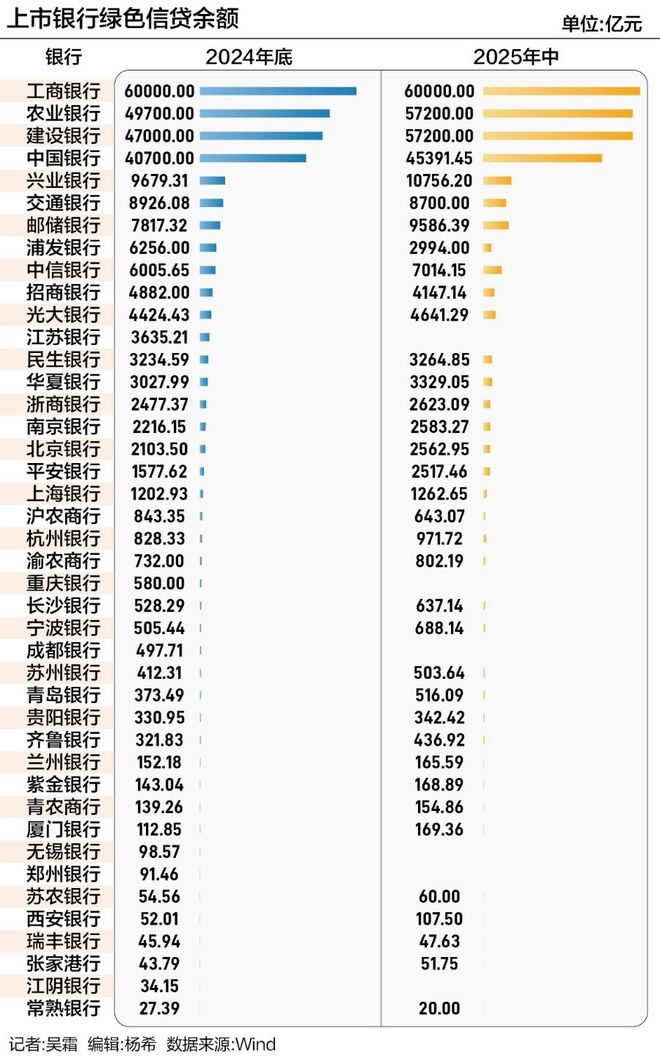
Core Insights - Green finance has transitioned from an optional strategy to a mandatory focus for banks, becoming a new engine for strategic transformation and a blue ocean market in the context of a shift towards a green low-carbon economy [1][2] - The balance of green financing at Industrial Bank has reached nearly 2.5 trillion yuan, with green loans exceeding 1 trillion yuan and a non-performing loan rate of only 0.57% [1] - The People's Bank of China and other departments have issued a unified policy framework for green finance, effective from October 1, 2025, to standardize the support scope for green loans and bonds [2] Green Credit Landscape - By the end of 2024, the total balance of green credit among 42 A-share listed banks exceeded 27 trillion yuan, with a year-on-year growth of approximately 20% [3] - State-owned banks are the main contributors to green credit, with the six major state-owned banks holding over 21 trillion yuan, accounting for 77.6% of the total [3] - The growth pattern shows large banks maintaining scale, joint-stock banks demonstrating strong vitality, and regional banks achieving rapid growth [3] Green Loan Balances - As of the end of 2024, only four listed banks had green loan balances exceeding 1 trillion yuan: Industrial Bank, Agricultural Bank, Construction Bank, and Bank of China [5] - Industrial Bank's green loan balance rose to 1.08 trillion yuan in the first half of the year, joining the "trillion club" [5] - Among joint-stock banks, Industrial Bank, CITIC Bank, and Pudong Development Bank lead in green credit scale, collectively accounting for nearly 40% of the total [5] Growth Rates and Sector Focus - The average growth rate of green credit for A-share listed banks in 2024 was 20.6%, a slowdown from approximately 28% in 2023, yet leading institutions maintained strong growth [5] - The focus of green credit is heavily concentrated in clean energy, green transportation, energy conservation, and green buildings, with key regions being the Yangtze River Delta, Guangdong-Hong Kong-Macau Greater Bay Area, and Chengdu-Chongqing economic circle [6] Financial Product Innovation - A-share listed banks are deepening innovation in green financial products, creating a multi-dimensional product system that includes loans, bonds, asset securitization, insurance, and carbon finance [7] - Green loans remain the core vehicle for green finance, with a total balance exceeding 27 trillion yuan by the end of 2024, reflecting a year-on-year growth of about 20% [7] - Innovative tools such as sustainability-linked loans and carbon emission rights pledge financing are gaining traction [7] Bond and Investment Developments - The issuance of green bonds has expanded, with the cumulative issuance of labeled green bonds in 2024 surpassing 4 trillion yuan [8] - Banks are actively participating in green wealth management and fund products, enhancing investor engagement through innovative offerings [8] - Carbon finance tools are transitioning from pilot programs to broader applications, with banks launching carbon emission rights pledge financing products [8] Future Directions - The banking sector is expected to continue innovating green financial products to support sustainable economic development more effectively [9] - This evolution will extend beyond traditional green loans to include financing models linked to carbon emissions and environmental rights [10]
10月6家银行收到超千万罚单 行长任职资格罕见被否
2 1 Shi Ji Jing Ji Bao Dao· 2025-11-05 09:25
Core Insights - In October, financial institutions received 489 fines, a year-on-year decrease of 2.59%, but the total penalty amount reached 378 million yuan, a significant increase of 223.08% compared to the previous year [1][3] Summary by Categories Penalty Overview - The number of fines issued in October decreased compared to the first three months of the year, but the total penalty amount remains substantial, with October being the second highest for penalties this year, following September [1][3] Institution-Specific Penalties - Banks received 310 fines, a month-on-month decrease of 24.39% - Insurance companies received 108 fines, a month-on-month decrease of 16.92% - Securities firms received 16 fines, a month-on-month decrease of 42.86% - Futures and private equity fines also decreased, while insurance asset management companies remained stable compared to the previous month [5] Major Fines - Six fines in October exceeded 10 million yuan, with the largest fines against banks for issues related to corporate governance, loans, interbank transactions, and asset quality management [8][9] Compliance Cases - Five major compliance cases were highlighted, including: 1. Wenkang Securities faced criticism for issuing incorrect bond rates and results due to improper management of the issuance process [10] 2. Jintou Futures was ordered to rectify its operations after significant losses due to ineffective risk management [11] 3. A rare case of a bank president's qualification being denied due to non-compliance with regulatory requirements [13] Compliance Trends - There was a notable increase in penalties for improper loan issuance, with 19 fines issued, reflecting a year-on-year increase of 111.11% [14] - Penalties related to internal control management also rose, with 32 fines issued, a month-on-month increase of 52.38% [15] Penalty Rankings - China Agricultural Development Bank had the highest penalty amount in October, continuing its trend from the third quarter [18] - Zhongcheng Trust received the largest penalty among non-bank institutions, totaling 6.6 million yuan for various compliance violations [21]
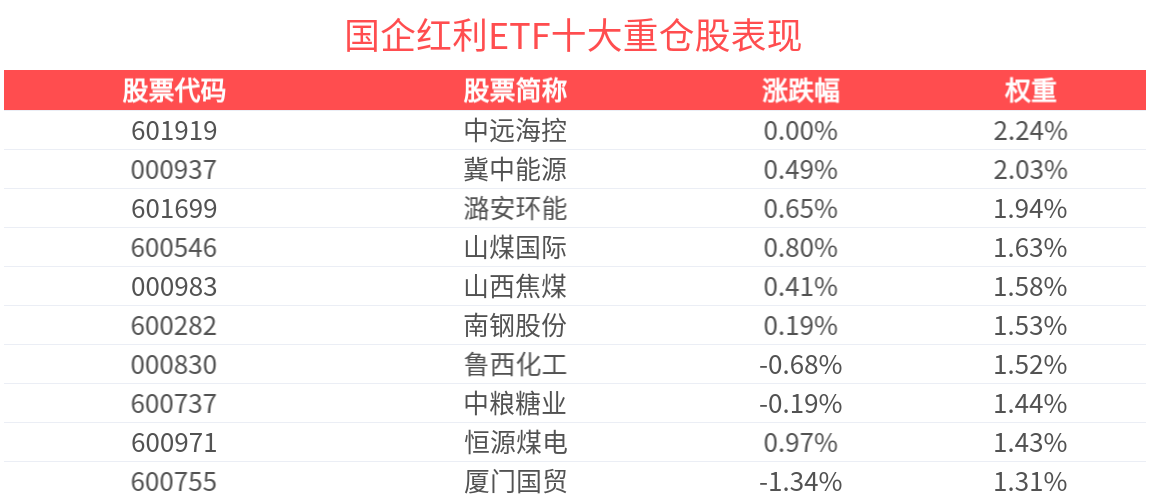
部分资金转向防御性布局推动红利板块维持相对强势,国企红利ETF(159515)调整蓄势
Sou Hu Cai Jing· 2025-11-05 02:28
Core Viewpoint - The performance of the China Securities State-Owned Enterprises Dividend Index (000824) has shown a slight decline, with a focus on dividend-paying stocks amid increased market volatility and a shift in investor behavior towards defensive strategies [1][2]. Group 1: Market Performance - As of November 5, 2025, the China Securities State-Owned Enterprises Dividend Index (000824) decreased by 0.01%, with leading stocks such as Shanghai Pudong Development Bank (600000) rising by 1.55% [1]. - The National Enterprise Dividend ETF (159515) experienced a turnover of 0.12% during the trading session, with a total transaction value of 55,100 yuan, while the average daily transaction value over the past week was 5.8418 million yuan [1]. Group 2: Sector Analysis - The technology growth sector has been experiencing fluctuations since the fourth quarter, leading to increased market volatility and a cautious approach from investors [1]. - There is a notable shift from aggressive investment strategies to defensive positioning, which has allowed the dividend sector to maintain a relatively strong performance [1]. Group 3: Policy and Long-term Outlook - Short-term analysis indicates that during periods of market fluctuation, the cost-effectiveness of dividend-style investments becomes more pronounced [1]. - Long-term policies, such as the new "National Nine Articles" and market capitalization management, are encouraging listed companies to distribute dividends, which is beneficial for state-owned enterprises in stabilizing dividend expectations and enhancing investor returns [1].