AGRICULTURAL BANK OF CHINA(601288)

Search documents
六大国有行官宣:今日起,实施!
券商中国· 2026-01-01 07:51
Core Viewpoint - Starting from January 1, 2026, six major state-owned banks in China will pay interest on the balances of real-name digital RMB wallets at the same rate as current deposit rates, marking China as the first economy to offer interest on central bank digital currency [1][2][5]. Group 1: Announcement from Major Banks - The six major state-owned banks include Industrial and Commercial Bank of China, Agricultural Bank of China, Bank of China, China Construction Bank, Bank of Communications, and Postal Savings Bank of China [1][3]. - The current interest rate for current deposits is 0.05% [3]. - Only real-name digital RMB wallets (categories one, two, and three) will earn interest, while category four wallets, which are non-real-name and used for anonymous payments, will not [3][4]. Group 2: Digital RMB Usage and Statistics - As of November 2025, digital RMB has processed 3.48 billion transactions with a total transaction amount of 16.7 trillion yuan [4]. - There are 230 million personal digital RMB wallets and 18.84 million unit wallets opened [4]. - The cross-border payment business using digital RMB has processed 4,047 transactions, amounting to approximately 387.2 billion yuan, with digital RMB accounting for about 95.3% of the transaction volume in various currencies [4]. Group 3: Expansion of Digital RMB Scenarios - The People's Bank of China has introduced an action plan to enhance the management and service system for digital RMB, which will officially start on January 1, 2026 [5]. - The plan allows banks to manage digital RMB wallet balances similarly to deposits, providing the same level of security as traditional deposits [5][6]. - The interest payment on digital RMB wallets is expected to increase user willingness to adopt digital RMB and expand its usage scenarios, reinforcing China's leading position in the global exploration of central bank digital currencies [5][6]. Group 4: Implications for Users and Banks - Users will benefit from interest on their digital RMB wallets, similar to current deposits, which is expected to enhance their holding willingness [6]. - The interest incentive and improved ecosystem will encourage more merchants to accept digital RMB, enriching payment scenarios [6]. - For commercial banks, digital RMB deposits can become a source of usable funds, enhancing their promotional efforts and allowing for the development of new financial products [6].








工、农、建、交、邮储,国有大行集体官宣!
Sou Hu Cai Jing· 2026-01-01 07:34
Core Viewpoint - Starting January 1, 2026, major Chinese banks will pay interest on the balances of real-name digital RMB wallets at the same rate as demand deposits, highlighting a shift towards enhancing financial security and real-name verification in digital currency usage [1] Group 1: Policy Changes - Industrial and Commercial Bank of China, Agricultural Bank of China, China Construction Bank, Bank of Communications, and Postal Savings Bank of China announced interest payments on real-name digital RMB wallets [1] - The interest calculation rules for these wallets will align with those of demand deposits [1] Group 2: Wallet Types and Regulations - The announcement specifies that certain types of wallets, particularly the four categories of non-real-name wallets, will not earn interest [1] - Non-real-name wallets require only a mobile phone verification for activation and are primarily used for small anonymous payments, while real-name wallets require varying degrees of identity verification [1] - The emphasis on wallet types and interest rules indicates a stronger regulatory focus on financial security and consumer awareness regarding wallet limits and safety [1]
多家国有银行发布公告,数字人民币余额按0.05%付息
Xin Lang Cai Jing· 2026-01-01 06:24
Core Viewpoint - The People's Bank of China (PBOC) announces the transition of digital RMB from the "digital cash era" to the "digital deposit currency era" after ten years of research and pilot programs [1] Group 1: Digital RMB Development - The PBOC's new action plan will officially implement on January 1, 2026, introducing a new measurement framework, management system, operational mechanism, and ecosystem for digital RMB [1] - Major banks including Industrial and Commercial Bank of China, Agricultural Bank of China, China Construction Bank, Bank of Communications, and Postal Savings Bank will start paying interest on digital RMB wallet balances at the same rate as current deposit rates from January 1, 2026 [1] Group 2: Interest Mechanism - The introduction of an interest mechanism for digital RMB wallet balances is a significant highlight of the new action plan, aligning it with traditional savings accounts [1]

六大国有银行,集体宣布
Sou Hu Cai Jing· 2026-01-01 05:16
Core Viewpoint - Starting from January 1, 2026, the six major state-owned banks in China will begin to pay interest on the balances in customers' real-name digital RMB wallets at the same rate as current deposit rates, which is currently set at 0.05% [1][2]. Group 1: Digital RMB Overview - Digital RMB is a legal digital currency issued by the People's Bank of China, applicable in various scenarios such as transportation, dining, shopping, and bill payments [3]. - The pilot program for digital RMB has expanded from select cities to provincial levels, including major municipalities and several provinces [3]. Group 2: Implementation Details - The People's Bank of China has released an action plan to enhance the management and service system for digital RMB, effective from January 1, 2026, which includes interest payments on wallet balances [3]. - Digital RMB will be included in the deposit insurance scheme, providing the same security guarantees as traditional deposits [3]. Group 3: Wallet Classification - Digital RMB wallets are classified into four categories based on the level of real-name verification, with categories one to three requiring more stringent identity verification than category four [4]. - The balance limits for different wallet categories are as follows: category one has no limit, category two is capped at 500,000 yuan, category three at 20,000 yuan, and category four at 10,000 yuan [4][5]. Group 4: Banking Institutions - Currently, ten commercial banks are authorized to open digital RMB wallets, including the six major state-owned banks and four other banks [6].
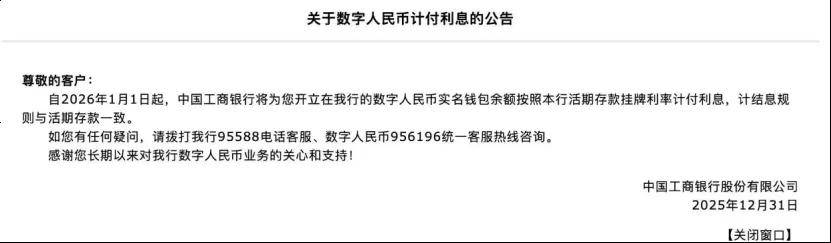
六大国有银行公告:数字人民币实名钱包余额明起计付利息
Sou Hu Cai Jing· 2026-01-01 04:42
Core Viewpoint - Starting January 1, 2026, several major banks in China, including Industrial and Commercial Bank of China, Agricultural Bank of China, Bank of China, China Construction Bank, Bank of Communications, and Postal Savings Bank, will offer interest on the balances of digital RMB real-name wallets at the same rate as current deposit rates [1] Group 1 - The interest calculation rules for digital RMB wallets will align with those of current deposits [1] - China Construction Bank's announcement specifies that four types of wallets are excluded from this interest policy [1] - Bank of Communications states that if a customer opens a type four personal digital RMB wallet, the balance will not earn interest [1]
多家国有大行,集体公告
Sou Hu Cai Jing· 2026-01-01 03:32
Core Viewpoint - Digital Renminbi will start accruing interest from January 1, 2026, as major banks in China announce plans to pay interest on the balances of digital Renminbi wallets at the same rates as regular savings accounts [1] Group 1: Bank Announcements - Industrial and Commercial Bank of China, Agricultural Bank of China, and China Construction Bank will begin paying interest on digital Renminbi wallet balances according to the current savings deposit rates starting January 1, 2026 [1] - Bank of Communications will also pay interest on digital Renminbi wallet balances, including various types of personal and corporate wallets, based on its announced savings deposit rates, while balances in certain wallet types will not earn interest [1] Group 2: Regulatory Framework - The People's Bank of China has introduced an action plan to enhance the management and service system for digital Renminbi, which will officially launch on January 1, 2026 [1] - The action plan specifies that banks must comply with self-discipline agreements regarding deposit interest rate pricing for customer digital Renminbi wallet balances [1]
2025银行股业绩梳理
2 1 Shi Ji Jing Ji Bao Dao· 2025-12-31 23:42
Core Viewpoint - The A-share banking sector experienced a year of volatility in 2025, with an overall increase of 7%, which is significantly lower than the 34.39% gain in 2024, yet many individual bank stocks reached historical highs [1][3]. Group 1: Market Performance - By the end of 2025, 35 out of 42 bank stocks in the sector recorded gains, with 20 banks hitting historical highs and 21 banks increasing by over 10%, while 6 banks saw gains exceeding 20% [1][6]. - Agricultural Bank of China saw a remarkable stock price increase of over 52% during the year, briefly surpassing Industrial and Commercial Bank of China (ICBC) in market capitalization [1][3]. - ICBC maintained its position as the "king of stocks" with a market capitalization of 2.63 trillion yuan and a stock price increase of 21.54% [1][3]. Group 2: IPO Market - The A-share IPO market for banks remained stagnant in 2025, with no new listings, as several banks, including Guangzhou Bank, withdrew their applications [2][11]. - The only banks still in the IPO queue are Dongguan Bank, Huzhou Bank, Hubei Bank, Jiangsu Kunshan Rural Commercial Bank, and Guangdong Nanhai Rural Commercial Bank [11]. Group 3: Investment Trends - Long-term funds, particularly insurance capital, have been actively purchasing bank stocks, with insurance companies holding 382.5 million shares valued at 37.976 billion yuan by the end of Q3 2025 [8]. - The "stock accumulation for dividends" strategy has gained popularity among investors, with 28 out of 42 listed banks offering dividend yields above 4% [7][8]. Group 4: Capital Support - In 2025, state-owned banks received significant capital injections, with a total of approximately 520 billion yuan raised through targeted placements to enhance their capital structure [10]. - Meanwhile, smaller banks attracted investments from foreign and local state-owned enterprises, although the IPO process remains challenging for most [10][11].
银行:银行2026年展望:稳中求进
2025-12-31 16:02
Summary of the Conference Call Transcript Industry Overview - The banking sector is entering a phase of high-quality development, with a focus on absolute and relative returns from bank stocks, driven by high dividend yields and asset quality [3][4][20]. Key Points Financial Performance Projections - Expected revenue growth for listed banks in 2026 and 2027 is +2.5% and +3.6% respectively, with net profit growth of +1.9% and +2.6% [4][20]. - Revenue and profit growth are anticipated to improve due to: 1. Narrowing net interest margin pressure 2. Quality-focused credit issuance amid weak demand [4][20]. 3. Stabilization of fee income growth after several years of fee reductions [4][20]. 4. Stable or improving net non-performing loan generation rates [4][11]. 5. Accelerated supply-side reforms leading to a reduction in the number of bank licenses, improving competition and operational landscape [4][11]. Customer Demand and Market Dynamics - The low-interest-rate environment has shifted customer demand, with government and state-owned enterprises becoming significant contributors to leverage, affecting the structure of new social financing [5][10]. - Regulatory policies are influencing the development of inclusive finance, focusing on risk compensation rather than merely increasing customer numbers [5][10]. Risk Factors - Risks associated with real estate developers and retail sectors are highlighted, with potential for greater-than-expected exposure [6][11]. Profitability and Valuation Adjustments - Adjustments to profitability forecasts for 2025 and 2026 have been made, with a focus on net interest income recovery and fee income growth [20][21]. - The expected net interest margin for 2026 is projected to be approximately 1.34%, a decrease of 6 basis points from 2025 [21][22]. - Fee income is expected to grow by 3.6% and 4.9% in 2026 and 2027 respectively, indicating a positive trend in non-interest income [21][22]. Asset Quality and Credit Costs - The net non-performing loan generation rate is expected to stabilize or slightly decline, with structural characteristics of retail and corporate lending continuing [11][21]. - Credit costs are projected to remain stable at around 0.58% for 2026 and 2027, reflecting the balance between corporate and household debt servicing capabilities [21][22]. Investment Recommendations - The report suggests a continued positive outlook for bank stocks, emphasizing the importance of dividend yield and asset quality in investment decisions [3][4][20]. Additional Insights - The banking sector is undergoing a transformation towards high-quality development, with a shift in focus from scale to quality, driven by macroeconomic pressures and regulatory changes [12][20]. - The reduction in the number of banking licenses over the past five years indicates successful risk management efforts within the sector [11][12]. - The report emphasizes the need for banks to adapt their strategies to maintain competitiveness in a changing regulatory and economic environment [12][20].

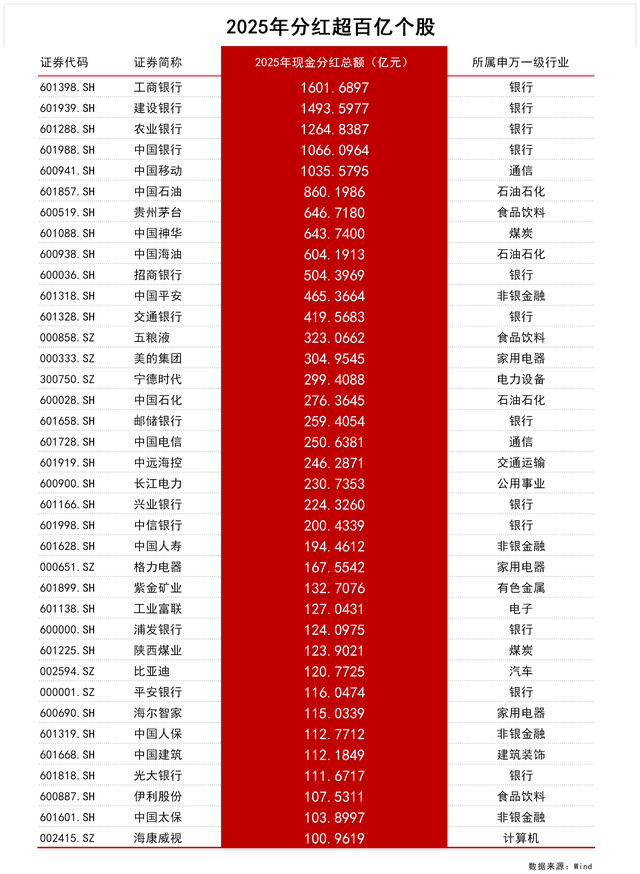
2025年A股上市公司分红超2.63万亿元 5股分红超千亿
Sou Hu Cai Jing· 2025-12-31 15:23
Core Insights - A total of 3,767 A-share listed companies have implemented cash dividends this year, amounting to over 2.63 trillion yuan [1] - The top 37 companies have distributed dividends exceeding 10 billion yuan, with the "Big Four" banks leading the list, each distributing over 100 billion yuan [1] Company Summaries - Industrial and Commercial Bank of China (ICBC) has the highest dividend payout at 160.17 billion yuan [2] - China Construction Bank follows with a dividend of 149.36 billion yuan [2] - Agricultural Bank of China and Bank of China have distributed dividends of 126.48 billion yuan and 106.61 billion yuan, respectively [2] - China Mobile ranks fifth with a dividend of 103.56 billion yuan [2] - Other notable companies in the top ten include China Petroleum, Kweichow Moutai, China Shenhua, China National Offshore Oil Corporation, and China Merchants Bank, all with dividends exceeding 50 billion yuan [1] Industry Distribution - The majority of companies distributing over 10 billion yuan in dividends are concentrated in the banking, telecommunications, and oil & petrochemical sectors [1]

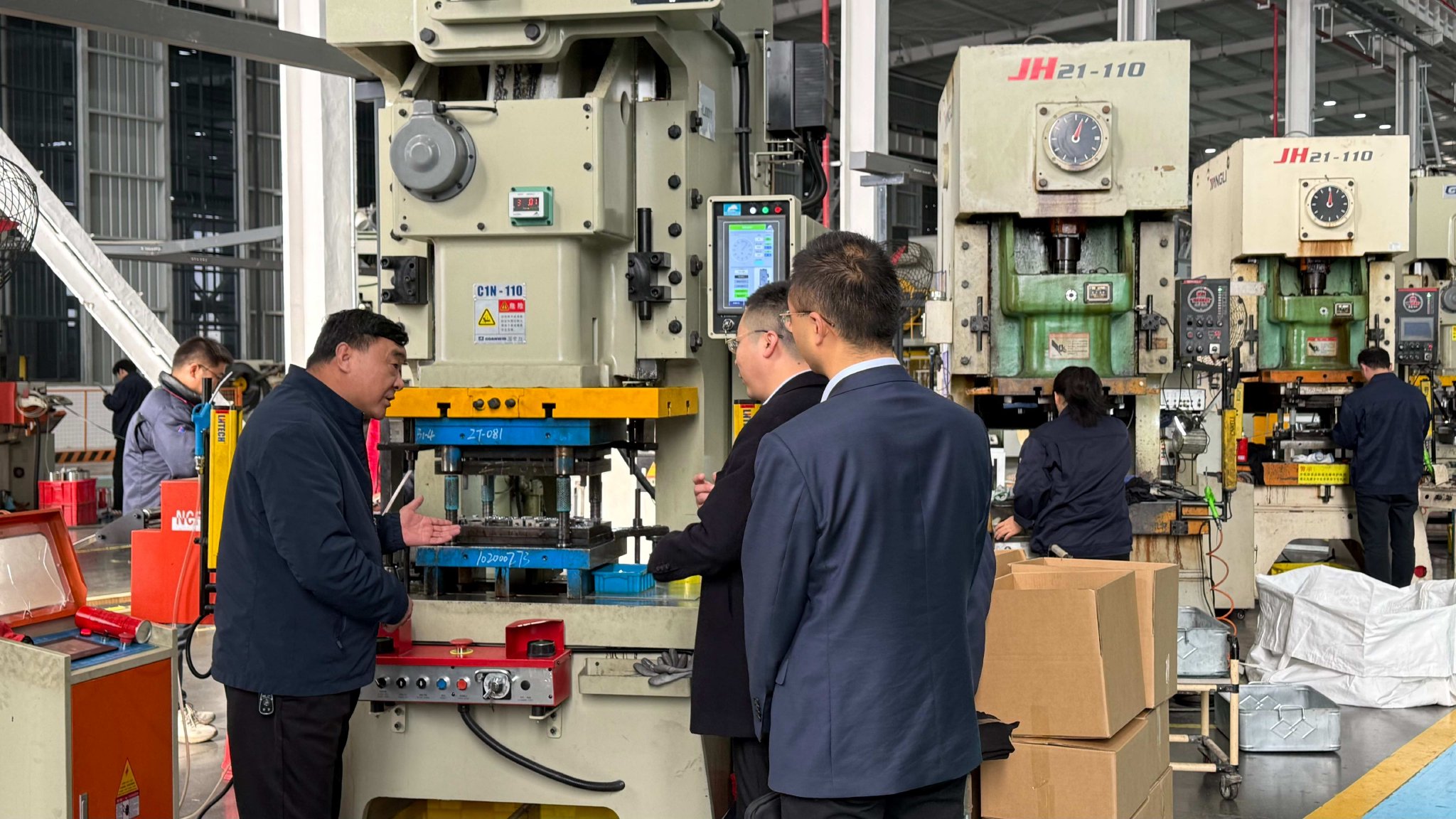
农行安徽分行:以科技金融之笔 绘就高质量发展新画卷
Zhong Guo Jin Rong Xin Xi Wang· 2025-12-31 14:11
转自:新华财经 近年来,中国农业银行安徽省分行(以下简称"农行安徽分行")以做好金融"五篇大文章"为抓手,深入贯彻落实国家创新驱动发展战略,对标安徽现代化产 业体系建设,制定实施"徽聚合力·农银助企"行动计划,通过运用产业金融服务平台,强化科技赋能,为新质生产力发展注入金融动能。截至2025年11月 末,该行战略性新兴产业贷款余额1759亿元,较2024年末增长404亿元;科技贷款余额722亿元,较2024年末增长193亿元。 在矿山智能化改造领域,农行淮南分行瞄准中感集团特码斯派克工业技术(安徽)有限公司(以下简称"特码斯派克")的行业突破性技术,量身定制金融服 务方案。2025年初,该行率先为企业提供票据金融服务,解决企业日常运营资金周转难题;随着企业规模扩大,又迅速对接信贷需求,于2025年9月成功发 放500万元短期流动资金贷款,为企业技术研发、市场拓展注入及时雨。目前,农行淮南分行正推进将其短期流动资金授信额度提升至1500万元的审批流 程,将以更大力度的金融支持,助力企业在矿山智能装备领域持续深耕。 在农行淮南分行的"精准滴灌"与大力支持下,目前,特码斯派克自主研发的"矿山智能换绳机器人成套装备" ...