AGRICULTURAL BANK OF CHINA(601288)

Search documents
二级资本债周度数据跟踪(20251222-20251226)-20251227
Soochow Securities· 2025-12-27 07:03
1. Report Industry Investment Rating - No information provided regarding the industry investment rating in the report 2. Core View of the Report - The report presents a weekly data tracking of secondary - capital bonds from December 22, 2025, to December 26, 2025, covering primary - market issuance, secondary - market trading, and valuation deviation of individual bonds [1] 3. Summary by Relevant Catalogs 3.1 Primary - Market Issuance - During the week from December 22, 2025, to December 26, 2025, 8 new secondary - capital bonds were issued in the inter - bank and exchange markets, with a total issuance scale of 53.15 billion yuan. The issuance term was 10 years, and the issuers included local state - owned enterprises, private enterprises, other enterprises, and central financial enterprises. The issuer regions were Sichuan, Zhejiang, Jiangsu, Beijing, and Hunan, and the subject ratings were AA +, AA -, A +, and AAA [1] 3.2 Secondary - Market Trading - **Trading Volume**: The total weekly trading volume of secondary - capital bonds was approximately 272.9 billion yuan, a decrease of 1 billion yuan compared to the previous week. The top three bonds in terms of trading volume were 25 Bank of China Secondary Capital Bond 03A(BC) (19.41 billion yuan), 25 China Construction Bank Secondary Capital Bond 03BC (9.691 billion yuan), and 25 Bank of China Secondary Capital Bond 01BC (8.304 billion yuan). By issuer region, the top three in trading volume were Beijing (about 217.1 billion yuan), Shanghai (about 19.3 billion yuan), and Guangdong (about 10 billion yuan) [2] - **Yield to Maturity**: As of December 26, for 5Y secondary - capital bonds, the yield - to - maturity changes of AAA -, AA +, and AA - rated bonds compared to the previous week were 1.19BP, 0.00BP, and 0.00BP respectively; for 7Y bonds, the changes were - 1.05BP, - 1.52BP, and - 1.52BP; for 10Y bonds, the changes were - 1.92BP, - 0.95BP, and - 0.95BP [2] 3.3 Valuation Deviation of Top 30 Individual Bonds - **Overall Situation**: The overall valuation deviation of the weekly average trading price of secondary - capital bonds was not significant. The proportion of discount transactions was less than that of premium transactions, but the discount magnitude was greater than the premium magnitude [3] - **Discount Bonds**: The top three bonds with the highest discount rates were 22 Shengjing Bank Secondary Capital Bond 01 (- 0.5385%), 24 Chang'an Bank Secondary Capital Bond 01 (- 0.4596%), and 25 Jilin Bank Secondary Capital Bond 01 (- 0.3868%). The Zhongzheng implied ratings were mainly AAA -, AA, and AA +, and the regions were mainly Beijing, Tianjin, and Guangdong [3] - **Premium Bonds**: The top three bonds with the highest premium rates were 23 Huaxing Bank Secondary Capital Bond 01 (0.3868%), 22 China Construction Bank Secondary Capital Bond 02B (0.2792%), and 23 Bank of China Secondary Capital Bond 01B (0.2319%). The Zhongzheng implied ratings were mainly AAA -, AA, and AA -, and the regions were mainly Beijing, Shanghai, and Sichuan [3]


“百千万工程”推进路上的坚实金融后盾——农行广东分行倾力服务“百千万工程”
2 1 Shi Ji Jing Ji Bao Dao· 2025-12-26 23:09
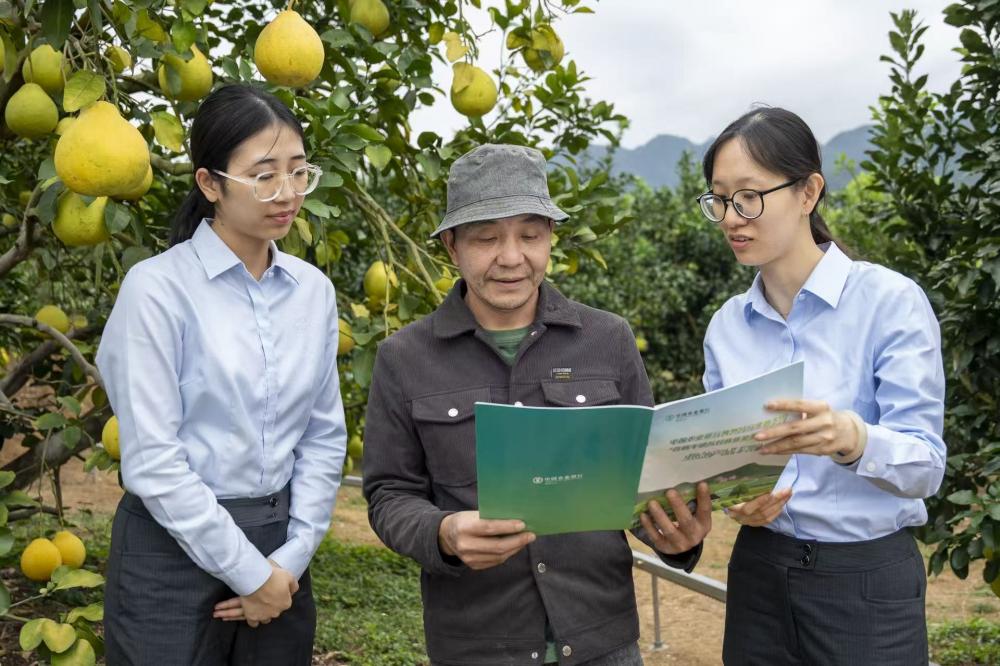
Core Viewpoint - The Agricultural Bank of China Guangdong Branch is actively supporting the "Hundred Counties, Thousand Towns, and Ten Thousand Villages High-Quality Development Project" in Guangdong, aiming to enhance rural revitalization through significant financial contributions and tailored services [1][11]. Financial Contributions - As of November 2025, the Agricultural Bank of China Guangdong Branch has provided over 600 billion yuan in county loans and over 500 billion yuan in agricultural loans, marking increases of 220 billion yuan and 170 billion yuan respectively since the project's initiation [1]. - The bank has been recognized as an "excellent" performer in financial services for rural revitalization for five consecutive years [1]. Service Framework - The bank has established a comprehensive service system to ensure financial resources are effectively allocated to rural areas, implementing four major actions focused on industrial revitalization, county empowerment, aesthetic enhancement, and quality improvement [3]. - A total of 20 specialized teams have been formed to support rural revitalization across 22 secondary branches and 18 primary branches in Guangzhou [3]. Collaborative Efforts - The bank has created a regular communication mechanism with provincial departments to align financial services with government initiatives, resulting in the issuance of 1 billion yuan in loans across 12 pilot counties [4]. - It has also engaged in cross-regional cooperation to support poverty alleviation and rural revitalization efforts in Guangxi and Guizhou [4]. Focus Areas for Investment - The bank prioritizes three key areas for credit allocation: industrial development, urban-rural construction, and farmer income enhancement [5]. - In the industrial development sector, loans for grain security have reached over 32 billion yuan, with a 38% increase since the beginning of the year [5]. - The bank has supported the cultural tourism sector with nearly 20 billion yuan in loans, benefiting over 1,500 enterprises [6]. Service Accessibility - The bank is enhancing service accessibility by establishing 200 rural revitalization service stations and deploying mobile service teams to underserved areas [7]. - A dedicated customer manager system has been implemented to ensure personalized financial services are available in every town [7]. Product Innovation - The bank has developed a diverse range of over 100 specialized financial products tailored to rural needs, including customized loans for specific agricultural sectors [8]. - It has also facilitated investments in local enterprises, such as a 360 million yuan investment in a county-level economic development fund [8]. Success Stories - The bank's financial support has significantly impacted local industries, such as the "Golden Pomelo" industry in Meizhou, which has generated nearly 10 billion yuan in annual output value [9]. - In Qingyuan, the meat pigeon industry has seen rapid growth, with the bank providing 50 million yuan in loans to local farmers [10]. Future Commitment - The Agricultural Bank of China Guangdong Branch is committed to continuing its support for the "Hundred Counties, Thousand Towns, and Ten Thousand Villages" initiative, aiming to provide more precise products, superior services, and ample resources to facilitate coordinated urban-rural development [11].

中国农业银行股份有限公司关于执行董事任职的公告
Xin Lang Cai Jing· 2025-12-26 19:01
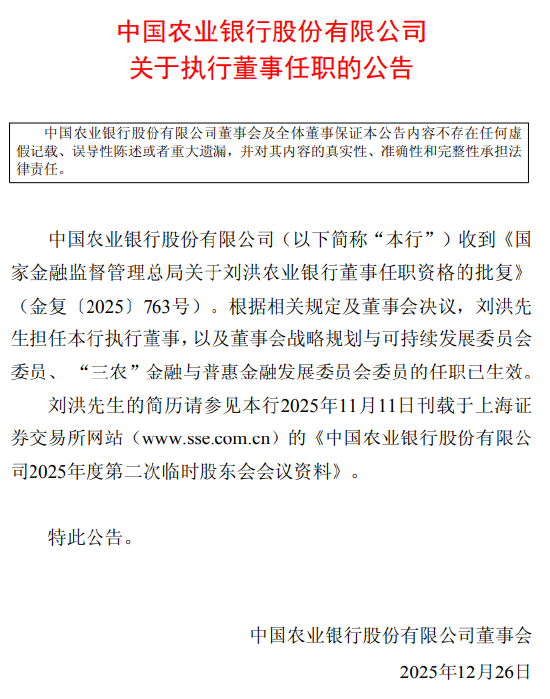
证券代码:601288 证券简称:农业银行 公告编号:临2025-059号 中国农业银行股份有限公司 关于执行董事任职的公告 刘洪先生的简历请参见本行2025年11月11日刊载于上海证券交易所网站(www.sse.com.cn)的《中国农 业银行股份有限公司2025年度第二次临时股东会会议资料》。 特此公告。 中国农业银行股份有限公司董事会 2025年12月26日 中国农业银行股份有限公司董事会及全体董事保证本公告内容不存在任何虚假记载、误导性陈述或者重 大遗漏,并对其内容的真实性、准确性和完整性承担法律责任。 中国农业银行股份有限公司(以下简称"本行")收到《国家金融监督管理总局关于刘洪农业银行董事任 职资格的批复》(金复〔2025〕763号)。根据相关规定及董事会决议,刘洪先生担任本行执行董事, 以及董事会战略规划与可持续发展委员会委员、 "三农"金融与普惠金融发展委员会委员的任职已生 效。 ...
1年近400家银行机构退出市场
21世纪经济报道· 2025-12-26 14:52
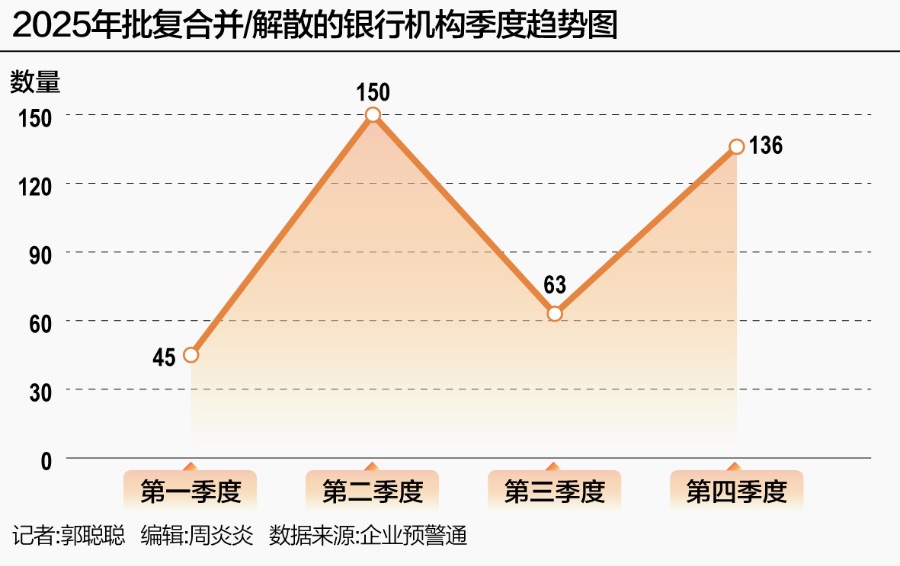
Core Viewpoint - The wave of mergers and restructuring among China's small and medium-sized banks has progressed with unexpected intensity and speed, focusing on financial risk prevention and high-quality industry development in 2025 [1][2]. Summary by Sections Mergers and Restructuring Overview - As of December 26, 2025, a total of 394 banking institutions have been approved for mergers or dissolutions, doubling the total from 2024 [1]. - Between 2024 and 2025, nearly 550 banking institutions were reduced through mergers and restructuring, surpassing the total from the previous seven years [1]. - The restructuring involved 28 provinces, with Inner Mongolia leading by integrating 139 institutions, followed by Shandong (33), Henan (26), and Sichuan (25) [1][9]. Characteristics of the Restructuring - The 2025 restructuring is characterized by two significant trends: the involvement of state-owned banks in "village-to-branch" transformations and the acceleration of provincial-level reforms in the rural credit system [2]. - This transformation is not merely a reduction in numbers but a comprehensive change across various types of institutions, moving towards a quality-driven development phase [2]. Regulatory and Policy Framework - The central financial work conference in 2024 emphasized the need to "properly handle risks in small financial institutions," placing them alongside local debts and real estate as key areas for financial risk prevention [4]. - The regulatory focus has been on risk prevention and resolution, with tailored reform plans developed for different regions [5]. Achievements and Progress - The reform efforts have led to a significant increase in the disposal of non-performing assets, with over a 40% increase compared to the previous five-year period [5]. - The number of high-risk small and medium-sized banks has significantly decreased, with some provinces achieving a "dynamic zero" for high-risk institutions [6]. Integration of Institutions - The integration process has seen state-owned banks actively participating in the restructuring of village banks, providing stronger support for their transformation [11]. - By the end of 2025, 231 village banks had merged or dissolved, with a notable acceleration in the second half of the year [12]. Future Outlook - The ongoing restructuring is expected to continue, with a focus on enhancing the quality and effectiveness of the integration process [17]. - The emphasis on "reducing quantity and improving quality" will remain a core theme in the upcoming years, as the industry transitions to a more stable and effective phase [17].

深度|银行业“瘦身”
2 1 Shi Ji Jing Ji Bao Dao· 2025-12-26 13:02
Core Insights - The wave of mergers and restructuring among China's small and medium-sized banks has progressed with unexpected intensity and speed, focusing on financial risk prevention and high-quality industry development as the core themes of the year [1][2]. Summary by Sections Mergers and Restructuring - As of December 26, 2025, a total of 394 banking institutions were approved to exit the market through mergers and dissolutions, doubling the total from 2024 [1][7]. - Between 2024 and 2025, nearly 550 banking institutions were reduced through mergers and restructuring, surpassing the total from the previous seven years [1]. - The restructuring involved 28 provinces, with Inner Mongolia leading by integrating 139 institutions, followed by Shandong (33), Henan (26), and others [1][9]. Characteristics of the Restructuring - The integration of small and medium-sized banks in 2025 is characterized by two significant trends: the involvement of state-owned banks in "village-to-branch" transformations and the acceleration of provincial-level reforms in the rural credit system [1][15]. - The core entities in the restructuring are village banks (231), followed by rural commercial banks (81) and rural credit cooperatives (71) [12]. Policy and Regulatory Framework - The central financial work conference in 2024 emphasized the need to "properly handle risks in small financial institutions," placing them alongside local debts and real estate as key areas for financial risk prevention [3]. - The regulatory focus during the "14th Five-Year Plan" period has been on risk prevention and resolution for small financial institutions, with a commitment to personalized reform strategies based on regional differences [4]. Achievements and Future Directions - Significant progress has been made in risk resolution, with over 40% more non-performing asset disposals compared to the previous five-year period, and the total capital and provisions in the industry exceeding 50 trillion yuan [5]. - The government work report for 2025 outlined a market-oriented and legal approach to risk resolution and transformation of local small financial institutions [5]. Service Upgrades and Market Dynamics - The restructuring is not merely a reduction in numbers but aims to enhance the quality and efficiency of financial services, particularly for rural and small enterprises [19][20]. - Merged institutions are expected to improve operational standards, risk resistance, and expand their service offerings through enhanced digital capabilities [19][20]. Long-term Outlook - The ongoing restructuring of small and medium-sized banks is anticipated to continue into 2026, with a focus on quality improvement and effective integration as the core theme [21].

农业银行(601288) - 农业银行关于执行董事任职的公告
2025-12-26 12:46
刘洪先生的简历请参见本行2025年11月11日刊载于上海证 券交易所网站(www.sse.com.cn)的《中国农业银行股份有限公 司2025年度第二次临时股东会会议资料》。 特此公告。 证券代码:601288 证券简称:农业银行 公告编号:临 2025-059 号 中国农业银行股份有限公司 关于执行董事任职的公告 中国农业银行股份有限公司董事会及全体董事保证本公告内容不存在任何虚 假记载、误导性陈述或者重大遗漏,并对其内容的真实性、准确性和完整性承担法 律责任。 中国农业银行股份有限公司(以下简称"本行")收到《国 家金融监督管理总局关于刘洪农业银行董事任职资格的批复》 (金复〔2025〕763号)。根据相关规定及董事会决议,刘洪先 生担任本行执行董事,以及董事会战略规划与可持续发展委员会 委员、 "三农"金融与普惠金融发展委员会委员的任职已生效。 中国农业银行股份有限公司董事会 2025年12月26日 1 ...
农业银行:刘洪担任执行董事及相关委员会委员
Xin Lang Cai Jing· 2025-12-26 12:43
12月26日金融一线消息,农业银行公告称,公司收到批复,刘洪担任公司执行董事,以及董事会战略规 划与可持续发展委员会委员、"三农"金融与普惠金融发展委员会委员的任职已生效。 简历信息显示,刘洪,1968 年 8 月出生,北京大学公共管理硕士, 高级经济师。2023 年 8 月任农业银 行副行长,2025 年 8 月起任农业银行党委副书记。曾任中国农业银行人力资源部副总经理, 办公室副 主任、中国城乡金融报社(二级部)社长兼总编, 监事会办公室主任,监事,青海省分行行长,机关 党委常务副书记、机关纪委书记,人力资源部/三农及普惠金融人力资源管理中心总经理,三农业务总 监。目前兼任中国金融教育发展基金会副理事长、全国党的建设研究会理事。 党委常务副书记、机关纪委书记,人力资源部/三农及普惠金融人力资源管理中心总经理,三农业务总 监。目前兼任中国金融教育发展基金会副理事长、全国党的建设研究会理事。 责任编辑:李琳琳 12月26日金融一线消息,农业银行公告称,公司收到批复,刘洪担任公司执行董事,以及董事会战略规 划与可持续发展委员会委员、"三农"金融与普惠金融发展委员会委员的任职已生效。 简历信息显示,刘洪,1968 ...
农业银行:刘洪担任公司执行董事及相关委员会委员
Xin Lang Cai Jing· 2025-12-26 12:32
农业银行公告称,公司收到批复,刘洪担任公司执行董事,以及董事会战略规划与可持续发展委员会委 员、"三农"金融与普惠金融发展委员会委员的任职已生效。刘洪简历可参见公司2025年11月11日刊载于 上交所网站的相关会议资料。 ...
金融“升维”:当好现代化产业体系的“增长伙伴”
经济观察报· 2025-12-26 12:23
Core Viewpoint - The article emphasizes the need for a profound financial transformation to support China's industrial upgrade towards an intelligent, green, and integrated modern industrial system, which is positioned as a top strategic task in the new "14th Five-Year Plan" [1][2][3]. Group 1: Industrial Development and Financial Integration - China is advancing its industrial system towards intelligent, green, and integrated development, achieving significant historical progress in scale, technological innovation, and enterprise competitiveness [1][2]. - The financial sector, particularly Agricultural Bank, plays a crucial role in supporting industrial development by providing tailored financial services that integrate deeply with industry needs [3][11]. Group 2: Innovative Financial Models - Traditional credit models have created barriers for technology-driven companies, which often lack physical assets for collateral, leading to financing challenges [5]. - Agricultural Bank has introduced a "technology flow" evaluation system that assesses companies based on their technological capabilities rather than traditional asset-based metrics, enabling precise financial support [6][8]. Group 3: Comprehensive Financial Support - The bank's approach has evolved from merely providing loans to becoming a partner in the entire lifecycle of a company's development, offering diverse financing solutions that adapt to changing business needs [10][11]. - Agricultural Bank has established a comprehensive service system that includes investment, loans, and advisory services, supporting over 80,000 technology enterprises [11][15]. Group 4: Systemic Integration and Ecosystem Building - The competition in modern industrial systems is fundamentally about the competition between ecosystems, necessitating a shift from single-point support to systemic integration and co-construction of industrial ecosystems [13]. - Agricultural Bank is actively building a collaborative financial ecosystem that connects technology, industry, and finance, facilitating the growth of key industrial chains and innovative enterprises [15].

关于2025深圳金融创新大赛拟获奖项目的公示
Xin Lang Cai Jing· 2025-12-26 12:21
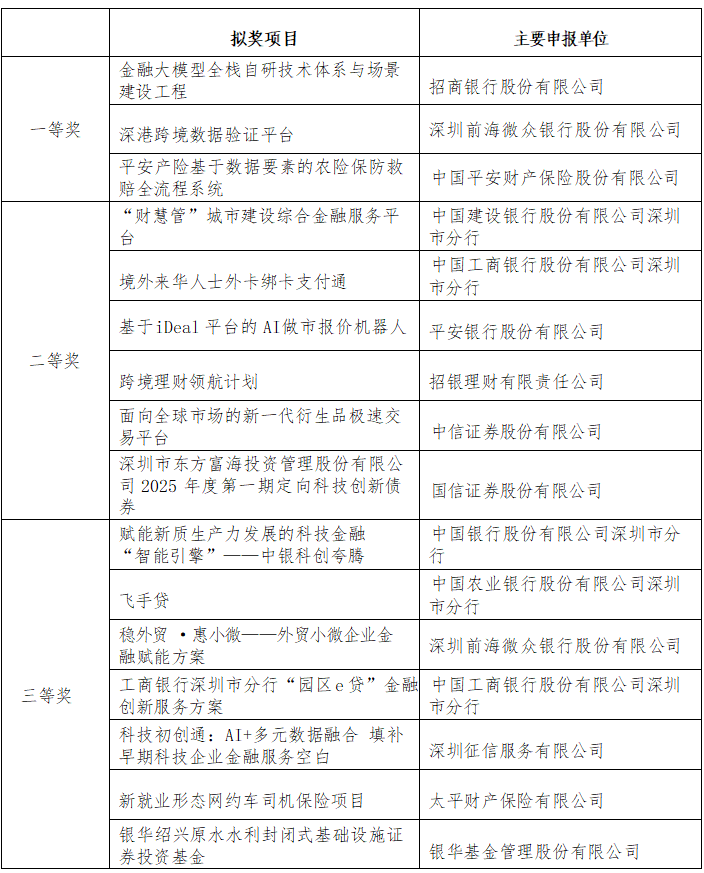
Core Viewpoint - The 2025 Shenzhen Financial Innovation Competition aims to enhance the financial services of local institutions and promote Shenzhen as a globally influential financial center, showcasing the innovation level of the financial industry in Shenzhen [1][4]. Summary by Category Competition Overview - The competition was announced in September 2025, receiving submissions from 113 units with a total of 173 projects [4]. - After various evaluation stages, 30 projects were selected for awards, including 3 first prizes, 6 second prizes, 12 third prizes, 3 most potential awards, 3 best growth awards, and 3 innovation breakthrough awards [4]. Awarded Projects - **First Prize Projects**: - Financial model full-stack self-research technology system and scenario construction project by China Merchants Bank and WeBank [6]. - Hong Kong-Shenzhen cross-border data verification platform [6]. - Agricultural insurance prevention and rescue system based on data elements by Ping An Property & Casualty Insurance [6]. - **Second Prize Projects**: - Cross-border wealth management navigation plan by China Merchants Bank Wealth Management [6]. - New generation derivative rapid trading platform for global markets by CITIC Securities [6]. - Technology financial empowerment plan for new quality productivity development by Bank of China Shenzhen Branch [6]. - **Third Prize Projects**: - AI and multi-data integration service for early-stage technology enterprises by Shenzhen Credit Service [6]. - New employment form ride-hailing driver insurance project by Taiping Property Insurance [6]. - **Most Potential Award Projects**: - "Housing Dream" project for large-scale urban village renovation by the National Development Bank Shenzhen Branch [7]. - New energy "technology + insurance" model construction by Ping An Property & Casualty Insurance Shenzhen Branch [7]. - **Best Growth Award Projects**: - New model for marine pastoral + insurance + N by Taiping Property Insurance [7]. - **Innovation Breakthrough Award Projects**: - "WeChat Quick Compensation" proactive claim model by Weimin Insurance Agency [7]. - Online self-service tax refund mini-program "Xing Shui Tong" by Guangdong Huaxing Bank Shenzhen Branch [7].