QDPI(601298)

Search documents
我国首套真空式自动系泊系统在青岛港投用
Xin Hua She· 2026-01-01 11:32
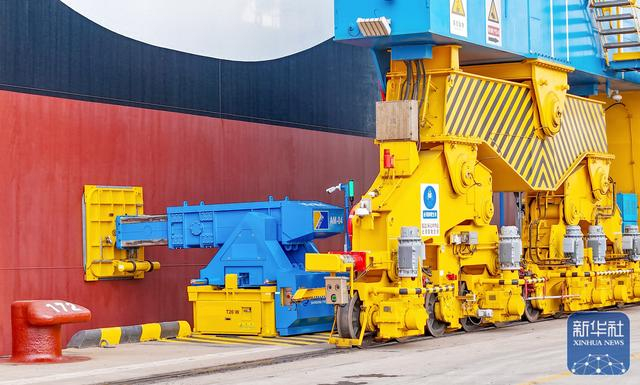
Core Viewpoint - The first vacuum automatic mooring system in China has been officially put into operation at the Qingdao Port in Shandong, significantly enhancing the efficiency of container ship mooring operations [2][4][6]. Group 1: System Overview - The vacuum automatic mooring system employs a three-tier intelligent control model consisting of remote centralized control, mobile terminals, and local single units [2]. - The system is equipped with 13 mooring units deployed at the berth, capable of automatically securing large container ships over 200 meters in length [2]. Group 2: Efficiency Improvements - The mooring time for a single ship has been drastically reduced from the traditional 20-30 minutes to under 30 seconds [2]. - This transition marks a significant leap from manual operations to automated intelligent operations in the mooring process [2].

中国首套真空式自动系泊系统在山东青岛投用
Zhong Guo Xin Wen Wang· 2026-01-01 10:26
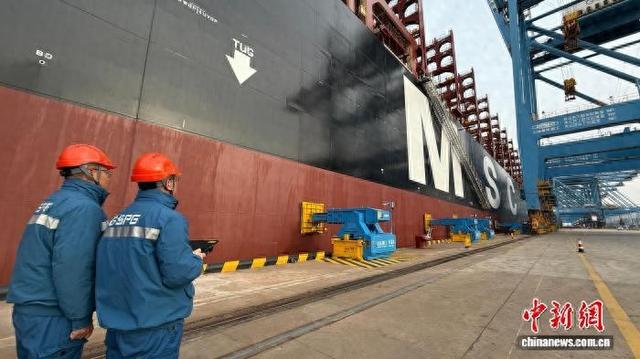
Core Viewpoint - The first vacuum automatic mooring system in China has been officially put into operation at Qingdao Port, marking a significant technological advancement in port operations [1][3]. Group 1: System Overview - The vacuum automatic mooring system is a breakthrough achievement of Qingdao Port's "Lian Steel Innovation Team," which redefines the mooring process and significantly reduces the mooring time from 20-30 minutes to under 30 seconds [3]. - The system consists of 13 mooring units that can generate an adhesion force of 2600 kilonewtons, capable of accommodating container ships over 200 meters in length [3]. Group 2: Technological Features - The system integrates multi-sensor fusion perception and intelligent decision-making algorithms, combining hydraulic drive, high negative pressure vacuum suction, and real-time motion tracking technologies [3]. - It features rapid mooring capabilities and can adapt to environmental changes such as wind, waves, and currents, establishing a comprehensive environmental monitoring system [3]. Group 3: Industry Impact - Qingdao Port is recognized as a leading comprehensive port globally and has established the only pilot base for artificial intelligence applications in the port sector in China [4]. - The port's automated terminal is the first fully domestically produced and autonomous automated terminal in China, as well as the first truly automated container terminal in Asia [4]. - The port aims to continue leading innovation in smart and green port construction, promoting the application of more cutting-edge technologies in the future [4].
中韩自贸区概念涨2.25%,主力资金净流入这些股
Zheng Quan Shi Bao Wang· 2025-12-31 09:29
Group 1 - The core viewpoint of the news is that the China-South Korea Free Trade Zone concept has seen a significant increase of 2.25%, ranking fourth among concept sectors, with 12 stocks rising, including Zhongchuang Logistics, which hit the daily limit, and Qingdao King, Huaguang Source Sea, and Langzi Co., which rose by 5.23%, 5.02%, and 4.55% respectively [1][2] - The main inflow of funds into the China-South Korea Free Trade Zone concept sector amounted to 102 million yuan, with nine stocks receiving net inflows, led by Qingdao King with a net inflow of 49.93 million yuan [2][3] - The top three stocks in terms of net inflow ratio are Zhongchuang Logistics at 40.76%, Qingdao King at 7.18%, and Qingdao Port at 6.67% [3][4] Group 2 - The concept sectors with the highest daily increases include Xiaohongshu concept at 2.88%, Kuaishou concept at 2.49%, and China Shipbuilding System at 2.30%, while sectors with declines include Silicon Energy at -1.03% and Organic Silicon concept at -0.99% [2] - The trading volume and turnover rates for the top stocks in the China-South Korea Free Trade Zone concept show that Zhongchuang Logistics had a turnover rate of 2.35% and Qingdao King at 13.07% [3][4] - Stocks that experienced declines include ST Xinhua Jin at -0.63% and Mingtai Aluminum at -0.47%, indicating some volatility within the sector [1][4]




六年七阶亿吨跃升:山东港口高质量发展“解码”
Qi Lu Wan Bao· 2025-12-29 08:24
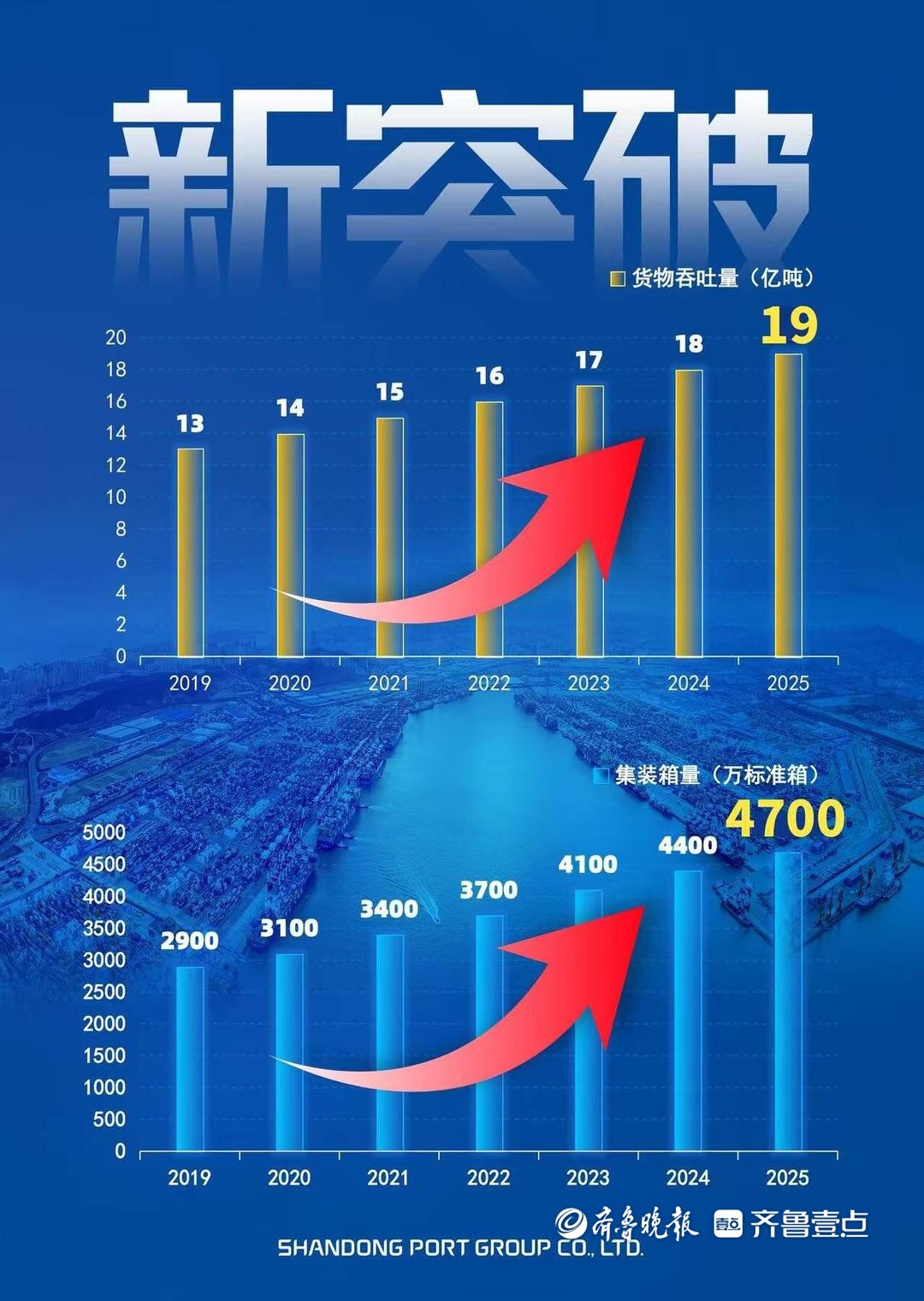
Core Insights - Shandong Port has achieved a remarkable milestone with cargo throughput exceeding 1.9 billion tons and container volume surpassing 47 million TEUs, solidifying its position as the world's largest and second-largest port respectively, showcasing high-quality development in the global shipping industry [1][11] Group 1: Structural Support Behind Growth - The rapid rise of Shandong Port is attributed to a combination of steady economic growth in the province, geographical advantages, integrated port collaboration, proactive supply chain service strategies, and continuous infrastructure investment [2][3] - Since its establishment in 2019, Shandong Port's cargo throughput has increased from nearly 1.3 billion tons to over 1.9 billion tons, and container volume has risen from approximately 30 million TEUs to 47 million TEUs, marking a cumulative increase of over 60% [2] Group 2: Economic and Geographical Advantages - Shandong's strategic location at the intersection of the Northeast Asia Economic Circle and the Bohai Economic Rim positions it as a crucial node for the Belt and Road Initiative and the most accessible maritime outlet for the Yellow River Basin [3] - The continuous improvement of Shandong's economy has become a fundamental driver for the port's throughput increase, providing stable cargo sources and optimizing cargo types [3] Group 3: Integrated Port Collaboration - Shandong Port has established an integrated and international development pattern, breaking down administrative barriers and regional limitations, which allows for resource sharing and collaborative operations among various ports [3][4] - The port's collaborative effect is a core element of its leap in development, enabling a shift from traditional "one port, one city" models to a more integrated and differentiated operational approach [3] Group 4: Supply Chain Service Transformation - Shandong Port is transitioning from a "single port operator" to a "comprehensive service provider," focusing on building a first-class supply chain service system that integrates logistics, commerce, finance, and information flows [4][10] - This transformation enhances the port's ability to support national strategies, regional economic development, and cost reduction for enterprises, thereby driving significant increases in cargo throughput and container volume [4] Group 5: Infrastructure Investment - Continuous and large-scale investments in infrastructure have been pivotal for Shandong Port's high-quality development, expanding berth capacity and improving berth standards to accommodate larger specialized vessels [5][4] - The port has established a robust infrastructure network, including numerous specialized terminals, which supports the handling of various cargo types and accounts for a significant portion of the province's foreign trade [5] Group 6: Structural Changes in Trade Dynamics - Shandong Port has experienced three structural changes: an increase in containerization rates, enhanced international transshipment capabilities, and a more developed multimodal transport system [8][9] - The rise in containerization reflects an increase in high-value goods, while the expansion of international routes and multimodal transport enhances the port's role as a key hub in global supply chains [8][9] Group 7: Global Trade and Regional Economic Impact - The growth of Shandong Port is expected to reshape global shipping resource allocation, enhance supply chain resilience, and solidify China's core position in the global shipping system [11][12] - The port's economic hinterland covers some of China's most active coastal regions and extends to the central and western provinces, facilitating efficient export channels for various goods and supporting high-quality development in both domestic and foreign trade [12]
从码头到云端,解码全国最大纸浆进口港的自动化之路
Qi Lu Wan Bao· 2025-12-29 08:11
Core Viewpoint - Qingdao Port has successfully developed the world's first fully automated pulp terminal, marking a significant advancement in the automation of breakbulk cargo operations, which have long been considered a challenging area in port automation [1][2][7]. Group 1: Automation Achievements - The automated pulp terminal is set to officially commence operations in July 2024, completing the full-process digital and intelligent operation system for all cargo types at Qingdao Port [1]. - The terminal features the "Beichen" system, which integrates information on ship types, cargo types, and stowage positions, utilizing AI to create dynamic 3D stowage maps, improving operational efficiency by over 20% [2][3]. - The automated unloading process has reduced the need for manual labor by approximately 80%, while overall operational efficiency has increased by 20% and energy consumption has decreased by 63% [4]. Group 2: Technological Innovations - The terminal employs innovative technologies such as automatic hook systems for pulp handling, which enhance safety and efficiency by minimizing human involvement [3][4]. - Unmanned IGV transport vehicles and autonomous telescopic forklifts are utilized for cargo movement, integrating advanced technologies like Beidou positioning, laser radar, and 5G communication for optimal path planning and obstacle avoidance [3][4]. - The development of the autonomous telescopic forklift involved overcoming significant challenges related to the non-standard nature of breakbulk cargo, achieving precise handling of over 40 different pulp sizes [5][6]. Group 3: Future Prospects - The automation of the pulp terminal is not an endpoint but a starting point for further advancements, with plans to enhance supply chain data integration and establish industry standards for breakbulk automation [7][8]. - Qingdao Port aims to strengthen its position as a global hub for pulp logistics, enhancing its influence in the port industry and striving to become the "mother port" for pulp unloading in China [8].
青岛港12月26日获融资买入737.72万元,融资余额1.04亿元
Xin Lang Cai Jing· 2025-12-29 04:45
Core Viewpoint - Qingdao Port's stock experienced a slight decline of 0.36% on December 26, with a trading volume of 89.55 million yuan, indicating a stable market presence despite minor fluctuations [1] Financing Summary - On December 26, Qingdao Port had a financing buy-in amount of 7.38 million yuan, with a net financing purchase of 2.67 million yuan after 4.71 million yuan in repayments, reflecting a healthy demand for its shares [1] - The total financing and securities balance for Qingdao Port reached 10.5 million yuan, with the financing balance accounting for 0.23% of its market capitalization, indicating a relatively high level compared to the past year [1] - The securities lending data showed no shares were repaid, with 3,800 shares sold short, amounting to 32,000 yuan, and a remaining short position of 67,700 shares, which is at the 90th percentile of the past year [1] Company Overview - Qingdao Port International Co., Ltd. was established on November 15, 2013, and listed on January 21, 2019, focusing on various cargo handling services including containers, metal ores, coal, and crude oil [2] - The company's revenue composition includes 56.72% from handling and related services, 36.96% from logistics and port value-added services, and smaller contributions from other port-related services [2] - As of September 30, 2025, Qingdao Port reported a revenue of 14.24 billion yuan, a year-on-year increase of 1.86%, and a net profit attributable to shareholders of 4.18 billion yuan, up 6.33% year-on-year [2] Dividend and Shareholder Information - Since its A-share listing, Qingdao Port has distributed a total of 13.77 billion yuan in dividends, with 6.64 billion yuan paid out over the last three years [3] - As of September 30, 2025, the number of shareholders increased by 7.23% to 38,300, with significant holdings by various institutional investors, including the Southern S&P China A-share Large Cap Dividend Low Volatility ETF [3]
青岛港上周获融资净买入1048.38万元,居两市第497位
Jin Rong Jie· 2025-12-29 01:03
Core Viewpoint - Qingdao Port has seen a net financing inflow of 10.48 million yuan last week, ranking 497th in the two markets, with a total financing amount of 40.50 million yuan and repayment of 30.02 million yuan [1] Financing and Investment Summary - Qingdao Port's financing net inflow last week was 10.48 million yuan, with a financing buy amount of 40.50 million yuan and a repayment amount of 30.02 million yuan [1] - Over the past 5 days, the main capital outflow from Qingdao Port was 21.58 million yuan, with a decline of 4.13% [1] - Over the past 10 days, the main capital outflow was 51.58 million yuan, with a decline of 4.43% [1] Company Overview - Qingdao Port International Co., Ltd. was established in 2013 and is located in Qingdao, primarily engaged in water transportation [1] - The company has a registered capital of 649.11 million yuan and a paid-in capital of 649.11 million yuan [1] - The legal representative of the company is Su Jianguang [1] Investment Activities - Qingdao Port International Co., Ltd. has invested in 63 enterprises and participated in 4,255 bidding projects [1] - The company holds 3 trademark registrations and 1,372 patent registrations, along with 103 administrative licenses [1]
山东港口2025年货物吞吐量超19亿吨
Zhong Guo Jin Rong Xin Xi Wang· 2025-12-27 10:03
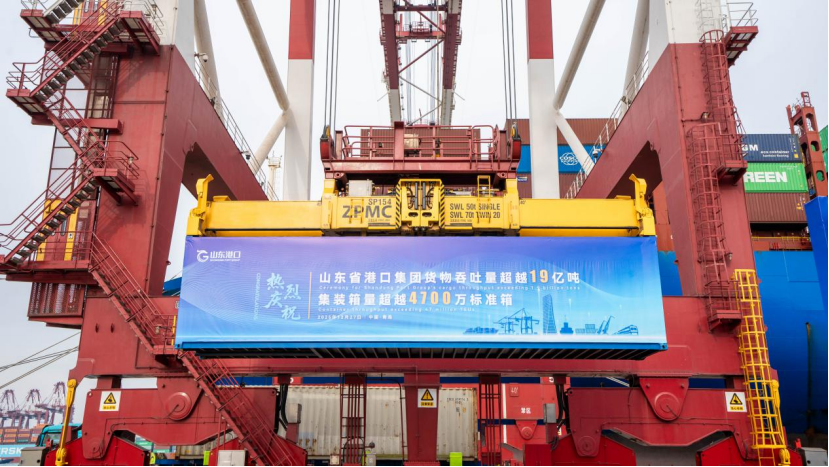
Core Insights - Shandong Port is set to exceed a cargo throughput of 1.9 billion tons and container volume of 47 million TEUs by 2025, significantly contributing to the coastal ports of Shandong Province leading the nation and surpassing the "14th Five-Year Plan" targets [1][4] Group 1: Performance Goals - The event highlighted Shandong Port's ambitious targets for 2025, including a container volume of 6 million TEUs for COSCO Shipping and over 3 million TEUs for CMA CGM [2] - The total number of shipping routes has reached 367, maintaining the leading position among northern ports, with inland ports and trains totaling 56 and 107 respectively [3] Group 2: Strategic Development - Shandong Port aims to integrate its development into national and provincial growth strategies, enhancing its core competitiveness, market influence, and risk resilience [3] - The port is focused on building a world-class marine port cluster and a comprehensive supply chain service system, which is expected to amplify its strategic role [4] Group 3: Innovation and Sustainability - The port has been approved as the only artificial intelligence base in the national port sector, promoting the development of a green fuel industry and accelerating digital and green transformation [3]
山东海洋生产总值年均增长8.4%
Qi Lu Wan Bao· 2025-12-26 12:13
Group 1: Marine Economy Development - Shandong has implemented the "Ten Major Actions" for building a strong marine province, achieving significant results in modern marine economic development, with an average annual growth of 8.4% in marine production value [1] - Seven industries, including marine fisheries and marine chemical industry, have the highest added value in the country [1] - Three national marine economic development demonstration zones have been established in Weihai, Qingdao Blue Valley, and Rizhao, along with 71 national-level marine ranch demonstration zones, leading the nation in both quantity and scale [1] - The province has set up 13 provincial-level marine characteristic industrial clusters, achieving an industrial agglomeration rate of 78% [1] - The shipbuilding and marine engineering equipment cluster in Qingdao, Yantai, and Weihai has been recognized as a national advanced manufacturing cluster [1] Group 2: Marine Science and Technology - Marine scientific achievements are accelerating, with the establishment of the Laoshan Laboratory and three major platforms: the National Deep Sea Gene Bank, Deep Sea Big Data Center, and Deep Sea Specimen Sample Museum [1] - Shandong has 50 national-level marine research institutions and innovation platforms, with 22 academicians in the marine field residing in the province, accounting for one-third of the national total [1] - In 2024, five marine-related achievements from Shandong are expected to receive the National Science and Technology Award, representing half of the national total [1] Group 3: Port Construction - Shandong leads the nation in marine port construction, having deepened the integration reform of coastal ports and established the Shandong Port Group, transforming from "a group of ports" to a "port cluster" [2] - The province has built the world's largest terminals for iron ore, crude oil, containers, liquefied natural gas, and cruise ships, along with the first smart green demonstration port for bulk dry cargo in Rizhao [2] - Container sea-rail intermodal transport volume has ranked first in the country for ten consecutive years, with Qingdao Port, Rizhao Port, and Yantai Port among the top ten coastal ports globally in terms of throughput [2]

再投超300亿,青岛西部新城真的来了
Xin Lang Cai Jing· 2025-12-26 02:27
Core Insights - The focus of the article is on the emerging growth area of Dongjiakou in Qingdao, driven by significant investments in port and railway infrastructure, which are expected to reshape the city's economic landscape and enhance its industrial capabilities [2][5][14]. Investment and Infrastructure Development - Qingdao Port announced a total investment of 15.7 billion yuan for two major terminal projects in Dongjiakou, including the construction of the eastern container terminal and a general cargo terminal [2]. - The Dongjiakou to Wulian Railway and the expansion of the Jiaoxin Railway have received preliminary design approvals, with a total investment of 17.577 billion yuan, indicating readiness for bidding and potential commencement within the year [2][7]. Port Capacity and Strategic Importance - Dongjiakou Port is already a major hub, with a projected throughput of 220 million tons in 2024, featuring the world's largest 400,000-ton ore terminal and a 300,000-ton oil terminal [6]. - The new container terminal, with an investment of 9.097 billion yuan, aims to alleviate congestion at the existing Qingdao Port, particularly for container handling [6]. - The general cargo terminal, with an investment exceeding 6.6 billion yuan, will support the transfer of various cargo types from adjacent ports, enhancing service for local industries [6]. Economic Zone Development - The Dongjiakou Economic Zone is positioned as a key area for industrial development, focusing on integrating port operations with industrial growth [11]. - The zone is expected to become a new industrial hub, with significant investments in high-end chemicals and food processing, including a notable project by Louis Dreyfus Company with an investment of approximately 7 billion yuan [12][13]. Future Growth and Urban Shift - The development of Dongjiakou is anticipated to shift Qingdao's urban focus westward, emphasizing industrial growth over population expansion [15]. - The successful resolution of transportation bottlenecks and the establishment of large-scale projects are expected to solidify Dongjiakou's role as a new growth engine for Qingdao [14].