PICC(601319)

Search documents
金十图示:2025年07月10日(周四)富时中国A50指数成分股午盘收盘行情一览:保险、石油、证券板块全线走高,银行板块多数飘红
news flash· 2025-07-10 03:45
Group 1: Market Overview - The FTSE China A50 Index components showed a positive trend with insurance, oil, and securities sectors rising significantly, while the banking sector also performed well [1][6]. Group 2: Sector Performance - The insurance sector, including companies like China Life and Ping An, saw increases in market capitalization, with China Life at 1,387.12 billion and Ping An at 1,036.22 billion, reflecting gains of 2.05% and 2.04% respectively [3]. - The oil sector, represented by Sinopec and PetroChina, also experienced growth, with Sinopec's market cap at 698.73 billion and PetroChina at 1,588.62 billion, both showing positive changes of 1.17% and 1.41% respectively [3]. - The semiconductor industry, including Northern Huachuang and Cambrian, faced slight declines, with Northern Huachuang down by 1.43% [3]. - The beverage sector, particularly Kweichow Moutai, reported a market cap of 1,780.16 billion, with a minor decrease of 0.13% [3]. Group 3: Trading Volume - Trading volumes varied across sectors, with the insurance sector leading with a total trading volume of 24.01 billion for Ping An, while the semiconductor sector had lower volumes, with Northern Huachuang at 9.73 billion [3][4]. - The automotive sector, represented by BYD, had a significant trading volume of 47.62 billion, indicating strong investor interest [3].








深圳罗湖给990栋“老房子”买了“养老保险”
2 1 Shi Ji Jing Ji Bao Dao· 2025-07-09 11:15
Core Viewpoint - The launch of the first batch housing safety insurance product in Shenzhen aims to provide comprehensive coverage for aging buildings, addressing risks such as structural collapse and personal injury from falling objects [1][2]. Group 1: Insurance Product Details - The insurance covers 990 aging buildings in the Luohu district, primarily those over 30 years old, with specific focus on the Huangbei and Donghu streets [1]. - The insurance service is a collaboration between the Luohu District Financial Services Office and China People's Property Insurance Shenzhen Branch, utilizing market mechanisms for regular inspections and assessments [1]. Group 2: "Fee Reform and Insurance" Model - The insurance initiative is part of the "Fee Reform and Insurance" model proposed by Luohu, which aims to shift from traditional government subsidies to direct insurance or premium subsidies for risk management [2]. - The model is designed to transform passive compensation into proactive monitoring, early warning, and remediation of potential hazards [2]. Group 3: Responsibilities of the Insurance Company - The insurance company will establish a professional inspection team and employ smart monitoring tools for comprehensive safety checks of insured properties [3]. - A dedicated insurance fund will be created to provide coverage for structural damage, third-party property loss, and personal injury due to accidents [3]. - An information management platform will be developed for online classification and management of properties, generating risk assessment reports to support government decision-making [3]. Group 4: Project Implementation and Scope - Luohu has identified 28 application scenarios and over 40 projects in the "Fee Reform and Insurance" domain, with nine projects already implemented [3]. - The district has a strong foundation for innovation in property insurance, with seven of the top ten property insurance companies in Shenzhen located in Luohu [2].
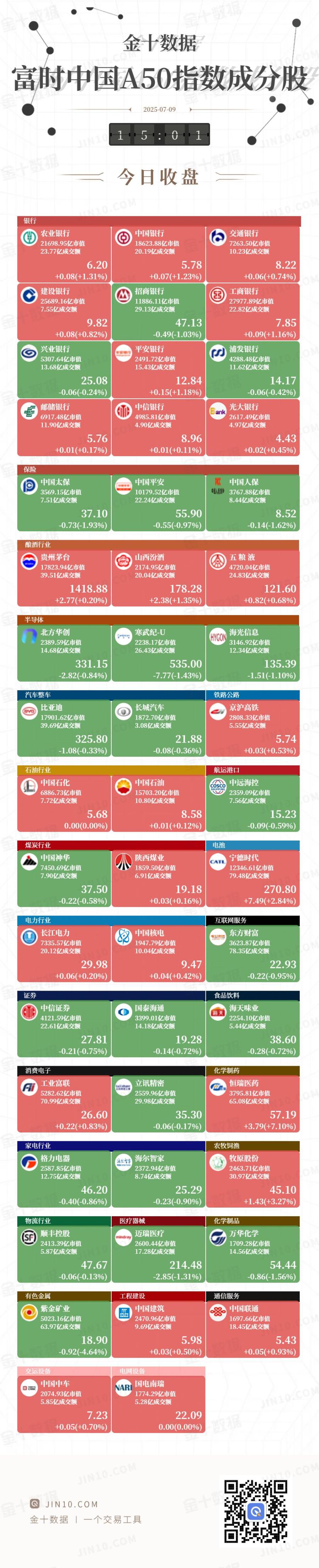
金十图示:2025年07月09日(周三)富时中国A50指数成分股今日收盘行情一览:酿酒板块全天走高,半导体板块午后全数转跌
news flash· 2025-07-09 07:07
Market Overview - The FTSE China A50 Index components showed varied performance, with the liquor sector rising throughout the day while the semiconductor sector experienced a decline in the afternoon [1] Insurance Sector - China Life Insurance, China Pacific Insurance, and Ping An Insurance had market capitalizations of CNY 376.78 billion, CNY 356.91 billion, and CNY 1,017.95 billion respectively, with trading volumes of CNY 0.75 billion, CNY 2.22 billion, and CNY 0.84 billion [3] - The stock prices changed as follows: China Life Insurance decreased by CNY 0.73 (-1.93%), China Pacific Insurance decreased by CNY 0.55 (-0.97%), and Ping An Insurance decreased by CNY 0.14 (-1.62%) [3] Liquor Industry - Kweichow Moutai, Shanxi Fenjiu, and Wuliangye had market capitalizations of CNY 1,782.39 billion, CNY 217.50 billion, and CNY 472.00 billion respectively, with trading volumes of CNY 3.95 billion, CNY 2.00 billion, and CNY 2.48 billion [3] - Stock price changes included Kweichow Moutai increasing by CNY 2.38 (+1.35%), Shanxi Fenjiu increasing by CNY 0.82 (+0.68%), and Wuliangye increasing by CNY 2.77 (+0.20%) [3] Semiconductor Sector - Northern Huachuang, Cambricon Technologies, and Hygon had market capitalizations of CNY 238.96 billion, CNY 223.82 billion, and CNY 314.69 billion respectively, with trading volumes of CNY 1.47 billion, CNY 1.23 billion, and CNY 2.64 billion [3] - The stock prices changed as follows: Northern Huachuang decreased by CNY 7.77 (-1.43%), Cambricon Technologies decreased by CNY 1.51 (-1.10%), and Hygon decreased by CNY 2.82 (-0.84%) [3] Automotive Sector - BYD, Great Wall Motors, and Beijing-Shanghai High-Speed Railway had market capitalizations of CNY 187.27 billion, CNY 1,790.16 billion, and CNY 280.83 billion respectively, with trading volumes of CNY 3.97 billion, CNY 0.31 billion, and CNY 0.56 billion [3] - Stock price changes included BYD decreasing by CNY 1.08 (-0.33%), Great Wall Motors decreasing by CNY 0.08 (-0.36%), and Beijing-Shanghai High-Speed Railway increasing by CNY 0.03 (+0.53%) [3] Shipping and Oil Sector - COSCO Shipping Holdings, Sinopec, and PetroChina had market capitalizations of CNY 235.91 billion, CNY 688.67 billion, and CNY 1,570.32 billion respectively, with trading volumes of CNY 0.77 billion, CNY 1.08 billion, and CNY 0.76 billion [3] - The stock prices changed as follows: COSCO Shipping Holdings remained unchanged, Sinopec decreased by CNY 0.09 (-0.59%), and PetroChina increased by CNY 0.01 (+0.12%) [3] Coal and Battery Sector - China Shenhua, Shaanxi Coal and Chemical Industry, and CATL had market capitalizations of CNY 185.95 billion, CNY 745.07 billion, and CNY 1,234.66 billion respectively, with trading volumes of CNY 0.79 billion, CNY 0.69 billion, and CNY 7.95 billion [3] - Stock price changes included China Shenhua increasing by CNY 7.49 (+2.84%), Shaanxi Coal and Chemical Industry decreasing by CNY 0.22 (-0.58%), and CATL increasing by CNY 0.03 (+0.16%) [3] Other Sectors - Various sectors such as food and beverage, electronics, and pharmaceuticals showed mixed performance in terms of market capitalization and stock price changes [4]




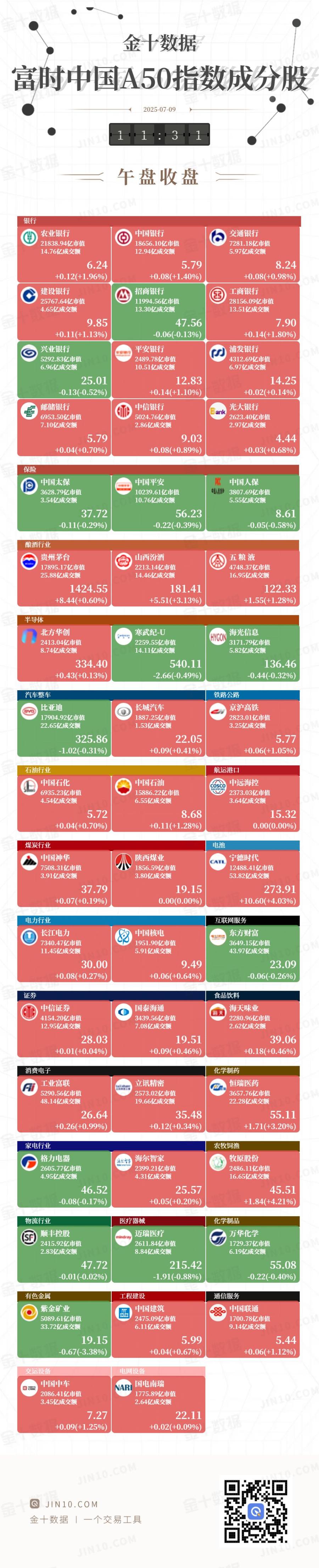
金十图示:2025年07月09日(周三)富时中国A50指数成分股午盘收盘行情一览:银行板块多数走高,半导体板块涨跌不一
news flash· 2025-07-09 03:34
Financial Sector - The banking sector showed a general upward trend with notable performances from major banks such as China Life Insurance and Ping An Insurance, with market capitalizations of 380.77 billion and 1,023.96 billion respectively [4] - China Life Insurance experienced a slight decline of 0.29% while Ping An Insurance decreased by 0.58% [4] Semiconductor Sector - The semiconductor sector displayed mixed results, with North Huachuang's market capitalization at 241.30 billion and a decrease of 0.32% [4] - Cambrian's stock price increased slightly by 0.13%, while Haiguang Information saw a decline of 0.49% [4] Automotive Sector - The automotive sector, led by BYD with a market capitalization of 1,790.49 billion, experienced a minor decline of 0.31% [4] - Great Wall Motors and China Railway High-speed also showed slight increases of 0.41% and 1.05% respectively [4] Energy Sector - In the energy sector, China Petroleum and China Petrochemical had market capitalizations of 1,588.62 billion and 693.52 billion respectively, with China Petroleum increasing by 1.28% [4] - China Shipping Development remained stable with no change [4] Coal Industry - The coal industry saw Shaanxi Coal and China Shenhua with market capitalizations of 750.83 billion and 185.66 billion respectively [4] - China Shenhua's stock price increased by 4.03% while Shaanxi Coal remained unchanged [4] Food and Beverage Sector - The food and beverage sector included major players like Haitian Flavor Industry with a market capitalization of 228.10 billion, which increased by 0.46% [5] - Other companies in this sector showed stable performances with minor fluctuations [5] Electronics and Pharmaceuticals - The electronics sector, represented by Hon Hai Precision Industry, had a market capitalization of 365.78 billion and a slight increase of 0.34% [5] - In pharmaceuticals, Hengrui Medicine's market capitalization was 529.06 billion, with a notable increase of 0.99% [5] Logistics and Medical Devices - The logistics sector, led by SF Holding, had a market capitalization of 2,415.92 billion, experiencing a decline of 0.88% [5] - In medical devices, Mindray Medical's market capitalization was 172.94 billion, with a minor decrease of 0.02% [5] Metals and Construction - The non-ferrous metals sector included Zijin Mining with a market capitalization of 247.51 billion, which saw a decline of 3.38% [5] - China State Construction had a market capitalization of 1,700.78 billion, with a slight increase of 0.67% [5]



2025上半年保险公司罚款1.8亿:10张百万罚单,2家许可证被吊销,28人终身禁业,11人撤职!
13个精算师· 2025-07-08 14:29
Core Viewpoint - In the first half of 2025, the insurance industry faced significant regulatory scrutiny, with a total of 97 companies fined 180 million yuan, highlighting an increase in large penalties and accountability measures against responsible individuals [1][6][13]. Regulatory Actions - The Financial Regulatory Bureau directly penalized six companies, resulting in over 1305 fines totaling more than 172 million yuan [13][39]. - Two companies, Tianan Insurance and Tianan Life, had their business licenses revoked, and multiple executives faced lifetime bans from the industry [14][22]. - A total of 28 individuals received lifetime bans, while 11 were dismissed from their positions, with 10 fines exceeding one million yuan each [24][31]. Industry Performance - The insurance sector experienced a slowdown in premium growth due to previous product suspensions and a shift in focus away from "New Year" sales strategies [8][11]. - By the end of May 2025, the original insurance premium growth rate for life insurance companies had increased by nearly 8 percentage points compared to the beginning of the year [11]. Financial Trends - The industry is transitioning towards products that offer "minimum guaranteed returns plus floating income" in response to ongoing interest rate declines [9][10]. - The total number of fines issued by local regulatory branches reached 778, accounting for 39% of the total fines imposed on insurance companies [39][40]. Accountability Measures - The regulatory environment has intensified, with a clear emphasis on personal accountability, as evidenced by the significant number of individuals facing penalties and bans [32][31]. - The trend of increasing penalties and the revocation of business licenses for insurance companies is a rare occurrence, indicating a shift in regulatory enforcement [23][22].


为近千栋“高龄”房屋上保险!深圳首单落地罗湖
Nan Fang Du Shi Bao· 2025-07-08 11:27
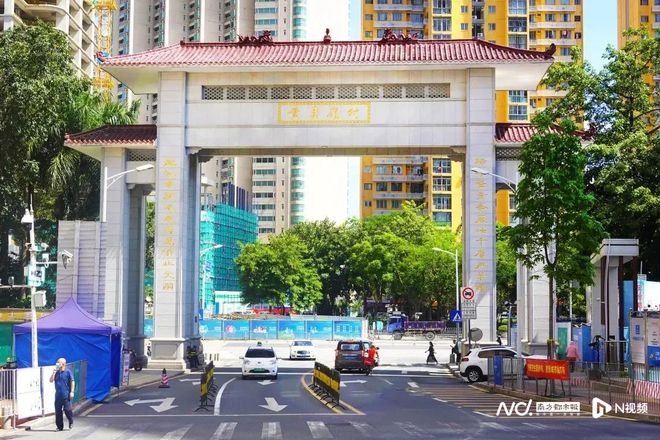
Core Viewpoint - The introduction of a bulk insurance scheme for aging houses in Shenzhen's Luohu District aims to enhance safety management and reduce costs through a combination of insurance, technology, and safety inspections [1][3]. Group 1: Insurance Scheme Details - The pilot program covers over 990 aging houses in the Donghu and Huangbei streets, with Huangbei street alone insuring 757 houses, most of which are over 30 years old and present various safety risks [3][4]. - The annual insurance cost for these aging houses is 300,000 yuan, which includes safety inspection services, compensation for property loss due to structural collapse, personal injury, and damages from falling objects [3][4]. Group 2: Risk Management Approach - The traditional management model relies heavily on grassroots inspections, which often leads to delayed identification of hazards and increased government liability in case of accidents. The new "fee-for-insurance" model shifts the focus from post-incident compensation to proactive risk management [3][4]. - Insurance companies and third-party service providers will conduct regular inspections and checks on key properties, especially during extreme weather events, enhancing the timeliness of hazard detection [3][4]. Group 3: Insurance Company Responsibilities - Under the new mechanism, insurance companies will perform three core functions: forming a professional inspection team, establishing a compensation mechanism for property and personal losses, and creating an online management platform for risk assessment [4]. - The initiative is part of a broader effort in Luohu District to innovate insurance practices, with 28 application scenarios and over 40 projects identified, leading to the implementation of nine projects so far [4].
金十图示:2025年07月08日(周二)富时中国A50指数成分股今日收盘行情一览:酿酒、石油板块全天走高,银行板块午后维持分化走势
news flash· 2025-07-08 07:11
Market Overview - The FTSE China A50 Index components showed a mixed performance with the liquor and oil sectors rising throughout the day, while the banking sector exhibited a divergent trend in the afternoon [1][6]. Liquor Industry - Major companies in the liquor sector include Kweichow Moutai with a market capitalization of 1,778.91 billion, Shanxi Fenjiu at 214.59 billion, and Wuliangye at 468.82 billion. Their respective trading volumes were 2.643 billion, 1.107 billion, and 1.405 billion [3]. - Kweichow Moutai's stock price increased by 5.41 (+0.38%), Shanxi Fenjiu rose by 3.41 (+1.98%), and Wuliangye gained 0.87 (+0.73%) [3]. Oil Industry - Key players in the oil sector include China Petroleum & Chemical Corporation (Sinopec) with a market cap of 1,568.49 billion, China National Offshore Oil Corporation (CNOOC) at 688.67 billion, and China National Petroleum Corporation (CNPC) at 237.30 billion. Their trading volumes were 857 million, 571 million, and 777 million respectively [3]. - Sinopec's stock price increased by 0.04 (+0.47%), while CNOOC rose by 0.03 (+0.53%) and CNPC decreased by 0.09 (-0.58%) [3]. Semiconductor Industry - The semiconductor sector includes North China Innovation at 240.99 billion, Cambricon Technologies at 227.07 billion, and Hygon Information Technology at 318.20 billion. Their trading volumes were 1.290 billion, 2.143 billion, and 1.375 billion respectively [3]. - North China Innovation's stock price rose by 1.29 (+0.39%), Cambricon Technologies increased by 1.39 (+0.26%), and Hygon gained 0.87 (+0.64%) [3]. Automotive Industry - Major automotive companies include Great Wall Motors with a market cap of 187.95 billion, BYD at 1,796.10 billion, and China Railway High-speed at 279.37 billion. Their trading volumes were 3.825 billion, 273 million, and 519 million respectively [3]. - Great Wall Motors' stock price decreased by 1.71 (-0.52%), BYD fell by 0.03 (-0.14%), while China Railway High-speed increased by 0.01 (+0.18%) [3]. Power Industry - The power sector features China Yangtze Power with a market cap of 1,939.56 billion and China Nuclear Power at 83 billion. Their trading volumes were 3.220 billion and 8.05 billion respectively [4]. - China Yangtze Power's stock price decreased by 0.34 (-1.12%), while China Nuclear Power fell by 0.05 (-0.53%) [4]. Internet Services - Key players in the internet services sector include Dongfang Caifu with a market cap of 732.09 billion and a trading volume of 96.34 billion [4]. - Dongfang Caifu's stock price increased by 0.40 (+1.76%) [4]. Food and Beverage Industry - The food and beverage sector includes Haitian Flavoring with a market cap of 227.05 billion and trading volumes of 3.38 billion [4]. - Haitian Flavoring's stock price increased by 0.28 (+0.73%) [4]. Consumer Electronics - Major companies in the consumer electronics sector include Industrial Fulian with a market cap of 523.89 billion and Luxshare Precision at 256.43 billion. Their trading volumes were 74.83 billion and 31.19 billion respectively [4]. - Industrial Fulian's stock price rose by 2.40 (+10.01%), while Luxshare Precision increased by 0.61 (+1.76%) [4]. Chemical Industry - The chemical sector features Wanhua Chemical with a market cap of 263.50 billion and a trading volume of 11.61 billion [4]. - Wanhua Chemical's stock price increased by 1.00 (+1.84%) [4]. Logistics Industry - Key players in the logistics sector include SF Holding with a market cap of 173.63 billion and a trading volume of 20.29 billion [4]. - SF Holding's stock price increased by 0.92 (+0.43%) [4].



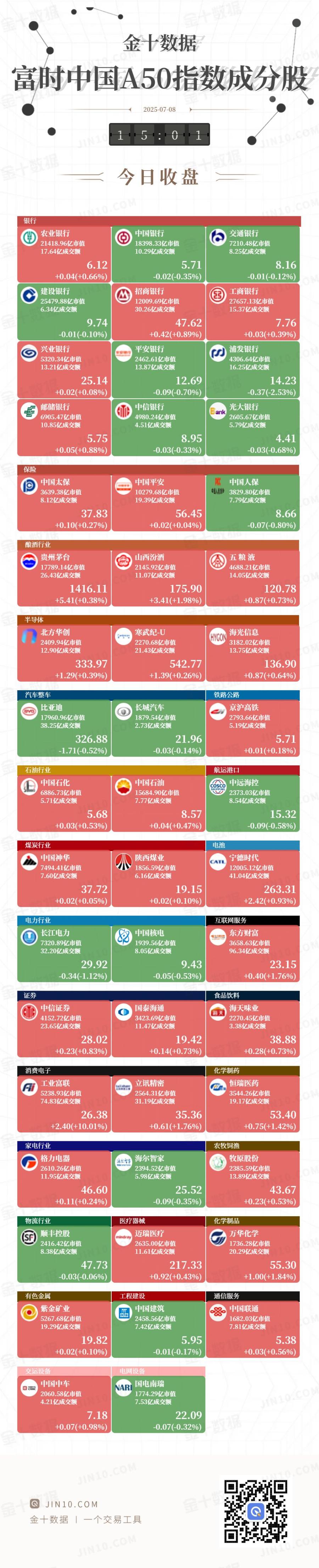
金十图示:2025年07月08日(周二)富时中国A50指数成分股午盘收盘行情一览:酿酒、石油板块全线走高,银行、汽车板块涨跌不一
news flash· 2025-07-08 03:35
Industry Performance - The FTSE China A50 Index components showed a mixed performance with the liquor and oil sectors rising, while the banking and automotive sectors experienced varied movements [1][6]. - The liquor industry saw significant market capitalizations with Kweichow Moutai at 1,780.28 billion, Wuliangye at 213.86 billion, and Shanxi Xinghuacun Fen Wine at 468.01 billion [3]. - The oil sector also performed well, with China Petroleum at 1,572.15 billion and China National Offshore Oil at 237.46 billion [3]. Company Highlights - China Pacific Insurance reported a market capitalization of 1,200 billion with a trading volume of 5.62 million [3]. - North Huachuang in the semiconductor sector had a market cap of 239.77 billion, while Cambrian Technology reached 226.87 billion [3]. - Gree Electric Appliances and Haier Smart Home in the home appliance sector had market caps of 262.43 billion and 236.16 billion respectively [4]. Trading Volumes - The trading volume for Kweichow Moutai was 15.53 million, while Wuliangye had 6.50 million [3]. - In the semiconductor sector, North Huachuang had a trading volume of 7.22 million, and Cambrian Technology had 11.30 million [3]. - The trading volume for Gree Electric Appliances was 7.15 million, and Haier Smart Home was 3.24 million [4].

2025一季度车险榜&非车险榜:平安增速快,泰康、众安等车险增速超20%,众安、京东等非车增速连续3年超10%
13个精算师· 2025-07-07 14:51
Core Viewpoint - The insurance industry is experiencing a shift with the "old three" insurance companies maintaining their market share in the auto insurance sector while new entrants are rapidly growing in the non-auto insurance market [11][21][36]. Auto Insurance Premium Rankings - In Q1 2025, the top three auto insurers, namely People's Insurance, Ping An, and Taiping, have increased their insured vehicles by over 2% compared to the previous year [21][25]. - The overall auto insurance premium income for the industry reached 515.5 billion, with a notable increase in premium growth driven by consumer incentives and rising vehicle sales [11][21]. - New entrants like BYD Insurance have shown significant growth, with a premium of 740 million, ranking 22nd in the market, benefiting from low commission rates and high payout ratios [35][36]. Non-Auto Insurance Premium Rankings - Ping An's non-auto insurance premium growth exceeded 14%, while companies like Zhong An and Tai Kang have maintained over 10% growth for three consecutive years [36][37]. - The non-auto insurance market is seeing a competitive landscape where new players are closing in on the traditional leaders, indicating a shift in market dynamics [11][36]. Market Trends - The auto market is benefiting from government incentives such as "trade-in" subsidies, leading to a 16.1% increase in passenger car production and a 12.9% increase in sales in Q1 2025 [21][24]. - The overall premium income for the insurance industry in Q1 2025 was 2,246.8 billion, reflecting a 3.03% growth year-on-year [21][36]. - The competition in the auto insurance sector is intensifying, with 32 companies reporting premium growth exceeding the market average, primarily among smaller firms [31][32].
百万医疗险,内卷中求增长
Hu Xiu· 2025-07-07 12:38
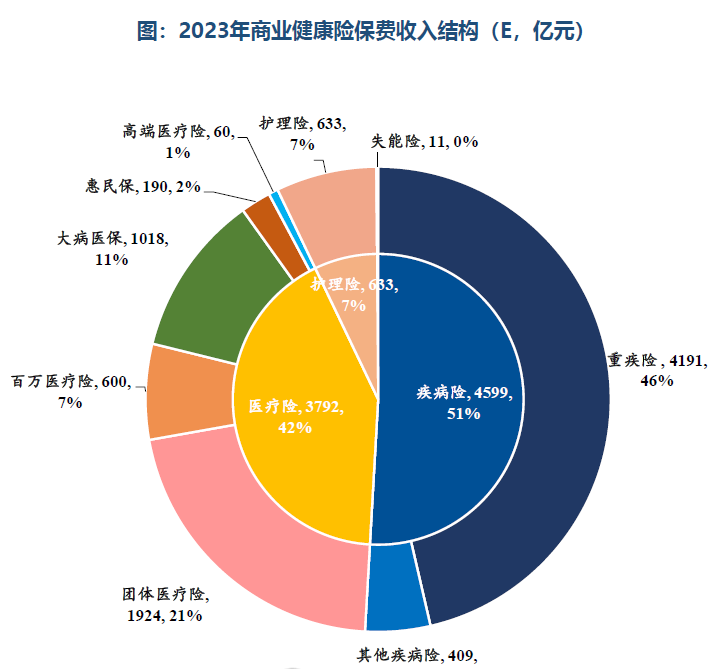
Core Insights - The million medical insurance sector has seen significant innovation and upgrades in 2023, with major players expanding coverage to include outpatient treatments and advanced medications [1][2][3] - The competition in the million medical insurance market is intensifying, with companies striving to enhance their offerings to meet evolving consumer demands [5][9] - Despite a slowdown in growth, the market for million medical insurance is expected to continue expanding, driven by increasing healthcare costs and the need for supplementary insurance [10][17] Company Developments - Ant Group's "Good Insurance" series has upgraded its core products to include coverage for specific diseases treated in advanced hospitals and expanded outpatient medication reimbursements [1] - China Life has launched its first 10-year guaranteed renewal product, "Guoshou Kangyue Zhenxiang," which covers outpatient expenses for specific major diseases [2] - ZhongAn Insurance has upgraded its health insurance series, "Zunxiang Esheng" and "Zhongminbao," to include long-term medication coverage and expanded hospitalization benefits [1][2] Market Trends - The million medical insurance market has evolved from high-end and mid-range medical insurance to more affordable options, with products like "Zunxiang Wuyou" and "Eshengbao" gaining popularity [4][9] - The market has seen a shift towards covering outpatient treatments and advanced therapies, with many products now offering zero deductible options [7][8] - The overall scale of the million medical insurance market has grown from negligible in 2016 to approximately 600 billion yuan by 2023, accounting for about 20% of the medical insurance market [9][13] Competitive Landscape - Major players like Renbao Health, ZhongAn, and Ping An Health dominate the market, with their products collectively accounting for a significant share of the total premium income [14][15] - The competitive environment has led to a focus on improving renewal conditions and expanding coverage, with many products now offering guaranteed renewal periods [5][6] - The introduction of lower-cost alternatives like "Hui Min Bao" has created additional pressure on million medical insurance products, although its impact appears to be diminishing [13][21] Future Outlook - The potential for growth in the million medical insurance sector remains strong, with expectations that it could reach a scale of 1.7 to 2.6 trillion yuan by 2029 [18] - The increasing pressure on basic medical insurance is likely to drive demand for commercial health insurance, positioning million medical insurance as a crucial supplement [17][23] - However, challenges such as low claims payout ratios and the need for better customer satisfaction must be addressed to ensure sustainable growth [22][23]