PICC(601319)

Search documents
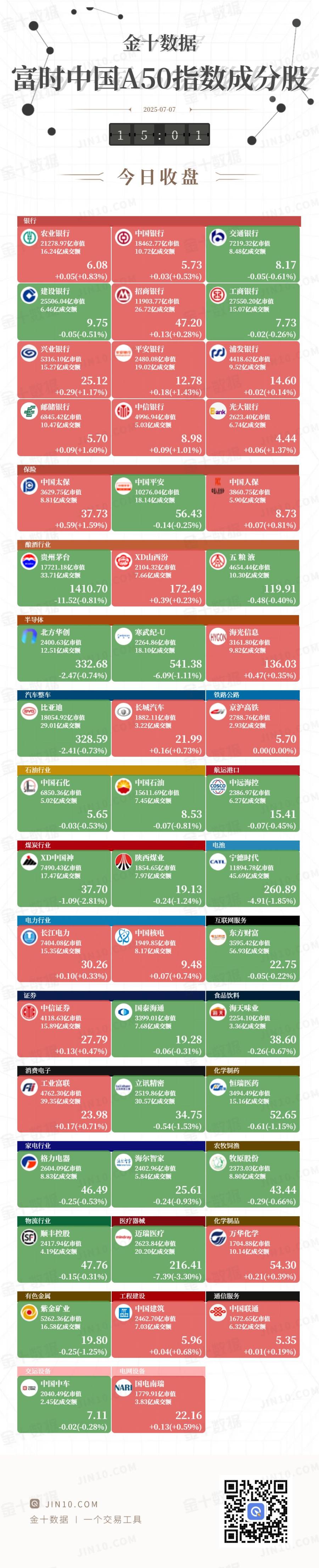
金十图示:2025年07月07日(周一)富时中国A50指数成分股今日收盘行情一览:银行股多数飘红,酿酒、保险、半导体板块走势分化
news flash· 2025-07-07 07:06
金十图示:2025年07月07日(周一)富时中国A50指数成分股今日收盘行情一览:银行股多数飘红,酿酒、保险、半导体板块走 势分化 +0.09(+1.60%) +0.09(+1.01%) +0.06(+1.37%) 保险 中国太保 中国平安 0.000 中国人保 08 3860.75亿市值 3629.75亿市值 10276.04亿市值 8.81亿成交额 18.14亿成交额 5.90亿成交额 37.73 8.73 56.43 +0.59(+1.59%) -0.14(-0.25%) +0.07(+0.81%) 酸酒行业 贵州茅台 XD山西分 五粮液 17721.18亿市值 2104.32亿市值 4654.44亿市值 33.71亿成交额 10.30亿成交额 7.66亿成交额 119.91 1410.70 172.49 -11.52(-0.81%) +0.39(+0.23%) -0.48(-0.40%) 半导体 北方华创 寒武纪-U 海光信息 HYGON 2400.63亿市值 2264.86亿市值 3161.80亿市值 12.51亿成交额 18.10亿成交额 9.82亿成交额 332.68 541.38 136.03 ...







构建巨灾保险保障体系 守护百姓生命财产安全
Zheng Quan Ri Bao Zhi Sheng· 2025-07-06 15:44
Core Viewpoint - The article emphasizes the urgent need to strengthen catastrophe insurance mechanisms in response to increasing extreme weather events and climate change, highlighting its role in safeguarding public safety and property [1][3]. Group 1: Catastrophe Insurance Development - Catastrophe insurance is recognized as an important economic stabilizer and social safety net, with recent events in Guangdong demonstrating its effectiveness in providing timely financial support during disasters [2][3]. - As of the end of 2024, catastrophe insurance in China has provided risk coverage for 64.39 million households, amounting to 22.36 trillion yuan, with expectations to exceed 70 million households by 2025 [3][4]. - The development of catastrophe insurance is transitioning from regional pilot programs to nationwide coverage, supported by policy initiatives and industry efforts [3][4]. Group 2: Product and Service Optimization - Catastrophe insurance focuses on proactive prevention rather than just compensation, with companies like PICC leading efforts to create a comprehensive risk management system that includes pre-disaster prevention, response, and post-disaster compensation [4]. - Technological advancements have significantly improved the efficiency of catastrophe insurance, with innovations such as catastrophe index insurance speeding up claims processes and enhancing disaster response [4][5]. - New index-based catastrophe insurance products are being developed to address various extreme weather events, leveraging big data and AI for better risk assessment and pricing [4]. Group 3: Reinsurance and Risk Management - Reinsurance plays a crucial role in the catastrophe insurance ecosystem, providing a mechanism for risk dispersion and supporting the stability of the insurance market [5]. - The establishment of specialized catastrophe risk management companies, such as Zhongcai Catastrophe Risk Management Co., enhances the capacity for managing and transferring catastrophe risks [5]. Group 4: Collaborative Efforts and Future Outlook - Despite progress, there is still significant room for improvement in the coverage and protection levels of catastrophe insurance, necessitating collaborative efforts among government, enterprises, and society [6][7]. - Future initiatives will focus on enhancing the catastrophe insurance system, improving public awareness of risks, and optimizing data-sharing platforms to better manage catastrophe risks [7]. - The ongoing development of standardized catastrophe insurance products and services aims to expand the scope and effectiveness of risk reduction efforts [7].

险企治理大变革!监事会加速“谢幕”
Bei Jing Shang Bao· 2025-07-06 12:56
又一险企加入撤销监事会大军!7月6日,北京商报记者注意到,大家保险集团有限责任公司(以下简称"大家保险集团")日前公告,该公司不再 设立监事会,由董事会审计委员会行使监事会职权。 近期泰康保险集团、中国人保等也先后宣布,将不再设立监事会。以往由股东大会、董事会、监事会和高级管理层构成的"三会一层"公司治理架 构正发生变革。在业内专家看来,将传统监事会的法定监督职权明确赋予董事会下设的审计委员会,旨在降低管理成本、提升治理灵活性与决策 效率。 险企监事陆续"失业" 种种迹象表明,保险机构的公司治理正在经历一次深刻改革。这场变革源于2024年7月实施的新《中华人民共和国公司法》及金融监管总局2024 年12月发布的配套《关于公司治理监管规定与公司法衔接有关事项的通知》。金融监管总局明确金融机构可以按照公司章程规定,在董事会中设 置由董事组成的审计委员会,行使监管制度规定的监事会职权,不设监事会或者监事。 治理结构持续优化 从职能结构性调整视角来看,对于撤销监事会,当前存在多重改革动因。 浙大城市学院文化创意研究所秘书长林先平认为,保险公司撤销监事会的原因,主要是优化公司治理结构、提高决策效率、适应现代企业治理趋 ...

非银金融行业周报:关注非银中报业绩对估值的催化-20250706
Shenwan Hongyuan Securities· 2025-07-06 11:14
Investment Rating - The report maintains a "Positive" outlook on the non-bank financial industry, indicating that it is expected to outperform the overall market [3][4]. Core Insights - The insurance sector showed a slight decline, with the Shenwan Insurance II Index down by 0.27%, underperforming the CSI 300 Index by 1.81 percentage points. However, the second quarter of 2025 is expected to see strong performance from certain insurance companies, leading to valuation boosts [4]. - The brokerage sector also experienced a decline, with the Shenwan Brokerage II Index down by 0.71%, underperforming the CSI 300 Index by 2.25 percentage points. Despite this, the brokerage sector has shown significant growth in stock trading volumes and IPOs, suggesting potential for recovery [4][19]. Market Review - The CSI 300 Index closed at 3,982.20 with a weekly change of +1.5%. The non-bank index closed at 1,871.55, with a weekly change of -0.7%. The brokerage, insurance, and diversified financial sectors reported changes of -0.7%, -0.3%, and -2.7% respectively [7]. - As of July 4, 2025, the average daily stock trading volume was 14,416.07 billion yuan, reflecting a year-on-year increase of 30.83% [19][42]. Insurance Sector Highlights - The second quarter of 2025 is anticipated to show robust growth in new business value (NBV) for insurance companies, driven by a low base effect and strong performance in bancassurance [4][13]. - The long-term interest rates have decreased, which is expected to positively impact the insurance sector's performance [4]. Brokerage Sector Highlights - The brokerage sector has seen a significant increase in trading activity, with the average daily trading volume for the first half of 2025 reaching 13,915.03 billion yuan, a year-on-year increase of 30.83% [19]. - The report highlights that the valuation of the brokerage sector remains low, with a price-to-book (PB) ratio of 1.35, down 19.6% from the highest valuation level since September 2024 [4]. Investment Recommendations - For the insurance sector, the report recommends stocks such as New China Life, China Life (H), China Pacific Insurance, and ZhongAn Online [4]. - In the brokerage sector, the report suggests focusing on leading firms with strong competitive positions, such as CITIC Securities and Guotai Junan, as well as firms with significant international business capabilities like China Galaxy and CICC [4].



广东人保财险:五大维度精准发力,高质服务农业强省建设
Nan Fang Nong Cun Bao· 2025-07-06 08:30
Core Viewpoint - The company has significantly enhanced its agricultural insurance services in Guangdong, focusing on five key dimensions to support the construction of a strong agricultural province [10][11]. Group 1: Agricultural Insurance Performance - The company has provided risk protection for 3.38 million farming households in Guangdong, amounting to 121.2 billion yuan [2]. - It has insured 8.647 million mu of rice, offering risk coverage of 10.453 billion yuan, with claims totaling 304 million yuan benefiting 345,700 households [21][22]. - The company has developed and implemented 95 new and revised agricultural insurance products, with a total of 160 specialty agricultural insurance products providing over 17.3 billion yuan in risk coverage [4][40]. Group 2: Focus on Food Security - Food security is prioritized, with the company implementing measures to enhance rice and corn production insurance, including a complete cost insurance product for rice that covers all production costs [24][25]. - The insurance amount for rice has been increased to 1,250 yuan per mu, ensuring comprehensive coverage for land, labor, and material costs [25][26]. - The company has also introduced a full lifecycle insurance system for rice, setting a benchmark in the industry [31]. Group 3: Support for Specialty Industries - The company has created a comprehensive insurance system covering various agricultural products, including rice, fruits, and marine products, to support the high-quality development of Guangdong's agricultural industry [39][41]. - In 2024, the company provided 1.86 billion yuan in risk coverage for marine aquaculture, marking a 48% increase year-on-year [44]. - Innovative insurance products, such as the "Abalone Seed Typhoon Disaster and Price Index Comprehensive Insurance," have been recognized internationally [47][48]. Group 4: Risk Reduction Management - The company has established a management system for disaster reduction in agriculture, implementing a comprehensive approach to risk management [66][70]. - In 2024, it invested 83.83 million yuan in disaster reduction projects, benefiting 1.654 million households and achieving over 357 million yuan in risk reduction [79][81]. Group 5: Rural Insurance Expansion - The company has extended its insurance services to rural areas, providing over 4.94 trillion yuan in risk protection for 10.88 million farming households [84]. - It has introduced various insurance products tailored for rural tourism and agricultural facilities, ensuring water security during droughts [88][89]. - The company has also launched unique products like "Rural Cadre Accident Insurance" and "Rural Left-behind Children Accident Insurance" to fill service gaps in rural insurance [90][91]. Group 6: Future Development Goals - The company aims to continue enhancing the quality of agricultural insurance services, contributing to the "Hundred Million Project" and rural revitalization efforts in Guangdong [102][104].

非银金融行业跟踪周报:继续看好保险股估值修复,期待非银中报较好表现-20250706
Soochow Securities· 2025-07-06 06:03
证券研究报告·行业跟踪周报·非银金融 非银金融行业跟踪周报 继续看好保险股估值修复;期待非银中报较 好表现 增持(维持) [Table_Tag] [Table_Summary] 投资要点 2025 年 07 月 06 日 证券分析师 孙婷 东吴证券研究所 1 / 15 执业证书:S0600524120001 sunt@dwzq.com.cn 研究助理 罗宇康 执业证书:S0600123090002 luoyk@dwzq.com.cn 行业走势 -7% 1% 9% 17% 25% 33% 41% 49% 57% 65% 2024/7/8 2024/11/5 2025/3/5 2025/7/3 非银金融 沪深300 相关研究 《权益 ETF 系列:行情轮动较快,存 在结构性机会》 2025-07-06 《2025 年 7 月大类资产配置展望》 2025-07-03 请务必阅读正文之后的免责声明部分 ◼ 非银行金融子行业近期表现:最近 5 个交易日(2025 年 06 月 30 日-2025 年 07 月 04 日)非银金融板块各子行业中仅保险行业跑赢沪深 300 指 数。保险行业上涨 1.73%,证券行业下跌 0 ...


机构预测三季度人身险预定利率或将迎下调50bp;北京率先试点医保商报同步结算|13精周报
13个精算师· 2025-07-05 02:50
Regulatory Dynamics - The first inclusion of commercial health insurance innovative drug directory into the medical insurance adjustment plan aims to enhance the multi-payment capability for innovative drugs [5] - The Financial Regulatory Bureau has proposed strict adherence to approved insurance terms and rates for non-auto insurance businesses [6][7] - In May 2025, the insurance industry reported a total premium income of 3.06 trillion yuan, with Jiangsu province leading at 315.1 billion yuan [10] Company Dynamics - Taikang Life has completed its first transaction with a pilot fund of 10 billion yuan [18] - Lian'an Life increased its stake in Jiangnan Water by acquiring 46.99 million shares, representing a 5.03% ownership [20] - Zhongyou Life officially acquired a 5% stake in Eastern Airlines Logistics, with a total transaction value of approximately 869 million yuan [21] - China Life announced a cash dividend of 0.45 yuan per share, totaling approximately 12.71 billion yuan [26] - China Life's insurance payout exceeded 30.2 billion yuan in the first half of 2025 [27] Personnel Changes - Zhao Yue has been appointed as a member of the Party Committee and Secretary of the Discipline Inspection Commission of the Fujian Financial Regulatory Bureau [31] - Yang Fan resigned as Chairman of Xinmei Mutual, with Hu Han taking over [33] - Bai Kai is expected to become the Vice President of Taiping Group [34] Industry Dynamics - Insurance capital has accelerated its entry into the market, with 19 instances of stake increases recorded this year, nearing last year's total [40] - The insurance industry raised nearly 50 billion yuan in capital in the first half of 2025, with 13 companies involved [42] - The health insurance market is evolving, with a focus on service-oriented products and addressing the needs of chronic disease patients [51][52] Product Services - Zhong'an Insurance launched the "Zhongminbao Million Medical Insurance 2025 Edition," which includes coverage for chronic disease patients [55] - The first "Low-altitude Operation Management Liability Insurance" was implemented in Jiangsu [56] - Guo Life Property Insurance introduced the "Yao Yan Bao" comprehensive insurance, focusing on drug research and development risks [58]

保险股走出牛市节奏!
证券时报· 2025-07-05 00:02
Core Viewpoint - The insurance sector in A-shares has shown significant growth since April, with companies like New China Life Insurance nearing historical highs and China People's Insurance Group reaching a six-year peak, indicating a bullish market trend for insurance stocks [1] Group 1: Market Dynamics - The recent rise in insurance stocks is attributed to both funding and fundamental factors. Institutional investors have increased their allocation to insurance stocks due to their potential to outperform indices and higher elasticity in a low-interest-rate environment [2] - Insurance companies are expected to enhance their equity allocation, positioning themselves as a "second flag bearer" in the bull market due to the expansion of equity risk appetite among various institutions [2] Group 2: Fundamental Factors - The insurance sector is benefiting from macroeconomic improvements and a favorable capital market environment, with expectations of enhanced performance for insurance companies as the economy recovers [3] - The cost of liabilities for life insurance is expected to improve, with a projected decrease in the preset interest rate for insurance products, which could lower the rigid liability costs [3] - The growing emphasis on commercial health insurance is creating new growth opportunities, supported by national policies that promote a multi-tiered medical security system [3] Group 3: Future Outlook - Analysts emphasize the importance of asset-liability matching for insurance stocks, which is crucial for determining their "real value" in a low-interest-rate environment [4] - The ongoing policy guidance aimed at reducing liability costs and expense ratios is expected to enhance profit levels in the life insurance sector, with projections indicating a potential turning point in effective business value returns by 2025 [4]

保险股走出牛市节奏 下半年重在资产负债匹配
Zheng Quan Shi Bao· 2025-07-04 17:16
Core Viewpoint - The A-share insurance stocks have shown significant gains since April, with New China Life Insurance nearing historical highs and China People's Insurance Group reaching a six-year high, indicating a bullish market trend for insurance stocks [1] Group 1: Market Performance - A-share insurance sector rose by 0.74% recently, with intraday gains exceeding 1%, attracting market attention [1] - In the H-share market, both New China Life and China People's Insurance have seen approximately 200% growth over the past year, reaching historical highs [1] Group 2: Funding and Investment Logic - Analysts attribute the rise in insurance stocks to both funding and fundamental logic, with a focus on market fund allocation behavior [2] - Insurance stocks are favored by active equity funds due to their potential to outperform indices and higher elasticity in a low-interest, low-credit spread environment [2] - Institutional investors previously had lower allocations to the insurance sector compared to index weights, indicating room for increased equity allocation [2] Group 3: Fundamental Factors - The insurance sector is expected to benefit from macroeconomic recovery and improved capital market conditions, with a positive outlook for company performance [3] - The insurance industry's operating characteristics are significantly pro-cyclical, suggesting that both liability and investment sides will improve with economic recovery [3] - Recent data indicates a marginal improvement in the interest spread that previously suppressed insurance stock valuations, with expected decreases in life insurance liability costs [3] Group 4: Long-term Growth Drivers - The emphasis on commercial health insurance is creating new growth opportunities, supported by national policies promoting a multi-tiered medical security system [3] - Companies like China People's Insurance have highlighted the potential for closer integration between basic medical insurance and commercial health insurance, indicating substantial growth potential in this area [3] Group 5: Future Outlook - Analysts emphasize the importance of asset-liability matching for insurance stocks' true value, particularly in a low-interest environment [4] - The improvement in liability costs and the stable returns from asset allocation are expected to enhance profitability stability for insurance companies [4] - Predictions suggest that the effective business value yield may reach a turning point by 2025, with a potential upward trend in interest spreads starting in 2026 [4]
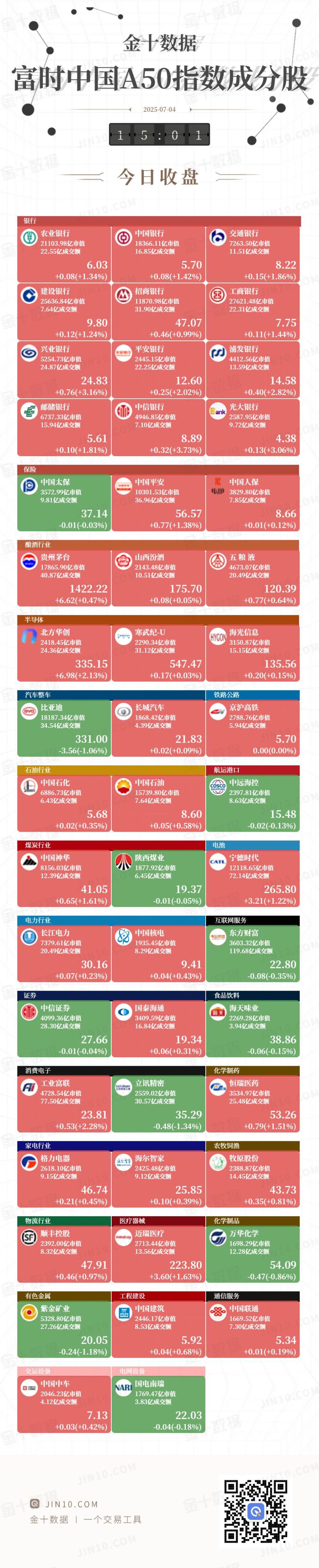
金十图示:2025年07月04日(周五)富时中国A50指数成分股今日收盘行情一览:银行、白酒、半导体、物流等板块走高,有色金属、化学制药等走弱,比亚迪跌超1%
news flash· 2025-07-04 07:04
Market Overview - The FTSE China A50 Index components showed a mixed performance with banking, liquor, semiconductor, and logistics sectors rising, while non-ferrous metals and chemical pharmaceuticals sectors weakened [1] - BYD's stock price fell over 1% [1] Sector Performance Banking Sector - Major banks like China Pacific Insurance, Ping An Insurance, and China Life Insurance reported market capitalizations of 382.98 billion, 357.30 billion, and 1,030.15 billion respectively, with trading volumes of 9.81 million, 36.96 million, and 7.85 million [3] Liquor Industry - Key players such as Kweichow Moutai, Shanxi Fenjiu, and Wuliangye had market capitalizations of 1,786.59 billion, 214.35 billion, and 467.31 billion respectively, with trading volumes of 40.87 million, 10.51 million, and 20.49 million [3] Semiconductor Sector - Companies like Northern Huachuang, Cambricon Technologies, and Haiguang Information had market capitalizations of 241.84 billion, 229.03 billion, and 315.09 billion respectively, with trading volumes of 24.36 million, 31.12 million, and 15.15 million [3] Automotive Sector - BYD, Great Wall Motors, and Beijing-Shanghai High-Speed Railway had market capitalizations of 1,818.73 billion, 186.84 billion, and 278.88 billion respectively, with trading volumes of 34.54 million, 4.39 million, and 5.94 million [3] Oil Industry - China Petroleum, Sinopec, and COSCO Shipping had market capitalizations of 239.78 billion, 688.67 billion, and 1,573.98 billion respectively, with trading volumes of 8.63 million, 6.43 million, and 7.64 million [3] Coal Industry - Major companies like China Shenhua and Shaanxi Coal and Chemical Industry had market capitalizations of 187.79 billion and 815.60 billion respectively, with trading volumes of 12.39 million and 6.45 million [3] Power Industry - Key players such as Yangtze Power and China Nuclear Power had market capitalizations of 360.33 billion and 737.96 billion respectively, with trading volumes of 20.49 million and 8.29 million [4] Food and Beverage Sector - Companies like Citic Securities, Guotai Junan, and Haitian Flavoring had market capitalizations of 409.94 billion, 340.96 billion, and 226.93 billion respectively, with trading volumes of 28.30 million, 3.94 million, and 16.84 million [4] Consumer Electronics - Industrial Fulian, Luxshare Precision, and Gree Electric Appliances had market capitalizations of 472.85 billion, 255.90 billion, and 242.55 billion respectively, with trading volumes of 30.57 million, 77.50 million, and 25.48 million [4] Chemical Products - Companies like Wanhua Chemical and SF Holding had market capitalizations of 239.20 billion and 271.34 billion respectively, with trading volumes of 12.28 million and 8.32 million [4] Construction and Engineering - China State Construction and Zijin Mining had market capitalizations of 532.88 billion and 166.95 billion respectively, with trading volumes of 27.26 million and 8.53 million [4]