
PICC(601319)

Search documents
陕西省“险资入陕”交流观摩活动举办
Shan Xi Ri Bao· 2025-11-30 22:36
11月27日至28日,由省委金融办、省发展改革委、省民政厅、省金融监管局联合主办,陕西丝路金 融研究院协办的2025年陕西省"险资入陕"交流观摩活动在西安举办。 11月28日,险资机构投资团队分赴西安市丝路科学城、集成电路创新中心、陕西空天动力创新中 心、曲江文旅产业园区、龙腾半导体项目基地、西安财金投资管理公司等重点园区与企业实地考察,深 入了解项目融资需求,推动产投合作加快落地。 保险资金作为天然的"耐心资本",具有规模大、期限长、来源稳等显著优势,在服务国家战略、支 持实体经济和保障国计民生中发挥着重要作用。省委金融办相关负责人表示,将联合省发展改革委、省 民政厅、陕西金融监管局等部门,持续加大工作力度,进一步畅通资本与项目合作渠道,推动保险资金 与陕西优质项目深度对接,为谱写陕西新篇、争做西部示范注入强劲金融动能。(记者:孙丹) 在2025年陕西省"险资入陕"交流大会上,政府有关部门负责人、险资机构代表以及省内高端制造、 能源化工、文化旅游等重点领域的产业园区、重点企业和上市后备企业负责人共计300余人参会。人保 资本保险资产管理公司、中保投资公司、太平洋资产管理公司等头部险资机构专家围绕保险资金支持 ...


非银金融行业跟踪周报:交易量有所下降,商业不动产REITs试点稳步推进-20251130
Soochow Securities· 2025-11-30 15:09
Investment Rating - The report maintains an "Overweight" rating for the non-bank financial industry [1] Core Insights - The non-bank financial sector has shown a decline in trading volume, with the commercial real estate REITs pilot program progressing steadily [1] - The insurance industry has surpassed a total asset value of 40 trillion yuan, indicating robust growth [5][23] - The report highlights the performance of various sub-sectors within non-bank finance, with insurance leading in growth [11] Summary by Sections Non-Bank Financial Sub-Sector Performance - In the recent five trading days (November 24-28, 2025), all sub-sectors of non-bank finance underperformed compared to the CSI 300 index, with insurance up by 0.21%, securities by 0.75%, and multi-financial by 1.63% [10] - Year-to-date, the insurance sector has increased by 14.41%, while multi-financial has risen by 6.76% [11] Securities Sector - Trading volume has decreased month-on-month, with the average daily trading amount for November at 22,411 billion yuan, a 12.90% decline from the previous month but a 4.61% increase year-on-year [15] - The China Securities Regulatory Commission (CSRC) has released a consultation draft for the commercial real estate REITs pilot program, aiming to enhance the market [18][21] Insurance Sector - As of Q3 2025, the total assets of insurance companies reached 40.4 trillion yuan, a 12.5% increase from the beginning of the year [23] - The insurance sector's premium income for the first three quarters was 5.2 trillion yuan, reflecting an 8.5% year-on-year growth [23] - The report indicates a strong cyclical characteristic in the insurance industry, with expectations for improvement in both liabilities and investments as the economy recovers [27] Multi-Financial Sector - The trust industry is experiencing a stable transition, with total assets reaching 29.56 trillion yuan in 2024, a 23.58% year-on-year increase [30] - The futures market saw a trading volume of 6.03 billion hands in October 2025, with a transaction value of 61.22 trillion yuan, indicating a 4.56% year-on-year growth [35] Industry Ranking and Key Company Recommendations - The report ranks the non-bank financial sectors as follows: insurance > securities > other multi-financial [46] - Key recommended companies include China Life, Ping An, New China Life, China Pacific Insurance, CITIC Securities, Tonghuashun, and Jiufang Zhitu Holdings [46]






非银金融行业周报:多只券商股被调入重要指数,关注被动资金流入、调整公告日-20251130
Shenwan Hongyuan Securities· 2025-11-30 10:45
Investment Rating - The report maintains a positive outlook on the non-bank financial sector, particularly highlighting the potential benefits for brokerage firms and insurance companies in the upcoming year [3][4]. Core Insights - The report emphasizes the expected inflow of passive funds into newly included stocks in major indices, which could enhance liquidity and market performance for these stocks [4]. - It identifies key trends for 2026, including a shift in insurance companies' focus towards asset-liability matching and the stabilization of core business indicators due to new regulatory standards [4]. - The report recommends specific brokerage firms such as Dongfang Securities, GF Securities, Huatai Securities, and China Galaxy, as well as insurance companies like China Life and Ping An, based on their competitive positioning and growth potential [4]. Summary by Sections Market Performance - The Shanghai Composite Index closed at 4,526.66 with a weekly increase of 1.64%, while the non-bank index rose to 1,932.15, reflecting a 0.68% increase [7]. - The brokerage sector index reported a 0.74% increase, and the insurance sector index saw a 0.20% rise [7]. Brokerage Sector Insights - Notable stocks in the brokerage sector included Guosheng Securities and Xinyi Securities, which saw increases of 3.68% and 3.36%, respectively [9]. - The average daily trading volume for the Shanghai and Shenzhen markets was 17,370.85 billion, a decrease of 6.87% week-on-week, but a year-to-date increase of 61.11% [20]. Insurance Sector Insights - The insurance sector is expected to experience a systematic revaluation in 2026, driven by long-term interest rate increases and continued investment from insurance funds into the stock market [4]. - The report highlights the performance of major insurance companies, with A-shares like China Life and Ping An showing modest increases [9]. Key Data Points - As of November 28, 2025, the average daily trading volume was 19,147.38 billion, and the margin trading balance was 24,720.45 billion, reflecting a year-on-year increase of 32.6% [51][20]. - The report notes that the total market value of private equity funds reached 22.05 trillion, marking a historical high [21].


阿克苏监管分局同意中国人保财险沙雅县央塔克协海尔营销服务部营业场所变更
Jin Tou Wang· 2025-11-28 07:26
Core Viewpoint - The National Financial Supervision Administration's Aksu Regulatory Branch has approved the change of business location for China People's Property Insurance Company Limited's marketing service department in Shaya County, indicating regulatory compliance and operational adjustments within the insurance sector [1] Group 1 - The business location of China People's Property Insurance Company Limited's Shaya County marketing service department has been officially changed to a new address in Wotuziluke Village, Aksu Region, Xinjiang [1] - The approval is based on the relevant provisions of the "Administrative Measures for Market Access of Insurance Company Branches," highlighting the regulatory framework governing such changes [1] - The company is required to complete the certificate replacement process within 10 days of the approval, ensuring adherence to regulatory timelines [1]
险企发债观察:发行规模仍居历史高位 永续债占比接近七成
2 1 Shi Ji Jing Ji Bao Dao· 2025-11-27 09:59
(原标题:险企发债观察:发行规模仍居历史高位 永续债占比接近七成) 21世纪经济报道记者 叶麦穗 "为什么永续债几乎成了大型寿险和银行系险企的专属点心?" 南开大学金融发展研究院院长田利辉此前接受采访时表示,对险企而言,是否发行永续债取决于公司的 战略规划和资金需求。永续债具有长期性、无到期日的特点,有助于险企稳定资金来源,优化债务结 构。但是,险企同时也要考虑市场的接受问题、利息的支付压力和估值波动的风险等因素。 2025年以来,保险公司掀起新一轮"发债潮"。据不完全统计,截至11月26日,已有17家保险公司发行了 663.7亿元债券,其中资本补充债191亿元,永续债472.7亿元,其中永续债在全年发债总额中占比高达 71.2%,远超去年约25%的水平,增长势头迅猛。 与 2024 年"百亿级"大单频出不同,2025 年迄今仅平安人寿一家跨过百亿红线;去年动辄百亿的人保财 险、新华人寿等今年均未再现大手笔。隋东判断,去年四季度以来投资端回暖,行业偿付能力普遍"回 血",资本补充节奏随之放缓。 金融监管总局最新季报显示,2025 年三季度末,保险业综合偿付能力充足率 186.3%,核心偿付能力充 足率 134 ...

保险板块11月27日涨0.53%,中国人保领涨,主力资金净流出4534.21万元
Zheng Xing Xing Ye Ri Bao· 2025-11-27 09:07
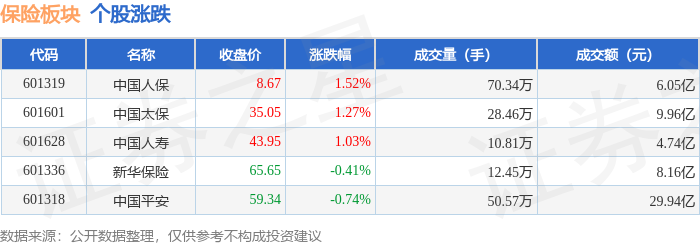
Core Insights - The insurance sector experienced a slight increase of 0.53% on November 27, with China Pacific Insurance leading the gains [1] - The Shanghai Composite Index closed at 3875.26, up 0.29%, while the Shenzhen Component Index closed at 12875.19, down 0.25% [1] Insurance Sector Performance - China Life Insurance closed at 43.95, up 1.03%, with a trading volume of 108,100 shares and a transaction value of 474 million [1] - China Pacific Insurance closed at 35.05, up 1.27%, with a trading volume of 284,600 shares [1] - China Reinsurance led the sector with a closing price of 8.67, up 1.52%, and a trading volume of 703,400 shares [1] - New China Life Insurance and Ping An Insurance saw declines of 0.41% and 0.74%, respectively [1] Capital Flow Analysis - The insurance sector saw a net outflow of 45.34 million from institutional investors, while retail investors experienced a net outflow of 76.06 million [1] - Speculative funds recorded a net inflow of 121 million into the sector [1] - China Reinsurance had a net inflow of 56.55 million from institutional investors, while China Pacific Insurance saw a net outflow of 76.20 million [2]


庆阳监管分局同意中国人保寿险环县支公司营业场所变更
Jin Tou Wang· 2025-11-27 05:28
Core Viewpoint - The National Financial Supervision Administration of Gansu Province has approved the change of business location for China Life Insurance Company Limited's Huan County branch to a new address in Qinyang City, Gansu Province [1] Group 1 - The new business location for China Life Insurance Company Limited's Huan County branch is set to be: No. 9-2, Binhai Road, Huan Cheng Town, Qinyang City, Gansu Province [1] - The company is required to handle the change and obtain a new license in accordance with relevant regulations [1]
中国人保南昌市分公司:城房保险守护百姓“安居梦”
Zhong Guo Jin Rong Xin Xi Wang· 2025-11-26 11:50
Core Insights - The project initiated by the Nanchang branch of China People's Property Insurance Co., Ltd. focuses on a "insurance + technology + service" model to enhance urban housing insurance coverage and ensure public safety [1][2] Group 1: Project Overview - The urban housing insurance project has covered 63,189 households and 2,642 buildings, with a total risk coverage amounting to 1.14 billion yuan [1] - Insurance responsibilities include property loss due to building collapse, personal injury, temporary accommodation costs, structural reinforcement, and routine inspection expenses [1] Group 2: Risk Prevention Measures - The company employs a combination of equipment and manual inspections for risk prevention, collecting data on structural issues every 8 hours and uploading it to a monitoring system [1] - Monthly safety inspections are conducted in 10 residential communities, focusing on building structure, functionality, and surrounding environment [1] Group 3: Service Improvement Initiatives - A dedicated service team has been established to create standardized claims processes, aiming to enhance resident satisfaction and responsiveness [2] - An information-sharing mechanism has been initiated to facilitate risk assessment and disaster reduction efforts [2] Group 4: Financial Model and Future Plans - The insurance adopts a cost-sharing model where the government subsidizes 30% of the risk premium and residents cover 70%, promoting government involvement and resident awareness [2] - Future plans include improving fund management, increasing promotional efforts, and optimizing product design to enhance service efficiency [2]
中国人保财险南昌分公司:从快查勘到快赔付,人保农险解农忧
Zhong Guo Jin Rong Xin Xi Wang· 2025-11-26 11:50
Core Viewpoint - The company has effectively enhanced agricultural insurance services, focusing on innovation and technology to provide timely support and compensation to farmers affected by disasters [1][2]. Group 1: Agricultural Insurance Development - The company has strengthened its agricultural insurance product innovation, expanding coverage and increasing the variety of products offered, including specialized insurance for rice and freshwater aquaculture [1]. - The establishment of "Precision Insurance and Claim Demonstration Bases" aims to improve the quality and efficiency of insurance services through an information technology system [1]. Group 2: Technological Integration - The company utilizes advanced technologies such as satellite remote sensing and AI image recognition to accurately identify and assess insured agricultural assets, ensuring targeted and effective insurance solutions [2]. - The implementation of drone technology for aerial surveys of affected farmland enhances the efficiency of damage assessment, allowing for quicker compensation to farmers [2]. - The "Yun Zhi Bao" platform integrates various data sources, creating a comprehensive inspection network that improves the accuracy of damage assessments to over 90% [2]. Group 3: Service Enhancement - The company plans to increase the coverage of comprehensive cost insurance for rice and develop customized insurance products for new agricultural business entities [2]. - Initiatives like "Three Rural Service Stations" and mobile service vehicles aim to improve access to insurance services for farmers, ensuring that policies benefit every farmer [2].
南京人保财险开展新员工座谈会
Jiang Nan Shi Bao· 2025-11-26 10:26
Core Insights - The meeting aimed to understand the learning and growth status of new employees and optimize the training environment for the claims team [1][2] - New employees actively shared their experiences and insights regarding the transition from campus to workplace, demonstrating a positive attitude and commitment to their roles [1] - The claims center introduced a new employee social practice program to enhance familiarity with core business processes and improve professional service and communication skills [1] Summary by Sections Employee Development - The meeting provided a platform for new employees to express their thoughts and ideas, highlighting the company's emphasis on nurturing new talent [2] - The claims line leadership expressed three key expectations for new employees: to maintain high aspirations and intrinsic motivation, to continuously learn and enhance professional skills, and to uphold the integrity of their roles [1] Future Outlook - The company anticipates that new employees will contribute significantly to the high-quality development of the claims sector, aligning with the company's vision for a promising future [2]