
BANK COMM(601328)

Search documents
农、中、建、交四大行上半年私人银行客户增长超8万户,工行将“科学家”群体纳入重点客群
Xin Lang Cai Jing· 2025-09-03 06:11
Core Insights - The growth rate of private banking clients in major state-owned banks has outpaced the market, with a total of 864,000 clients reported by four major banks in the first half of 2025, reflecting an increase of approximately 83,400 clients or 11% since the beginning of the year [1][2] Group 1: Client Growth Data - Agricultural Bank of China reported 279,000 private banking clients with managed assets of 3.5 trillion yuan as of June 2025 [1] - Bank of China had 216,900 private banking clients and financial assets of 3.4 trillion yuan by the end of June 2025 [1] - China Construction Bank reported 265,500 private banking clients with financial assets of 3.18 trillion yuan [2] - Bank of Communications reached a milestone with 102,600 private banking clients, marking the first time it surpassed the 100,000 client threshold [2] Group 2: Comparative Analysis - In the first half of 2025, the increase in private banking clients for the four major banks was as follows: Agricultural Bank (+23,000), Bank of China (+18,000), China Construction Bank (+34,000), and Bank of Communications (+8,400) [5] - The total number of private banking clients for the four major banks reached 864,000, with all traditional "Big Five" banks surpassing the 100,000 client mark [2] Group 3: Industry Trends - Industrial and Commercial Bank of China did not disclose specific private banking client data in its report but emphasized its focus on serving entrepreneurs and scientists, indicating a strategic shift in targeting high-net-worth individuals [3] - Postal Savings Bank has been increasing its focus on private banking, reporting a significant growth in its high-net-worth client base, with 41,400 clients having assets over 6 million yuan, a 21.28% increase from the previous year [5]



交行2025年中报:以“稳”筑根基,以“质”创价值
券商中国· 2025-09-03 05:21
Core Viewpoint - The article emphasizes the resilience and steady growth of the Bank of Communications (BoCom) in the first half of 2025, highlighting its significant role in supporting the real economy amidst macroeconomic recovery [1][2]. Financial Performance - As of June 2025, BoCom's total assets reached 15.44 trillion yuan, a year-on-year increase of 3.59%, with customer loan balances at 9 trillion yuan, up 5.18% [3]. - The bank reported operating income of 133.368 billion yuan, a 0.77% increase year-on-year, and a net profit attributable to shareholders of 46.016 billion yuan, up 1.61% [2][3]. - BoCom's non-performing loan (NPL) ratio stood at 1.28%, down 0.03 percentage points from the end of the previous year, while the provision coverage ratio increased by 7.62 percentage points to 209.56% [3]. Business Strategy and Development - BoCom has integrated a comprehensive business model, including commercial banking, financial leasing, and insurance, with subsidiaries contributing 9.91% to the group's net profit [4]. - The bank has focused on high-quality development, implementing the "One Four Five" strategy and emphasizing digital transformation and the construction of Shanghai as a financial hub [4][10]. Support for Key Sectors - BoCom is actively supporting major national strategies and key sectors, with a focus on technology finance, green finance, and inclusive finance, aligning with the central government's "Five Major Articles" initiative [5][6]. - The bank's technology loan balance exceeded 1.5 trillion yuan, with a year-on-year growth of 22.93% in loans to technology-oriented small and medium-sized enterprises [6]. Innovation and Digital Transformation - BoCom has established a digital operation center to enhance its financial services through technology, including the application of artificial intelligence and blockchain [11][12]. - The bank has launched various digital products and services, including cross-border payment solutions and credit products, to improve efficiency and customer experience [11][12]. Shareholder Returns - In the first half of 2025, BoCom distributed cash dividends of 0.1563 yuan per share, totaling 13.811 billion yuan, maintaining a dividend payout ratio of 30% for the 14th consecutive year [4].


信用卡失速消费贷补位,上市银行零售信贷的“跷跷板”能稳吗
Nan Fang Du Shi Bao· 2025-09-03 04:01
Core Viewpoint - The retail credit market is experiencing a significant divergence between traditional credit card business contraction and the expansion of personal loans, driven by consumer demand and policy support [2][11]. Credit Card Business - The total number of credit cards and credit card loans has declined for 11 consecutive quarters, with a reduction of 12 million cards compared to the end of last year [2]. - Among 15 listed banks, 11 reported a decrease in credit card loan balances compared to the end of last year, highlighting a pronounced industry-wide contraction [3]. - The most significant decline in credit card loan balances was observed at Bank of China, with a drop of 13.89%, followed by Postal Savings Bank at 5.67% [4]. - Credit card transaction volumes have also decreased, leading to a decline in non-interest income, with some banks reporting drops exceeding 15% [2][6]. Personal Loans - In contrast to the credit card sector, personal loans, particularly consumer loans, have seen robust growth, with several banks reporting increases exceeding 10% [11]. - Among state-owned banks, personal loans and consumer loans have both shown positive growth, with Agricultural Bank leading at 5.60% [12]. - The consumer loan segment has become a key growth driver for banks, with many institutions launching tailored products to stimulate demand [2][11]. Asset Quality - The asset quality of retail credit is under pressure, with rising non-performing loan (NPL) ratios for personal loans and credit cards across many banks [16]. - State-owned banks generally exhibit higher NPL ratios, with notable increases in personal loan NPLs for several institutions [17]. - Credit card NPL ratios have also risen, particularly at Industrial and Commercial Bank of China, which reported a rate of 3.75% [18][20]. Market Dynamics - The decline in credit card usage reflects a broader shift in consumer spending patterns, with an increase in smaller, more frequent transactions [6][8]. - The overall market for credit cards is facing significant challenges, with many banks reporting double-digit declines in credit card income [9][10].




四川金融监管局同意交通银行成都大邑支行开业
Jin Tou Wang· 2025-09-03 03:27
2025年8月25日,四川金融监管局发布批复称,《交通银行(601328)股份有限公司四川省分行关于成 都大邑支行开业的请示》(交银川〔2025〕39号)收悉。根据法律、法规和国家金融监督管理总局颁布 的行政许可规章等有关规定,经审定,现批复如下: 一、同意交通银行股份有限公司成都大邑支行开业,营业场所为四川省成都市大邑县晋原镇富民路中段 1栋168-170号。 二、核准交通银行成都大邑支行业务范围为:经银行保险监督管理机构或其他有行政许可权的机构批准 并由上级行授权办理的业务。 三、交通银行成都大邑支行应当自四川金融监管局作出行政许可决定之日起10日内持相关手续到四川金 融监管局领取金融许可证,并及时到市场监管部门办理相关手续,在市场监管、税务登记等法定程序完 成后1个月内向四川金融监管局书面报告相关情况。 四、交通银行成都大邑支行应当自领取营业执照之日起6个月内开业。不能按期开业的,应在开业期限 届满前1个月向四川金融监管局提交开业延期报告。开业延期不得超过一次,开业延期的最长期限为3个 月。未在规定时限内开业的,交通银行政许可决定失效,由四川金融监管局办理开业许可注销手续,收 回金融许可证,并予以公告。 ...
交通银行:锚定上海主场把握金融开放机遇
Jin Rong Shi Bao· 2025-09-03 01:03
Core Viewpoint - The strategic decision to establish the headquarters of the Bank of Communications (BoCom) in Shanghai is aimed at enhancing its role in supporting the city's development as a global financial center, leveraging its unique advantages in technology finance and cross-border financial services [1][2]. Group 1: Financial Market Participation - BoCom is actively participating in the construction of Shanghai's financial market, with its trading volumes in Bond Connect and Swap Connect ranking among the top in the market. In the first half of the year, BoCom was approved as a custodian and clearing bank for the Southbound Trading [1]. - The bank's cross-border trade financing balance increased by nearly 40% compared to the beginning of the year, reflecting its commitment to supporting domestic and international dual circulation [1]. Group 2: Comprehensive Financial Services - BoCom is enhancing its comprehensive financial services across various sectors, including equity, loans, bonds, leasing, and trust services, focusing on key customer groups in technology and cross-border trade [2]. - The bank has seen significant growth in equity investments in technology enterprises in Shanghai and led the underwriting of the first technology innovation bond in the interbank market for the city [2]. - As of June, BoCom has established 23 specialized branches for technology in Shanghai, aiming to better serve the city's leading industries and contribute to its development as a global innovation center [2]. Group 3: Future Plans - The senior management of BoCom plans to further implement central government policies under the guidance of financial management departments and local authorities, focusing on developing technology finance, cross-border finance, and offshore finance [2].
消费贷“国补”落地!五大行已上线“贴息专区” 中行嵌入现有业务流程
Xin Lang Cai Jing· 2025-09-03 00:31
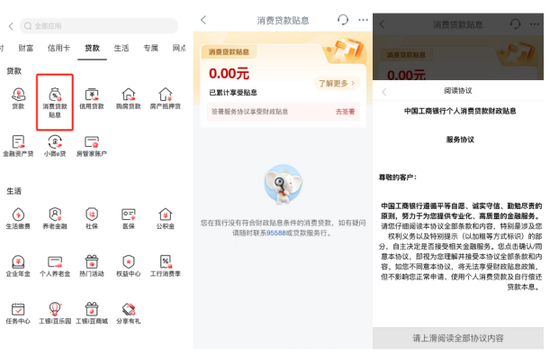
Core Viewpoint - The implementation plan for personal consumption loan interest subsidies has been officially launched, allowing residents to benefit from interest subsidies on personal consumption loans issued by various banks from September 1, 2025, to August 31, 2026, provided the loans are used for consumption and can be verified by the lending institutions [1]. Group 1: Policy Details - The interest subsidy policy applies to personal consumption loans (excluding credit card business) issued by six major state-owned banks, twelve national joint-stock banks, and five other lending institutions [1]. - The subsidy will be directly deducted from the loan interest charged to borrowers, calculated based on the specified subsidy ratio and upper limit [16]. Group 2: Bank Implementation - Major state-owned banks, including Industrial and Commercial Bank of China, Agricultural Bank of China, China Construction Bank, Bank of Communications, and Postal Savings Bank, have launched "subsidy zones" on their mobile banking apps [1][2]. - China Bank has integrated the subsidy agreement signing process into its existing loan application workflow, enhancing customer experience [13]. - Other joint-stock banks, such as Ping An Bank and CITIC Bank, have also introduced specific features for applying for the interest subsidy through their mobile banking platforms [15]. Group 3: User Experience - Borrowers can access the subsidy features through various pathways in their respective banking apps, such as "loan" sections or dedicated subsidy areas [3][6][10][12]. - The signing of the subsidy service agreement does not guarantee eligibility for the subsidy; eligibility will be determined based on the borrower's loan consumption records [8]. Group 4: Compliance and Warnings - Banks have emphasized that the subsidy policy does not cover credit card (including installment) business [16]. - Borrowers must follow the prescribed procedures to apply for the subsidy, and failure to sign the necessary agreements will be considered a waiver of the subsidy [16]. - Banks have warned against fraudulent activities related to obtaining subsidy funds and will take strict actions against any violations [17].

精耕资产质量 交通银行上半年经营实现“稳中向好”
2 1 Shi Ji Jing Ji Bao Dao· 2025-09-02 23:58
Core Viewpoint - The low interest rate environment is testing the operational management capabilities of major banks, with a focus on precise strategies, efficient execution, and stable growth becoming a key challenge for the industry [1] Financial Performance - In the first half of 2025, Bank of Communications (BoCom) demonstrated strong performance among the six major state-owned banks, with a net profit attributable to shareholders increasing by 1.61% year-on-year [3] - The bank's total assets reached 15.44 trillion yuan, growing by 3.59% compared to the end of the previous year [3] - The non-performing loan (NPL) ratio improved to 1.28%, with a provision coverage ratio of 209.56%, up by 7.62 percentage points from the end of the previous year [3] Asset Quality Improvement - BoCom disposed of 37.83 billion yuan in non-performing loans, a year-on-year increase of 27.9%, with substantial recoveries of 20.37 billion yuan, up 54.3% [3] Net Interest Margin - In the context of a general narrowing of interest margins across the banking sector, BoCom experienced the smallest year-on-year decline in net interest margin among the six major state-owned banks [4] Strategic Focus - The bank is strategically focusing on key sectors and regions, enhancing financial support for national strategies and key areas, while also deepening its engagement in the Shanghai market [6][8] - BoCom's loans in the Yangtze River Delta, Guangdong-Hong Kong-Macao Greater Bay Area, and Beijing-Tianjin-Hebei regions increased by 5.57% [7] Digital Transformation - BoCom is leading in digital transformation, with a focus on integrating technology and finance, achieving significant results in technology capability and application [9] - The bank's loans to core digital economy industries exceeded 286 billion yuan, with internet loans growing by 8.52% year-on-year [10] Dividend Policy - The bank's board approved a mid-term dividend distribution plan, proposing a cash dividend of 0.1563 yuan per share, totaling 13.811 billion yuan, which accounts for 30% of the net profit attributable to shareholders [11]

精耕资产质量 交通银行上半年经营实现“稳中向好”
21世纪经济报道· 2025-09-02 23:52
Core Viewpoint - The low interest rate environment is testing the operational management capabilities of major banks, making precise strategies and efficient execution essential for stable growth [1] Group 1: Performance Highlights - In the first half of 2025, Bank of Communications (BoCom) showed outstanding performance among the six major state-owned banks, with a net profit attributable to shareholders increasing by 1.61% year-on-year [2][3] - The bank's total assets reached 15.44 trillion yuan, growing by 3.59% compared to the end of the previous year, indicating a steady expansion [3] - The non-performing loan (NPL) ratio decreased to 1.28%, and the provision coverage ratio improved to 209.56%, up by 7.62 percentage points from the end of the previous year [3][4] Group 2: Risk Management and Loan Recovery - The bank has emphasized risk control and significantly strengthened the disposal of non-performing loans, with a total of 37.83 billion yuan in NPLs disposed of, a year-on-year increase of 27.9% [4] - The net interest margin (NIM) decline was the smallest among the six major state-owned banks, attributed to measures such as optimizing the asset-liability structure and enhancing pricing management [4] Group 3: Strategic Focus Areas - BoCom is focusing on key sectors and regions, providing financial support for national strategies and key areas, while also reserving high-quality credit projects for itself [5] - The bank's technology finance loans exceeded 1.5 trillion yuan, supporting over 32,300 technology-based SMEs, with a year-on-year growth of 22.93% [5] - Green finance initiatives have led to a loan balance growth of 6.58% in energy-saving and carbon-reduction industries, with a total of 145 billion yuan in green bonds issued [5] Group 4: Digital Transformation - BoCom is advancing its digital transformation, establishing a digital operation center and implementing an AI framework to enhance operational efficiency [8] - The bank's core loans in the digital economy reached over 286 billion yuan, with internet loans growing by 8.52% compared to the end of the previous year [8] Group 5: Future Outlook and Dividends - The board approved a mid-term dividend policy, proposing a cash dividend of 0.1563 yuan per share, totaling 13.811 billion yuan, which accounts for 30% of the net profit attributable to shareholders [10] - The bank aims to maintain the continuity and stability of its dividend policy, sharing development results with shareholders [11]
天风证券晨会集萃-20250903
Tianfeng Securities· 2025-09-02 23:42
Group 1 - The report highlights that the performance of various sectors such as electronics, home appliances, non-bank financials, machinery, non-ferrous metals, computers, food and beverage, defense, telecommunications, media, and agriculture is improving [3][25]. - From the perspective of earnings surprises, industries with the highest upward revisions in net profit forecasts from June 30, 2025, to August 30, 2025, include steel, non-ferrous metals, beauty care, non-bank financials, and banks [3][27]. - The report identifies a phenomenon of profit discontinuity, where the lowest price on the first trading day after earnings announcements is higher than the highest price on the previous trading day, particularly in sectors like food and beverage, beauty care, non-bank financials, banks, and transportation [3][27]. Group 2 - In August, major equity indices in the A-share market continued to rise, with the ChiNext index increasing by 24.13% [4][31]. - The central bank's net fund injection in August was 446.6 billion yuan, indicating a slight tightening of liquidity towards the end of the month [4][31]. - The report notes a rebound in non-ferrous metals, while oil prices have slightly declined, and pork prices remain low [4][31]. Group 3 - The global semiconductor industry is experiencing structural prosperity driven by rapid growth in AI computing demand, accelerated terminal intelligence, recovery in automotive electronics, and deepening domestic substitution [11][25]. - In Q2 2025, the semiconductor sector reported revenues of 133.66 billion yuan and a net profit of 10.63 billion yuan, indicating a clear trend of profit recovery [11][25]. - The report suggests focusing on sectors such as storage, power, foundry, ASIC, and SoC for their earnings elasticity, as well as equipment materials and domestic substitution in computing chips [11][25]. Group 4 - The U.S. fixed income market is the largest globally, with a market size of 58.2 trillion USD in 2024, accounting for 40.10% of the global total [9][38]. - As of Q1 2025, the U.S. fixed income market's outstanding amount reached 47.44 trillion USD, with U.S. Treasury bonds making up over 60% of this figure [9][38]. - The report indicates that the issuance volume in the U.S. fixed income market for the first half of 2025 was 5.70 trillion USD, reflecting a 14.21% increase compared to the same period in 2024 [9][38]. Group 5 - The report emphasizes the importance of AI applications across various sectors, including gaming, healthcare, marketing, education, finance, and office productivity, highlighting the ongoing integration of AI technologies [6][34]. - The AI sector is expected to see significant growth driven by government policies promoting the integration of AI into key industries [6][34]. - The satellite internet industry is also noted for its rapid development, with low-orbit satellites driving innovation across the supply chain [6][34].



国有六大行合计日赚超37亿元
Sou Hu Cai Jing· 2025-09-02 20:20
Core Viewpoint - The six major state-owned banks in China reported strong performance in the first half of 2025, with increased credit issuance, rising operating income, and improved asset quality, as indicated by a collective decrease in non-performing loan ratios [1][4]. Group 1: Financial Performance - The six major banks achieved a total operating income exceeding 1.8 trillion yuan and a net profit attributable to shareholders of 682.5 billion yuan in the first half of 2025, averaging over 3.7 billion yuan in net profit per day [2]. - Industrial and Commercial Bank of China (ICBC) led with an operating income of 427.1 billion yuan, followed by China Construction Bank (CCB) and Agricultural Bank of China (ABC) with 394.3 billion yuan and 369.9 billion yuan, respectively [2]. - In terms of net profit, ICBC reported 168.1 billion yuan, CCB followed with 162.1 billion yuan, while ABC, Bank of China (BOC), Postal Savings Bank of China (PSBC), and Bank of Communications (BoCom) reported net profits of 139.5 billion yuan, 117.6 billion yuan, 49.2 billion yuan, and 46.0 billion yuan, respectively [2]. Group 2: Asset Quality - The asset quality of the six banks remained stable, with a collective decrease in non-performing loan ratios and a high provision coverage ratio, indicating strong risk mitigation capabilities [4]. - PSBC reported the lowest non-performing loan ratio at 0.92% among the six banks [4]. Group 3: Asset Scale - All six banks experienced steady growth in total assets, with ICBC's total assets surpassing 52 trillion yuan, reaching 52.32 trillion yuan, maintaining its leading position in the industry [3]. Group 4: Net Interest Margin - The banks faced pressure on net interest margins due to factors such as the reduction in loan market quotation rates (LPR) and changes in deposit structures, leading to a general contraction in interest income [5]. - Management from various banks indicated efforts to stabilize interest income through adapting to interest rate changes and diversifying non-interest income sources, with expectations for marginal stabilization in net interest margins in the second half of the year [5][6].