NCI(601336)

Search documents
甘南监管分局同意新华保险甘南中心支公司变更营业场所
Jin Tou Wang· 2026-02-05 03:34
二、新华人寿保险股份有限公司应按照有关规定及时办理变更及许可证换领事宜。 2026年2月4日,国家金融监督管理总局甘南监管分局发布批复称,《新华人寿保险股份有限公司甘肃分 公司关于甘南中心支公司营业场所变更的请示》(新保甘字〔2026〕9号)材料收悉。经审核,现批复如 下: 一、同意新华人寿保险股份有限公司甘南中心支公司将营业场所变更为:甘肃省甘南州合作市美森佳苑 保障性住宅小区15#楼二楼1号商铺。 ...
保险股跌幅居前 传大型险企将迎特别国债注资 机构称行业仍面临偿付能力
Zhi Tong Cai Jing· 2026-02-05 03:19
Core Viewpoint - The insurance stocks have experienced significant declines, with major companies like China Life, New China Life, and China Pacific Insurance seeing drops of 3.81%, 3.6%, and 3.14% respectively. The government is planning to issue approximately 200 billion yuan in special bonds to inject capital into large insurance firms, marking a potential first for such a move in China [1]. Group 1: Stock Performance - China Life (601628) shares fell by 3.81%, trading at 33.82 HKD [1] - New China Life (601336) shares decreased by 3.6%, trading at 60.2 HKD [1] - China Pacific Insurance (601601) shares dropped by 3.14%, trading at 38.24 HKD [1] Group 2: Government Action - The government plans to issue around 200 billion yuan in special bonds to provide capital to state-owned insurance companies like China Life and PICC [1] - This initiative could be announced as early as the first quarter of this year [1] - It represents a potential first for the issuance of special bonds aimed at injecting capital into insurance firms in China [1] Group 3: Industry Analysis - According to Industrial Securities, leading state-owned insurance companies require additional capital due to the lagging nature of the 750-day curve used in calculating reserves [1] - The 750-day curve is expected to continue declining, which will further pressure solvency despite interest rates remaining stable [1] - The recent increase in equity allocation by insurance companies is likely to exacerbate existing solvency pressures, indicating that the industry faces ongoing challenges [1] - From a regulatory perspective, the capital injection may aim to mitigate tail risks within the industry [1]


金融制造行业2月投资观点及金股推荐-20260204
Changjiang Securities· 2026-02-04 11:06
Investment Rating - The report provides a "Buy" rating for several key stocks in the financial and manufacturing sectors, including China Resources Land and Beike-W [15][18][20][21]. Core Insights - The macroeconomic environment shows a continuation of strong supply and weak demand characteristics, with short-term growth pressure remaining manageable [9]. - The real estate sector is experiencing a valuation recovery opportunity for quality developers due to a resonance between fundamentals and policies [10]. - The banking sector is witnessing a recovery from oversold conditions, with stock prices rebounding ahead of improvements in the funding environment [20]. - The non-bank financial sector is expected to benefit from policy-driven high-quality development, with a focus on high-performing stocks [22]. - The new energy sector has established a bottom line, with attention on marginal changes in new technologies [25]. - The machinery sector is gaining order resilience from overseas solar expansion and new business developments, while space solar technology opens growth opportunities [31]. - The environmental sector is focusing on carbon neutrality opportunities, with overseas expansion and metal prices providing elasticity [33]. Summary by Sections Real Estate - The sector is expected to face challenges in 2026, but recent policy easing and improved second-hand housing sales indicate a potential recovery [14]. - China Resources Land is highlighted as a leading developer with strong operational capabilities and a solid financial position, projected to achieve a net profit of 26.2 billion, 27 billion, and 28.2 billion from 2025 to 2027 [15]. Banking - Nanjing Bank is recommended due to its expected double-digit revenue growth in 2025, driven by stable asset quality and improved net interest margins [21]. Non-Bank Financials - New China Life Insurance is noted for its high elasticity and potential for improved returns on equity, with projected intrinsic values of 292.1 billion and 329.0 billion for 2025 and 2026, respectively [24]. New Energy - The storage sector is expected to see demand stability supported by national capacity pricing, while lithium battery technology is anticipated to rebound with improved economic conditions [25]. - JunDa Co. is recognized for its strategic partnerships and potential growth in the space solar sector, with projected profits increasing significantly by 2027 [27]. Machinery - The machinery sector is benefiting from overseas solar project expansions, with companies like DiEr Laser positioned to capitalize on new technologies and increased order volumes [31][32]. Environmental - Weiming Environmental is highlighted for its potential in the Indonesian waste-to-energy market, with expected project launches in early 2026 [39]. - The company is projected to achieve net profits of 2.88 billion and 3.44 billion in 2025 and 2026, respectively [39]. Light Industry - The light industry is seeing a rebound in export-driven companies, with a focus on quality stocks that can leverage cost efficiencies and supply chain advantages [43]. Military Industry - The military sector is expected to benefit from the transition of military technology to civilian applications and increased military trade, with key recommendations including Aviation Power and AVIC Xi'an Aircraft Industry [51][53].




保险板块2月4日涨1.1%,中国太保领涨,主力资金净流入3.18亿元
Zheng Xing Xing Ye Ri Bao· 2026-02-04 08:57
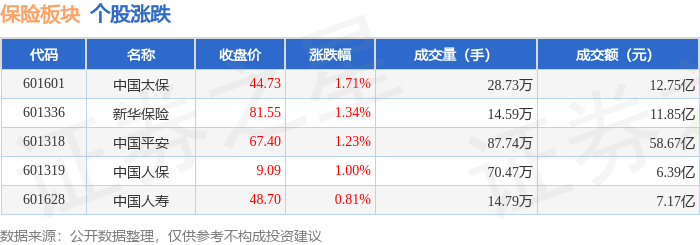
Core Viewpoint - The insurance sector experienced a 1.1% increase on February 4, with China Pacific Insurance leading the gains, while the overall market indices also showed positive movement [1] Group 1: Market Performance - The Shanghai Composite Index closed at 4102.2, up 0.85% [1] - The Shenzhen Component Index closed at 14156.27, up 0.21% [1] Group 2: Individual Stock Performance - China Pacific Insurance (601601) closed at 44.73, with a gain of 1.71% and a trading volume of 287,300 shares, totaling a transaction value of 1.275 billion yuan [1] - New China Life Insurance (601336) closed at 81.55, up 1.34% with a trading volume of 145,900 shares [1] - Ping An Insurance (601318) closed at 67.40, gaining 1.23% with a trading volume of 877,400 shares [1] - China Life Insurance (601628) closed at 48.70, up 0.81% with a trading volume of 147,900 shares [1] - China Reinsurance (601319) closed at 9.09, gaining 1.00% with a trading volume of 704,700 shares [1] Group 3: Capital Flow - The insurance sector saw a net inflow of 318 million yuan from institutional investors, while retail investors experienced a net outflow of 28.0153 million yuan [1] - The capital flow for major stocks showed that Ping An Insurance had a net inflow of 281 million yuan from institutional investors, but a net outflow of 265 million yuan from speculative investors [2] - China Pacific Insurance had a net inflow of approximately 36.6 million yuan from institutional investors, while retail investors saw a net outflow of about 61.9 million yuan [2]



新华保险与和睦家母公司新风天域达成战略合作
Sou Hu Cai Jing· 2026-02-04 08:18
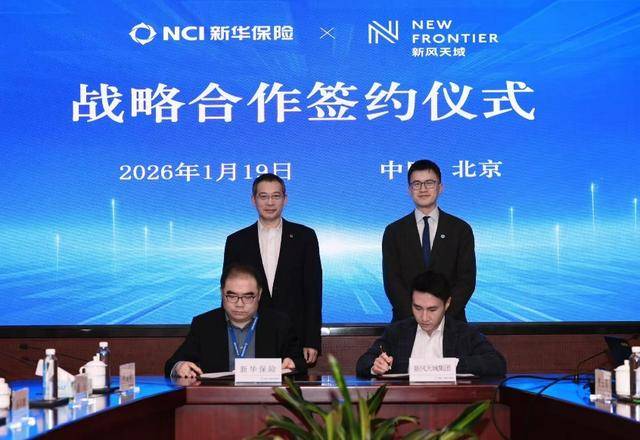
所以,下次当你翻开保单时,不妨多问一句:它连接了哪些健康资源?能为我提供怎样的医疗支持?因 为在今天,保险的价值早已不止于理赔,它可能正在无声中,为你预约一个更健康、更安心、更从容的 未来。 审核:王霆杰 你是否曾想过,一张保单不仅能保障风险,还能提前为你锁定稀缺医疗资源、对接健康服务?随着人们 对健康管理的需求日益多元与深入,保险正在悄然蜕变——从单纯的风险补偿,演进为贯穿健康预防、 医疗对接、康复管理的全流程服务伙伴。 近期,新华保险与和睦家母公司新风天域集团达成战略合作,标志着"保险+医疗健康"融合模式进入新 阶段。这并不是新华保险在医康养生态中的首次布局——此前其已携手复星集团、欧葆庭、雅达资本等 多方力量,持续构建覆盖健康管理、养老服务、医疗资源的服务网络。而此次合作,标志着这一生态网 络进一步深化与拓展,也反映出新华保险在战略上的持续聚焦。新华保险坚持"保险+服务+投资"三端 协同,打造以客户为中心的健康服务生态。公司全面加速康养生态布局,完善"机构养老+居家养老+旅 居养老"的养老生态,持续丰富健康医疗服务内容。截止目前,新华保险已在全国布局康养社区40城57 家,"东西南北中"全国化战略布局持 ...
新华人寿酒泉中心支公司被罚8.6万元:代理人学历不真实、销售误导等
Xin Lang Cai Jing· 2026-02-04 02:39
以下为罚单详细信息: 来源:金融一线 2月4日金融一线消息,据酒泉金融监管分局行政处罚信息公开表显示,新华人寿保险股份有限公司酒泉 中心支公司因代理人学历不真实,产说会上存在销售误导情形被警告并处罚款8.6万元 。同时,吴双劳 (时任新华人寿保险股份有限公司酒泉中心支公司总经理)因代理人学历不真实,产说会上存在销售误 导情形 ,被警告并处罚款1.4万元 。 ...
保险板块2月3日跌0.01%,中国太保领跌,主力资金净流入6.9亿元
Zheng Xing Xing Ye Ri Bao· 2026-02-03 09:03
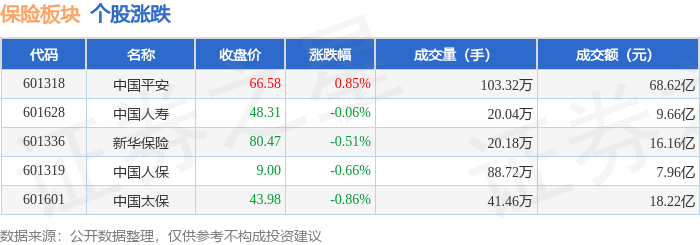
从资金流向上来看,当日保险板块主力资金净流入6.9亿元,游资资金净流出1.18亿元,散户资金净流出5.73亿元。保险板块个股资金流向见下 表: | 代码 | 名称 | 主力净流入 (元) | | 主力净占比 游资净流入 (元) | | 游资净占比 散户净流入(元) | | 散户净占比 | | --- | --- | --- | --- | --- | --- | --- | --- | --- | | 601318 中国平安 | | | 6.47亿 | 9.43% | -1.12 Z | -1.63% | -5.36亿 | -7.80% | | 601336 新华保险 | | | 5732.65万 | 3.55% | 2205.59万 | 1.37% | -7938.24万 | -4.91% | | 601628 中国人寿 | | | 1619.42万 | 1.68% | 2616.98万 | 2.71% | -4236.40万 | -4.39% | | 601601 中国太保 | | | 650.30万 | 0.36% | -9417.22万 | -5.17% | 8766.92万 | 4.81% | | ...
保险Ⅱ行业点评报告:保险行业2025年业绩前瞻:预计全年NBV高增长,Q4净利润或受投资短期波动影响
Soochow Securities· 2026-02-03 00:24
证券研究报告·行业点评报告·保险Ⅱ 保险Ⅱ行业点评报告 保险行业 2025 年业绩前瞻:预计全年 NBV 高增长,Q4 净利润或受投资短期波动影响 增持(维持) [Table_Tag] [Table_Summary] 投资要点 ◼ 风险提示:长端利率趋势性下行;新单增长不及预期。 2026 年 02 月 02 日 证券分析师 孙婷 执业证书:S0600524120001 sunt@dwzq.com.cn 证券分析师 曹锟 执业证书:S0600524120004 caok@dwzq.com.cn 行业走势 -5% 0% 5% 10% 15% 20% 25% 30% 35% 40% 45% 2025/2/5 2025/6/5 2025/10/3 2026/1/31 保险Ⅱ 沪深300 相关研究 《保险行业 12 月保费:产寿 25Q4 保 费增速均有所放缓,看好寿险 2026 年 新单增长》 2026-01-31 《政策引导+行协牵头,保险业布局康 养领域进程再加速》 ◼ 我们预计上市险企 2025 年归母净利润同比较快增长,Q4 净利润或受短 期投资波动影响。1)我们预计上市险企 2025 年归母净利润普遍同比 ...
新华保险(601336) - 新华保险H股公告
2026-02-02 09:15
FF301 本月底法定/註冊股本總額: RMB 3,119,546,600 股份發行人及根據《上市規則》第十九B章上市的香港預託證券發行人的證券變動月報表 截至月份: 2026年1月31日 狀態: 新提交 致:香港交易及結算所有限公司 公司名稱: 新華人壽保險股份有限公司 呈交日期: 2026年2月2日 I. 法定/註冊股本變動 | 1. 股份分類 | 普通股 | 股份類別 | H | | | 於香港聯交所上市 (註1) | | 是 | | | --- | --- | --- | --- | --- | --- | --- | --- | --- | --- | | 證券代號 (如上市) | 01336 | 說明 | | | | | | | | | | | 法定/註冊股份數目 | | | 面值 | | | 法定/註冊股本 | | | 上月底結存 | | | 1,034,107,260 | RMB | | | 1 RMB | | 1,034,107,260 | | 增加 / 減少 (-) | | | | | | | RMB | | | | 本月底結存 | | | 1,034,107,260 | RMB | | ...
保险板块2月2日跌2.14%,新华保险领跌,主力资金净流出4.03亿元
Zheng Xing Xing Ye Ri Bao· 2026-02-02 09:15
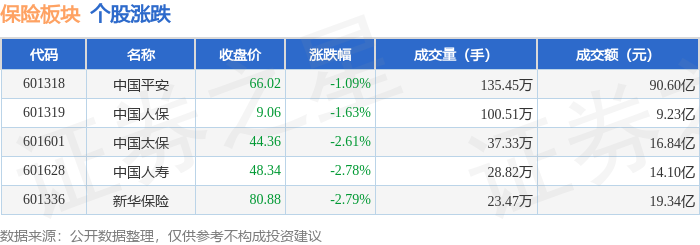
证券之星消息,2月2日保险板块较上一交易日下跌2.14%,新华保险领跌。当日上证指数报收于 4015.75,下跌2.48%。深证成指报收于13824.35,下跌2.69%。保险板块个股涨跌见下表: | 代码 | 名称 | 收盘价 | 涨跌幅 | 成交量(手) | 成交额(元) | | --- | --- | --- | --- | --- | --- | | 601318 | 中国平安 | 66.02 | -1.09% | 135.45万 | 90.60亿 | | 601319 | 中国人保 | 9.06 | -1.63% | 100.51万 | 9.23亿 | | 601601 | 中国太保 | 44.36 | -2.61% | 37.33万 | 16.84亿 | | 601628 | 中国人寿 | 48.34 | -2.78% | 28.82万 | 14.10 Z | | 601336 | 新华保险 | 80.88 | -2.79% | 23.47万 | 19.347 | 以上内容为证券之星据公开信息整理,由AI算法生成(网信算备310104345710301240019号),不构成投资建议。 从资金流向 ...