
BROS(601339)

Search documents
重磅!2025年中国及31省市纺织行业政策汇总及解读(全)“纺织行业加速推进高端化”
Qian Zhan Wang· 2025-06-09 02:23
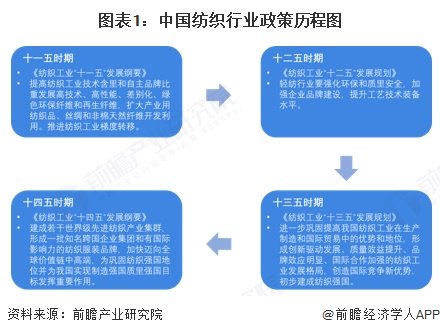
Core Viewpoint - The article discusses the evolution and current policies of China's textile industry, emphasizing the government's support for digital transformation, quality improvement, and sustainable development to enhance the industry's global competitiveness and achieve the goals of becoming a manufacturing and quality powerhouse [1][3]. Policy Evolution - During the "11th Five-Year Plan," the focus was on increasing the technological content and brand proportion in the textile industry, promoting high-tech and environmentally friendly fibers, and expanding the use of non-cotton natural fibers [1]. - The "12th Five-Year Plan" emphasized environmental protection, quality safety, and brand building within the light textile industry [1]. - The "13th Five-Year Plan" aimed to consolidate China's advantages in textile manufacturing and international trade, establishing the country as a textile powerhouse [1]. - The "14th Five-Year Plan" seeks to elevate the textile industry to a higher position in the global value chain, contributing to the goals of becoming a manufacturing and quality strong nation [1]. National Policy Summary and Interpretation - Recent national policies, such as the "Three-Year Action Plan for Digital Transformation of the Textile Industry (2022-2024)" and the "Implementation Plan for Quality Improvement and Upgrading of the Textile Industry (2023-2025)," provide a favorable macro environment and policy support for the industry's development [3][4]. - These policies aim to promote healthy and rapid development across various segments of the textile supply chain and enhance the industry's global competitiveness [3]. Key Policy Details - The "Implementation Plan" outlines goals for 2025, including: - R&D expenditure intensity of 1.3% for large-scale textile enterprises [8]. - 70% of large-scale textile enterprises achieving digital networking [8]. - Reduction in energy and water consumption per unit of industrial added value, along with continuous decreases in major pollutant emissions [8]. - Improvement in the quality and scale of recycled textile products, aiming to establish 20 globally recognized brands [8]. Key Tasks and Focus Areas - Accelerate innovation-driven development and enhance independent innovation capabilities by focusing on key technology breakthroughs and establishing industry innovation platforms [9]. - Promote high-end manufacturing in textiles and expand the application of functional chemical fibers across various sectors of the economy [9]. - Develop smart manufacturing and improve industry quality and efficiency through the adoption of digital technologies [9]. - Advance green and circular low-carbon development by promoting energy-saving and pollution-reducing technologies [9]. - Enhance the resilience of the supply system to meet and lead fashion consumption upgrades [9]. - Optimize regional industrial layouts and foster open cooperation within the textile industry [9]. Provincial Policy Summary - Various provinces have introduced policies to support the development of the textile industry, focusing on high-quality growth, digital transformation, and the promotion of environmentally friendly materials [12][14]. - For example, Guangdong aims to enhance the digital transformation of its textile industry by 2025, achieving over 60% integration of digital technologies [16].


保险业为低空经济织密“安全网”
Jin Rong Shi Bao· 2025-06-04 07:24
Core Viewpoint - The low-altitude economy in China is rapidly developing, with an annual growth rate exceeding 30%, creating a trillion-yuan market in the airspace below 1,000 meters. The insurance industry is evolving from a passive risk bearer to an active architect of the industry ecosystem, focusing on comprehensive risk management for the low-altitude economy [1]. Group 1: Industry Development - The low-altitude economy has established a complete industrial chain structure, including upstream research and manufacturing, midstream operation services, and downstream application scenarios. Any risk in these segments could lead to systemic impacts [2]. - The demand for low-altitude detection services has surged, with business volume in Chongqing increasing nearly twofold since 2025. However, equipment damage incidents remain a significant challenge [2]. - The introduction of the first "low-altitude aircraft onboard detection equipment loss compensation insurance" serves as a critical breakthrough in establishing a safety net for low-altitude equipment monitoring [2]. Group 2: Insurance Product Innovation - The "new comprehensive low-altitude economy insurance service system" has been developed, expanding coverage to include cargo transport, loss during downtime, and extended warranty responsibilities, thus creating a multi-scenario, full lifecycle risk protection system around eVTOL [3]. - The new insurance products aim to enhance the lifecycle and value retention of eVTOLs, providing significant support for the stability of low-altitude economy enterprises [3]. Group 3: Collaborative Ecosystem - The sustainable development of low-altitude economy insurance relies on deep collaboration in technology empowerment, data sharing, and institutional innovation. Recent developments indicate a shift from "single-point innovation" to "ecological co-construction" [4]. - The establishment of the "Bay Area Low Altitude Economy Research Institute" aims to create a unified low-altitude flight data platform and develop risk assessment models suitable for various scenarios [5]. - The collaboration between Zhongcai Property Insurance and Ping An Property Insurance to form a "New Emerging Risk Research Institute" will integrate resources to create innovative insurance products and service models for the low-altitude economy [5]. Group 4: Market Trends and Challenges - The current trends in low-altitude economy insurance include extending coverage upstream to encompass research, detection, and manufacturing, accelerating technology empowerment through big data and AI, and deepening ecological collaboration [7]. - National policies have been introduced to support the development of the low-altitude economy, with projections indicating that the market size could reach 1.5 trillion yuan by 2025 and 3.5 trillion yuan by 2035 [8]. - Challenges such as slow infrastructure development, weak core technologies, and an underdeveloped market system need to be addressed to enhance the insurance coverage and commercial applicability of low-altitude economy products [9][10].


2025年全球纺织发展现状分析:2024年全球纺织行业产值达1.07万亿美元
Qian Zhan Wang· 2025-05-25 05:06
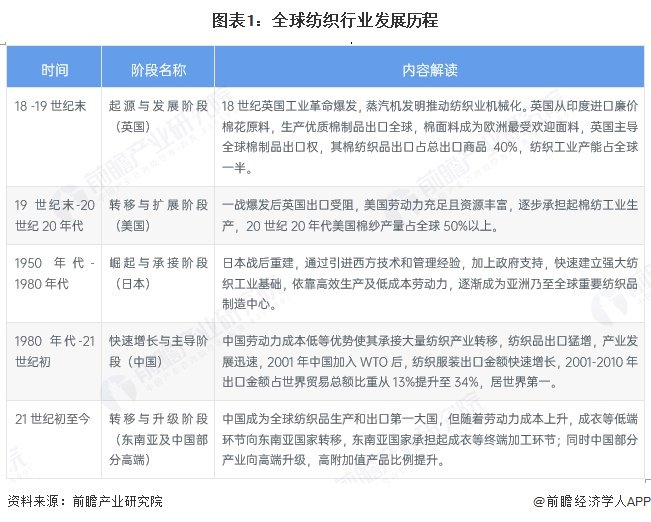
Core Insights - The global textile industry is experiencing a shift towards Southeast Asia, while parts of China's textile sector are upgrading to high-end production [1][4][5] Group 1: Historical Development - The textile industry originated during the 18th century with the British Industrial Revolution, where steam engines significantly increased production efficiency [2] - By the late 19th century, the U.S. began to take over cotton textile production due to labor and resource advantages, with U.S. cotton yarn production exceeding 50% of global output by the 1920s [2] - Japan established a strong textile industry post-World War II through Western technology and government support, becoming a key manufacturing center [2] - China emerged as the world's largest textile producer and exporter in the early 21st century, with textile and apparel exports rising from 13% to 34% of global trade from 2001 to 2010 [2] - Currently, as labor costs rise in China, low-end production is shifting to Southeast Asian countries, while China focuses on high-value products [2][4] Group 2: Market Size and Growth - The global textile industry market value is projected to reach $1.07 trillion in 2024, reflecting a year-on-year growth of approximately 2% [4][5] - The number of companies in the global textile market is estimated at 2.731 million, indicating a significant market presence [5] Group 3: Fiber Production - Global fiber production reached a record high of 124 million tons in 2023, up from 116 million tons in 2022, with polyester fibers accounting for 57% of total fiber production [7] Group 4: Market Structure - The global textile industry exhibits a low concentration level, characterized by a long-tail feature and fragmented competition, with over 3 million registered companies [10] - In the home textile sector, the top three companies hold only 2.31% market share, indicating a highly competitive environment [10] Group 5: Regional Contribution - East Asia dominates the global textile industry, accounting for $717.7 billion, or 66.89% of the total market value [12]
百隆东方: 百隆东方2024年年度权益分派实施公告
Zheng Quan Zhi Xing· 2025-05-22 09:11
Core Points - The company announced a cash dividend of 0.26 CNY per share for the fiscal year 2024, totaling approximately 389.89 million CNY to be distributed to shareholders [1][2] - The dividend distribution plan was approved at the annual shareholders' meeting held on May 9, 2025 [1] - The record date for the dividend is set for May 29, 2025, with the last trading day and ex-dividend date on May 30, 2025 [2] Dividend Distribution Details - The total number of shares for the dividend calculation is 1,499,569,000 [2] - The cash dividend will be distributed through the China Securities Depository and Clearing Corporation Limited Shanghai Branch to shareholders registered by the end of the trading day on the record date [2] - Shareholders who have not completed designated trading will have their dividends held by the clearing company until the trading is completed [2] Taxation Information - For individual shareholders and securities investment funds, the company will not withhold personal income tax at the time of dividend distribution, with the actual cash dividend being 0.26 CNY per share [3] - The tax burden for individual shareholders varies based on the holding period, with a maximum tax rate of 20% for holdings of one month or less, and a reduced rate of 10% for holdings between one month and one year [3] - For Qualified Foreign Institutional Investors (QFII), a 10% corporate income tax will be withheld, resulting in a net dividend of 0.234 CNY per share [4][5]
百隆东方(601339) - 百隆东方2024年年度权益分派实施公告
2025-05-22 09:00
证券代码:601339 证券简称:百隆东方 公告编号:2025-017 百隆东方股份有限公司2024年年度权益分派实施公告 本公司董事会及全体董事保证本公告内容不存在任何虚假记载、误导性陈述或者重大遗 漏,并对其内容的真实性、准确性和完整性承担法律责任。 重要内容提示: 每股分配比例 A 股每股现金红利0.26元 相关日期 | 股份类别 | 股权登记日 | 最后交易日 | 除权(息)日 | 现金红利发放日 | | --- | --- | --- | --- | --- | | A股 | 2025/5/29 | - | 2025/5/30 | 2025/5/30 | 差异化分红送转: 否 一、 通过分配方案的股东会届次和日期 本次利润分配方案经公司2025 年 5 月 9 日的2024年年度股东会审议通过。 二、 分配方案 本次利润分配以方案实施前的公司总股本1,499,569,000股为基数,每股派发 现金红利0.26元(含税),共计派发现金红利389,887,940.00元。 1 三、 相关日期 1. 发放年度:2024年年度 2. 分派对象: 截至股权登记日下午上海证券交易所收市后,在中国证券登记结算有限 ...
2025年中国纺织行业经营效益分析:行业盈利能力减弱,毛利率周期性波动显著
Qian Zhan Wang· 2025-05-21 07:12
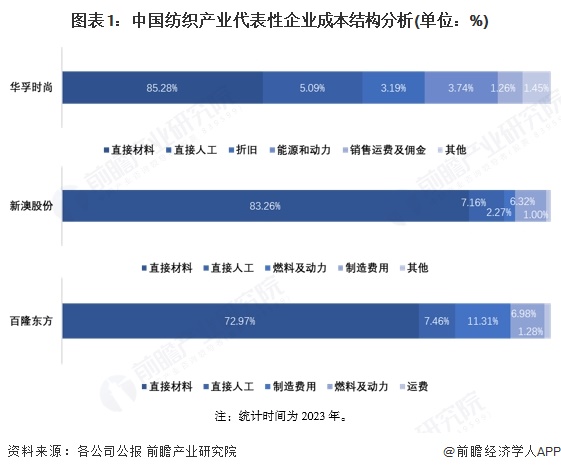
Group 1: Cost Structure Analysis - In the textile industry, direct material costs constitute the primary component of production costs, accounting for approximately 70%-85% of total costs, which significantly impacts pricing and profitability [1][4] - Fluctuations in raw material prices have a notable effect on cost control and profitability, leading companies to adopt strategies such as centralized purchasing, hedging, and advance stocking to mitigate risks [1] Group 2: Price Transmission Mechanism - The textile industry operates through a supply, manufacturing, and sales chain, where costs from the supply side, including raw materials and labor, are transmitted to the manufacturing side as production costs, which then influence consumer pricing through demand elasticity [4] Group 3: Value Distribution in the Textile Industry - Sales represent the most critical segment of the textile value chain, with downstream apparel and home textile brands holding significant bargaining power, while upstream suppliers have limited negotiation capabilities, resulting in intense price competition and low profitability for textile manufacturers [6] Group 4: Industry Operating Efficiency - From 2015 to 2023, the total profit of China's textile industry has shown a downward trend, indicating weakened profitability; however, in 2024, the total profit for textile enterprises (excluding apparel and chemical fiber) is projected to reach 86.87 billion yuan, reflecting a year-on-year increase of 3.5% after two consecutive years of decline [10] Group 5: Profitability of Textile Enterprises - The gross profit margin in the textile industry exhibits significant quarterly cyclicality, typically fluctuating between 10% and 12%, with November generally showing higher margins above 11%, while May and August tend to have lower margins due to seasonal production and sales factors [11]
百隆东方:公司国内外的产能利用率均接近或达到满产水平
news flash· 2025-05-19 10:10
智通财经5月19日电,百隆东方董事长兼总经理杨卫新在今天下午举行的2024年度暨2025年第一季度业 绩说明会上表示,"根据公司在手订单的生产排期,目前公司下属国内及越南工厂的产能利用率均接近 或达到满产水平。近三年,公司没有对美直接出口业务,此次美国的对等关税政策对公司没有直接影 响。但因美国加征关税会对全球纺织服装供应链造成较大影响,公司作为纺织服装供应链的上游企业, 会受到一定的间接影响。"(智通财经记者 汪斌) 百隆东方:公司国内外的产能利用率均接近或达到满产水平 ...
2025年中国纺织行业进出口现状分析:贸易金额持续顺差
Qian Zhan Wang· 2025-05-14 04:15
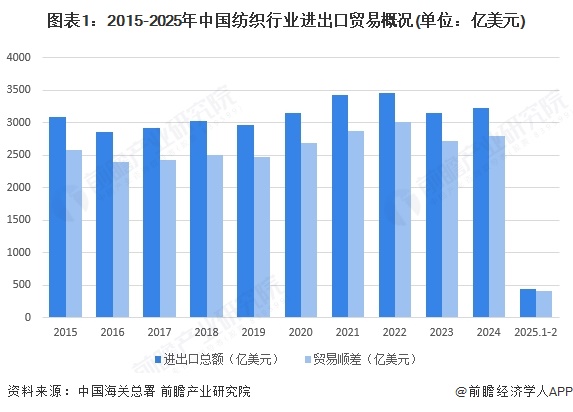
Textile Industry Overview - The textile industry in China has a wide range of products, with import and export statistics categorized under the HS codes specified by the World Customs Organization [1] - The total import and export value of the textile industry in China has shown significant fluctuations from 2015 to 2024, with a notable decline in trade scale in 2023 [2] Import Situation - From 2015 to 2024, the import value of China's textile industry fluctuated between 21 billion to 28 billion USD, peaking at 27.73 billion USD in 2021, a 20.2% increase year-on-year [4] - The textile imports have been on a downward trend from 2022 to 2024, with a significant drop of 58.1% in the first two months of 2025 compared to the same period last year [4] Export Situation - The export scale of China's textile industry has remained substantial, consistently around 300 billion USD over the past decade, increasing from 262.87 billion USD in 2016 to 323.34 billion USD in 2022, with a compound annual growth rate of 3.51% [8] - In 2023, exports to major markets such as the US, EU, and Japan decreased by 9.2%, but are projected to rebound to 301.10 billion USD in 2024, a 2.5% increase year-on-year [11] - The export value in the first two months of 2025 was 42.88 billion USD, reflecting a 4.9% decline compared to the same period in 2024 [11] Price Trends - The price index for imported textile products has shown fluctuations, with a maximum variation of less than 10% from 2015 to 2024, and a 2.47% decrease in 2024 compared to the previous year [6] - The export price index for textile products has also experienced volatility, with a notable increase of 10.27% in December 2022, while the index for 2024 was recorded at 94.03, indicating a decline for two consecutive years [12]
百隆东方: 百隆东方2024年年度股东大会法律意见书
Zheng Quan Zhi Xing· 2025-05-09 10:27
Core Viewpoint - The legal opinion letter confirms that the procedures for convening and holding the 2024 annual general meeting of Baolong Oriental Co., Ltd. comply with relevant laws and regulations, ensuring the legitimacy and effectiveness of the meeting and its resolutions [1][7]. Group 1: Meeting Procedures - The board of directors published a notice regarding the 2024 annual general meeting on April 16, 2025, detailing the meeting's time, location, and voting methods [3][4]. - The meeting was held on May 9, 2025, at 14:00, presided over by the chairman, Yang Weixin [4]. - The voting process included both on-site and online voting, with specific timeframes and procedures outlined in the meeting notice [4][5]. Group 2: Attendance and Qualifications - Eligible attendees included all shareholders registered with the China Securities Depository and Clearing Corporation as of May 6, 2025, along with the company's directors, supervisors, senior management, and appointed lawyers [5]. - A total of 309 attendees participated, representing 1,164,753,499 shares, which accounted for 77.6725% of the total shares with voting rights [5]. Group 3: Voting Procedures and Results - The meeting utilized a combination of on-site and online voting for the proposed resolutions, with results being counted and announced immediately after voting concluded [6]. - All proposed resolutions were approved, and the voting results were consistent with the stipulations of the company's articles of association [7]. - The legal opinion confirms that the voting procedures and results adhered to the relevant legal and regulatory requirements [7].
百隆东方(601339) - 百隆东方2024年年度股东大会法律意见书
2025-05-09 10:00
国浩律师(杭州)事务所 百隆东方 2024 年年度股东大会法律意见书 国浩律师(杭州)事务所 关 于 百隆东方股份有限公司 2024 年年度股东大会 法律意见书 致:百隆东方股份有限公司 国浩律师(杭州)事务所(以下简称"本所")接受百隆东方股份有限公司 (以下简称"公司")委托,指派律师出席公司 2024 年年度股东大会(以下简称 "本次股东大会"),并依据《中华人民共和国公司法》(以下简称"《公司法》")、 《中华人民共和国证券法》(以下简称"《证券法》")、中国证券监督管理委员会 (以下简称"中国证监会")发布的《上市公司股东会规则》(以下简称"《股东 会规则》")、《上市公司治理准则》(以下简称"《治理准则》")等法律、行政法规、 规范性文件及现行有效的《百隆东方股份有限公司章程》(以下简称"《公司章 程》")、《百隆东方股份有限公司股东大会议事规则》(以下简称"《股东大会议事 规则》")的规定,就本次股东大会的召集、召开程序、出席会议人员资格、召集 人资格、会议的表决程序、表决结果等事宜出具法律意见书。 为出具本法律意见书,本所律师出席了公司本次股东大会,审查了公司提供 的本次股东大会的有关文件的原 ...