
ICBC(601398)

Search documents
【银行】G-SIBs整体排名提升,工商银行晋档3组——中资银行2025年全球系统重要性银行G-SIBs排名点评(王一峰/董文欣)
光大证券研究· 2025-12-01 23:04
Core Viewpoint - The Financial Stability Board (FSB) has released the 2025 Global Systemically Important Banks (G-SIBs) list, with five major Chinese banks included, and the Industrial and Commercial Bank of China (ICBC) has been upgraded from Group 2 to Group 3 [4][5]. Group 1: G-SIBs List and Rankings - Five major Chinese banks, including ICBC, Bank of China, China Construction Bank, Agricultural Bank of China, and Bank of Communications, are included in the 2025 G-SIBs list [5]. - ICBC's capital requirement has increased by 0.5 percentage points due to its upgrade to Group 3, raising its additional capital requirement from 1.5% to 2% [5]. - Other four major banks maintain their additional capital requirements at 1.5%, while Bank of Communications remains at 1% [5]. Group 2: Score Changes and Future Prospects - The scores of the five major banks have increased by 9 to 33 points, indicating a potential for Bank of China to be upgraded in the future [5]. - ICBC and Bank of China scored above 300 points, with ICBC's score rising by 33 points to 332 and Bank of China's by 32 points to 314, just 16 points away from the Group 3 threshold [5]. - Agricultural Bank of China and China Construction Bank scored 272 and 259 points respectively, with stable group expectations in the short term [5]. - Bank of Communications scored 138 points, an increase of 9 points, remaining in Group 1 [5]. Group 3: Potential for Other Banks - The likelihood of China Merchants Bank entering the G-SIBs list has significantly increased, with its score rising by 19 points to 122, just 8 points shy of Group 1 [6]. - Other banks such as Industrial Bank and CITIC Bank have maintained stable scores, while Shanghai Pudong Development Bank's score has remained unchanged [6]. Group 4: Capital Adequacy and Regulatory Compliance - After the upgrade, ICBC's core Tier 1 capital adequacy ratio requirement increases to 9.5%, while its actual ratio stands at 13.6%, providing a buffer of 4.1 percentage points [7]. - All major banks meet the G-SIBs regulatory requirements, with safety margins ranging from 0.8 to 5.4 percentage points [7]. - The total loss-absorbing capacity (TLAC) requirements are also being met, with ICBC's total capital adequacy ratio at 19%, exceeding the required thresholds [7].

12月指数定期调样的影响估算




HTSC· 2025-12-01 12:34
Quantitative Models and Construction Methods 1. Model Name: Liquidity Impact Coefficient Model - **Model Construction Idea**: This model measures the liquidity impact of index adjustments on individual stocks by calculating the ratio of net fund flows to the stock's recent average daily trading volume[12][13] - **Model Construction Process**: The liquidity impact coefficient for a stock is calculated as follows: $$ impact_{i} = \sum_{k=1}^{N} \frac{\Delta weight_{k,i} \times AUM_{k}}{amt\_avg_{i,20}} $$ - \( \Delta weight_{k,i} \): Estimated weight change of stock \( i \) in index \( k \) - \( AUM_{k} \): Total assets under management of passive products tracking index \( k \) as of the end of November - \( amt\_avg_{i,20} \): Average daily trading volume of stock \( i \) over the past 20 trading days as of the end of November[12][13] - **Model Evaluation**: The model provides a quantitative framework to estimate short-term liquidity shocks caused by index adjustments, but it is subject to data discrepancies and assumptions, which may lead to deviations from actual results[13] --- Model Backtesting Results Liquidity Impact Coefficient Model - **Top 5 Stocks with Highest Positive Impact Coefficients**: - Zhangjiagang Bank (002839 CH): 11.55[15] - Jiangzhong Pharmaceutical (600750 CH): 11.44[15] - Tower Group (002233 CH): 11.04[15] - Jichuan Pharmaceutical (600566 CH): 10.14[15] - Zhengbang Technology (002157 CH): 9.99[15] - **Top 5 Stocks with Highest Negative Impact Coefficients**: - Shenzhen Expressway (600548 CH): -24.95[16] - Vanward Electric (002543 CH): -20.90[16] - Aviation Materials (688563 CH): -14.06[16] - Huaxi Biology (688363 CH): -10.81[16] - Ninghu Expressway (600377 CH): -10.54[16] --- Quantitative Factors and Construction Methods 1. Factor Name: Net Fund Flow Factor - **Factor Construction Idea**: This factor estimates the net fund inflow or outflow for stocks due to index adjustments, based on changes in index weights and the total AUM of passive products tracking the index[9][10] - **Factor Construction Process**: - Outflow Amount: Total AUM of linked products multiplied by the stock's actual weight in the index as of the end of November - Inflow Amount: Total AUM of linked products multiplied by the estimated weight of the stock in the index post-adjustment - Weight estimation is based on free-float market capitalization and index-specific weighting rules, such as dividend yield weighting or market capitalization weighting[9][10] - **Factor Evaluation**: The factor provides a transparent and systematic approach to estimate fund flows, but it is sensitive to assumptions about future index weights and AUM changes[9][10] --- Factor Backtesting Results Net Fund Flow Factor - **Top 5 Stocks with Highest Net Fund Inflows**: - Victory Precision (300476 CH): 112.61 billion CNY[10] - Dongshan Precision (002384 CH): 99.32 billion CNY[10] - Guangqi Technology (002625 CH): 77.81 billion CNY[10] - Sugon Information (603019 CH): 65.44 billion CNY[10] - Top Group (601689 CH): 53.07 billion CNY[10] - **Top 5 Stocks with Highest Net Fund Outflows**: - China Mobile (600941 CH): -40.02 billion CNY[11] - CRRC Corporation (601766 CH): -36.40 billion CNY[11] - Aluminum Corporation of China (601600 CH): -34.29 billion CNY[11] - TCL Zhonghuan (002129 CH): -30.07 billion CNY[11] - Huagong Tech (000988 CH): -27.44 billion CNY[11]
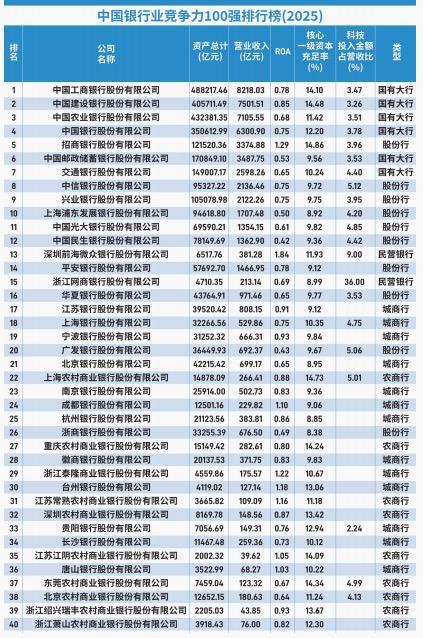
《2025中国银行业竞争力100强》发布,浙江16家银行上榜
2 1 Shi Ji Jing Ji Bao Dao· 2025-12-01 11:13
Core Insights - The "2025 China Banking Competitiveness Report" was released at the 21st Century Financial Annual Conference, highlighting the competitive landscape of the banking sector in China [1] - A total of 16 banks from Zhejiang province made it to the "Top 100 Competitiveness Rankings of Chinese Banks" [1] Rankings Overview - The rankings include 6 state-owned banks, 12 national joint-stock banks, 53 city commercial banks, 27 rural commercial banks, and 2 private banks, with 5 foreign banks also making the list [2][4] - The top three banks are Industrial and Commercial Bank of China, China Construction Bank, and Agricultural Bank of China, with total assets of 488.22 billion, 405.71 billion, and 532.38 billion respectively [2] Evaluation Framework - The evaluation framework consists of four categories: scale, profitability, stability, and growth, based on objective data from the 2024 annual reports [4] - Sub-rankings for scale, profitability, and growth provide a more detailed view of different types of banks' performances [4] Regional Insights - Zhejiang province's banks, such as Zhejiang Commercial Bank, ranked 26th, while Zhejiang Internet Bank and WeBank were the only two private banks to make the list, ranking 15th and 16th respectively [4][5] - City commercial banks from Zhejiang, including Ningbo Bank and Hangzhou Bank, ranked 19th and 25th, respectively, indicating a strong regional presence [5] Development Trends - The asset scale of China's banking industry continues to expand, with state-owned banks showing significant scale advantages, while smaller banks adopt differentiated growth strategies [6] - Profitability indicators show a widening gap, with larger banks benefiting from scale effects, while smaller banks face challenges due to factors like reduced loan prime rates [6] - Growth indicators reflect the potential for banks, focusing on core tier one capital adequacy, cost-to-income ratios, revenue growth, and technology investment [6]



透视上市银行盈利能力丨银行与保险
清华金融评论· 2025-12-01 10:46
Core Viewpoint - The overall performance of A-share listed banks shows a recovery in both revenue and net profit, with state-owned banks maintaining significant profitability, while the return on equity (ROE) continues to decline across the sector [2]. Revenue Performance - The revenue of listed banks is generally stable with internal differentiation, and state-owned banks continue to stand out [3]. - Over 60% of banks reported positive revenue growth in Q3 2025, with 29 banks showing growth and 13 experiencing declines [4]. - The six major state-owned banks achieved a total revenue of CNY 2.72 trillion, a year-on-year increase of 1.87% in Q3 2025, with all six banks reporting growth [4]. - Among the four major banks, Industrial and Commercial Bank of China (ICBC) had the highest revenue at CNY 821.80 billion, up 2.17% year-on-year [4]. - Joint-stock banks reported a total revenue of CNY 1.12 trillion, a decline of 2.56% year-on-year, with only two banks showing revenue growth [5][6]. - City commercial banks collectively generated CNY 402.08 billion in revenue, a year-on-year increase of 4.67%, with 14 out of 17 banks reporting growth [7]. - Rural commercial banks saw a slight decline in revenue, totaling CNY 790.64 billion, with 10 banks reporting a minor decrease of 0.03% year-on-year [8]. Net Profit Performance - The net profit of listed banks steadily increased, with 35 banks reporting year-on-year growth and 7 experiencing declines [10]. - The six major state-owned banks reported a combined net profit of CNY 1.09 trillion, a year-on-year increase of 1.32% in Q3 2025, with all six banks achieving positive growth [10]. - ICBC led the state-owned banks with a net profit of CNY 271.88 billion, up 0.52% year-on-year [10]. - Joint-stock banks collectively reported a net profit of CNY 406.10 billion, a slight decline of 0.10% year-on-year, with only four banks showing profit growth [11]. - City commercial banks achieved a net profit of CNY 173.60 billion, reflecting a year-on-year increase of 6.79%, with 16 banks reporting growth [12]. - Rural commercial banks reported a total net profit of CNY 377.78 billion, a year-on-year increase of 3.41%, with most banks showing varying degrees of growth [13]. Return on Equity (ROE) - The overall ROE for listed banks continued to decline, with only one bank exceeding the regulatory benchmark of 11% [14]. - Among state-owned banks, none met the 11% ROE requirement, with the highest being Construction Bank at 7.40% [15]. - Joint-stock banks also fell short of the 11% benchmark, with the best performer, China Merchants Bank, achieving an ROE of 9.13% [15]. - City commercial banks did not meet the 11% standard either, with only two banks exceeding 10% [16]. - In the rural commercial bank sector, only one bank met the regulatory requirement, with Jiangsu Changshu Rural Commercial Bank leading at 11.36% [18].



广东工行以金融助力赛事经济融入大湾区发展
Zhong Guo Jin Rong Xin Xi Wang· 2025-12-01 10:20
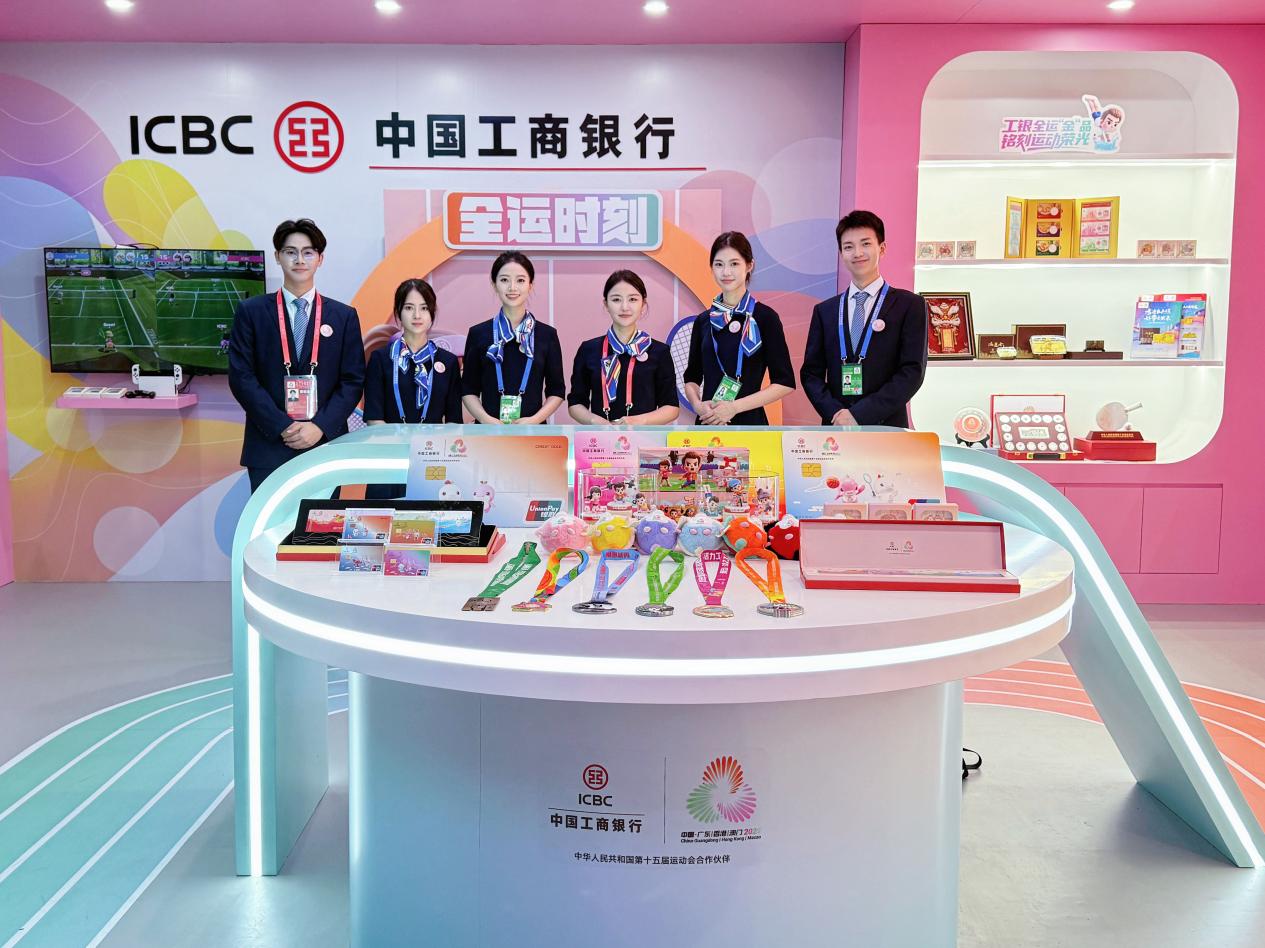
Core Insights - The 15th National Games successfully concluded on November 21, 2025, with Industrial and Commercial Bank of China (ICBC) Guangdong Branch providing comprehensive financial services to support the event and further integrate into the Guangdong-Hong Kong-Macao Greater Bay Area development [1] Group 1: Integrated Services - ICBC is actively involved in the Greater Bay Area construction, establishing a collaborative service system led by its Guangdong Branch, covering seven regional institutions to enhance infrastructure, industrial collaboration, and financial connectivity [3] - The bank provided all-around financial support during the National Games from four dimensions: serving the event, the public, the economy, and society [5] Group 2: Cross-Border Financial Services - ICBC Guangdong Branch launched the "Bay Area Pass" service in collaboration with Hong Kong and Macao institutions, facilitating cross-border fund flows and enhancing payment convenience, with over 30 billion yuan in cross-border investments and small fund transfers [6] - The bank deployed 4,000 self-service banking devices supporting foreign cards during the event, enhancing payment convenience for participants and visitors [6] Group 3: Support for Real Economy - The bank is focusing on providing financial support for industrial transfer, infrastructure, and cross-border e-commerce, with a commitment to invest 15 billion yuan in special credit funds for key areas related to the National Games [7] - ICBC is prioritizing financing for renewable energy transportation projects in line with the "green event" concept and assisting in the issuance of offshore RMB government bonds to support infrastructure development [7] Group 4: Consumer Engagement - ICBC has created a comprehensive payment matrix for event ticket sales, supporting various payment methods to enhance the experience for participants and tourists [8] - The bank introduced special financial products for the National Games, including themed cards and digital collectibles, and allocated 300 million yuan for consumer subsidies to promote tourism and related activities [9]
立减金、组合礼扎堆!银行个人养老金开启年末冲刺
Hua Xia Shi Bao· 2025-12-01 09:36
Core Insights - Banks are intensifying promotional activities for personal pension accounts, focusing on customer retention and active participation rather than just attracting new accounts [3][6][7] Group 1: Promotional Strategies - Major banks, including China Bank and Industrial and Commercial Bank, are offering various incentives such as WeChat discounts and cash rewards to encourage account opening and contributions [4][5] - The promotional focus has shifted from merely attracting new customers to enhancing customer experience and retention, as many accounts remain inactive after initial opening [3][6] Group 2: Customer Behavior and Market Trends - There is a prevalent issue of "high account openings but low contributions," with many customers opening accounts for short-term rewards but not actively contributing [7][8] - A report indicates that as of November 2024, only 21% of personal pension account holders are making contributions, despite a significant number of accounts being opened [7][8] Group 3: Regulatory and Competitive Landscape - The regulatory framework allows individuals to open only one personal pension account with a commercial bank, intensifying competition among banks to attract customers [5][8] - Banks are innovating their services, such as introducing appointment-based contribution options, to lower barriers for customers and encourage ongoing contributions [9][10]

我国5家银行入选2025年G-SIB名单 分析称未来继续看好银行板块
Zhong Guo Jing Ying Bao· 2025-12-01 09:21
Group 1 - The Financial Stability Board (FSB) announced the 2025 list of Global Systemically Important Banks (G-SIBs), with five Chinese banks included, maintaining the same number as the previous year [1] - Industrial and Commercial Bank of China (ICBC) has been upgraded to the third group with an additional capital requirement of 2.0%, while Bank of China, Agricultural Bank of China, and China Construction Bank remain in the second group with a requirement of 1.5%, and Bank of Communications stays in the first group with a requirement of 1% [1] - Following the upgrade, ICBC's core Tier 1 capital adequacy ratio regulatory requirement increases from 9% to 9.5%, with a current ratio of 13.6%, providing a buffer of 4.6 percentage points [1] Group 2 - Fitch Ratings noted that the scoring changes for Chinese G-SIBs in 2025 show that scale is no longer the primary driver for score increases, and exchange rate effects have positively influenced scores [2] - The Basel Committee plans to adjust the framework for identifying G-SIBs from year-end static data to annual average calculations, which may reduce data volatility and limit the impact on most banks, although institutions near threshold levels may experience changes [2] - The increase in global systemic importance reflects the fundamental strength of large banks, with scores for the five major banks rising between 9 to 33 points, and Bank of China is likely to be upgraded soon [2] Group 3 - The banking sector is viewed positively for long-term investment, with a high dividend strategy still having room for growth amid an "asset shortage" environment, suggesting a continuation of structural market trends [3]
工商银行(601398) - 工商银行H股公告
2025-12-01 09:15
致:香港交易及結算所有限公司 股份發行人及根據《上市規則》第十九B章上市的香港預託證券發行人的證券變動月報表 截至月份: 2025年11月30日 狀態: 新提交 公司名稱: 中國工商銀行股份有限公司 呈交日期: 2025年12月1日 I. 法定/註冊股本變動 | 1. 股份分類 | 普通股 | 股份類別 | H | | 於香港聯交所上市 (註1) | | 是 | | | --- | --- | --- | --- | --- | --- | --- | --- | --- | | 證券代號 (如上市) | 01398 | 說明 | | | | | | | | | | 法定/註冊股份數目 | | | 面值 | | 法定/註冊股本 | | | 上月底結存 | | | 86,794,044,550 | RMB | | 1 RMB | | 86,794,044,550 | | 增加 / 減少 (-) | | | 0 | | | RMB | | 0 | | 本月底結存 | | | 86,794,044,550 | RMB | | 1 RMB | | 86,794,044,550 | | 2. 股份分類 | 普通股 | ...
国有大型银行板块12月1日跌0.26%,农业银行领跌,主力资金净流出3.48亿元
Zheng Xing Xing Ye Ri Bao· 2025-12-01 09:09
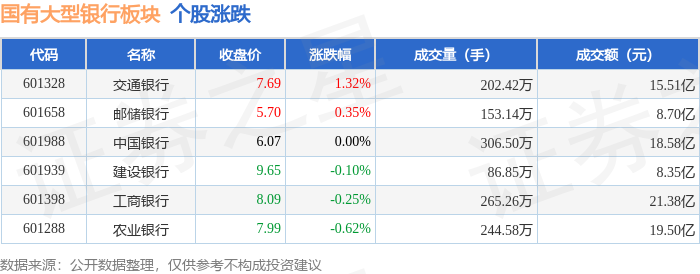
证券之星消息,12月1日国有大型银行板块较上一交易日下跌0.26%,农业银行领跌。当日上证指数报收 于3914.01,上涨0.65%。深证成指报收于13146.72,上涨1.25%。国有大型银行板块个股涨跌见下表: | 代码 | 名称 | 收盘价 | 涨跌幅 | 成交量(手) | 成交额(元) | | | --- | --- | --- | --- | --- | --- | --- | | 601328 | 交通银行 | 7.69 | 1.32% | 202.42万 | | 15.51 Z | | 601658 | 邮储银行 | 5.70 | 0.35% | 153.14万 | | 8.70 Z | | 601988 | 中国银行 | 6.07 | 0.00% | 306.50万 | | 18.58 Z | | 666109 | 建设银行 | 9.65 | -0.10% | 86.85万 | | 8.35 Z | | 601398 | 工商银行 | 8.09 | -0.25% | 265.26万 | | 21.38 Z | | 601288 | 农业银行 | 7.99 | -0.62% | 244.58万 ...


工商银行(01398) - 截至二零二五年十一月三十日止股份发行人的证券变动月报表
2025-12-01 08:51
致:香港交易及結算所有限公司 股份發行人及根據《上市規則》第十九B章上市的香港預託證券發行人的證券變動月報表 截至月份: 2025年11月30日 狀態: 新提交 公司名稱: 中國工商銀行股份有限公司 呈交日期: 2025年12月1日 | 1. 股份分類 | 普通股 | 股份類別 | H | | 於香港聯交所上市 (註1) | | 是 | | | --- | --- | --- | --- | --- | --- | --- | --- | --- | | 證券代號 (如上市) | 01398 | 說明 | | | | | | | | | | 法定/註冊股份數目 | | | 面值 | | 法定/註冊股本 | | | 上月底結存 | | | 86,794,044,550 | RMB | | 1 RMB | | 86,794,044,550 | | 增加 / 減少 (-) | | | 0 | | | RMB | | 0 | | 本月底結存 | | | 86,794,044,550 | RMB | | 1 RMB | | 86,794,044,550 | | 2. 股份分類 | 普通股 | 股份類別 A | | | ...