
ICBC(601398)

Search documents
“存款搬家”主要是结构调整,而非系统性的流动性迁移
2 1 Shi Ji Jing Ji Bao Dao· 2026-02-13 10:56
Core Viewpoint - The rapid growth of non-bank financial institution deposits in China reflects a significant shift in the financial landscape, driven by factors such as the deepening of financial market reforms, the demand for wealth management, and the challenges posed to banks' liquidity management and profitability strategies [1][5]. Group 1: Non-Bank Deposit Growth - By the end of 2025, the balance of deposits in non-bank financial institutions reached 34.6 trillion yuan, a year-on-year increase of 22.8%, marking the highest growth in a decade [1]. - The increase in non-bank deposits is attributed to a "deposit migration" phenomenon, where residents and enterprises reallocate funds from traditional bank deposits to higher-yielding financial products like wealth management and funds [2][3]. - The balance of asset management products sourced from households and enterprises reached 56.3 trillion yuan by the end of 2025, growing by 9.7% year-on-year, indicating a clear trend of wealth migration from traditional deposits to asset management products [3]. Group 2: Impact on Banking Sector - The rapid growth of non-bank deposits has altered the liability structure of banks, with household and enterprise deposits decreasing in proportion while non-bank deposits are on the rise [6]. - Non-bank deposits are characterized by higher volatility and uncertainty compared to traditional deposits, necessitating enhanced liquidity management by banks [7]. - The increase in non-bank deposits poses challenges to banks' net interest margins and profitability, as the decline in deposit rates does not match the decrease in asset yields [7][8]. Group 3: Risk Management and Regulatory Response - The rise of non-bank deposits requires banks to expand their risk management frameworks to include monitoring of the asset management industry and systemic risks in financial markets [8]. - The People's Bank of China has accelerated the improvement of macro-prudential management frameworks, indicating a heightened focus on systemic risks associated with non-bank financial institutions [8]. - Banks are advised to enhance their liquidity risk management systems and conduct regular stress tests to prepare for potential scenarios of rapid deposit migration [15][16].

工商银行:2月13日召开董事会会议
Mei Ri Jing Ji Xin Wen· 2026-02-13 10:53
Group 1 - The core point of the article highlights the significant fluctuations in the company's net profit, which surged ninefold before unexpectedly reporting a loss exceeding 200 million [1] - The company’s chairman has personally injected 50 million into the business to cover the financial shortfall, raising questions about the company's financial health and management decisions [1] - There is uncertainty regarding the whereabouts of 5 billion in trust financial products, leading to confusion among shareholders [1] Group 2 - The company’s board meeting was held on February 13, 2026, to review the annual operational plan for inclusive finance [1] - The meeting took place at the company's headquarters located at 55 Fuxingmennei Street, Xicheng District, Beijing [1] - The announcement of the board meeting indicates ongoing strategic planning within the company despite recent financial challenges [1]
最新21家系统重要性银行名单出炉
Di Yi Cai Jing Zi Xun· 2026-02-13 10:53
Core Viewpoint - The People's Bank of China and the National Financial Regulatory Administration have published the list of systemically important banks for 2025, identifying 21 domestic banks, with Zheshang Bank newly included, indicating an increase in its systemic importance [3][4]. Group 1: Systemically Important Banks - The 2025 list includes 21 systemically important banks: 6 state-owned commercial banks, 10 joint-stock commercial banks, and 5 city commercial banks [3]. - Zheshang Bank's inclusion in the list signifies its rising importance within the banking system [3]. - The banks are categorized into five groups based on their systemic importance scores, with the first group containing 11 banks, including Zheshang Bank, and the fifth group having no banks [3]. Group 2: Regulatory Framework - Systemically important banks are characterized by their large scale and significant role in the financial system, leading to stricter regulatory measures to ensure stability and prevent financial risks [4]. - The People's Bank of China and the National Financial Regulatory Administration will continue to enhance the additional regulatory framework for systemically important banks to promote their safe and sound operation [4].





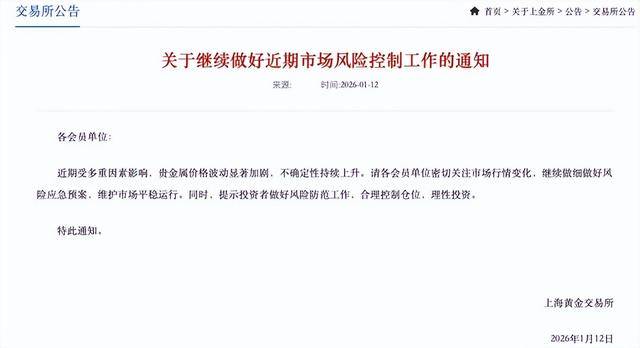
金银还能不能买?答案只有一个:看你是想配置保险,还是想赌短线
Sou Hu Cai Jing· 2026-02-13 10:46
Core Viewpoint - The gold and silver markets have experienced significant volatility in early 2026, with gold prices surpassing $5000 per ounce and silver prices increasing nearly 8% in a single day, prompting regulatory bodies to implement stricter risk management measures [1][2]. Market Dynamics - The recent surge in gold and silver prices has led to a series of adjustments in trading regulations, including higher margin requirements and revised price fluctuation limits, indicating a recognized shift into a high volatility zone [1][5]. - The Shanghai Gold Exchange and the Shanghai Futures Exchange have both issued notifications regarding adjustments to margin and trading limits for silver contracts, reflecting the increased market volatility [1]. Regulatory Actions - Financial institutions, including banks, have raised the minimum investment thresholds for precious metals, with examples such as Industrial Bank increasing the starting point for accumulation gold from 1200 yuan to 1400 yuan, emphasizing the need for cautious investment strategies [5][6]. - The adjustments made by banks aim to mitigate risks associated with concentrated buying and selling during periods of high volatility, indicating a proactive approach to managing investor behavior [5]. Investment Strategies - For ordinary investors, gold and silver should not be viewed as short-term speculative assets but rather as long-term hedges against extreme risks, especially in uncertain macroeconomic environments [8][9]. - The People's Bank of China has been increasing its gold reserves, which reflects a strategic preference for gold as a long-term asset rather than a short-term trading tool [8]. Investment Tools - Different investment vehicles are available for gold and silver, including ETFs, accumulation gold, and physical gold, each with distinct risk profiles and suitability for various investor strategies [11][12]. - ETFs are recommended for those looking to track gold prices with lower risk, while accumulation gold allows for smaller, incremental investments, though recent changes in bank policies require investors to adapt to new rules [12]. - Physical gold is considered a safe asset for long-term holding, while leveraged tools like futures and options are deemed risky for ordinary investors due to the potential for significant losses in volatile markets [12][14].

人民银行、国家金融监管总局发布我国系统重要性银行名单,共计21家
Bei Jing Shang Bao· 2026-02-13 10:39
Core Viewpoint - The People's Bank of China and the National Financial Regulatory Administration have conducted an assessment of systemically important banks for 2025, identifying 21 domestic banks that play a crucial role in the financial system [1] Group 1: Identification of Systemically Important Banks - A total of 21 domestic banks have been recognized as systemically important, including 6 state-owned commercial banks, 10 joint-stock commercial banks, and 5 city commercial banks [1] - The banks are categorized into five groups based on their systemic importance scores, with the first group consisting of 11 banks, the second group having 4 banks, the third group with 2 banks, the fourth group containing 4 banks, and no banks in the fifth group [1] Group 2: Breakdown of Banks by Group - Group 1 includes: China Minsheng Bank, China Everbright Bank, Ping An Bank, Huaxia Bank, Ningbo Bank, Jiangsu Bank, Beijing Bank, Nanjing Bank, Guangfa Bank, Zheshang Bank, and Shanghai Bank [1] - Group 2 includes: Industrial Bank, China CITIC Bank, Shanghai Pudong Development Bank, and China Postal Savings Bank [1] - Group 3 includes: Bank of Communications and China Merchants Bank [1] - Group 4 includes: Industrial and Commercial Bank of China, Bank of China, China Construction Bank, and Agricultural Bank of China [1] Group 3: Future Regulatory Actions - The People's Bank of China and the National Financial Regulatory Administration will implement additional regulatory measures for systemically important banks according to the "Regulations on Additional Supervision of Systemically Important Banks (Trial)" [1] - The aim is to enhance macro-prudential management and micro-prudential supervision, ensuring the safe and sound operation of systemically important banks and better supporting the high-quality development of the real economy [1]
央行、金融监管总局发布我国系统重要性银行名单!工行、农行、中行、建行、交行、邮储银行、招行、宁波银行等21家银行在列
Mei Ri Jing Ji Xin Wen· 2026-02-13 10:33
Core Viewpoint - The People's Bank of China and the National Financial Regulatory Administration have conducted an assessment of systemically important banks for 2025, identifying 21 domestic banks as systemically important, which includes 6 state-owned commercial banks, 10 joint-stock commercial banks, and 5 city commercial banks [1] Group 1: Assessment Results - The identified 21 systemically important banks are categorized into five groups based on their systemic importance scores [2] - Group 1 consists of 11 banks, including China Minsheng Bank, China Everbright Bank, Ping An Bank, Huaxia Bank, Ningbo Bank, Jiangsu Bank, Beijing Bank, Nanjing Bank, Guangfa Bank, Zheshang Bank, and Shanghai Bank [2] - Group 2 includes 4 banks: Industrial Bank, China CITIC Bank, Shanghai Pudong Development Bank, and China Postal Savings Bank [2] - Group 3 has 2 banks: Bank of Communications and China Merchants Bank [2] - Group 4 consists of 4 major banks: Industrial and Commercial Bank of China, Bank of China, China Construction Bank, and Agricultural Bank of China [2] - Group 5 currently has no banks included [2] Group 2: Regulatory Actions - The People's Bank of China and the National Financial Regulatory Administration will implement additional regulatory measures for systemically important banks according to the "Regulations on Additional Supervision of Systemically Important Banks (Trial)" [2] - The aim is to enhance macro-prudential management and micro-prudential supervision, ensuring the safe and sound operation of systemically important banks [2] - This initiative is intended to better support the high-quality development of the real economy [2]


我国21家系统重要性银行名单公布
2 1 Shi Ji Jing Ji Bao Dao· 2026-02-13 10:23
第五组暂无银行进入。 按系统重要性得分从低到高分为五组: 第一组11家,包括中国民生银行、中国光大银行、平安银行、华夏银行、宁波银行、江苏银行、北京银 行、南京银行、广发银行、浙商银行、上海银行; 第二组4家,包括兴业银行、中信银行、浦发银行、中国邮政储蓄银行; 第三组2家,包括交通银行、招商银行; 第四组4家,包括中国工商银行、中国银行、中国建设银行、中国农业银行; 2月13日,据央行网站,为构建覆盖全面的宏观审慎管理体系,强化系统重要性金融机构监管,根据 《系统重要性银行评估办法》,近期中国人民银行、国家金融监督管理总局开展了2025年度我国系统重 要性银行评估,认定21家国内系统重要性银行,其中国有商业银行6家,股份制商业银行10家,城市商 业银行5家。 下一步,中国人民银行、国家金融监督管理总局将按照《系统重要性银行附加监管规定(试行)》要 求,发挥好宏观审慎管理与微观审慎监管合力,持续夯实系统重要性银行附加监管,促进系统重要性银 行安全稳健经营和健康发展,更好服务实体经济高质量发展。 SFC 出品丨21财经客户端 21世纪经济报道 编辑丨黎雨桐 ...
我国21家系统重要性银行名单公布
21世纪经济报道· 2026-02-13 10:14
按系统重要性得分从低到高分为五组: 第一组11家,包括中国民生银行、中国光大银行、平安银行、华夏银行、宁波银行、江苏银 行、北京银行、南京银行、广发银行、浙商银行、上海银行; 2月13日,据央行网站,为构建覆盖全面的宏观审慎管理体系,强化系统重要性金融机构监 管,根据《系统重要性银行评估办法》,近期中国人民银行、国家金融监督管理总局开展了 2025年度我国系统重要性银行评估, 认定21家国内系统重要性银行,其中国有商业银行6家, 股份制商业银行10家,城市商业银行5家。 第四组4家,包括中国工商银行、中国银行、中国建设银行、中国农业银行; 第五组暂无银行进入。 下一步,中国人民银行、国家金融监督管理总局将按照《系统重要性银行附加监管规定(试 行)》要求,发挥好宏观审慎管理与微观审慎监管合力,持续夯实系统重要性银行附加监管, 促进系统重要性银行安全稳健经营和健康发展,更好服务实体经济高质量发展。 出品丨21财经客户端 21世纪经济报道 编辑丨黎雨桐 蛇年A股第一牛股,狂飙1836% 一线城市二手房价降幅明显收窄 深圳对黄金市场划定十条红线 SFC 21君荐读 第二组4家,包括兴业银行、中信银行、浦发银行、中国邮 ...

两部门发布我国系统重要性银行名单
Xin Lang Cai Jing· 2026-02-13 10:06
Core Viewpoint - The People's Bank of China and the National Financial Regulatory Administration have released the list of systemically important banks in China for 2025, identifying 21 banks that will be subject to enhanced regulatory scrutiny to ensure their stability and support the high-quality development of the real economy [1]. Group 1: Identification of Systemically Important Banks - A total of 21 domestic banks have been recognized as systemically important, including 6 state-owned commercial banks, 10 joint-stock commercial banks, and 5 city commercial banks [1]. - The banks are categorized into five groups based on their systemic importance scores, with the first group consisting of 11 banks, the second group having 4 banks, the third group with 2 banks, the fourth group containing 4 banks, and no banks in the fifth group [1]. Group 2: Breakdown of Banks by Group - **First Group (11 banks)**: China Minsheng Bank, China Everbright Bank, Ping An Bank, Huaxia Bank, Ningbo Bank, Jiangsu Bank, Beijing Bank, Nanjing Bank, Guangfa Bank, Zheshang Bank, Shanghai Bank [1]. - **Second Group (4 banks)**: Industrial Bank, China CITIC Bank, Shanghai Pudong Development Bank, China Postal Savings Bank [1]. - **Third Group (2 banks)**: Bank of Communications, China Merchants Bank [1]. - **Fourth Group (4 banks)**: Industrial and Commercial Bank of China, Bank of China, China Construction Bank, Agricultural Bank of China [1]. - **Fifth Group**: No banks are included [1]. Group 3: Regulatory Framework and Future Actions - The People's Bank of China and the National Financial Regulatory Administration will implement additional regulatory measures as per the "Regulations on Additional Supervision of Systemically Important Banks (Trial)" to enhance macro-prudential management and micro-prudential supervision [1]. - The aim is to ensure the safe and sound operation of systemically important banks and to better serve the high-quality development of the real economy [1].
我国系统重要性银行名单发布 共计21家
Xin Lang Cai Jing· 2026-02-13 10:05
Core Viewpoint - The People's Bank of China and the National Financial Regulatory Administration have conducted an assessment of systemically important banks for 2025, identifying 21 domestic banks that play a crucial role in the financial system [1] Group 1: Identification of Systemically Important Banks - A total of 21 domestic banks have been recognized as systemically important, including 6 state-owned commercial banks, 10 joint-stock commercial banks, and 5 city commercial banks [1] - The banks are categorized into five groups based on their systemic importance scores, with the first group containing 11 banks, the second group 4 banks, the third group 2 banks, the fourth group 4 banks, and the fifth group having no banks [1] Group 2: Breakdown of Banks by Group - **First Group (11 banks)**: Includes China Minsheng Bank, China Everbright Bank, Ping An Bank, Huaxia Bank, Ningbo Bank, Jiangsu Bank, Beijing Bank, Nanjing Bank, Guangfa Bank, Zheshang Bank, and Shanghai Bank [1] - **Second Group (4 banks)**: Includes Industrial Bank, China CITIC Bank, Shanghai Pudong Development Bank, and China Postal Savings Bank [1] - **Third Group (2 banks)**: Includes Bank of Communications and China Merchants Bank [1] - **Fourth Group (4 banks)**: Includes Industrial and Commercial Bank of China, Bank of China, China Construction Bank, and Agricultural Bank of China [1] - **Fifth Group**: No banks are included in this group [1] Group 3: Future Regulatory Actions - The People's Bank of China and the National Financial Regulatory Administration will implement additional regulatory measures as per the "Regulations on Additional Supervision of Systemically Important Banks (Trial)" to enhance macro-prudential management and micro-prudential supervision [1] - The aim is to ensure the safe and sound operation of systemically important banks and to better serve the high-quality development of the real economy [1]