SCS(601555)

Search documents
储能行业2026年度策略:全球开花,开启两年持续高增新周期-东吴证券
Sou Hu Cai Jing· 2025-12-22 18:09
Global Market Overview - The global energy storage industry is expected to enter a two-year high-growth cycle starting in 2026, driven by strong demand in both domestic and international markets, optimizing the industry chain structure, and highlighting the advantages of leading companies [1] - Global energy storage demand is projected to explode, with installed capacity reaching 236 GWh in 2025 (+69%), 428 GWh in 2026 (+82%), and 617 GWh in 2027 (+44%) [1][10] - China and the United States are the main markets driving this growth, with Europe and emerging markets also experiencing rapid penetration [1][11] Domestic Market Dynamics - In China, the energy storage market is benefiting from capacity price subsidies and innovative business models, with a tendering volume of 190 GWh from January to November 2025 (+138%) and a record filing volume exceeding 1 TWh [1][6] - The installed capacity in China is expected to reach 163 GWh in 2025 (+47%) and 265 GWh in 2026 (+60%) [1][6] - Independent energy storage is becoming mainstream, replacing mandatory storage requirements, with diversified revenue sources and an internal rate of return (IRR) generally between 6-12% [1][6] Segment Analysis - Large-scale energy storage (big storage) is the core growth driver, with global demand expected to continue high growth from 2025 to 2027 [3] - The demand for energy storage batteries is projected to reach 628 GWh in 2025 (+91%) and 663 GWh in 2026 (+61%), with prices rebounding from the bottom [3][6] - The user-side storage market is also growing steadily, with global installations expected to maintain a growth rate of 10-20% from 2025 to 2026, particularly in Australia and Europe [3][6] International Market Trends - In the United States, the surge in electricity demand from AI data centers and grid shortcomings is driving the adoption of solar-plus-storage systems, with expected installations of 53 GWh in 2025 and 80 GWh in 2026 (+51%) [2][6] - Europe is seeing significant policy support, with large-scale storage installations projected to reach 20 GWh in 2025 (+131%) and 42 GWh in 2026 (+109%) [2][6] - Emerging markets, including the Middle East, Australia, and Southeast Asia, are expected to contribute significantly, with large-scale storage installations projected to reach 34 GWh in 2025 (+220%) and 80 GWh in 2026 (+134%) [2][6] Investment Recommendations - The energy storage market in China and the U.S. is entering a new growth cycle, supported by multiple points of growth in Europe and emerging markets, indicating a sustained high growth potential for 2026-2027 [6] - Companies such as Sungrow Power Supply, CATL, Haibo Technology, and Yiwei Lithium Energy are recommended for investment in the large-scale storage sector, while companies like Deye Technology, Airo Energy, and Jinlang Technology are favored in the user-side storage segment [6]


东吴证券给予五粮液“买入”评级:守正创新,以更强决心深化变革
Sou Hu Cai Jing· 2025-12-22 12:39
每经头条(nbdtoutiao)——新能源重卡爆单了,11月销量同比增长178%!两班倒都供不应求,客户直 接进厂催单,这情景十年难遇 (记者 王晓波) 免责声明:本文内容与数据仅供参考,不构成投资建议,使用前请核实。据此操作,风险自担。 每日经济新闻 每经AI快讯,东吴证券12月21日发布研报称,给予五粮液(000858.SZ,最新价:110.33元)"买入"评 级。评级理由主要包括:1)2026围绕渠道、产品、机制多维发力,全面落实高质量市场动销;2)营销 变革持续深化,渠道优化久久为功。风险提示:宏观继续承压消费不振;高端竞争加剧;改革效果不及 预期。 ...

研报掘金丨东吴证券:维持五粮液“买入”评级,中长期利润中枢有望企稳修复
Ge Long Hui A P P· 2025-12-22 06:32
Core Viewpoint - Wuliangye held its annual dealer conference on December 18, outlining its marketing strategy for 2026 as the "Year of Marketing Integrity and Innovation," focusing on market rules, merchant interests, and consumer rights to enhance marketing transformation and execution capabilities [1] Group 1: Marketing Strategy - The company aims to achieve high-quality market activation and effective market share growth through a multi-dimensional approach involving channels, products, and mechanisms [1] - For 2025, the company has set the marketing guideline of "stabilizing prices, boosting sales, improving efficiency, and changing work style" [1] Group 2: Industry Context - In response to the deep adjustments in the liquor industry, the company is focused on consolidating its development certainty to address external uncertainties [1] - The short-term inventory reduction is expected to solidify the foundation for long-term development, with a stable recovery of mid-to-long-term profit levels anticipated [1]
东吴证券:保险公司资产负债管理新规征求意见,板块估值仍有较大向上空间
Zhi Tong Cai Jing· 2025-12-22 05:10
Core Viewpoint - The new regulatory framework for asset-liability management in the insurance industry aims to enhance risk management and ensure stable operations, responding to changes in interest rates, product structures, and accounting standards [1][4]. Group 1: Reasons for Revising Regulations - The revision responds to the requirement of the "National Ten Articles" to strengthen asset-liability linkage supervision [1]. - It promotes insurance companies to enhance their asset-liability management [1]. - The new regulations align with the implementation of new accounting standards by 2026, adjusting the metrics for asset-liability matching [1]. Group 2: Changes Compared to Current Rules - The new draft consolidates previous scattered regulatory requirements, providing comprehensive norms for governance, responsibility allocation, and management procedures [2]. - It specifies regulatory indicators and emphasizes long-term assessment [2]. Group 3: Quantitative Management Indicators - The new regulations include two types of indicators: regulatory indicators (3 for property insurance, 4 for life insurance) and monitoring indicators (3 for property insurance, 7 for life insurance) [3]. - Regulatory indicators for property insurance include: 1. Coverage ratio of settled funds = settled funds / long-term assets 2. Income coverage ratio = (insurance service income + comprehensive investment income) / total costs 3. Liquidity coverage ratio under stress scenarios, all must be above 100% [3]. - Regulatory indicators for life insurance include: 1. Effective duration gap = effective duration of cash inflows - effective duration of cash outflows, with a required range of [-5, 5] 2. Comprehensive investment income coverage ratio = comprehensive investment income / liability funding cost 3. Net investment income coverage ratio = net investment income / guaranteed liability cost 4. Liquidity coverage ratio under stress scenarios, all must be above 100% [3]. - The calculation metrics have been optimized, adjusting for macroeconomic changes and extending the evaluation period for cost-benefit indicators to 3-5 years [3]. Group 4: Industry Outlook - The industry is entering a new cycle with improvements in both the liability and asset sides, indicating significant upward valuation potential [5]. - Market demand remains strong, with a reduction in preset interest rates and a shift towards dividend insurance expected to optimize liability costs [5]. - The recent decline in the ten-year government bond yield to approximately 1.83% is anticipated to alleviate pressure on new fixed-income investment returns as the domestic economy recovers [5]. - The current under-allocation of public funds in insurance stocks suggests that the insurance sector is undervalued, with projected valuations for December 19, 2025, at 0.65-0.95 times PEV and 1.27-2.17 times PB, which are historically low [5].
全球央行政策分化,500质量成长ETF(560500)盘中涨0.85%,A股跨年布局迎春躁
Sou Hu Cai Jing· 2025-12-22 02:24
Group 1 - The core viewpoint of the articles highlights the performance of the CSI 500 Quality Growth Index and its constituent stocks, indicating a positive trend in the market with a 0.81% increase as of December 22, 2025 [1] - The CSI 500 Quality Growth ETF (560500) has shown a recent increase of 0.85%, with significant trading activity, averaging daily transactions of 8.55 million yuan over the past week [1] - The report from Galaxy Securities notes a "super central bank week," with mixed monetary policy actions from major global central banks, leading to increased volatility in capital markets, including A-shares [1] Group 2 - The A-share market is entering a critical window for cross-year layout, with expectations for structural opportunities driven by policy guidance and industry prosperity, particularly in early 2026 [2] - The CSI 500 Quality Growth Index closely tracks 100 high-profitability, sustainable, and cash-rich companies, providing diverse investment options for investors [2] - As of November 28, 2025, the top ten weighted stocks in the CSI 500 Quality Growth Index account for 21.53% of the index, with notable companies including Huagong Technology and Kaiying Network [2]


东吴证券:保险公司资产负债管理新规征求意见 板块估值仍有较大向上空间
智通财经网· 2025-12-22 02:08
Core Viewpoint - The new regulatory framework for insurance asset-liability management aims to enhance risk management and ensure stable operations within the industry, responding to changes in the interest rate environment, product structure, and accounting standards [1][4]. Group 1: Reasons for Revising Regulations - The revision responds to the requirement of the third insurance "National Ten Articles" to strengthen asset-liability linkage supervision [1] - It promotes insurance companies to enhance their asset-liability management [1] - The new regulations align with the implementation of new accounting standards in 2026, adjusting the asset-liability matching indicators [1] Group 2: Changes Compared to Current Rules - The new draft consolidates previously scattered regulatory requirements, providing comprehensive norms for governance systems, responsibility allocation, and management procedures [2] - It specifies regulatory indicators and emphasizes long-term assessment and evaluation [2] Group 3: Quantitative Management Indicators - The new regulations include two types of indicators: regulatory indicators (3 for property insurance, 4 for life insurance) and monitoring indicators (3 for property insurance, 7 for life insurance) [3] - Regulatory indicators for property insurance include: 1. Coverage ratio of settled funds = settled funds / medium to long-term assets 2. Income coverage ratio = (insurance service income + comprehensive investment income) / comprehensive costs 3. Liquidity coverage ratio under stress scenarios, all must not be below 100% [3] - Regulatory indicators for life insurance include: 1. Effective duration gap = effective duration of cash inflows - effective duration of cash outflows, with a required range of [-5, 5] 2. Comprehensive investment income coverage ratio = comprehensive investment income / liability funding cost 3. Net investment income coverage ratio = net investment income / liability guarantee cost 4. Liquidity coverage ratio under stress scenarios, all must not be below 100% [3] - The calculation methods for these indicators have been optimized, with adjustments based on macroeconomic changes and an extended evaluation period of 3-5 years to guide long-term operations [3] Group 4: Industry Outlook - The industry is entering a new cycle with improvements in both the liability and asset sides, indicating significant upward valuation potential [5] - Market demand remains strong, with a reduction in preset interest rates and a shift towards dividend insurance expected to optimize liability costs [5] - The recent decline in the yield of 10-year government bonds to approximately 1.83% is anticipated to alleviate pressure on new fixed-income investment yields for insurance companies as the domestic economy recovers [5] - Current public fund holdings in insurance stocks are under-allocated, with the insurance sector's valuation projected at 0.65-0.95 times PEV and 1.27-2.17 times PB by December 19, 2025, indicating historical low valuations [5]
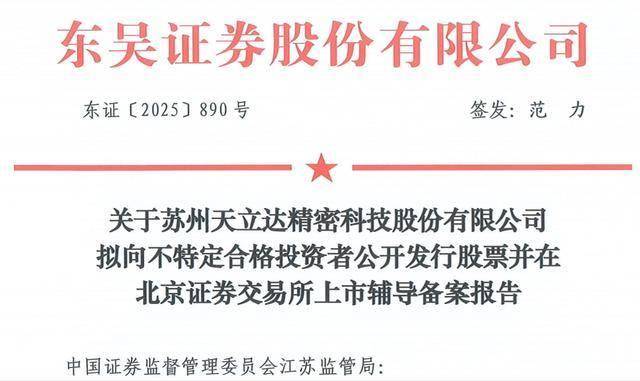
天立达IPO前新聘36岁董秘胡云垒,曾任辅导机构东吴证券业务总监
Sou Hu Cai Jing· 2025-12-22 01:51
Core Viewpoint - Suzhou Tianlida Precision Technology Co., Ltd. has initiated the IPO counseling record with Jiangsu Securities Regulatory Bureau, aiming for listing on the Beijing Stock Exchange, with Dongwu Securities as the counseling institution [1] Company Overview - Established on January 25, 2005, Tianlida has a registered capital of 110 million yuan and is headquartered at 1688 Songlu Road, Wuzhong District, Suzhou [2] - The controlling shareholder is Shen Weiming, holding 62.23% of the shares [2] - The company operates in the electronic specialized materials manufacturing industry, focusing on the R&D, design, production, and sales of precision functional components and backlight modules for electronic products [2] Financial Performance - In the first half of 2025, the company achieved operating revenue of 358 million yuan, representing a year-on-year growth of 31.86% [2] - The net profit for the same period was 24.696 million yuan, with a year-on-year increase of 2.47% [2] Corporate Governance Changes - In November, Tianlida announced the cancellation of its supervisory board and removed related terms from its articles of association, replacing "supervisory board" with "audit committee" in certain clauses [3] - The board approved the appointment of Wang Qicang as the vice general manager [3] - In August, Hu Yunlei was appointed as the secretary of the board, effective from August 14, 2025, until the end of the second board term [3] Key Personnel Background - Hu Yunlei, a male Chinese national born in September 1989, holds a bachelor's degree and is a certified public accountant and tax advisor [4] - His previous experience includes working as an auditor at Tianzhi International Accounting Firm from September 2011 to October 2014, and as a business director at Dongwu Securities from November 2014 to July 2025 [4]
每周研选 | 下一轮“躁动”行情会在何时开启?
Xin Lang Cai Jing· 2025-12-21 13:52
Group 1 - A-share market shows mixed performance with the Shanghai Composite Index being relatively stable while the ChiNext Index is weaker due to a pullback in the technology manufacturing sector [1][11] - The consensus is forming around a potential "rally" in the market as liquidity expectations improve following key overseas events and a positive policy environment from the Central Economic Work Conference [12][13] - The market style is expected to shift towards small-cap and technology growth sectors during the "rally" window from late January to early March 2026, following a period of value-driven performance [12][13] Group 2 - The strong market performance on Wednesday may indicate the start of the 2026 cross-year market trend, supported by significant net subscriptions in stock ETFs [14] - Continued policy support and stable economic growth are anticipated to bolster market confidence and attract various types of capital inflows [14] - The trend of high-net-worth individuals moving their deposits into the stock market is likely to continue, driven by lower expected returns from other asset classes [15] Group 3 - Incremental capital is entering the A-share market through broad-based ETFs, signaling positive market sentiment as investors prepare for the "spring rally" [16] - The technology and small-cap sectors are expected to perform actively as investors increase their positions [16] - The easing of "AI bubble" concerns and the resolution of liquidity uncertainties are providing a recovery opportunity for the market [17] Group 4 - Investment strategies should focus on three key areas: dividend value, high-growth sectors during the upcoming "rally," and active themes driven by policy and technology [18] - In a strengthening RMB environment, sectors such as aviation, gas, and paper are expected to benefit from cost advantages, while upstream resources and consumer goods may see profit margin improvements [20][21] - The non-bank financial sector, particularly insurance stocks, is showing increased elasticity and may outperform if policy catalysts emerge [21]



华龙证券陈磊专业团队:合规领航的行业示范意义
Sou Hu Cai Jing· 2025-12-21 09:02
Group 1 - The core viewpoint emphasizes that compliance is not only a lifeline for the stable development of financial institutions but also a cornerstone for the long-term stability of the industry [1][4] - The Chen Lei team integrates compliance awareness deeply into their business practices, viewing it as a proactive consideration in decision-making rather than a mere set of rules [1][3] - The team's "compliance first" philosophy allows them to identify potential risks early and establish a solid firewall for healthy business development [1][3] Group 2 - The professionalism of the Chen Lei team is reflected in their meticulous construction and dynamic optimization of the compliance system, adapting to the rapidly changing regulatory environment [3] - The team emphasizes a deep understanding of regulatory logic and trends, establishing a regular learning mechanism and cross-departmental communication platform to respond quickly to regulatory changes [3] - The team actively explores value creation within the compliance framework, recognizing that compliance and development are complementary rather than opposing forces [3][4] Group 3 - The compliance practices of the Chen Lei team reveal that compliance is not only a non-negotiable baseline for financial institutions but also a crucial pathway to enhance core competitiveness [4] - In an era of industry reshuffling and increasing investor protection, the team instills confidence in the market and provides valuable experiences for peers [4] - Their commitment to professional ethics and pursuit of expertise contributes positively to the cultivation of compliance culture in the industry and the high-quality development of China's capital market [4]

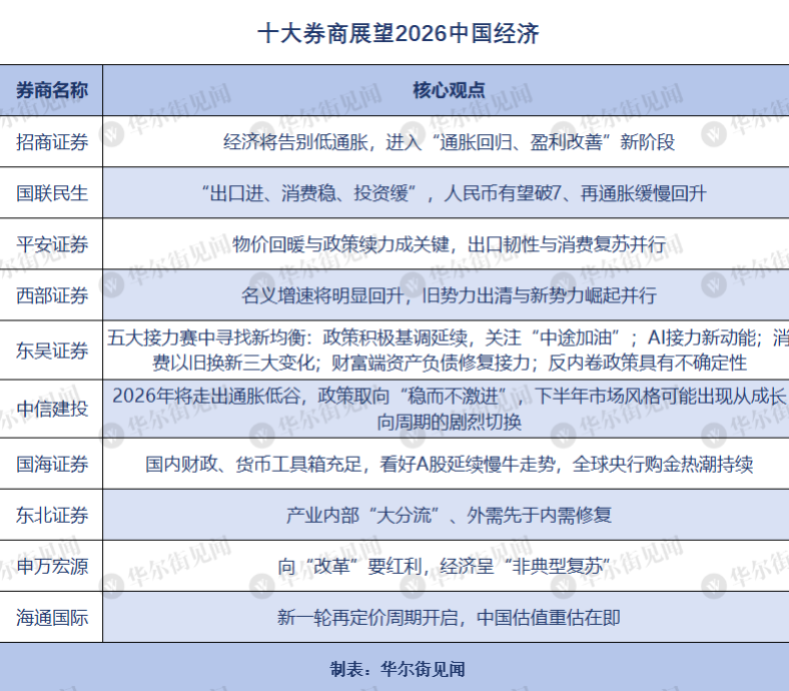
告别低通胀、AI接力新需求叙事,改革红利提振消费率......十大券商一文展望2026中国经济
Hua Er Jie Jian Wen· 2025-12-21 01:13
Core Viewpoint - The year 2026 is projected to be a turning point for China's economy, moving away from low inflation and establishing a "new equilibrium" as per the consensus among major securities firms [1]. Group 1: Macroeconomic Growth and Price Recovery - Major securities firms, including China Merchants, Ping An, and West Securities, agree that the Chinese economy will emerge from the low inflation phase, with expectations of nominal GDP growth recovery driven by price factor improvements [1][5]. - The "anti-involution" policy is expected to limit supply, combined with the pig cycle bottoming out and PPI turning positive, which will be key in improving corporate profitability and nominal GDP [1][5][6]. Group 2: Structural Transition and New Growth Drivers - 2026 is seen as a critical juncture for the transition between old and new growth drivers, with real estate investment entering a bottoming phase while AI, data center energy demand, and high-end manufacturing are expected to become substantial growth engines [1][5][21]. - The consensus is that the economy will experience a "new-old relay" with significant changes in investment structures, particularly in manufacturing and real estate [1][21]. Group 3: Demand-Side Drivers - There is a divergence in views regarding demand-side drivers; some firms like Minsheng and Northeast Securities believe external demand will outperform internal demand, while others like West Securities and Shenwan Hongyuan predict a shift towards internal demand dominance [1][5][21]. Group 4: Asset Allocation and Market Style Predictions - Opinions on asset allocation and market style are highly varied, with Haitong International being the most optimistic, predicting a 40% increase in the Shanghai Composite Index based on "value re-evaluation" logic [2][50]. - China Merchants Securities anticipates a shift from "policy-driven" to "profit-driven" market dynamics, while others suggest a more balanced focus on both growth and cyclical opportunities [2][21]. Group 5: Key Predictions from Securities Firms - China Merchants Securities predicts a recovery in corporate profits and a shift in policy focus towards enhancing development quality, with manufacturing investment expected to grow by 5% and real estate investment's decline narrowing to -8% [5][10]. - Ping An Securities emphasizes the importance of price recovery, forecasting CPI to rise to 0.6% and PPI to narrow its decline significantly [16][18]. - West Securities expects nominal GDP growth to accelerate, driven by inflation recovery and the emergence of new growth forces [21][23]. Group 6: External Environment and Trade Dynamics - The external environment is expected to improve, with strong export performance contributing significantly to GDP growth, projected to be around 40%-50% from actual export growth [11][44]. - The report from Northeast Securities highlights that external demand will recover before internal demand, with exports expected to grow by approximately 7% [44][45].