SCS(601555)

Search documents
东吴证券:维持华润万象生活(01209)“买入”评级 高分红护航长期成长
智通财经网· 2026-02-12 09:19
Core Viewpoint - The company, China Resources Vientiane Life, is expected to maintain strong profitability and growth due to its leading operational capabilities and high-quality project delivery from its parent company [1] Group 1: Operational Performance - The company operates with a dual focus on "commercial operations + property management," covering various sectors such as shopping centers, office buildings, residential, and urban spaces [1] - In H1 2025, the company's revenue grew by 7.1% year-on-year, with a gross margin of 37.1% (up 3.1 percentage points), and core net profit increased by 15.0%, indicating continuous improvement in efficiency and profitability [1] Group 2: Shopping Center Business - The shopping center segment outperformed the industry, with retail sales in managed shopping centers increasing by 21.1% year-on-year in H1 2025, and rental income rising by 17.2% [2] - The gross margin for the shopping center business reached 78.7%, up 6.2 percentage points, contributing significantly to the company's profit growth [2] Group 3: Property Management - The property management segment provided a stable revenue base, with total revenue of 51.56 billion yuan in H1 2025, a year-on-year increase of 1.1% [3] - The urban space revenue grew by 15.1% year-on-year, while the gross margin for property management services improved to 16.6%, up 1.4 percentage points [3] Group 4: Financial Health - The company demonstrated strong cash flow capabilities, with a net operating cash flow of 13.03 billion yuan in H1 2025 and cash and deposits totaling 179.21 billion yuan [4] - The company maintained a 100% distribution ratio of core net profit for dividends in 2023, enhancing shareholder returns [4]
东吴证券(601555) - 东吴证券股份有限公司关于向香港子公司增资事项获得中国证监会复函的公告
2026-02-12 09:15
证券代码:601555 证券简称:东吴证券 公告编号:2026-004 近日,公司收到中国证券监督管理委员会(以下简称"证监会")《关于东 吴证券股份有限公司向香港子公司增资有关意见的复函》(机构司函[2026]255 号,以下简称《复函》),对公司向东吴香港增资20亿港元无异议。公司将按照 《复函》的要求及国家外汇管理部门的相关规定,办理有关手续。 东吴证券股份有限公司 关于向香港子公司增资事项 获得中国证监会复函的公告 本公司董事会及全体董事保证本公告内容不存在任何虚假记载、误导性陈述 或者重大遗漏,并对其内容的真实性、准确性和完整性承担法律责任。 2025年4月24日,东吴证券股份有限公司(以下简称"公司")第四届董事 会第二十九次会议审议通过了《关于向东吴证券(香港)金融控股有限公司增资 的议案》,同意公司向东吴证券(香港)金融控股有限公司(以下简称"东吴香 港")增资不超过20亿港元。 本次公司向东吴香港增资事项尚需获得国资监管部门批准后方可实施。公司 将在增资完成后10个工作日内,将境外有关监管当局核准的东吴香港变更注册证 明文件等报送江苏证监局,并严格按照向证监会报告的增资用途使用有关资金, 不 ...
东吴证券:证监会对公司向东吴证券(香港)增资20亿港元无异议
Guo Ji Jin Rong Bao· 2026-02-12 08:53
东吴证券公告,公司向东吴证券(香港)增资事项获得中国证监会复函,证监会对公司增资20亿港元无异 议。此次增资尚需获得国资监管部门批准。 ...
研报掘金丨东吴证券:维持新宙邦“买入”评级,目标价79.8元
Ge Long Hui A P P· 2026-02-12 07:11
东吴证券研报指出,新宙邦业绩符合市场预期。公司预估25年实现营收96.4亿元,同比+22.8%,预估实 现归母净利11.0亿元,同比+16.6%。电解液六氟涨价贡献业绩弹性、单位盈利明显修复。26年公司半导 体冷却液产品客户认证有望基本完成,预计26年开始放量,且我们预计26年海德福减亏,预计氟化工合 计贡献10亿利润,增速恢复。考虑公司六氟及VC涨价幅度显著,25Q4单位盈利明显修复,26年预计将 进一步体现涨价弹性,以及氟化工业务新产品贡献增量,给予26年25xPE,目标价79.8元,维持"买 入"评级。 ...

东吴证券:维持新宙邦“买入”评级,目标价79.8元
Jin Rong Jie· 2026-02-12 07:05
东吴证券研报指出, 新宙邦业绩符合市场预期。公司预估25年实现营收96.4亿元,同比+22.8%,预估 实现归母净利11.0亿元,同比+16.6%。 电解液六氟涨价贡献业绩弹性、单位盈利明显修复。26年公司 半导体冷却液产品客户认证有望基本完成,预计26年开始放量,且我们预计26年海德福减亏,预计 氟 化工合计贡献10亿利润,增速恢复。考虑公司六氟及VC涨价幅度显著,25Q4单位盈利明显修复,26年 预计将进一步体现涨价弹性,以及氟化工业务新产品贡献增量,给予26年25xPE,目标价79.8元,维 持"买入"评级。 ...
东吴证券:AI营销重构全链路 GEO成新增长风口
Zhi Tong Cai Jing· 2026-02-12 01:49
Core Insights - AI marketing is transforming from experience-driven to data intelligence-driven, enhancing precision in advertising and operational efficiency [1] - The domestic AI marketing application market is projected to reach 97.6 billion yuan by 2029, with a CAGR of 36.5% [2] - Generative Engine Optimization (GEO) is emerging as a new trend, with a potential market size of 24 billion yuan by 2030, reflecting a CAGR of 53% [3] Group 1: AI Marketing Overview - AI marketing leverages AI technologies such as machine learning and natural language processing to capture user needs and respond in real-time, moving beyond traditional marketing methods [1] - The core functionalities of AI marketing include data insights, content generation, process execution, and interactive assistance [1] Group 2: Market Growth and Trends - The AI marketing application market is entering a rapid growth phase, with the revenue expected to reach 20.6 billion yuan in 2024 and 97.6 billion yuan by 2029 [2] - The competitive landscape for enterprise-level AI agent service providers is characterized by a three-tier structure, with major internet companies leading, niche players focusing on specific sectors, and startups seeking breakthroughs [2] Group 3: GEO Application Insights - GEO aims to enhance visibility and credibility in AI-generated engines, improving traffic acquisition efficiency compared to traditional SEO [3] - The domestic GEO marketing service market is expected to grow to 2.9 billion yuan by 2025 and 24 billion yuan by 2030 [3] - The competition in the GEO market is defined by technology-driven leaders and a focus on vertical scenarios, with e-commerce companies enhancing their GEO services [3] Group 4: Company Developments - Xinhua Du plans to launch the "MaiDian AI Intelligent Matrix" strategy in 2026, focusing on content generation and user behavior analysis [4] - Yiwan Yichuang is transitioning to an AI e-commerce service model in collaboration with Alibaba Cloud [4] - Aifeng Technology is driving growth through self-owned brand incubation and AI-enhanced services [4] - MaiFeng is recognized as a leading "AI + SaaS" intelligent marketing cloud platform, showcasing its integrated capabilities [4]


养元饮品获东吴证券增持评级 春节旺季与红牛经销成看点
Jing Ji Guan Cha Wang· 2026-02-12 01:15
Core Viewpoint - Dongwu Securities believes that Yangyuan Beverage (603156) is expected to regain growth during the Spring Festival season in 2026, maintaining a "buy" rating [1]. Group 1: Institutional View - The Spring Festival's later timing is expected to extend the sales period, leading to a strong start in the first quarter [2]. - The company is leveraging its walnut milk channel to introduce Red Bull's energy drink, which is anticipated to grow faster than the soft drink sector, potentially enhancing channel profits and revenue [2]. - External investments are focused on the technology sector, with some projects having IPO expectations, combined with a high dividend strategy that provides a safety margin [2]. Group 2: Stock Performance - Over the past week, Yangyuan Beverage's stock price has fluctuated, with a cumulative decline of 0.16% and a volatility of 2.99% [3]. - The financing balance remains high, indicating active trading in recent times, with a net inflow of 3.897 million yuan on February 11, closing at 30.35 yuan, reflecting a daily increase of 0.46% [3].

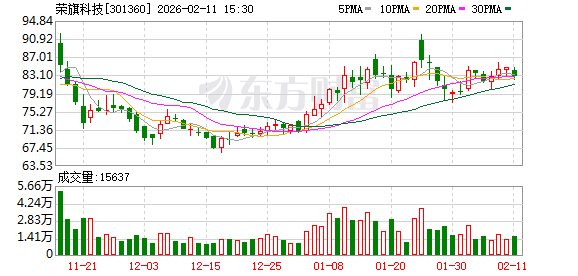
荣旗科技:关于更换持续督导保荐代表人的公告

Zheng Quan Ri Bao· 2026-02-11 13:43
Group 1 - The core point of the article is that Rongqi Technology announced a change in its continuous supervision sponsor representative from Dongwu Securities, with Wang Bo stepping down due to job changes and Sun Ping taking over alongside Xu Linlin until December 31, 2026 [2] Group 2 - The announcement was made on February 11, indicating a significant update in the company's governance structure [2] - The new representatives will be responsible for overseeing the company's operations and compliance until the end of 2026 [2]

研报掘金丨东吴证券:养元饮品26大年开局重拾增长,维持“增持”评级
Ge Long Hui· 2026-02-11 07:33
Group 1 - The core viewpoint of the article highlights that Yangyuan Beverage has resumed growth at the beginning of 2026 and is expected to benefit from external investments [1] - The company obtained exclusive distribution rights for the Red Bull Energy Drink series in northern China in 2020, with the energy drink market in China projected to grow from 28.79 billion yuan in 2015 to 62.06 billion yuan in 2024, reflecting a CAGR of nearly 9%, significantly higher than the 4% growth of soft drinks during the same period [1] - The company leverages its mature walnut milk distribution channels to introduce energy drinks, which enhances channel profitability and stickiness, contributing to revenue growth [1] Group 2 - The walnut milk product has strong gift-giving attributes, and the company is expected to transition from a small year to a big year during the Spring Festival in 2026, with a promising start in Q1 and an overall expectation of regaining growth for the year [1] - The company's external investments are focused on technology sectors, with potential for IPO exits under the current technological wave, which could yield good returns, while the company also offers high dividends providing a certain safety margin [1] - The rating for the company is maintained at "Buy" [1]
研报掘金丨东吴证券:维持汇川技术“买入”评级,目标价94.1元
Ge Long Hui A P P· 2026-02-11 06:21
Core Viewpoint - The performance of Huichuan Technology meets market expectations, with a continuous improvement in industrial control demand, projecting a net profit of 4.97 to 5.40 billion yuan for 2025, representing a year-on-year increase of 16% to 26% [1] Industry Summary - The industry demand is recovering steadily, with an expected overall revenue growth of 20% year-on-year for the sector [1] - In 2026, as industry demand further recovers, revenue is anticipated to maintain a growth rate of over 25% [1] Company Summary - Huichuan Technology is diversifying its development across new energy vehicles, traditional car manufacturers, and overseas car companies, with significant sales performance variations among domestic top clients such as Xiaomi, Li Auto, GAC Aion, and Chery, showing year-on-year sales changes of +201%, -19%, -23%, and +8% respectively [1] - In the field of humanoid robots, the company’s actuator and bionic arm products are leading in performance, aiming to become a solution provider [1] - The product range includes rotary and linear joint actuators and key components, with ongoing development in bionic arms and cerebellum products [1] - The products exhibit significant advantages in power density, torque density, heat dissipation, precision, and stability, with a high self-research rate for components [1] - The company is increasing its investment in research and sales, with promising progress expected [1] Valuation Summary - Considering the turning point in the company's industrial control business and the potential in robotics, a target price of 94.1 yuan is set with a 40x PE for 2026, maintaining a "buy" rating [1]