
China Life(601628)

Search documents
明知骗保仍“助攻”!中国人寿财险员工收54万好处费,伙同骗保123万获刑5年
Xin Lang Cai Jing· 2025-12-23 07:15
Core Viewpoint - The case highlights a significant breach of trust within the insurance industry, where an employee of China Life Property Insurance Co., Ltd. engaged in fraudulent activities, leading to substantial financial losses for the company [1][9]. Group 1: Fraudulent Activities - The employee, Hu, assisted an external accomplice, Jiang, in submitting false insurance claims, resulting in a total fraud amount of 1.229852 million yuan (approximately 122.99 million) [1][13]. - Hu received a total of 540,000 yuan (approximately 54 million) as kickbacks for facilitating the fraudulent claims [1][5]. Group 2: Legal Proceedings - The case underwent multiple legal processes, including a first-instance trial, an appeal, and a final judgment by the Yichun Intermediate People's Court, which sentenced Hu to five years in prison for fraud [1][9]. - The court determined that Hu's actions constituted a significant role in the fraud, leading to a conviction for fraud rather than bribery, despite his defense arguing otherwise [11][13]. Group 3: Internal Control Failures - The case revealed critical failures in the internal control mechanisms of China Life Property Insurance, as Hu, despite recognizing the fraudulent nature of the claims, chose to proceed with the submission [8][12]. - The insurance company's risk control system, which should have acted as a firewall against such fraud, was compromised due to Hu's negligence and unethical behavior [8][12].

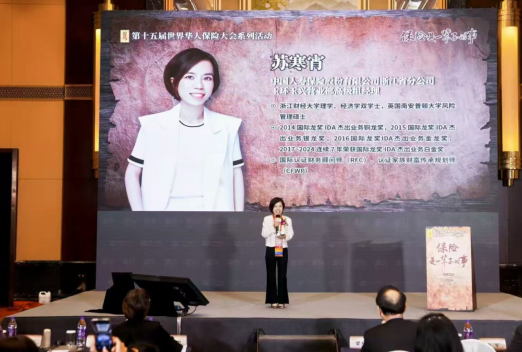
从金融学子到保险“水手”——苏寒宵的人身风险护航路
Jin Rong Jie Zi Xun· 2025-12-23 02:50
Core Viewpoint - The article emphasizes the evolution of the concept of "going to sea" in Taizhou, highlighting the region's strong manufacturing base and the role of insurance as a safety net for businesses and individuals venturing into new opportunities [1]. Group 1: Industry Overview - Taizhou is recognized as one of the birthplaces of China's private economy, with over 13,000 manufacturing enterprises established along the Yuhuan coast by 2024 [1]. - The region's manufacturing includes a wide range of components such as pumps, valves, molds, and automotive parts, showcasing the entrepreneurial spirit of the local population [1]. - The insurance industry is portrayed as a crucial support system, providing long-term risk management and security for those engaging in business ventures [1]. Group 2: Insurance Sector Insights - The insurance market in China is undergoing significant transformation, shifting from a focus on product sales to providing professional services and long-term support [8]. - The increasing aging population has led to a rise in demand for long-term insurance solutions, as individuals seek more substantial guarantees for their future [8]. - The article highlights the importance of building trust and long-term relationships between insurance agents and clients, emphasizing that effective communication is key to understanding clients' evolving needs [12]. Group 3: Personal Journey in Insurance - The narrative follows a sales agent's journey in the insurance industry, illustrating the challenges faced and the determination to succeed despite initial skepticism from others [6][9]. - The agent's commitment to lifelong learning and professional development is underscored, as they adapt to the changing landscape of the insurance market [17]. - The agent's involvement in philanthropy, particularly through educational initiatives, reflects a broader commitment to social responsibility within the insurance profession [14][15].

中国人寿富蕴县支公司被罚 为他人牟取不正当利益
Zhong Guo Jing Ji Wang· 2025-12-23 02:45
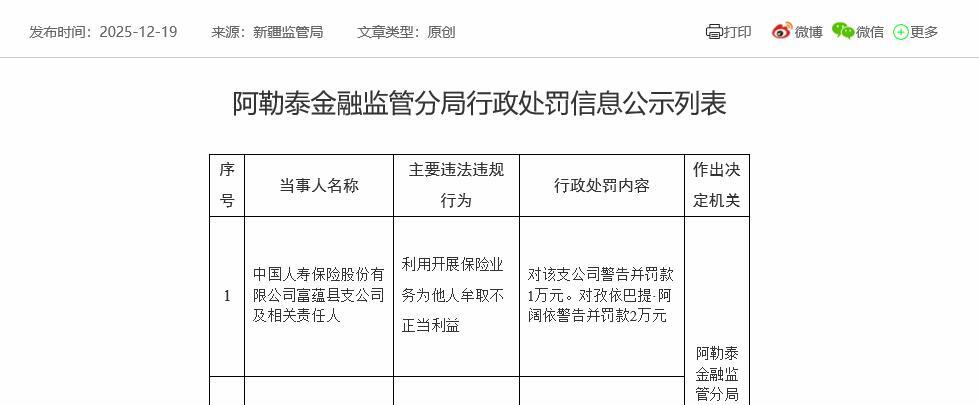
中国经济网北京12月23日讯 国家金融监督管理总局网站近日发布的阿勒泰金融监管分局行政处罚信息公示列表显示,中国人寿保险股 份有限公司富蕴县支公司及相关责任人利用开展保险业务为他人牟取不正当利益。阿勒泰金融监管分局对该支公司警告并罚款1万元。对孜 依巴提·阿阔依警告并罚款2万元。 以下为原文: | 序 | 当事人名称 | 主要违法违规 | 行政处罚内容 | 作出决 | | --- | --- | --- | --- | --- | | 号 | | 行为 | | 定机关 | | | 中国人寿保险股份有 | 利用开展保险业 | 对该支公司警告并罚款 | | | 1 | 限公司富蕴且支公司 | 务为他人年取不 | 1万元。对孜依巴提-阿 | | | | 及相关责任人 | 正当利益 | 阔依警告并罚款2万元 | | | | | | | 阿勒泰 | | | | | | 美國版 | | | | | | 管分局 | (责任编辑:华青剑) ...
保险板块走强,中国人保、中国平安涨超2%
Mei Ri Jing Ji Xin Wen· 2025-12-23 02:38
Group 1 - The insurance sector showed strength on December 23, with China Life Insurance and New China Life Insurance following the upward trend [1] - China Pacific Insurance and China Life Insurance both increased by over 2% [1]


保险板块走强 中国人保、中国平安、中国太保涨超2%
Xin Lang Cai Jing· 2025-12-23 02:29
Group 1 - The insurance sector has shown strong performance, with major companies such as China Life Insurance, China Ping An, and China Pacific Insurance all rising over 2% [1][2] - Other companies in the sector, including China Life and Xinhua Insurance, also experienced gains alongside the leading firms [1][2]

破局生命守护!中国人寿财险陕西省分公司让道交救助基金“活”起来
Sou Hu Cai Jing· 2025-12-23 02:16
Core Viewpoint - The article highlights the innovative approach taken by China Life Property & Casualty Insurance in Shaanxi Province to enhance traffic safety education through the integration of the Road Traffic Accident Social Rescue Fund into driver training programs, aiming to create a proactive culture of road safety among new drivers [1][2]. Group 1: Implementation of the "333 Strategy" - 2025 marks the concluding year of the "14th Five-Year Plan" and the beginning of the implementation of China Life's "333 Strategy" [1]. - The company is committed to deepening reforms and effectively implementing its strategic goals during a critical period for building a safe China [1]. Group 2: Traffic Safety Education Initiatives - The collaboration between China Life Property & Casualty Insurance and Xi'an Pengxiang Driving School aims to embed knowledge of the Road Traffic Accident Social Rescue Fund into the daily training curriculum for drivers [1]. - This initiative addresses the gap in traditional driver training, which often overlooks the importance of the rescue fund, focusing instead on driving skills and traffic regulations [1]. Group 3: Innovative Training Methods - The new training model incorporates "VR+AR experiential" technology to enhance the educational experience, allowing participants to engage with historical traffic safety lessons and the consequences of dangerous driving behaviors [2]. - Statistics indicate that the use of this technology can increase knowledge retention by 60% and awareness of dangerous driving behaviors by 80% [2]. Group 4: Future Commitment to Safety - China Life Property & Casualty Insurance aims to continue prioritizing public safety by developing a multi-layered, comprehensive safety education system [4]. - The goal is to make the Road Traffic Accident Social Rescue Fund a visible and accessible "life shield" for the community, contributing to the safety of the region [4].

合计被罚超2000万元 多家保险资管公司“踩红线”
Bei Jing Shang Bao· 2025-12-23 01:59
Core Viewpoint - The insurance asset management industry is facing increased regulatory scrutiny, with multiple companies penalized for violations related to the improper use of insurance funds, totaling over 21.41 million yuan in fines this year [1][2][4]. Group 1: Regulatory Penalties - Huaxia Jiuying Asset Management Co., Ltd. was fined 700,000 yuan and its responsible personnel were banned from the insurance industry for 10 years due to violations in fund usage [1]. - A total of 21.41 million yuan in fines has been imposed on various insurance asset management companies this year, with 17.23 million yuan attributed to institutional penalties [2]. - Common violations include the improper use of insurance funds, with companies like Zhongzai Asset Management and Minsheng Tonghui Asset Management facing fines of 300,000 yuan and 390,000 yuan respectively for similar infractions [2][3]. Group 2: Compliance and Risk Management - The regulatory environment is shifting towards a focus on substantive risk control rather than mere compliance, as indicated by the frequency and severity of penalties [4]. - New regulations, such as the "Interim Measures for Risk Classification of Insurance Assets," emphasize the need for enhanced monitoring and risk management practices within insurance companies [5]. - Companies are encouraged to adopt a "penetrating management" approach to ensure compliance with regulations regarding the underlying assets and risk exposures of investments [6]. Group 3: Future Directions - Companies are expected to strengthen internal compliance mechanisms and enhance risk management capabilities to prevent future violations [5][6]. - The introduction of digital compliance tools, such as AI-driven systems for real-time risk monitoring, is recommended to improve oversight of non-standard assets [6]. - There is a call for better governance structures, including independent compliance review mechanisms and linking executive compensation to long-term compliance performance [6].
保险板块12月22日跌0.06%,中国平安领跌,主力资金净流入5665.36万元
Zheng Xing Xing Ye Ri Bao· 2025-12-22 09:10
Group 1 - The insurance sector experienced a slight decline of 0.06% on December 22, with China Ping An leading the drop [1] - The Shanghai Composite Index closed at 3917.36, up by 0.69%, while the Shenzhen Component Index closed at 13332.73, up by 1.47% [1] Group 2 - On that day, the insurance sector saw a net inflow of main funds amounting to 56.65 million yuan, while retail investors experienced a net outflow of 171 million yuan [2] - The main fund inflows for key insurance companies included: China Ping An with 40.13 million yuan, New China Life with 34.82 million yuan, and China Life with 17.25 million yuan [2] - Conversely, China Pacific Insurance faced a significant outflow of 47.02 million yuan from main funds [2]


中国人寿50亿加码启航基金:从“股东”到“房东”的险资突围
Sou Hu Cai Jing· 2025-12-22 07:46
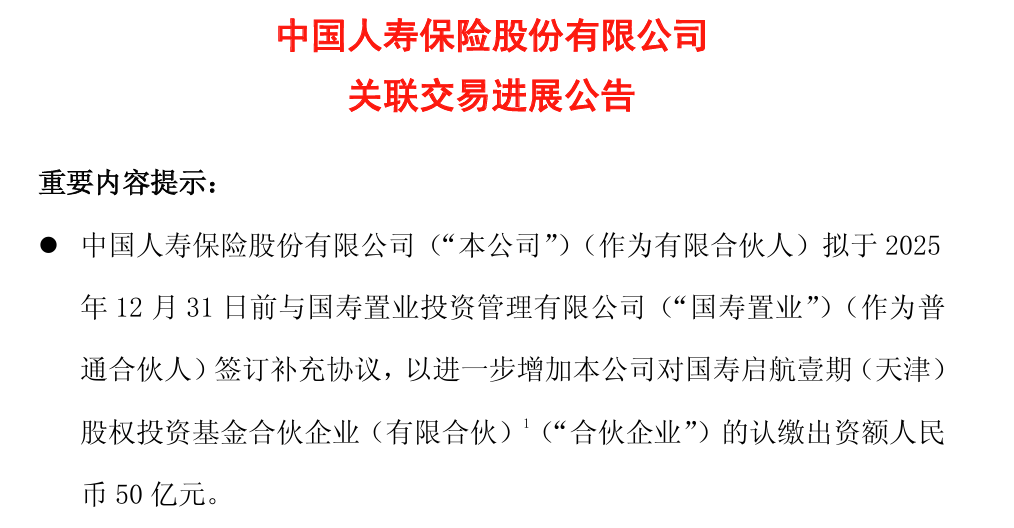
Core Viewpoint - China Life plans to sign a supplementary agreement with its controlling shareholder, Guoshou Real Estate Investment Management Co., Ltd., to increase its capital contribution to the Qihang Fund by RMB 5 billion before December 31, 2025, raising the total subscription amount from RMB 13.9 billion to RMB 18.9 billion [1] Group 1: Investment Details - The additional RMB 5 billion is expected to inject no more than RMB 3.3 billion into the flagship commercial landmark, Yiti Port Phase II, located in Beijing's Chaoyang District, ensuring the smooth completion of this giant complex [3] - The remaining amount, not less than RMB 1.7 billion, is anticipated to be directed towards market-oriented rental housing and other long-term yield "new tracks" [3] Group 2: Yiti Port Phase II Overview - Yiti Port has become a significant commercial center in Beijing's northeast since the opening of its first phase in 2012, developed by Swire Properties and Oceanwide Group [4] - The total investment for Yiti Port Phase II is projected to reach RMB 23 billion, with a total construction area exceeding 560,000 square meters, including seven international super-grade office buildings, a flagship shopping mall, and a high-end business hotel [4] - The entire Yiti Port project, including Phase I, will have a total construction area of 860,000 square meters, establishing it as a "city oasis" in northeastern Beijing [4] Group 3: Financial Challenges and Strategic Moves - Since 2022, Oceanwide Group has faced significant liquidity issues due to the downturn in the real estate market, with current liabilities exceeding current assets by approximately RMB 8.45 billion [6] - As of April 2024, Oceanwide's investment in the project was about RMB 6.3 billion, but ongoing capital injections became a burden [7] - On June 7, 2024, Oceanwide announced the transfer of all its rights in Yiti Port Phase II for RMB 4 billion, with China Life contributing approximately RMB 3.1 billion and Swire Properties about RMB 0.9 billion, acquiring a combined 49.9% stake [8] Group 4: Strategic Implications of the Transaction - Following the transaction, Oceanwide Group completely exited the target company's equity, while China Life and Swire Properties established a balanced governance structure [9] - The transaction includes a long-term strategic arrangement, allowing Oceanwide to retain a "right of first offer" for the project until September 30, 2037, indicating a potential future return to the project after financial recovery [9] Group 5: Broader Investment Strategy - The Qihang Fund represents China Life's proactive approach to real estate investment, combining "crisis intervention" with "long-term holding" strategies [13] - The fund has successfully intervened in distressed assets, such as acquiring a 51% stake in Zhuhai Shimao New Field Real Estate Development Co., Ltd. during a liquidity crisis [13] - In June 2024, the Qihang Fund announced plans to transfer 100% of Beijing Wanyuan's equity to a related party for approximately RMB 610 million, achieving investment returns while retaining core assets within the China Life system [16][17] Group 6: Transition from Shareholder to Landlord - China Life's transition from being a major shareholder in real estate companies to directly holding core commercial properties marks a strategic shift in response to the real estate market's downturn [18] - The value of China Life's stake in Oceanwide Group has significantly decreased from RMB 13.63 billion at the end of 2017 to RMB 2.19 billion by the end of 2022, ultimately reaching zero by the end of 2024 [19] - This shift aims to provide a more stable cash flow through direct property ownership, especially in a low-interest-rate environment where prime retail properties offer a capitalized return of 5.5% to 6% [22]
资本市场系列(一):保险资金入市展望
Minmetals Securities· 2025-12-22 06:15
Policy Direction - The policy aims to increase the proportion and stability of commercial insurance funds invested in A-shares, targeting a 30% investment of new premiums into A-shares from 2025[8] - The pilot program for long-term investment by insurance funds has been expanded, with a total of 222 billion yuan approved for long-term investments in 2023[9] - Regulatory rules are being optimized, including a 10% reduction in risk factors for stock investments and adjustments to the solvency ratio requirements for equity assets[9] Investment Projections - In a neutral scenario, insurance funds are projected to increase equity investments by 1.15 trillion yuan in 2026 and 1.45 trillion yuan in 2027, raising the equity asset proportion to 23.6% and 24.6% respectively[2] - If new premiums are allocated 30% to A-shares, the projected new equity investments would be 9.88 trillion yuan in 2026 and 10.77 trillion yuan in 2027, with equity asset proportions reaching 23.2% and 23.7%[28] Risk Factors and Challenges - Risks include lower-than-expected premium income, which could lead to insufficient new funds for investment[4] - Significant market volatility may impact investment returns and asset values, affecting the pace of insurance funds entering the market[4]