PSBC(601658)

Search documents
国有六大行前三季度业绩改善,银行ETF天弘(515290)年内份额增近40%,机构:红利价值持续凸显
2 1 Shi Ji Jing Ji Bao Dao· 2025-11-13 02:38
Group 1 - The bank ETF Tianhong (515290) has seen a year-to-date share growth rate of 39.92%, with the latest scale at 6.291 billion and circulating shares at 4.145 billion [1] - The Hong Kong Stock Connect Central Enterprise Dividend ETF Tianhong (159281) has experienced net inflows for two consecutive trading days, indicating strong investor interest [1] - The performance of the dividend sector, including banks, has been strong, with major banks like Agricultural Bank of China showing significant stock price increases [2] Group 2 - The six major state-owned banks reported double growth in revenue and net profit for the first three quarters of the year, with net profits for major banks ranging from 699.94 million to 2,699.08 million, reflecting a year-on-year growth of 0.33% to 3.03% [2] - The banking sector's performance is supported by stable growth in scale, improved net interest income, and a recovery in non-interest income, with asset quality remaining stable [3] - The policy environment is conducive to optimizing bank credit structures and protecting interest margins, which enhances the growth potential for non-interest income [3]



银行股逆势走强成避风港
Di Yi Cai Jing· 2025-11-13 01:53
Core Viewpoint - The banking sector has emerged as a "safe haven" amid market downturns, with significant gains in stock prices, particularly among state-owned banks, driven by rising risk aversion, institutional fund inflows, and expectations of loose monetary policy [2][5][8]. Group 1: Market Performance - On November 12, the banking index rose by 0.46%, outperforming the Shanghai Composite Index, which fell by 0.07%, and the Shenzhen Component Index, which declined by 0.36% [2]. - The banking sector has seen a cumulative increase of 8.73% as of the same date, indicating strong performance in the fourth quarter [2]. - Agricultural Bank of China led the sector with a 3.49% increase, reaching a market capitalization of over 3 trillion yuan [3]. Group 2: Fund Flows and Investment Trends - The banking sector experienced a net inflow of 1.076 billion yuan in principal funds, with Agricultural Bank, Ping An Bank, and Construction Bank being the top beneficiaries [4]. - The E Fund Bank ETF attracted 567 million yuan over nearly 22 trading days, reflecting strong investor interest [4]. Group 3: Factors Driving Performance - Analysts attribute the banking sector's resilience to a combination of heightened risk aversion, sustained long-term fund allocation, and reinforced expectations of monetary policy easing [5][6]. - The average dividend yield for the banking sector is approximately 6.5%, significantly higher than the 1.80% yield on 10-year government bonds, making it an attractive option for low-risk investors [5]. Group 4: Future Outlook - Institutions are optimistic about the banking sector's investment prospects, anticipating that the high dividend theme will continue to dominate the market [8]. - Analysts predict that the banking sector's net interest margin is likely to stabilize and improve, supported by monetary policy easing and regulatory measures aimed at reducing funding costs [7][8]. - The ongoing structural adjustments in banking services towards technology, green finance, and pension finance are expected to enhance long-term growth potential and valuation recovery [8].





邮储银行大宗交易成交410.90万元
Zheng Quan Shi Bao Wang· 2025-11-13 00:33
Core Insights - Postal Savings Bank of China executed a block trade on November 12, with a transaction volume of 700,000 shares and a transaction value of 4.109 million yuan, at a price of 5.87 yuan per share [2] Summary by Category Transaction Details - The block trade involved a total volume of 700,000 shares and a total transaction amount of 4.109 million yuan [2] - The transaction price of 5.87 yuan per share represented a 0% premium relative to the closing price on that day [2] - The buyer was from Industrial Securities Co., Ltd. Fuzhou Chaoyang Road Securities Business Department, while the seller was from Guotai Junan Securities Co., Ltd. Headquarters [2] Recent Trading Activity - Over the past three months, Postal Savings Bank has recorded a total of 7 block trades, with a cumulative transaction value of 24.496 million yuan [2]

邮储银行今日大宗交易平价成交70万股,成交额410.9万元
Xin Lang Cai Jing· 2025-11-12 09:34
Group 1 - Postal Savings Bank executed a block trade of 700,000 shares on November 12, with a transaction value of 4.109 million yuan, accounting for 0.41% of the total trading volume for the day [1][2] - The transaction price was 5.87 yuan, which remained unchanged compared to the market closing price of 5.87 yuan [1][2]

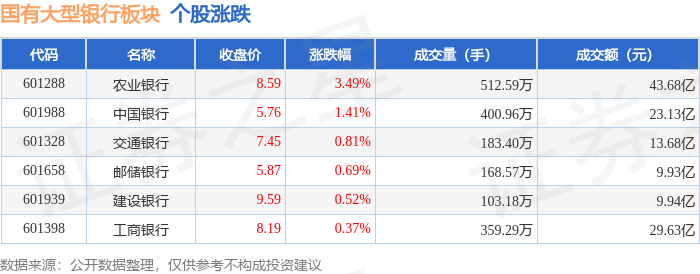
国有大型银行板块11月12日涨1.82%,农业银行领涨,主力资金净流入11.17亿元
Zheng Xing Xing Ye Ri Bao· 2025-11-12 08:44
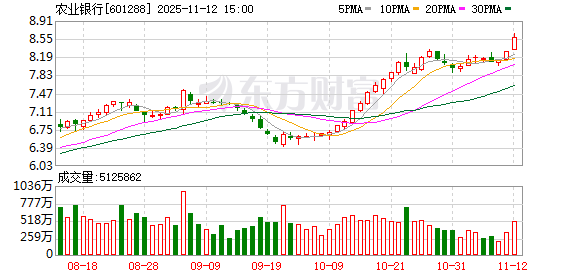
Core Insights - The state-owned large bank sector experienced a rise of 1.82% on November 12, with Agricultural Bank leading the gains [1] - The Shanghai Composite Index closed at 4000.14, down 0.07%, while the Shenzhen Component Index closed at 13240.62, down 0.36% [1] Bank Performance - Agricultural Bank (601288) closed at 8.59, up 3.49% with a trading volume of 5.1259 million shares [1] - Bank of China (601988) closed at 5.76, up 1.41% with a trading volume of 4.0096 million shares [1] - Bank of Communications (601328) closed at 7.45, up 0.81% with a trading volume of 1.8340 million shares [1] - Postal Savings Bank (601658) closed at 5.87, up 0.69% with a trading volume of 1.6857 million shares [1] - China Construction Bank (666109) closed at 9.59, up 0.52% with a trading volume of 1.0318 million shares [1] - Industrial and Commercial Bank (601398) closed at 8.19, up 0.37% with a trading volume of 3.5929 million shares [1] Capital Flow - The state-owned large bank sector saw a net inflow of 1.117 billion yuan from institutional investors, while retail investors experienced a net outflow of 769 million yuan [1] - Agricultural Bank had a net inflow of 506 million yuan from institutional investors, while retail investors had a net outflow of 303 million yuan [2] - Industrial and Commercial Bank had a net inflow of 214 million yuan from institutional investors, with retail investors experiencing a net outflow of 177 million yuan [2] - Bank of China had a net inflow of 203 million yuan from institutional investors, with retail investors seeing a net outflow of 113 million yuan [2] - Bank of Communications had a net inflow of 166 million yuan from institutional investors, while retail investors had a net outflow of 917.7 million yuan [2] - China Construction Bank experienced a net outflow of 22.94 million yuan from institutional investors, but had a net inflow of 606.79 million yuan from speculative funds [2]

这些上市银行获增持
Sou Hu Cai Jing· 2025-11-12 08:18
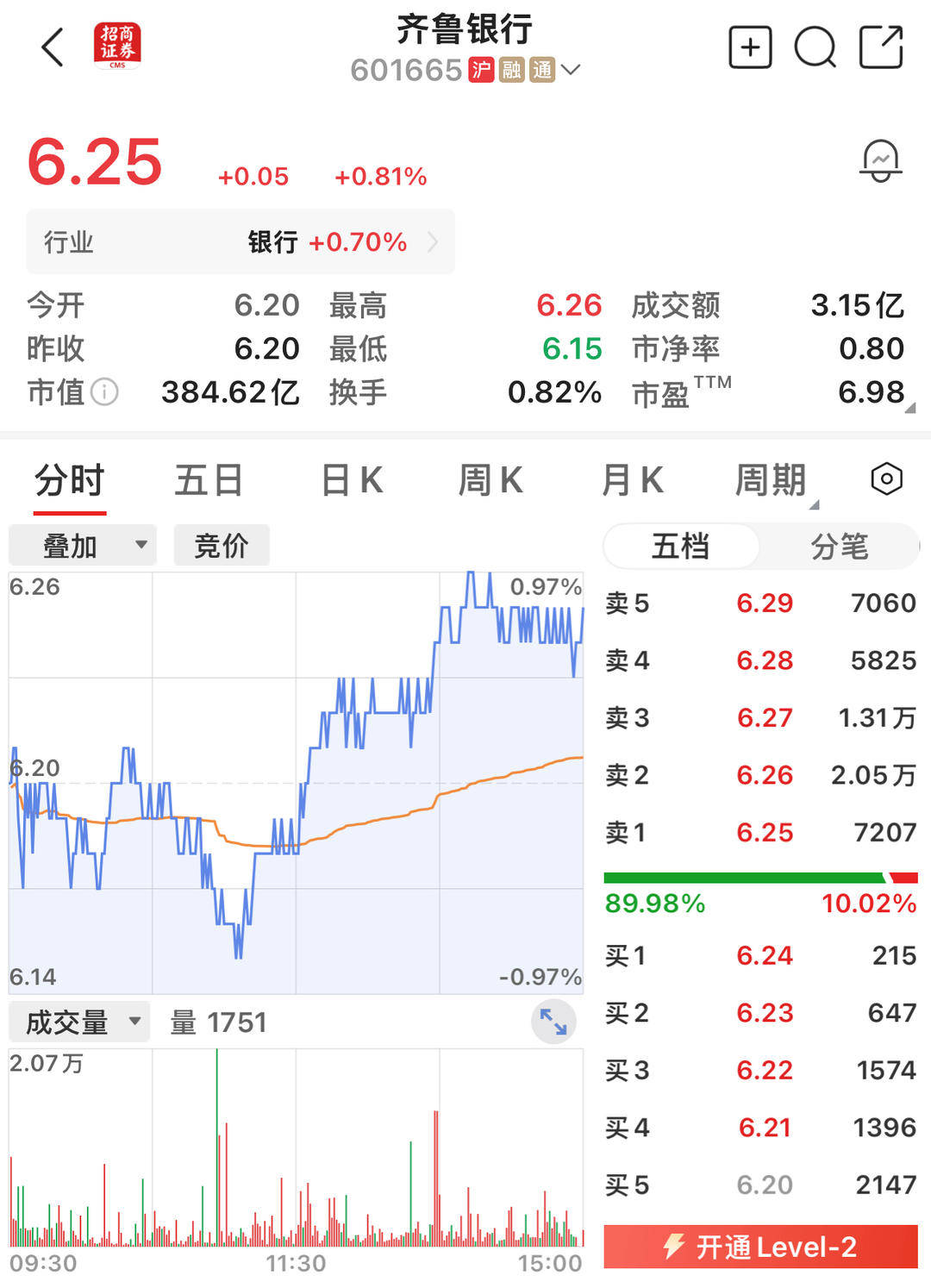
Core Insights - Multiple A-share listed banks have seen significant share purchases by executives and major shareholders since 2025, indicating confidence in the banking sector's long-term value [1][5] - Recent quarterly reports show that most city commercial banks have stabilized and improved their net interest margins compared to the end of the first half of the year [1] Group 1: Shareholder Activity - Over 10 banks have received share purchases from shareholders or executives, including Xiamen Bank, Suzhou Bank, Chengdu Bank, Chongqing Bank, Shanghai Bank, Everbright Bank, Lanzhou Bank, Postal Savings Bank, and Wuxi Bank, with city commercial banks being the majority [1] - On November 7, Qilu Bank reported that its directors, supervisors, and senior executives had collectively increased their holdings by approximately 3.15 million yuan, accounting for 90% of the planned increase [3] - Qingdao Bank's major shareholder, Guoxin Chanin Holdings, increased its stake through the Hong Kong Stock Connect, raising its total shareholding to 15.42%, making it the largest shareholder [5] Group 2: Financial Performance - Among the 42 listed banks, 35 reported a year-on-year increase in net profit for the first three quarters, with seven banks achieving double-digit growth, including Qingdao Bank, Qilu Bank, Hangzhou Bank, Jiangyin Bank, Changshu Bank, Shanghai Pudong Development Bank, and Chongqing Bank [5] - The recent quarterly reports reflect a positive performance for banks this year, contributing to market confidence [5]
邮储银行涨0.69%,成交额9.93亿元,今日主力净流入6778.66万
Xin Lang Cai Jing· 2025-11-12 07:57
Core Viewpoint - Postal Savings Bank of China (PSBC) shows stable performance with a recent stock price increase and a solid dividend yield, indicating potential investment opportunities in the context of state-owned enterprise reforms [1][2]. Financial Performance - PSBC's recent three-year dividend yields are 5.58%, 6.00%, and 4.61% respectively, reflecting a consistent return to shareholders [2]. - For the period from January to September 2025, PSBC reported a net profit of 765.62 billion yuan, representing a year-on-year growth of 0.98% [7]. Market Activity - On November 12, PSBC's stock rose by 0.69% with a trading volume of 9.93 billion yuan and a turnover rate of 0.25%, leading to a total market capitalization of 704.96 billion yuan [1]. - The main capital inflow for PSBC today was 67.79 million yuan, accounting for 0.07% of the total, with no significant trend in main capital movements observed [3][4]. Shareholder Structure - As of September 30, 2025, PSBC had 142,600 shareholders, a decrease of 13.09% from the previous period, while the average circulating shares per person increased by 15.29% to 478,570 shares [7]. - The top ten circulating shareholders include Hong Kong Central Clearing Limited and various ETFs, with notable reductions in their holdings compared to the previous period [8][9]. Business Overview - PSBC, established on March 6, 2007, and listed on December 10, 2019, primarily offers banking and financial services in China, with personal banking contributing 65.15% to its revenue, corporate banking 22.71%, and fund operations 12.10% [6].
“18罗汉”突然异动!背后有何逻辑
Zheng Quan Shi Bao Wang· 2025-11-12 07:07
Group 1 - The A-share market saw a significant rally among the top 18 stocks by market capitalization, with Agricultural Bank reaching a historical high and the total market value of these stocks exceeding 20 trillion yuan [2] - Despite the overall market showing some recovery, the number of declining stocks remained high, indicating a mixed performance with over 3,800 stocks falling [2] - Southbound capital experienced a substantial net inflow of 12.748 billion yuan last week, with banks, non-bank financials, and the oil and petrochemical sectors being the main beneficiaries [3] Group 2 - Analysts suggest that the recent shift towards large-cap stocks may be driven by changes in market risk appetite, with macro leverage around 12.46 times and high valuations in the technology sector [4] - The market is experiencing increased valuation and sentiment risks, with a decrease in liquidity for sell orders, indicating heightened selling pressure [4] - Recommendations for asset allocation include increasing exposure to domestic stocks and commodities, with a focus on large-cap stocks and sectors such as coal, photovoltaics, telecommunications, and agriculture showing good investment value [4]




首破3万亿!A股“市值王”再刷新记录
Ge Long Hui· 2025-11-12 06:53
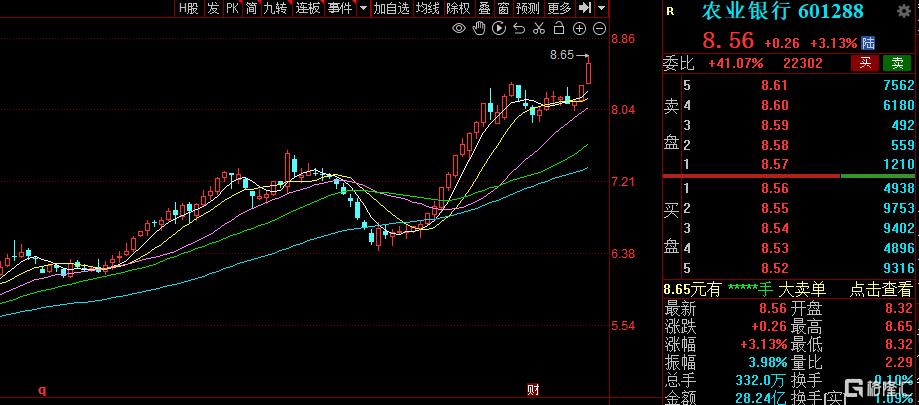
Core Insights - The banking sector showed resilience with Agricultural Bank and Industrial and Commercial Bank reaching historical highs in stock prices, with Agricultural Bank's A-shares up 3.13% to 8.65 yuan and H-shares up nearly 3% to 6.4 HKD, marking year-to-date increases of over 68% and 51% respectively [1][2] - The total market capitalization of Agricultural Bank surpassed 3 trillion yuan [1] Financial Performance - The six major state-owned banks reported a combined operating revenue of 27,205.35 billion yuan for the first three quarters of 2025, reflecting a year-on-year growth of 1.87%, and a net profit of 10,723.43 billion yuan, also up 1.22% year-on-year [5][6] - Agricultural Bank led the net profit growth among the six banks with a year-on-year increase of 3.03%, while other banks showed varying growth rates [5][6] Investment Trends - Insurance capital has increased its holdings in several major banks, with Postal Savings Bank seeing the largest increase in shares, while Industrial and Commercial Bank and Agricultural Bank also saw insurance capital enter their top ten shareholders [8][9] - Analysts suggest that with policy support for long-term capital entering the market, insurance capital is expected to increase its allocation to bank stocks, enhancing their investment value [9]
已有7家银行私银客户超10万户
2 1 Shi Ji Jing Ji Bao Dao· 2025-11-12 05:45
Core Insights - The private banking sector has seen significant growth in the first three quarters of this year, with seven listed banks reporting over 100,000 private banking clients as of September 30, 2023, indicating a rising demand for wealth management services among high-net-worth individuals [2][4][5] Group 1: Growth in Private Banking Clients - Multiple banks reported a client growth rate exceeding 10%, with Minsheng Bank, Beijing Bank, and Nanjing Bank showing increases over 15% [4] - Minsheng Bank had the fastest growth, reaching 73,409 private banking clients, an increase of 18.21% from the end of last year [5] - Beijing Bank reported 20,586 private banking clients, up 17.9%, and an asset under management (AUM) of 224 billion yuan, a 14.39% increase [5][6] Group 2: Market Position of Major Banks - State-owned banks continue to dominate the private banking market, with Agricultural Bank of China leading at 279,000 clients, followed by China Construction Bank and Bank of China [6] - China Merchants Bank and Ping An Bank have also joined the "100,000 club," with Ping An Bank reaching 103,300 clients, marking its first entry into this category [6][7] Group 3: Challenges and Opportunities in Wealth Management - The growth in private banking clients is attributed to the expanding base of high-net-worth individuals and the upgrading of banking services [9] - The Hu Run Wealth Report indicates that the total wealth of China's 6 million affluent families has reached 150 trillion yuan, with ultra-high-net-worth families holding 87 trillion yuan, an increase from 56% to 58% of total wealth [9] - The private banking sector is facing challenges such as economic shifts, declining risk-free returns, and reduced investor confidence, necessitating a transformation in wealth management services [10][11]