
PSBC(601658)

Search documents
邮储银行(01658) - 海外监管公告 关於获准筹建金融资產投资公司的公告
2025-10-27 10:25
香港交易及結算所有限公司及香港聯合交易所有限公司對本公告的內容概不負責,對其準確性 或完整性亦不發表任何聲明,並明確表示,概不對因本公告全部或任何部份內容而產生或因倚 賴該等內容而引致的任何損失承擔任何責任。 中國,北京 2025年10月27日 POSTAL SAVINGS BANK OF CHINA CO., LTD. 1658 海外監管公告 關於獲准籌建金融資產投資公司的公告 本公告乃根據《香港聯合交易所有限公司證券上市規則》第13.10(B)條作出。如下公 告已於上海證券交易所網站刊登,僅供參閱。 特此公告。 承董事會命 中國郵政儲蓄銀行股份有限公司 杜春野 聯席公司秘書 於本公告日期,本行董事會包括董事長及非執行董事鄭國雨先生;執行董事劉建軍先生及姚紅 女士;非執行董事韓文博先生、劉新安先生、張宣波先生、劉瑞鋼先生、胡宇霆先生、丁向明 先生及余明雄先生;獨立非執行董事溫鐵軍先生、鍾瑞明先生、潘英麗女士、唐志宏先生、洪 小源先生及楊勇先生。 * 中國郵政儲蓄銀行股份有限公司並非一家根據銀行業條例(香港法例第155章)之認可機 構,並不受限於香港金融管理局的監督,亦不獲授權在香港經營銀行及╱或接受存款業 ...
邮储银行:获准筹建金融资产投资公司 注册资本为人民币100亿元
Xin Lang Cai Jing· 2025-10-27 10:04
Core Viewpoint - Postal Savings Bank of China has received approval from the National Financial Regulatory Administration to establish China Post Financial Asset Investment Co., Ltd, aiming to enhance comprehensive service capabilities and support technological innovation and private enterprises [1] Group 1 - The registered capital of China Post Investment is set at 10 billion yuan [1] - China Post Investment will be managed as a wholly-owned first-level subsidiary of Postal Savings Bank [1] - The establishment of China Post Investment is intended to promote high-quality development and support the development of new productive forces through market-oriented debt-to-equity swaps and equity investment pilots [1]

激活地方经济“压舱石” 邮储银行南充市分行金融活水精准滴灌民生保障型企业
Zhong Guo Jing Ji Wang· 2025-10-27 09:20
这份迫切需求能被迅速捕捉,源于邮储银行南充市分行早已搭建的"金融+商会+企业"融资对接长 效机制,通过与南充市工商联签署战略合作协议,约定在资源共享、融资服务、企业培育等领域开展全 方位合作。因此,邮储银行南充市分行通过常态化走访、动态化摸排,得知马回电力的困境后,分行迅 速组建专项服务团队,深入企业生产一线,不仅详细核查经营状况、技术改造规划,更结合电力行业资 金周转特点,精准测算资金需求额度与使用周期,为定制化方案奠定基础。 "我们始终认为,优质的金融服务始于对企业需求的深刻理解。"邮储银行南充市分行相关负责人表 示,对民生保障型企业的服务不能停留在被动响应,而要通过长效联络机制实现"提前预判、主动对 接",让金融服务与企业发展同频共振。 方案定制:"抵押+信用"破解融资痛点 电力企业虽经营稳定、现金流可靠,但传统信贷中对抵押物的单一要求,往往使其陷入"有信用无 抵押、有需求难融资"的困境。针对这一痛点,邮储银行南充市分行创新推出"抵押+信用"组合贷款方 案,从额度、期限、担保、利率等多维度实现精准适配。 在南充市经济高质量发展的版图上,四川马回电力股份公司这样的老牌民生保障企业,既是区域运 行的"稳定器 ...
国务院重磅报告,明确下阶段金融工作6大重点
2 1 Shi Ji Jing Ji Bao Dao· 2025-10-27 08:55
Core Viewpoint - The report (2025) outlines the achievements of the financial system in supporting the real economy, enhancing financial regulation, deepening reform and opening up, and preventing and mitigating risks since November 2024, while also specifying six key work directions for the next phase [3] Group 1: Monetary Policy - The report emphasizes the need to implement a moderately loose monetary policy to create a suitable monetary and financial environment for consolidating and expanding economic recovery [5] - The People's Bank of China (PBOC) has been injecting liquidity into the banking system, with a recent announcement of a 900 billion yuan medium-term lending facility (MLF) operation scheduled for October 27, aiming to support government bond issuance and bank credit [5][6] - Analysts expect that the PBOC will continue to maintain a high level of liquidity injection to support credit expansion and government bond issuance [6] Group 2: Financial Regulation - The report highlights the importance of further strengthening and improving financial regulation to enhance regulatory quality and effectiveness [8] - Major banks have adopted a common principle of "preventing risks, strengthening regulation, and promoting high-quality development," indicating a deepened risk awareness and compliance culture within the banking sector [9] Group 3: Financial Supply-Side Structural Reform - The report stresses the need to focus on providing high-quality financial services to the real economy and to continue deepening financial supply-side structural reform [11] - From November 2024 to September 2025, 98 companies in the A-share market raised 91.8 billion yuan through initial public offerings, with 86% being private enterprises and 92% in strategic emerging industries [11] - Major banks are committed to enhancing their financial services to support the real economy, with specific initiatives aimed at modernizing the industrial system and promoting sustainable financial solutions [12] Group 4: Risk Prevention - The report emphasizes the need to prevent and mitigate financial risks in key areas while maintaining the bottom line of avoiding systemic financial risks [14] - Banks are focusing on comprehensive risk management and ensuring that development and safety are well-coordinated [14] - The banking sector has seen a reduction in the number of banking institutions and an improvement in asset quality, with the non-performing loan ratio decreasing to 1.49% [14]






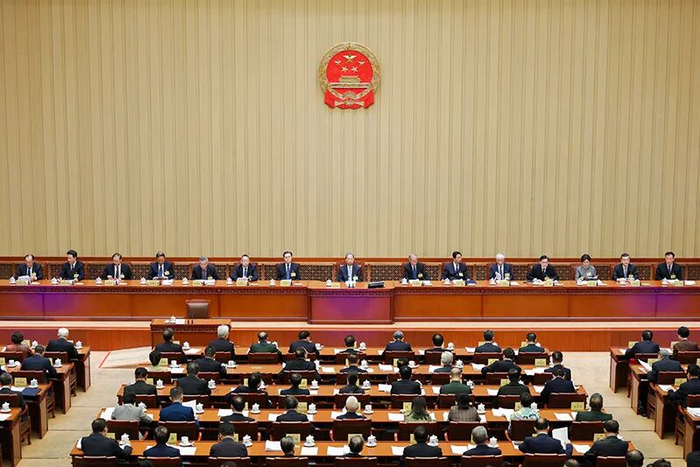
国务院重磅报告,明确下阶段金融工作6大重点
21世纪经济报道· 2025-10-27 08:41
Core Viewpoint - The report (2025) outlines the achievements of the financial system in supporting the real economy, enhancing financial regulation, deepening reform and opening up, and preventing and mitigating risks since November 2024, while also specifying six key work directions for the next phase [3]. Group 1: Monetary Policy - The report emphasizes the need to implement a moderately loose monetary policy to create a suitable monetary and financial environment for consolidating and expanding the economic recovery [5]. - The People's Bank of China (PBOC) has been injecting liquidity into the banking system, with a recent announcement of a 900 billion yuan medium-term lending facility (MLF) operation, maintaining high liquidity levels for three consecutive months [6][7]. - Analysts suggest that this approach aims to keep liquidity ample and guide financial institutions to increase credit support, particularly for government bond issuance [6]. Group 2: Financial Regulation - The report highlights the importance of further strengthening and improving financial regulation to enhance regulatory quality and effectiveness [9]. - Major banks have adopted a unified approach focusing on risk prevention, strong regulation, and promoting high-quality development, with a multi-layered risk control network being established [9]. - Banks like ICBC and CCB have committed to deepening comprehensive risk management and fulfilling their responsibilities as major financial institutions [9]. Group 3: Financial Supply-Side Structural Reform - The report stresses the need to provide high-quality financial services and continue deepening financial supply-side structural reforms [11]. - From November 2024 to September 2025, A-share IPOs raised 91.8 billion yuan, with 86% of the companies being private and 92% in strategic emerging industries [11]. - Loans in sectors such as technology, green finance, and digital economy have seen significant year-on-year growth, indicating a strong focus on supporting the real economy [11][12]. Group 4: Risk Prevention - The report underscores the necessity of preventing and mitigating financial risks in key areas while maintaining systemic financial safety [14]. - Banks are increasingly focusing on balancing development and safety, with measures in place to manage risks effectively [14]. - The banking sector has seen a reduction in the number of institutions and an improvement in asset quality, with the non-performing loan ratio decreasing to 1.49% [14].

国有大型银行板块10月27日涨1.47%,农业银行领涨,主力资金净流出8522.66万元
Zheng Xing Xing Ye Ri Bao· 2025-10-27 08:24
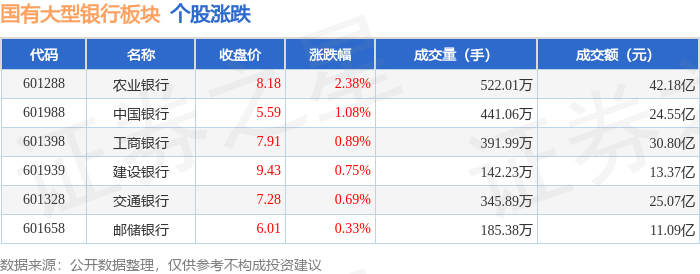
Core Insights - The state-owned large bank sector saw an increase of 1.47% on October 27, with Agricultural Bank leading the gains [1] - The Shanghai Composite Index closed at 3996.94, up 1.18%, while the Shenzhen Component Index closed at 13489.4, up 1.51% [1] Bank Performance Summary - Agricultural Bank (601288) closed at 8.18, up 2.38% with a trading volume of 5.22 million shares and a transaction value of 4.218 billion [1] - China Bank (601988) closed at 5.59, up 1.08% with a trading volume of 4.41 million shares and a transaction value of 2.455 billion [1] - Industrial and Commercial Bank (601398) closed at 7.91, up 0.89% with a trading volume of 3.92 million shares and a transaction value of 3.080 billion [1] - Construction Bank (601939) closed at 9.43, up 0.75% with a trading volume of 1.42 million shares and a transaction value of 1.337 billion [1] - Transportation Bank (601328) closed at 7.28, up 0.69% with a trading volume of 3.46 million shares and a transaction value of 2.507 billion [1] - Postal Savings Bank (601658) closed at 6.01, up 0.33% with a trading volume of 1.85 million shares and a transaction value of 1.109 billion [1] Fund Flow Analysis - The state-owned large bank sector experienced a net outflow of 85.2266 million from institutional investors and 43.0758 million from retail investors, while individual investors saw a net inflow of 128 million [1] - Specific fund flows for individual banks showed varied trends, with China Bank experiencing a net inflow of 77.0158 million from institutional investors but a net outflow of 84.6370 million from retail investors [2] - Agricultural Bank had a net outflow of 110 million from institutional investors, while retail investors contributed a net inflow of 113 million [2]
下阶段金融工作“路线图”来了,明确六大工作重点
2 1 Shi Ji Jing Ji Bao Dao· 2025-10-27 07:37
Core Insights - The report emphasizes the importance of implementing a moderately loose monetary policy to support economic recovery and create a suitable financial environment [1][2] - It outlines six key work directions for the next phase, including enhancing financial regulation, providing high-quality financial services, and preventing systemic financial risks [1][6] Monetary Policy - The People's Bank of China (PBOC) has committed to maintaining liquidity in the banking system, with a recent announcement of a 900 billion yuan medium-term lending facility (MLF) operation [2][3] - The PBOC aims to align social financing scale and money supply growth with economic growth and price level expectations [2][3] Financial Regulation - The report highlights the need to strengthen and improve financial regulation, enhancing regulatory quality and effectiveness [3][4] - Major banks have expressed a commitment to risk management and compliance, indicating a shift towards a more robust risk control framework [4][7] Support for the Real Economy - The report indicates that from November 2024 to September 2025, 98 companies raised 91.8 billion yuan through initial public offerings, with 86% being private enterprises [5] - Loans in sectors such as technology, green finance, and digital economy have seen significant year-on-year growth, indicating a focus on supporting strategic industries [5] Financial Risk Management - The report stresses the importance of preventing and mitigating financial risks in key areas, aiming to avoid systemic financial risks [6][7] - Banks are increasingly prioritizing comprehensive risk management and compliance in their operations [4][7] Financial Opening and Internationalization - Chinese banks are actively pursuing international competitiveness and enhancing global service capabilities, contributing to the internationalization of the yuan [9] - The emphasis on high-level financial openness reflects a commitment to both "going out" and "bringing in" strategies in the financial sector [9]
确保“十五五”各项部署 落到实处、取得实效
Jin Rong Shi Bao· 2025-10-27 06:56
Group 1 - The Fourth Plenary Session of the 20th Central Committee of the Communist Party of China was held from October 20 to 23 in Beijing, where the "15th Five-Year Plan" for national economic and social development was approved, outlining China's development blueprint for the next five years [1] - The session emphasized the importance of focusing on the real economy, enhancing the vitality of various business entities, and improving people's livelihoods to promote common prosperity [1] - Financial institutions expressed their commitment to support key areas such as technological innovation, green and low-carbon initiatives, and rural revitalization, aligning their services with the goals of the "15th Five-Year Plan" [1][2] Group 2 - The Bank of China in Guangdong plans to leverage regional advantages to enhance resource allocation and innovate service models in areas like financial connectivity and modern industrial construction [2] - The session highlighted the need for a strong domestic market and a new development pattern, focusing on expanding domestic demand and promoting effective investment [3] - Agricultural modernization and rural revitalization were identified as key components for supporting economic recovery and high-quality development [3][4] Group 3 - Financial institutions are encouraged to transform traditional services into value-creating platforms that integrate digital empowerment and community services [3] - The Agricultural Development Bank of China aims to support food security and urban-rural integration as part of its commitment to the agricultural strong nation goal [3] - The importance of financial support for rural revitalization and the development of new agricultural productivity was emphasized by various banking representatives [4]
行业深度报告:零售风险及新规影响有限,兼论信贷去抵押化
KAIYUAN SECURITIES· 2025-10-27 05:44
Investment Rating - The investment rating for the industry is "Positive" (maintained) [1] Core Insights - The report highlights that retail non-performing loan (NPL) rates and generation rates are currently high, indicating ongoing pressure on bank profitability. Despite a low overall NPL rate, the retail sector shows signs of risk, with a marginal increase in the NPL rate to 1.28% [14][15] - The transition period for new risk regulations is nearing its end, with concerns about the impact on banks' provisioning levels. However, the report suggests that the actual impact may be less severe than market expectations [16] - The trend of de-collateralization in bank lending is evident, driven by both business characteristics and strategic choices made by banks to reduce reliance on collateralized loans [17] Summary by Sections 1. Retail NPL and Generation Rates - The retail NPL rate has increased to 1.28%, with a steepening curve indicating ongoing risk. The generation rate for retail loans remains high, with significant increases noted in certain banks [14][18] - The report indicates that while the overall NPL rate is low, the divergence between overdue and NPL indicators suggests underlying risks in the retail sector [19] 2. Impact of New Risk Regulations - The new risk regulations will require banks to classify impaired loans as NPLs, potentially increasing reported NPL rates. However, the report anticipates that the actual provisioning pressure may be manageable [16][17] 3. De-Collateralization in Lending - The report notes a significant decline in the proportion of collateralized loans, with banks shifting towards non-collateralized lending strategies. This shift is influenced by the need to manage risk more effectively [17][18] 4. Investment Recommendations - The report recommends certain state-owned banks due to their customer base advantages and manageable retail risk pressures. It also highlights specific banks such as CITIC Bank and Agricultural Bank of China as beneficiaries of this trend [6]




邮储银行跌2.00%,成交额2.08亿元,主力资金净流出3777.02万元
Xin Lang Cai Jing· 2025-10-27 03:08
Core Viewpoint - Postal Savings Bank of China (PSBC) has experienced fluctuations in its stock price, with a year-to-date increase of 8.34% and a recent decline in trading activity, indicating mixed investor sentiment [1][2]. Company Overview - PSBC, established on March 6, 2007, and listed on December 10, 2019, is headquartered in Beijing and provides a range of banking and financial services in China [2]. - The bank's main business segments include personal banking (65.15% of revenue), corporate banking (22.71%), and funding operations (12.10%) [2]. - The bank operates in the categories of state-owned large banks and is associated with concepts such as low price-to-earnings ratio and net asset value [2]. Financial Performance - As of June 30, 2025, PSBC reported a net profit of 49.228 billion yuan, reflecting a year-on-year growth of 0.85% [3]. - The bank has distributed a total of 137.796 billion yuan in dividends since its A-share listing, with 77.395 billion yuan distributed over the past three years [4]. Shareholder Structure - As of June 30, 2025, the number of shareholders decreased by 10.31% to 164,100, while the average number of circulating shares per person increased by 11.66% to 415,086 shares [3]. - Major shareholders include Hong Kong Central Clearing Limited and various ETFs, with significant increases in their holdings compared to previous periods [4].