PSBC(601658)

Search documents
刚刚,招行、邮储发声!
Zhong Guo Ji Jin Bao· 2026-02-02 08:37
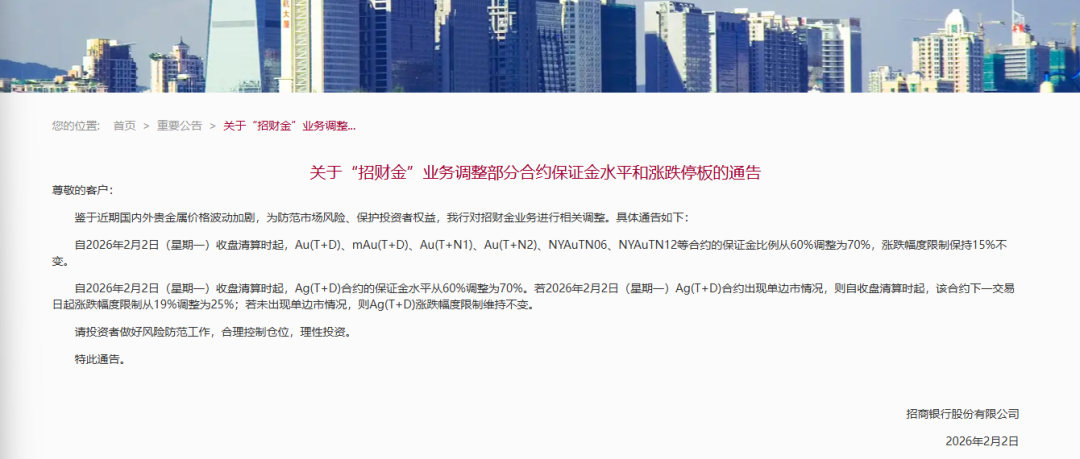
Core Viewpoint - Recent volatility in precious metal prices has prompted major banks, including China Merchants Bank and Postal Savings Bank, to issue risk warnings and adjust their trading policies to protect investors [1][2]. Group 1: China Merchants Bank - China Merchants Bank announced adjustments to its "Zhaocai Gold" business due to increased volatility in domestic and international precious metal prices [1]. - Starting from February 2, 2026, the margin ratio for various gold contracts, including Au(T+D) and Ag(T+D), will be increased from 60% to 70% [1]. - The price fluctuation limit for Ag(T+D) contracts will be adjusted to 25% if a one-sided market occurs; otherwise, it will remain unchanged [1]. Group 2: Postal Savings Bank - Postal Savings Bank issued a warning regarding the significant fluctuations in precious metal prices, urging clients to enhance their risk awareness [2][3]. - The bank advised clients to assess their financial situation and risk tolerance carefully, recommending rational investment and risk management strategies [2][3]. - Clients were encouraged to monitor market changes closely and control their positions to mitigate potential financial losses from price volatility [2][3].



邮储银行发布贵金属价格波动风险防范提示
Xin Lang Cai Jing· 2026-02-02 08:23
2月2日金融一线消息,邮储银行今日发布《关于做好贵金属价格波动风险防范的提示》称,近期国内外 贵金属市场价格波动剧烈,不确定因素显著增多。为保护黄金积存、实物贵金属业务客户利益,邮储银 行特别提示相关客户,请加强风险防范意识,在审慎评估自身财务状况及风险承受能力的基础上,理性 投资、合理配置、避免追涨杀跌,密切关注贵金属行情变化,控制持仓规模,防范贵金属价格波动带来 的资金损失。 2月2日金融一线消息,邮储银行今日发布《关于做好贵金属价格波动风险防范的提示》称,近期国内外 贵金属市场价格波动剧烈,不确定因素显著增多。为保护黄金积存、实物贵金属业务客户利益,邮储银 行特别提示相关客户,请加强风险防范意识,在审慎评估自身财务状况及风险承受能力的基础上,理性 投资、合理配置、避免追涨杀跌,密切关注贵金属行情变化,控制持仓规模,防范贵金属价格波动带来 的资金损失。 责任编辑:曹睿潼 责任编辑:曹睿潼 ...
重磅!涉黄金业务调整,工、农、中、建、交通、邮储六大行发布公告
Sou Hu Cai Jing· 2026-02-02 07:55
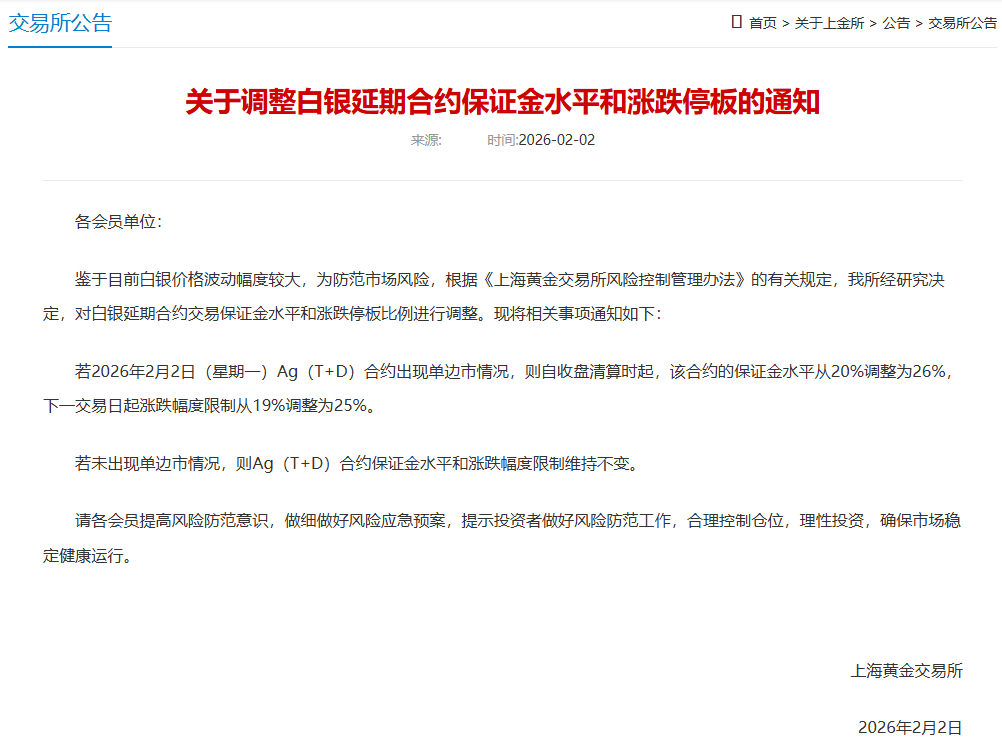
Group 1 - Shanghai Gold Exchange announced an adjustment to the margin level and price fluctuation limits for silver deferred contracts due to significant price volatility [2] - Starting February 2, 2026, the margin level for Ag (T+D) contracts will increase from 20% to 26%, and the price fluctuation limit will change from 19% to 25% if a one-sided market occurs [2] - If no one-sided market occurs, the margin level and price fluctuation limits for Ag (T+D) contracts will remain unchanged [3] Group 2 - Industrial and Commercial Bank of China (ICBC) advised clients to maintain a rational investment mindset amid significant fluctuations in precious metal prices, suggesting a diversified investment approach [5] - Agricultural Bank of China increased the margin ratio for Au (T+D) and mAu (T+D) contracts from 44% to 60% effective January 30 [6] - China Bank highlighted the uncertainties in the precious metals market and urged clients to manage their trading activities based on their financial status and risk tolerance [9] Group 3 - Construction Bank raised the minimum amount for regular gold accumulation business to 1500 yuan starting February 2, while also warning clients about increased market risks [11] - Both Bank of Communications and Postal Savings Bank issued announcements regarding adjustments to margin ratios for various gold contracts, with Postal Savings Bank increasing the margin ratio from 80% to 120% for certain contracts [12]



六大行密集调整黄金业务相关规则,应对市场波动
Jin Rong Jie· 2026-02-02 07:43
Group 1 - The six major state-owned banks in China have announced adjustments to their gold-related business rules and issued investment risk warnings in response to market volatility [1][2] - Industrial and Commercial Bank of China (ICBC) has implemented new requirements for personal customers to assess their risk tolerance before engaging in gold accumulation and investment plans, effective from January 12 [1] - Agricultural Bank of China (ABC) has raised the risk assessment requirement for its gold accumulation business, requiring a cautious risk level or higher starting January 30 [1] Group 2 - China Bank has highlighted increased uncertainty in the precious metals market and advised customers to manage their trading based on their financial situation and risk tolerance [1] - Construction Bank has raised the minimum amount for personal gold accumulation business to 1,500 yuan, effective February 2, and urged customers to enhance their risk awareness [2] - Postal Savings Bank has increased the margin ratio for several deferred contracts to 120% starting January 22, indicating a tightening of trading conditions [2]

邮储银行发布贵金属市场风险提示
Xin Lang Cai Jing· 2026-02-02 07:41
Core Viewpoint - Postal Savings Bank of China issued a warning regarding the recent volatility in precious metal prices, emphasizing the need for clients to enhance risk awareness and make informed investment decisions [1] Group 1: Market Conditions - Recent fluctuations in domestic and international precious metal markets have been significant, with increased uncertainty factors [1] - The bank highlights the importance of closely monitoring precious metal market trends to mitigate potential financial losses [1] Group 2: Client Advisory - Clients are advised to assess their financial situation and risk tolerance before making investment decisions [1] - The bank encourages rational investment strategies, including reasonable asset allocation and avoiding impulsive trading behaviors such as chasing price spikes [1] - Clients are urged to control their positions to prevent losses from price volatility in precious metals [1]
刚刚,黄金下跌超5%,白银猛跌10%,银行密集公告!
Sou Hu Cai Jing· 2026-02-02 07:17
Core Viewpoint - Precious metal prices have experienced significant declines, with gold dropping over 5% and silver falling more than 10%, prompting major banks to issue risk warnings and adjust their trading policies [1][2]. Group 1: Precious Metal Price Movements - As of February 2, spot gold prices are trading around $4636 per ounce, reflecting a decline of over 5% [1]. - Spot silver has dropped more than 10%, falling below $77 per ounce [2]. Group 2: Bank Responses and Adjustments - The Industrial and Commercial Bank of China (ICBC) has issued a risk warning, advising clients to assess their risk tolerance and adopt a rational investment approach amid increased market volatility [2]. - ICBC announced adjustments to its gold-related business operations, including changes to the processing times for certain gold products starting February 7 [2]. - Agricultural Bank of China has raised the margin requirement for gold trading contracts from 44% to 60% and emphasized the need for clients to control their positions and trade rationally [3]. - China Bank has also alerted clients to the uncertainties in the precious metals market and advised them to manage their trading activities based on their financial situation and risk tolerance [3]. - Construction Bank has increased the minimum investment amount for its gold accumulation business to 1500 yuan, citing heightened market risks [4]. - Other banks, including Bank of Communications and Postal Savings Bank, have also issued trading alerts and adjusted margin requirements for various gold contracts [4].

金价大幅震荡,六大行公告
Sou Hu Cai Jing· 2026-02-02 06:12
央视新闻 近期国内外贵金属价格波动剧烈,市场不确定性显著增强。日前,国有六大行多次发布公告调整黄金相 关业务,并提示交易风险。 工商银行 2月1日,工商银行通过公司贵金属业务部"工银金行家"公众号发布风险提示。近期国内外贵金属价格波 动剧烈,市场不确定性显著增强,工行建议客户在审慎评估自身风险承受能力的基础上,保持理性投资 心态,避免盲目追涨杀跌。公告建议客户从中长期视角考虑,坚持分批分散、适度均衡的原则进行投资 配置,同时密切关注行情变化,合理控制持仓规模,有效防范市场波动风险。 1月30日,中国银行发布公告表示,贵金属市场的不确定性因素较多,价格大幅波动。为保护积存金、 积利金、账户贵金属等贵金属相关业务的客户利益,中行特别提示客户做好市场风险防范,基于自身财 务状况和风险承受能力开展贵金属交易活动,合理控制贵金属持仓规模,防范贵金属价格波动带来的资 金损失风险。 建设银行 1月30日,建设银行发布公告调整个人黄金积存业务定期积存起点金额。自2月2日9:10起,建行个人黄 金积存业务定期积存起点金额(包括日均积存及自选日积存)上调至1500元。 同时,建行提示,近期国内外贵金属价格波动加剧,市场风险提升。 ...
贵金属价格波动 六大行发布风险提示
Bei Jing Wan Bao· 2026-02-02 06:07
Core Viewpoint - The recent fluctuations in gold prices have prompted major state-owned banks in China to adjust their gold-related business operations and issue risk warnings to clients regarding market volatility [1][2] Group 1: Gold Price Fluctuations - Gold prices experienced a historic surge at the beginning of 2026, reaching levels between $5000 and $5500 per ounce, followed by a significant drop on January 30 and further declines on February 2 [1] - The volatility in gold prices has led to increased market uncertainty, prompting banks to advise clients to assess their risk tolerance carefully [1] Group 2: Bank Responses - Industrial and Commercial Bank of China (ICBC) issued a risk warning on February 1, recommending clients maintain a rational investment mindset and avoid impulsive trading [1] - ICBC announced adjustments to its gold accumulation business and the sales of floating price physical gold products, effective February 7, including limits on transactions during non-trading days [1] - Other major banks, including Agricultural Bank of China and Postal Savings Bank, have also issued notifications regarding adjustments to gold trading operations and changes in margin requirements, urging clients to manage their positions prudently [2]
金银价格大幅震荡!上金所、六大行密集发布公告!
Huan Qiu Wang· 2026-02-02 05:53
Core Viewpoint - Recent fluctuations in domestic and international precious metal prices have significantly increased market uncertainty, prompting major state-owned banks to adjust their gold-related business and issue risk warnings [1][2][4]. Group 1: Shanghai Gold Exchange - On February 2, the Shanghai Gold Exchange announced adjustments to the margin levels and price limits for silver deferred contracts due to significant price volatility, increasing the margin from 20% to 26% and the price limit from 19% to 25% in case of a one-sided market [1]. - The Exchange urged members to enhance risk awareness and prepare emergency risk management plans to ensure stable market operations [1]. Group 2: Industrial and Commercial Bank of China (ICBC) - On February 1, ICBC advised clients to maintain a rational investment mindset and avoid impulsive trading amid heightened market uncertainty, recommending a diversified investment approach [2]. - ICBC announced changes to the processing times for certain gold products starting February 7, implementing limit management for transactions on non-trading days [2]. Group 3: Agricultural Bank of China - On January 29, the Agricultural Bank of China adjusted the margin ratio for gold deferred contracts from 44% to 60%, effective from January 30 [3]. - The bank also introduced a risk assessment requirement for personal clients engaging in gold accumulation transactions, mandating a cautious evaluation result for participation [3]. Group 4: Bank of China - On January 30, the Bank of China highlighted the uncertainties in the precious metals market and advised clients to manage their trading activities based on their financial status and risk tolerance [4]. Group 5: China Construction Bank - On January 30, China Construction Bank announced an increase in the minimum amount for regular gold accumulation to 1500 yuan, effective from February 2 [5]. - The bank emphasized the need for clients to enhance risk awareness and manage their positions carefully in light of increased market volatility [6]. Group 6: Other Banks - Both the Bank of Communications and Postal Savings Bank issued trading alerts, with the former adjusting suitability management requirements for its gold products and the latter increasing margin ratios for various gold contracts from 80% to 120% [7].
黄金跌停,黄金交易所突发公告,六大行曾提前预警
Sou Hu Cai Jing· 2026-02-02 05:07
Core Viewpoint - The domestic precious metals market experienced a historic shock on February 2, 2026, with significant declines in futures and stocks, prompting the Shanghai Gold Exchange to implement emergency risk control measures to stabilize the market [2][3][4]. Market Reaction - On February 2, the main silver futures contract on the Shanghai Futures Exchange hit the limit down, while gold futures fell over 10%, leading to a collective drop in the A-share precious metals sector, with over ten stocks hitting the limit down [2][6][7]. - The spot gold price fell below $4600 per ounce, with an intraday decline of 6.25%, reflecting a broader panic in the market [2][9]. Regulatory Response - The Shanghai Gold Exchange issued an urgent announcement to adjust the margin levels and price fluctuation limits for silver deferred contracts, aiming to curb excessive volatility and maintain market stability [3][4]. - The margin for silver contracts was raised from 20% to 26%, and the price fluctuation limit was increased from 19% to 25% in response to significant price movements [3][4]. Underlying Factors - The recent volatility in the precious metals market was attributed to multiple factors, including external liquidity concerns, changes in Federal Reserve policies, and panic selling among investors [11][12][14]. - The sharp decline in international gold prices, which fell over 12% in a single day, and the extreme volatility in silver prices, which dropped over 36%, were significant contributors to the market's instability [4][11]. Broader Market Impact - The panic in the precious metals market led to a domino effect, causing declines in related sectors such as oil and gas and telecommunications, with many stocks in these sectors also experiencing significant drops [10][11]. - The domestic commodity futures market saw widespread declines, with various precious metal futures hitting limit down, reflecting a broader market retreat [8][10]. Future Outlook - The long-term outlook for precious metals remains influenced by several key variables, including Federal Reserve policy adjustments, global liquidity changes, and geopolitical uncertainties [27][28]. - Despite the short-term volatility, the fundamental drivers for gold's long-term value, such as ongoing monetary easing and strong central bank demand, remain intact [24][25].