
CHINA TELECOM(601728)

Search documents
五大央企最新人事任免
券商中国· 2025-10-21 06:41
中国核工业集团有限公司 10月21日,国务院国资委网站发布《央企人事|5户中央企业外部董事职务变动》: 经研究,聘任 葛小春 为中国核工业集团有限公司外部董事, 欧阳谦 不再担任中国核工业集团有限公司 外部董事职务。 中国航天科工集团有限公司 经研究,聘任 张逢春 为中国航天科工集团有限公司外部董事。 中国电信集团有限公司 经研究,聘任 周渝波 为中国电信集团有限公司外部董事。 中国卫星网络集团有限公司 经研究,聘任 张建恒 为中国卫星网络集团有限公司外部董事。 中国第一汽车集团有限公司 经研究,聘任 丁绍斌 为中国第一汽车集团有限公司外部董事。 来源: 国务院国资委网站 责编:杨喻程 校 对: 姚远 百万用户都在看 刚刚,利好来了!A股公司,密集公告! 突发!美国、印度,重大变局! 刚刚,涨爆了!股市,集体拉升! 暴涨1600点!日本股市,突然引爆! 违法和不良信息举报电话:0755-83514034 邮箱:bwb@stcn.com 看券商中国 知天下财经 扫码关注券商中国公众号 扫码下载 券 中 社 A P P quanshangcn 舞#t 券中社APP qzs.stcn.com 券 商 中 国 是 证 ...

算力需求井喷 G.654.E光纤成为运力“黄金通道”
Xin Lang Cai Jing· 2025-10-21 06:21
Core Insights - China Telecom has announced the procurement of G.654.E optical fibers, marking the first time it has conducted a trunk cable tender in a framework format, with Yangtze Optical Fibre and Cable Joint Stock Limited Company winning the largest share [1] - The procurement involves approximately 2.24 million core kilometers of G.654.E optical fibers, indicating a significant increase in demand driven by the national "East Data West Computing" initiative [1] - The construction of backbone optical cable networks by China Telecom is accelerating, with the current procurement only meeting about half a year's project needs, suggesting a larger upcoming procurement in mid to late 2026 [1] Industry Trends - The three major telecom operators in China, including China Mobile and China Unicom, are entering a peak phase of G.654.E trunk network construction [1] - G.654.E optical fibers are becoming a critical foundation for supporting computing power networks, essential for the macro strategy of "East Data West Computing" and precise deployment in urban areas [1] - The new type of optical fiber, characterized by ultra-low loss, ultra-large capacity, and ultra-low latency, is being recognized as a "golden channel" for facilitating the digital economy in China [1]

国务院国资委:5户中央企业外部董事职务变动

Zheng Quan Shi Bao Wang· 2025-10-21 06:09
经研究,聘任张逢春为中国航天科工集团有限公司外部董事。 经研究,聘任葛小春为中国核工业集团有限公司外部董事,欧阳谦不再担任中国核工业集团有限公司外 部董事职务。 中国航天科工集团有限公司 人民财讯10月21日电,据国务院国资委网站,5户中央企业外部董事职务变动。 中国核工业集团有限公司 中国电信集团有限公司 经研究,聘任周渝波为中国电信(601728)集团有限公司外部董事。 中国第一汽车集团有限公司 经研究,聘任丁绍斌为中国第一汽车集团有限公司外部董事。 中国卫星网络集团有限公司 经研究,聘任张建恒为中国卫星(600118)网络集团有限公司外部董事。 ...
央企最新人事任免
Xin Jing Bao· 2025-10-21 05:57
Key Points - The State-owned Assets Supervision and Administration Commission of the State Council announced personnel changes for five central enterprises [1] Group 1: Personnel Changes - China National Nuclear Corporation appointed Ge Xiaochun as an external director, while Ouyang Qian is no longer serving in this role [2] - China Aerospace Science and Industry Corporation appointed Zhang Fengchun as an external director [3] - China Telecom Group appointed Zhou Yubo as an external director [4] - China Satellite Network Group appointed Zhang Jianheng as an external director [5] - China FAW Group appointed Ding Shaobin as an external director [6]
国资委公布5户中央企业外部董事职务变动
Xin Lang Cai Jing· 2025-10-21 04:33
Group 1 - The State-owned Assets Supervision and Administration Commission (SASAC) announced changes in external director positions for five central enterprises [1] - Ge Xiaochun has been appointed as an external director of China National Nuclear Corporation, while Ouyang Qian will no longer serve in this role [1] - Zhang Fengchun has been appointed as an external director of China Aerospace Science and Industry Corporation [1] - Zhou Yubo has been appointed as an external director of China Telecom Group [1] - Zhang Jianheng has been appointed as an external director of China Satellite Network Group [1] - Ding Shaobin has been appointed as an external director of China First Automobile Group [1]
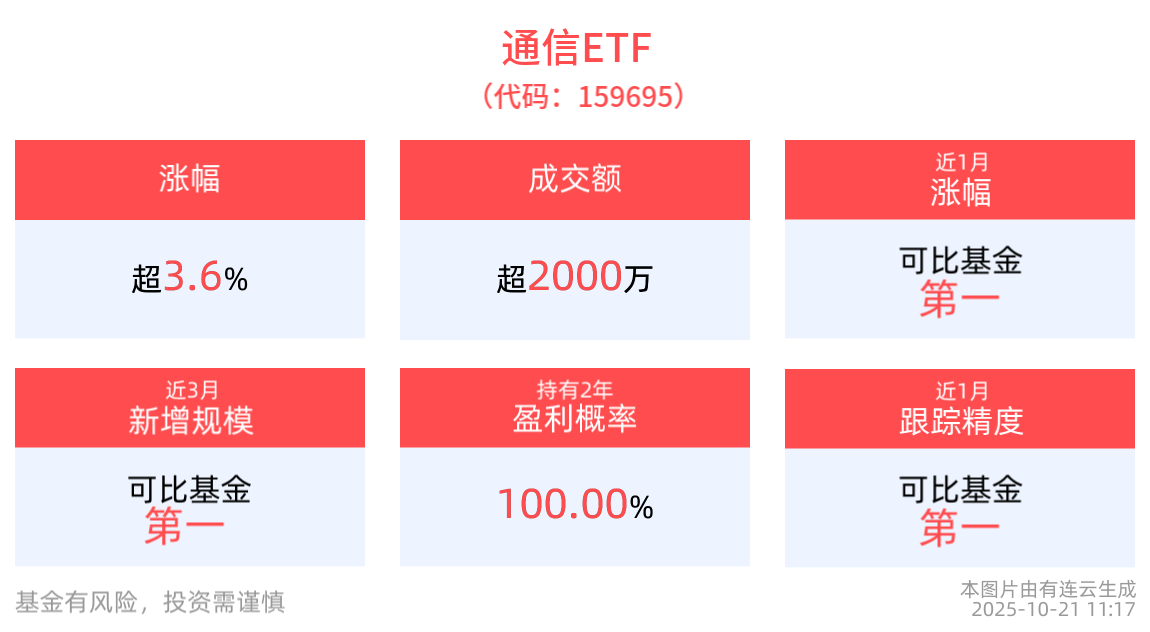
AI算力驱动光模块持续高景气,通信ETF(159695)盘中上涨3.63%,成分股中际旭创领涨
Sou Hu Cai Jing· 2025-10-21 03:44
Group 1 - The core viewpoint highlights the strong performance of the communication ETF, which has seen a net value increase of 94.23% over the past two years, ranking 39th out of 2358 index equity funds, placing it in the top 1.65% [2] - The communication ETF has recorded a maximum monthly return of 33.97% since its inception, with the longest consecutive monthly gains lasting 5 months and a total increase of 76.35%, averaging a monthly return of 7.57% during rising months [2] - Nvidia's Rubin has raised shipment expectations, indicating that leading companies may begin to increase total demand for 1.6T next year, reinforcing the sustainability and certainty of the high prosperity cycle for optical modules driven by AI computing power [2] Group 2 - The top ten weighted stocks in the Guozheng Communication Index account for 66.02% of the index, with major companies including Zhongji Xuchuang, Xinyi Sheng, ZTE, China Telecom, China Mobile, and China Unicom [3] - The stock performance of key companies shows varied results, with Zhongji Xuchuang increasing by 9.20% and China Telecom decreasing by 0.58%, while other companies like Xinyi Sheng and ZTE also showed positive growth [5] - Investors can access AI transformation opportunities in optical communication through the communication ETF linked fund (019072) [5]




我拿AI给神曲《八方来财》做了个MV,真的好魔性!
量子位· 2025-10-21 03:38
Core Viewpoint - The article highlights the emergence of AI-generated music videos, specifically through the platform TeleStudio developed by China Telecom, which allows users to create high-quality videos easily and for free during a limited period [3][6][40]. Group 1: TeleStudio Features - TeleStudio supports video generation in high definition (2K) with a maximum duration of 20 seconds, enabling complex actions to be executed seamlessly [5][14]. - The platform offers three main creative functions: image generation, video generation, and sound generation, allowing users to create content with simple prompts [7][13]. - Users can generate images based on specific prompts, select their preferred images, and use them as frames for video creation [9][11]. Group 2: User Experience and Functionality - The platform allows for the creation of videos by uploading images and providing descriptive prompts, making the process user-friendly [16][18]. - TeleStudio includes a unique feature called "Everything Dances," which enables users to make static images perform dance moves by simply selecting a dance style [22][23]. - The platform can also generate videos based on audio inputs, allowing for creative combinations of sound and visuals [37][38]. Group 3: Technological Support - TeleStudio is powered by the Starry Sky model developed by China Telecom's AI Research Institute, which effectively understands the complex relationships between text, images, and sounds [40][41]. - The platform's performance is supported by the AI Flow network, which ensures efficient and low-latency processing of the substantial computational power required for video generation [41]. Group 4: Market Impact and Opportunities - TeleStudio addresses the challenges of content creation in the short video era by lowering the barriers for both professional creators and amateurs, enabling anyone to become a creator [40][42]. - The platform is currently free to use and has launched a video creation challenge to encourage users to bring their creative ideas to life [42].

中国电信重磅亮相2025中国国际数字经济博览会(附图片)
Xin Lang Cai Jing· 2025-10-21 00:48
Group 1 - The 2025 China International Digital Economy Expo was officially launched in Shijiazhuang, showcasing over 30 digital innovation achievements by China Telecom under the theme "Leading Digital Transformation for a Smart Future" [4] - China Telecom is implementing the "East Data West Computing" project, developing an integrated intelligent computing service platform called "Xirang," which enables real-time computing resource scheduling [5] - The Hebei Telecom has established the first dedicated computing interconnection scheduling platform in the province, providing 3000P of domestic computing power [5] Group 2 - China Telecom has launched a provincial public data registration and authorization platform to enhance the value of data elements, supporting unified management of public data [6] - The company introduced the first quantum encryption office product in the province, enhancing data security for key industries [6] - A high-quality data set for industrial textile defect detection was recognized as a typical case by the National Data Bureau [6] Group 3 - China Telecom's satellite mobile communication system allows users to make calls and send messages without ground network signals, enhancing connectivity in low-signal areas [7] - The integration of 5G and satellite technology is being developed to create a comprehensive low-altitude intelligent network [8] - The "Jinong Tong Smart Planting Platform" utilizes AI and IoT technologies to optimize agricultural practices, improving crop yield and quality [8] Group 4 - China Telecom has introduced several digital technology products aimed at enhancing daily life, including the Tianyi Smart Screen and AI humanoid robots [9] - The company is building a smart home ecosystem that integrates connection, service, and security, providing a new experience in daily life [9] - The company aims to explore new development opportunities and unlock new scenarios for digital industry development [10]

国内首款eSIM手机即将发售 多家公司早有布局相关业务
Zheng Quan Shi Bao· 2025-10-20 17:10
Core Insights - Apple CEO Tim Cook announced the launch of the iPhone Air in China on October 22, which is the first smartphone in the country to use eSIM technology, eliminating the physical SIM card slot [1] - The launch follows the approval of eSIM services by major Chinese telecom operators, marking the official entry of eSIM technology into the mobile phone market in China [1][2] - The global eSIM market is projected to grow significantly, with an estimated 1 billion eSIM smartphone connections by the end of 2025 and 6.9 billion by 2030, representing 76% of total smartphone connections [2] Industry Developments - The eSIM ecosystem involves a complex supply chain including chip design, platform management, operator services, device integration, and end-user applications, with expectations for collaborative development and maturation of the industry [3] - Several companies in the A-share market have been actively developing eSIM capabilities, including Unisoc, which has launched multiple eSIM products compliant with GSMA standards [4] - Eastcompeace has successfully developed an embedded operating system and eSIM IoT management platform that received GSMA security certification [5] - Megmeet has established mature eSIM solutions with large-scale production on 4G/5G chip platforms [6] - Chutianlong's eSIM products have been approved by China Unicom, and Wanma Technology has been a long-term provider of eSIM solutions across various standards [7] Market Performance - eSIM concept stocks have seen an average increase of 42.42% year-to-date, significantly outperforming the Shanghai Composite Index, with six stocks rising over 50% [8] - Some eSIM concept stocks have experienced significant pullbacks from their year-to-date highs, with declines exceeding 30% for several companies [9] - A total of 14 eSIM concept stocks have received "positive" ratings from brokerage firms, with eight stocks rated by more than ten institutions, including ZTE, Guanghetong, China Telecom, China Mobile, and Megmeet [9]

苹果“引爆”eSIM手机商用,国产芯片供应企业:合作模式还待清晰|eSIM重返系列观察②
Mei Ri Jing Ji Xin Wen· 2025-10-20 15:08
Core Viewpoint - The approval of eSIM commercial trials by China's three major telecom operators marks a significant step towards the widespread adoption of eSIM technology in smartphones, with the iPhone Air leading the charge in the domestic market [1][2]. Group 1: eSIM Commercialization - China Mobile, China Unicom, and China Telecom have received approval to conduct eSIM commercial trials across all 31 provinces in China, allowing users to register for networks without a physical SIM card [1]. - The iPhone Air, set to launch on October 22, is the first smartphone in China to support only eSIM, achieving over 100 million yuan in sales within one second during pre-sales [1]. - Domestic manufacturers like Huawei and OPPO are expected to follow suit by launching their own eSIM-enabled smartphones [1]. Group 2: Supply Chain and Technology - The supply of domestic eSIM chips is still in the early stages, with companies like Unisoc and Tongfu Microelectronics being key players in the supply chain [1][3]. - Unisoc has developed eSIM chip technology that is compatible with over 400 global operators, but the final selection of domestic operators and partners remains unclear [1][6]. - The eSIM chip supply process is hindered by the need for clear operational protocols and collaboration models between telecom operators and smartphone manufacturers [6]. Group 3: Industry Development and Future Prospects - The eSIM market in China has experienced various phases, including exploration, trial, suspension, and re-initiation, with significant advancements made since 2015 [2][3]. - Companies like Huada Semiconductor and Changdian Technology are actively developing new technologies and expanding their market presence in the eSIM sector [4][5]. - The future of the eSIM market is contingent on the successful establishment of a collaborative ecosystem among industry players, as emphasized by the three major telecom operators [7].

