
CHINA TELECOM(601728)

Search documents
港股、海外周观察:多事之秋,反弹不畅
Soochow Securities· 2025-10-20 09:23
Group 1 - The report indicates that recent events suggest short-term volatility in the Hong Kong stock market may not have ended, but the long-term upward trend remains unchanged [1] - Economic data, US-China tariff news, US tech earnings, and the Fourth Plenary Session are expected to influence trading patterns and styles in the Hong Kong market [1][2] - The technology sector is facing increased volatility risks, with US tech earnings impacting the trading rhythm of Chinese tech stocks [1][2] Group 2 - The report highlights that the US stock market showed resilience despite concerns over US-China tensions and credit worries, with the Nasdaq leading gains at 2.1% [1][4] - Federal Reserve Chairman Powell's dovish stance suggests a likelihood of maintaining the current policy path, with a potential rate cut in October being the optimal solution [1][5] - The report notes that the average win rate for October over the past decade is low, while the advantages of November and December are relatively prominent [1][23] Group 3 - The report discusses the ongoing US government shutdown, which has entered its third week, potentially exacerbating negative impacts on the economy [3] - Concerns over credit quality in regional banks have emerged, but these are viewed as isolated incidents rather than indicative of a broader liquidity crisis [2][3] - The report emphasizes the importance of monitoring US-China trade relations, as further escalation could negatively impact the US economy and inflation risks [3][4] Group 4 - The report notes that developed markets saw an increase of 1.4% while emerging markets declined by 0.3% during the week [4][12] - The Hang Seng Tech Index fell by 8.0%, and the Hang Seng Index dropped by 4.0%, with public utilities leading sector gains [4][12] - The report highlights significant inflows into financials and non-essential consumer sectors, while the information technology sector experienced outflows [4][12] Group 5 - The report indicates that global stock ETFs saw a net inflow of $446.43 billion, with the US stock ETFs leading at $231.7 billion [7][49] - The technology sector was the top recipient of inflows among global stock ETFs, while the communication sector experienced the most significant outflows [7][51] - The report also notes that institutional investors marginally increased their holdings in gold, with significant inflows into major gold ETFs [6][54]



通信行业资金流入榜:中际旭创等8股净流入资金超亿元
Zheng Quan Shi Bao Wang· 2025-10-20 09:06
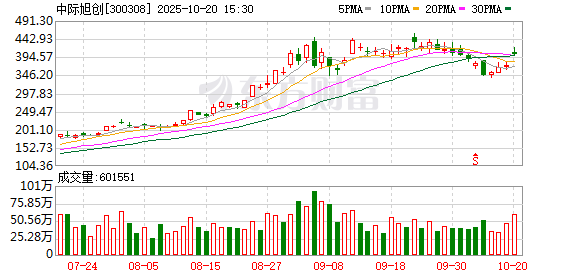
Market Overview - The Shanghai Composite Index rose by 0.63% on October 20, with 26 out of 28 sectors experiencing gains, led by the communication and coal industries, which increased by 3.21% and 3.04% respectively [2] - The net outflow of capital from the two markets was 4.601 billion yuan, with 12 sectors seeing net inflows, primarily in the communication sector, which attracted 4.397 billion yuan [2] Communication Industry - The communication sector saw a significant increase of 3.21%, with a total net inflow of 4.397 billion yuan, and 112 out of 125 stocks in this sector rose, including 4 stocks hitting the daily limit [3] - The top three stocks in terms of net capital inflow were Zhongji Xuchuang, with 2.087 billion yuan, followed by Xinyi Sheng and Tianfu Communication, with 835 million yuan and 704 million yuan respectively [3] - The sector also had 5 stocks with net outflows exceeding 30 million yuan, with the highest outflows from Dongxin He Ping, ZTE Corporation, and Shijia Guangzi, amounting to 296 million yuan, 229 million yuan, and 154 million yuan respectively [5] Capital Flow in Communication Sector - The top gainers in the communication sector included Zhongji Xuchuang (7.87%), Xinyi Sheng (4.09%), and Tianfu Communication (7.76%), with respective capital flows of 2.087 billion yuan, 834 million yuan, and 704 million yuan [4] - Other notable gainers included Jianqiao Technology (10.00%) and Guandun Quantum (2.42%), with capital flows of 459 million yuan and 183 million yuan respectively [4] Capital Outflow in Communication Sector - The stocks with the highest capital outflows included Dongxin He Ping (-6.98%), ZTE Corporation (-0.06%), and Shijia Guangzi (8.16%), with outflows of 296 million yuan, 229 million yuan, and 154 million yuan respectively [5] - Other stocks with notable outflows included China Telecom (-0.87%) and China Unicom (-0.55%), with outflows of 61 million yuan and 29 million yuan respectively [5]






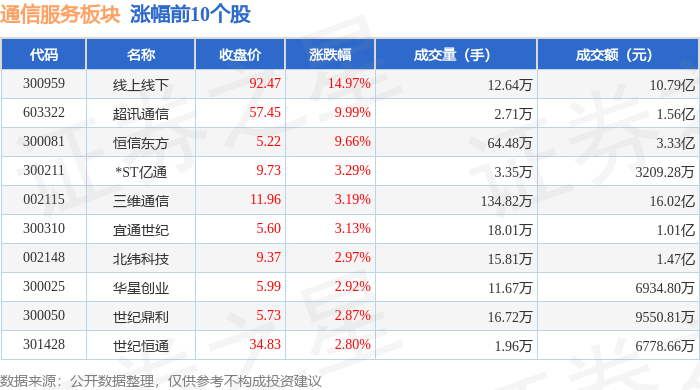
通信服务板块10月20日涨0.13%,线上线下领涨,主力资金净流入9545.79万元
Zheng Xing Xing Ye Ri Bao· 2025-10-20 08:37
Market Overview - On October 20, the communication services sector rose by 0.13% compared to the previous trading day, with online and offline leading the gains [1] - The Shanghai Composite Index closed at 3863.89, up 0.63%, while the Shenzhen Component Index closed at 12813.21, up 0.98% [1] Stock Performance - The top-performing stocks in the communication services sector included: - Online and Offline (300959) with a closing price of 92.47, up 14.97%, and a trading volume of 126,400 shares, totaling 1.08 billion yuan [1] - ChaoXun Communication (603322) closed at 57.45, up 9.99%, with a trading volume of 27,100 shares [1] - Hengxin Dongfang (300081) closed at 5.22, up 9.66%, with a trading volume of 644,800 shares [1] Fund Flow Analysis - The communication services sector saw a net inflow of 95.46 million yuan from institutional investors, while retail investors contributed a net inflow of 68.04 million yuan [2] - Notably, the sector experienced a net outflow of 163 million yuan from speculative funds [2] Individual Stock Fund Flow - Online and Offline (300959) had a net inflow of 155 million yuan from institutional investors, but a net outflow of 52.80 million yuan from speculative funds [3] - ChaoXun Communication (603322) recorded a net inflow of 61.15 million yuan from institutional investors, with a net outflow of 36.76 million yuan from speculative funds [3] - Hengxin Dongfang (300081) had a net inflow of 16.09 million yuan from institutional investors and a net inflow of 16.34 million yuan from speculative funds [3]



惠州电信:做好“暖心服务十件实事” 书写民生服务暖心答卷
Nan Fang Du Shi Bao· 2025-10-20 07:47
Core Viewpoint - China Telecom is actively implementing its "Warm-hearted Service Ten Initiatives" in Huizhou, focusing on enhancing communication services with both technological advancements and a human touch [1][12]. Group 1: Service Innovations - Huizhou Telecom is a pioneer in the "10 Gigabit Era," accelerating the construction of "10 Gigabit communities, factories, and parks," providing citizens with a glimpse of future living through smart home experiences and 5G technology [3][4]. - The company has integrated "cloud-network-AI" technologies to offer innovative services such as edge computing and cloud storage, benefiting both enterprises and households with applications like remote healthcare and cloud-based work [4][12]. Group 2: Online and Offline Service Integration - China Telecom has upgraded its online service capabilities, allowing users to manage various telecom services through the app and customer service hotline, enhancing convenience and efficiency [6][12]. - For those less familiar with online services, Huizhou Telecom provides structured offline service options, ensuring transparency in pricing and service agreements [6][12]. Group 3: Customer Protection and Security - The company has introduced services to reduce nuisance calls and enhance user privacy, utilizing advanced cloud-based interception technologies [7][12]. - Huizhou Telecom promotes a "one-click unbind" service for users facing issues with reactivated phone numbers, ensuring a smoother transition and enhanced security for users [7][24]. Group 4: Community Support Initiatives - The "Love Wing Station" at the Jiangbei service center offers essential services for outdoor workers and vulnerable groups, including rest areas, charging stations, and safety guidance [8][9]. - The company is committed to providing care for the elderly through dedicated service areas and educational programs on digital technology, helping them navigate modern communication tools [10][22]. Group 5: Network Quality and Accessibility - Huizhou Telecom is focused on improving network coverage and quality, particularly in high-traffic areas and essential public spaces, ensuring a seamless communication experience for users [12][13]. - The company has launched tailored data packages and services for cross-border customers, enhancing connectivity within the Greater Bay Area [12][13].


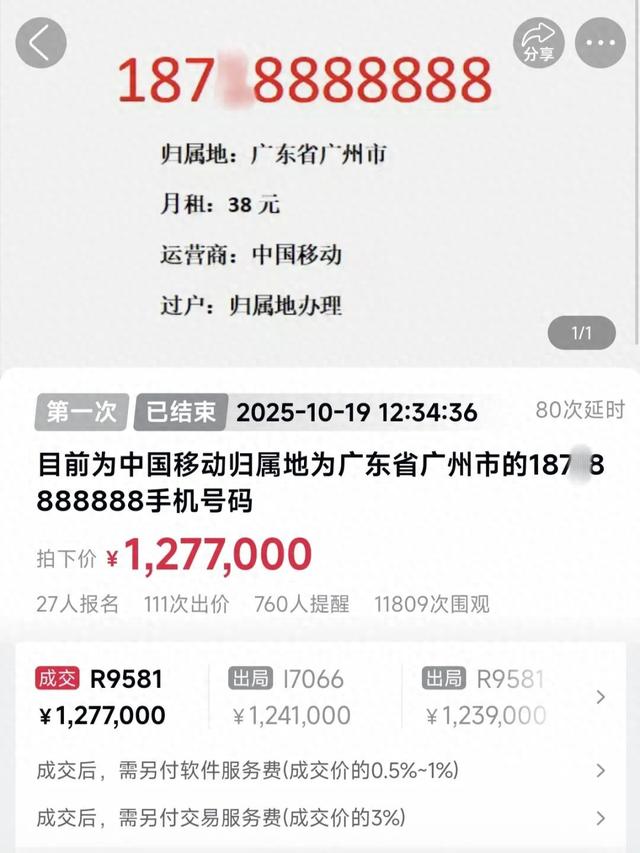
同一天拍出两个“尾号8888888”手机号,成交价分别为127.7万元和95.3万元
Huan Qiu Wang· 2025-10-20 05:35
Core Points - Two mobile phone numbers with the ending "8888888" were successfully auctioned on October 19, with one from China Mobile in Guangzhou sold for 1.277 million yuan and the other from China Telecom in Lijiang sold for 953,000 yuan [1][7] - The auction attracted significant interest, with 27 bidders for the China Mobile number and 33 bidders for the China Telecom number, resulting in a competitive bidding process [6][7] Auction Details - The starting bid for both numbers was set at 1,000 yuan, leading to substantial price increases during the auction [6] - The monthly rental for the China Mobile number is 38 yuan, while the China Telecom number has a monthly rental of 58 yuan, both with no minimum consumption period after transfer [3][4] Additional Costs - Buyers are required to pay additional fees, including a software service fee (0.5%-1% of the transaction price) and a transaction service fee (3% of the transaction price) [7]

计算机行业“一周解码”:政策东风助推智驾崛起
Bank of China Securities· 2025-10-20 05:11
Investment Rating - The industry investment rating is "Outperform the Market" [39] Core Views - The report highlights the acceleration of smart driving and the emergence of eSIM technology as key trends in the computer industry, indicating a shift towards a "cardless era" and the integration of smart terminals with communication ecosystems [4][11][14] - The report emphasizes the continuous order growth for humanoid robots from UBTECH, marking a significant advancement in the humanoid robotics industry [17][19] - Google's launch of the Veo 3.1 AI video generation model signifies a move towards "audio-visual integration," enhancing the capabilities of video content creation [21][23] - The policy push for vehicle-road collaboration is expected to facilitate the systematic development of smart driving infrastructure [14][16] Summary by Sections eSIM Technology - The three major telecom operators in China have received approval to conduct eSIM mobile service trials, which will enhance the convenience of mobile communication and drive upgrades across the entire industry chain [11][12] - eSIM technology allows for the integration of SIM card functions into the device, leading to lighter and more robust designs, and simplifying user operations such as activation and number changes [11][13] Humanoid Robotics - UBTECH has secured a procurement contract worth over 32 million yuan for its Walker S2 humanoid robots, following a record-breaking order in September [17][19] - The total contracts for the Walker series have approached 500 million yuan, indicating a strong demand and the company's commitment to increasing production capacity [17][19] AI Video Generation - Google's Veo 3.1 model introduces enhanced audio and narrative control, allowing for more realistic video generation and editing capabilities [21][22] - The model supports native audio generation, enabling users to control the emotional and narrative aspects of their videos during the creation process [21][23] Smart Driving Infrastructure - The Ministry of Housing and Urban-Rural Development has initiated a plan to promote the integration of smart city infrastructure with intelligent connected vehicles, focusing on enhancing urban logistics and emergency response capabilities [14][15] - The policy aims to improve the safety and reliability of smart driving through better infrastructure and technology integration [14][16]

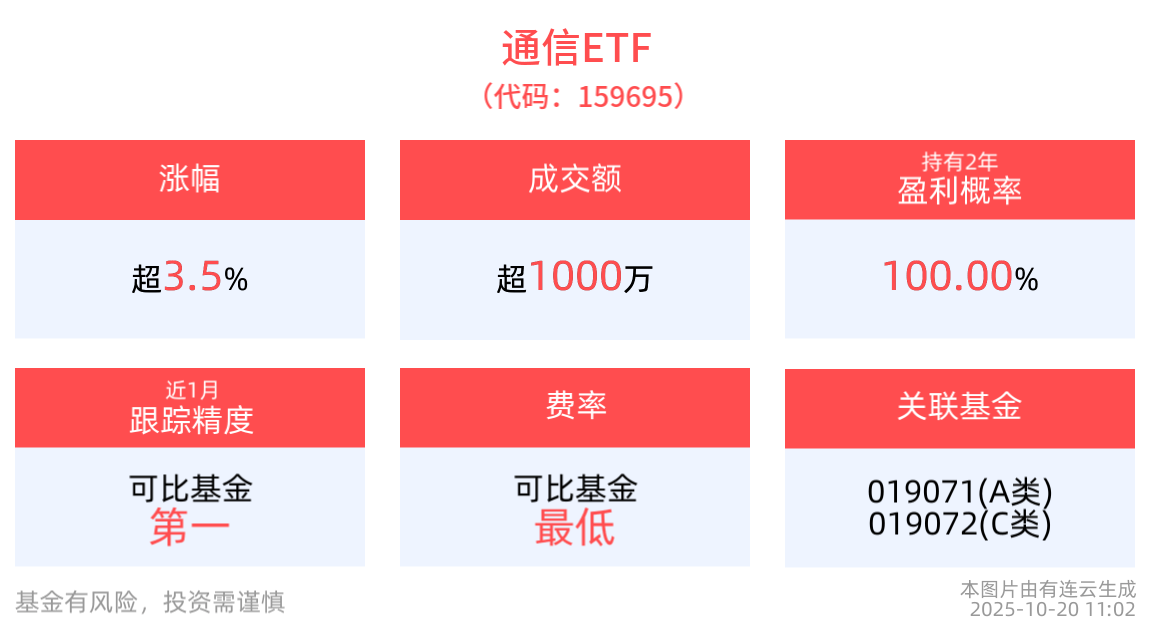
通信ETF(159695)盘中上涨3.52%,成分股剑桥科技10cm涨停,机构:持续看好25Q4通信板块机会
Sou Hu Cai Jing· 2025-10-20 03:36
Group 1 - The communication ETF has seen a turnover of 6.83% with a transaction volume of 17.29 million yuan, and its net value has increased by 76.97% over the past two years, ranking 80 out of 2353 index equity funds, placing it in the top 3.40% [3] - The highest monthly return since the establishment of the communication ETF is 33.97%, with the longest consecutive monthly gains being 5 months and a maximum increase of 76.35%, while the average return during rising months is 7.57% [3] - Galaxy Securities indicates strong demand and sustained prosperity in the AI-driven computing power industry, despite potential short-term market fluctuations and adjustments, maintaining a positive outlook for the AI computing sector from a medium to long-term perspective [3] Group 2 - According to Zheshang Securities, the communication industry is expected to see a 2.8% year-on-year revenue growth and a 7.8% increase in net profit attributable to the parent company in the first half of 2025, with steady performance improvements anticipated [3] - The report predicts continued high growth in sectors such as optical modules and liquid cooling in Q3 2025, with an ongoing improvement in the main business of operators and an increase in the proportion of innovative businesses [3] - The satellite internet industry is gradually establishing trends and is expected to see significant growth, with a positive outlook for opportunities in the communication sector in Q4 2025 [3] Group 3 - As of September 30, 2025, the top ten weighted stocks in the Guozheng Communication Index include Zhongji Xuchuang, Xinyi Sheng, ZTE Corporation, China Telecom, China Mobile, China Unicom, Tianfu Communication, Zhongtian Technology, Transsion Holdings, and Hengtong Optic-Electric, collectively accounting for 66.02% of the index [4] - The performance of individual stocks shows varied changes, with Zhongji Xuchuang increasing by 8.68% and Tianfu Communication rising by 9.80%, while China Telecom and China Mobile experienced slight declines [6] - Investors can access AI-driven optical communication investment opportunities through the communication ETF linked fund (019072) [6]

国内eSIM手机商用破冰 运营商加速迈向“无卡”时代
Zheng Quan Shi Bao· 2025-10-19 22:24
Core Insights - The introduction of eSIM technology marks a significant shift towards a "cardless" era in mobile communication, with eSIMs expected to gradually replace physical SIM cards in the long term [1][4][7] Industry Overview - eSIM technology allows for flexible network switching, space-saving in devices, and seamless connectivity across multiple devices and scenarios, indicating a trend towards "cardless" solutions [1][2] - The global market for eSIM-enabled smartphones is projected to reach approximately 1 billion connections by the end of 2025, with an expected growth to 7 billion by 2030, representing three-quarters of total smartphone connections [4] Market Dynamics - Major Chinese telecom operators have recently received approval to launch eSIM services for mobile phones, marking a significant milestone in the domestic market after a two-year pause [3][4] - The shift to eSIM is expected to enhance device waterproofing, internal space utilization, and battery optimization, thus driving innovation in high-end smartphone models [6][10] Competitive Landscape - The entry of eSIM technology into the Chinese smartphone market is seen as a catalyst for global eSIM development, with Apple leading the charge by launching eSIM-only devices [4][5] - Other smartphone manufacturers, including OPPO and vivo, are also preparing to release eSIM-compatible devices, indicating a rapid market response [4][5] Challenges and Considerations - The transition to eSIM technology faces challenges such as security concerns, consumer awareness, and the need for standardized interoperability among different operators [9][10] - The shift from physical SIM cards to eSIMs is expected to increase competition among telecom operators, as users will have greater flexibility to switch providers, potentially impacting traditional revenue models [10][11]
突破物联边界 eSIM技术迈入商用新阶段
Zhong Guo Zheng Quan Bao· 2025-10-19 22:21
Core Insights - Apple CEO Tim Cook announced the official launch of the iPhone Air in China on October 22, following the approval of eSIM services by major telecom operators in China [1][2] - The introduction of eSIM technology marks a significant shift in the mobile communication landscape, enabling a new phase of commercial use for smartphones in China [1][3] eSIM Technology and Market Trends - eSIM is predicted to be a major trend, with GSMA forecasting that global eSIM smartphone connections will reach 1 billion by 2025 and 6.9 billion by 2030, accounting for 76% of total smartphone connections [2][3] - The iPhone Air, being eSIM-only, is Apple's thinnest model at 5.6 mm and 165 grams, allowing for enhanced design possibilities and improved battery life [2][3] User Experience and Convenience - eSIM technology simplifies the process of changing phone numbers, particularly benefiting travelers who can easily switch to local numbers without needing physical SIM cards [3][4] - Over 400 global operators are expected to provide eSIM services by July 2025, with a 29% adoption rate among 5G users [3][4] Industry Implications and Innovations - The shift to eSIM is anticipated to drive significant investment across the entire supply chain, including wearables, IoT devices, tablets, and laptops, as the Chinese market sees annual smartphone sales of 300 million units [4][5] - eSIM's remote number-switching capability poses challenges for telecom operators, necessitating enhancements in marketing strategies and customer service to retain user loyalty [6][7] Future Applications and Developments - eSIM technology is expected to expand into various applications, including pet devices and robotics, further enhancing connectivity in the IoT landscape [5][6] - Telecom operators are actively participating in the development of eSIM standards and technology, ensuring compatibility and security for users [7]

突破物联边界eSIM技术迈入商用新阶段
Zhong Guo Zheng Quan Bao· 2025-10-19 20:13
Core Insights - Apple CEO Tim Cook announced the official launch of the iPhone Air in China on October 22, following the approval of eSIM services by major telecom operators in China [1][2] - eSIM technology is seen as a key infrastructure for transforming the communication industry, enhancing user experience, and driving digital economic growth in China [1][3] eSIM Technology Adoption - eSIM is predicted to be a significant trend, with GSMA forecasting that global eSIM smartphone connections will reach 1 billion by 2025 and 6.9 billion by 2030, accounting for 76% of total smartphone connections [2] - The iPhone Air, being the thinnest iPhone at 5.6 mm and weighing 165 grams, benefits from the removal of the physical SIM card, allowing for a larger battery and increased battery life by approximately 2 hours [2] User Experience and Convenience - eSIM simplifies the process of writing user identities, making it easier for travelers to manage communication needs abroad without needing physical SIM cards [3] - Over 400 global operators are expected to provide eSIM services by July 2025, with a 29% adoption rate among 5G users [3] Industry Impact and Future Applications - The introduction of eSIM is anticipated to drive significant investment across the entire industry chain, including wearables, IoT devices, tablets, and laptops, as the Chinese market sees annual mobile phone sales of 300 million units [4] - eSIM is expected to play a crucial role in the IoT sector, with GSMA predicting that over 50% of IoT applications will utilize eSIM by 2030 [4] Challenges for Telecom Operators - The remote number-switching capability of eSIM may increase user autonomy in changing service providers, posing challenges for telecom operators in terms of revenue stability and necessitating enhancements in marketing strategies and service offerings [4][6] - Telecom companies are focusing on optimizing eSIM services to meet diverse user needs and improve overall user experience [5][6]