
CEB BANK(601818)

Search documents
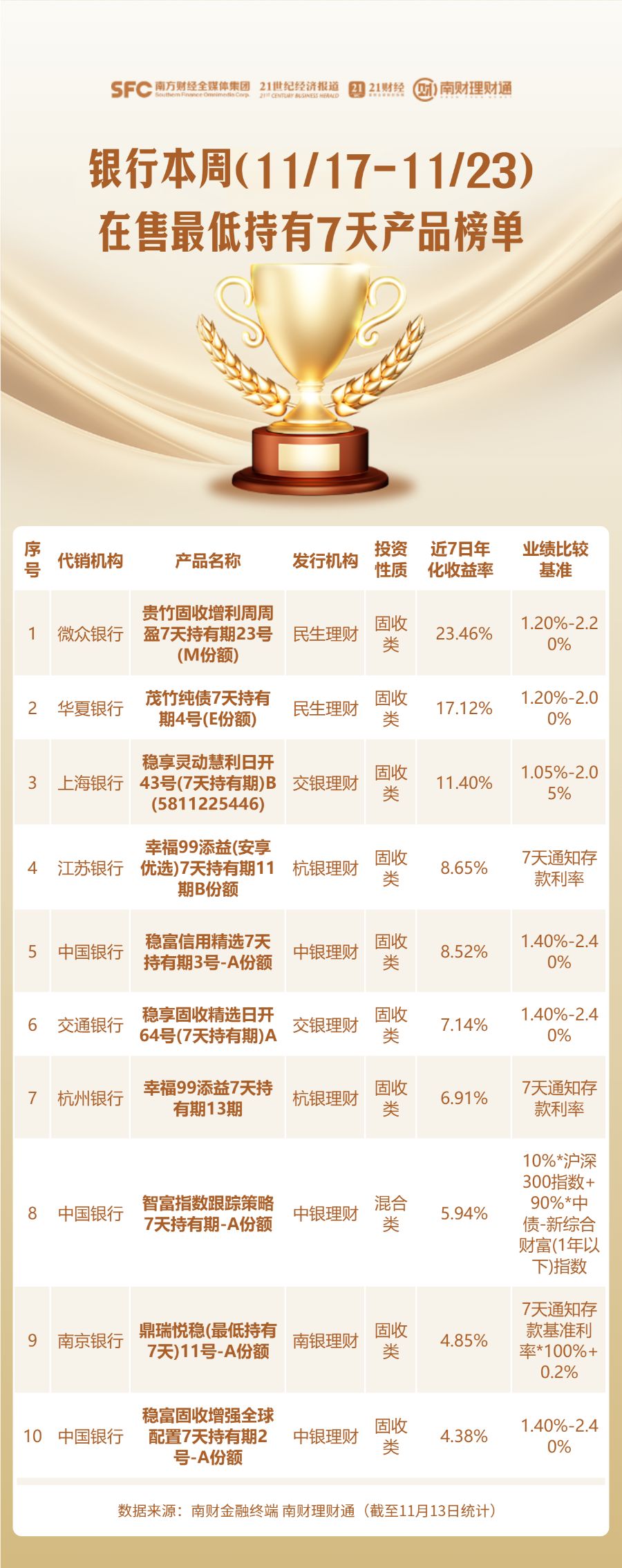
最低持有期榜单出炉!互联网银行7天持有期代销产品收益最高
2 1 Shi Ji Jing Ji Bao Dao· 2025-11-17 01:20
Core Insights - The article focuses on the performance of bank wealth management products with varying minimum holding periods, aiming to help investors identify and select high-performing products [1][5][12] Summary by Category Performance Rankings - The article provides a ranking of wealth management products based on their annualized returns for different holding periods: 7 days, 14 days, 30 days, and 60 days [1][5][12] - For the 7-day holding period, the top-performing product is from Minsheng Bank with an annualized return of 17.12% [4] - For the 14-day holding period, Minsheng Bank's product also leads with a return of 19.88% [6] - In the 30-day category, Minsheng Bank again tops the list with a return of 21.98% [10] - The 60-day holding period shows a leading return of 9.74% from Minsheng Bank [13] Product Categories - The products are categorized into fixed income and mixed types, with specific focus on their respective annualized returns and performance benchmarks [4][10][13] - The rankings are based on data from 28 distribution institutions, including major banks like ICBC, Bank of China, and Agricultural Bank of China [1] Investor Guidance - The article emphasizes the importance of checking the actual availability of products on bank apps, as some may be sold out or not displayed uniformly across different clients [1] - It aims to reduce the selection cost for investors by providing a clear performance overview of available products [1][5]







光大银行再推中期分红62亿加码股东回报 7家股份行将派现近670亿净息差有望趋稳
Chang Jiang Shang Bao· 2025-11-16 23:33
Core Viewpoint - Everbright Bank has announced a mid-term profit distribution plan for 2025, proposing a cash dividend of 1.05 yuan per 10 shares, totaling 6.204 billion yuan, which accounts for 25.2% of its net profit attributable to shareholders. This marks the second consecutive mid-term dividend after its first in 2024 [2][4]. Group 1: Dividend Distribution - Seven out of nine listed commercial banks have either implemented or are planning to implement mid-term dividends, with a cumulative payout amounting to 66.973 billion yuan [5]. - Minsheng Bank has already completed its mid-term dividend distribution, amounting to 5.954 billion yuan, while China Merchants Bank and Industrial Bank have initiated their first mid-term dividends, with amounts of 26.226 billion yuan and 11.957 billion yuan respectively [3][4]. Group 2: Net Interest Margin Trends - The net interest margin (NIM) for Everbright Bank in the first three quarters of 2025 was 1.34%, a decrease of 0.2 percentage points from 1.54% in 2024 [6][7]. - Despite the pressure on NIM, the overall decline is expected to narrow for the year, with management anticipating a stabilization in the banking sector's NIM and a potential recovery in net interest income growth [8][9]. Group 3: Financial Performance - The operating revenues of major banks have generally declined, with Everbright Bank reporting a 7.94% decrease in revenue to 94.27 billion yuan for the first three quarters of 2025 [6]. - In contrast, Minsheng Bank and Shanghai Pudong Development Bank reported revenue growth of 6.74% and 1.88% respectively, indicating a divergence in performance among the banks [8].

银行业周度追踪2025年第45周:非银存款加速增长-20251117
Changjiang Securities· 2025-11-16 23:30
Investment Rating - The report maintains a "Positive" investment rating for the banking sector [13]. Core Insights - The banking index accelerated its rise this week, outperforming the Shanghai and Shenzhen 300 and ChiNext indices, with a relative return of 2.8% and 4.7% respectively [9]. - Non-bank deposits have seen a significant increase, with a year-on-year growth of 770 billion yuan, attributed to high capital market activity [8][36]. - The report highlights that the four major banks have announced early dividend distributions, expected to attract more allocation from institutional investors [2][9]. Summary by Sections Banking Index Performance - The banking index rose by 1.7% this week, with individual stocks like Agricultural Bank of China leading the gains, reaching new highs [9][16]. - H-shares of banks have seen a continuous increase in holdings since October, indicating a growing interest from southbound funds [2][9]. Credit and Deposit Trends - In October, new social financing totaled 816.1 billion yuan, a year-on-year decrease of 595.9 billion yuan, with the month-end balance growth rate dropping to 8.5% [6][36]. - New RMB loans in October amounted to 220 billion yuan, down 280 billion yuan year-on-year, with a month-end balance growth rate of 6.5% [7][38]. - Both household and corporate deposits have decreased year-on-year, while non-bank deposits have increased, reflecting a shift in deposit behavior [8][55]. Market Dynamics - The average dividend yield for the six major banks' A-shares has decreased to 3.73%, with a spread of 191 basis points over the 10-year government bond yield [18][22]. - The report suggests monitoring convertible bonds of banks as their stock prices approach redemption thresholds, indicating potential trading opportunities [24][10].




多家银行出台方案优化供给——金融精准服务新型工业化
Jing Ji Ri Bao· 2025-11-15 23:03
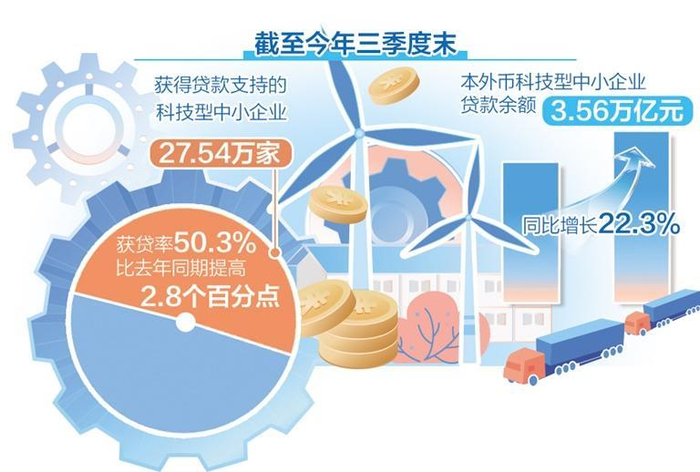
Core Viewpoint - The Chinese government is enhancing financial support for new industrialization through various banks and financial institutions, aiming to strengthen the manufacturing sector and promote technological innovation [2][3][4]. Group 1: Financial Support Initiatives - The People's Bank of China and other departments issued guidelines to accelerate financial support for new industrialization, with banks like China Construction Bank and Bank of China developing implementation plans [2]. - China Construction Bank aims to provide over 5 trillion yuan in financing to various manufacturing entities over the next three years, focusing on key areas and weak links in new industrialization [2]. - Bank of China reported a supply chain financing balance and loans to technology enterprises exceeding 2.3 trillion yuan, indicating strong growth in financial support for industrial sectors [3]. Group 2: Technological Innovation Financing - The financing support for technology-driven small and medium-sized enterprises (SMEs) has increased, with 275,400 SMEs receiving loans, achieving a loan approval rate of 50.3%, up by 2.8 percentage points year-on-year [4]. - The total loan balance for technology SMEs reached 3.56 trillion yuan, growing by 22.3% year-on-year, which is significantly higher than the growth rate of other loan categories [4]. - Banks are innovating their credit models to assess technology and team capabilities, moving towards a comprehensive financial service model for technology enterprises [4][5]. Group 3: Diversification of Financing Channels - Banks are enhancing their offerings by developing technology innovation bonds and knowledge property pledge loans, creating a service ecosystem that combines debt, equity, and platforms [6]. - China Construction Bank has actively participated in the issuance of technology innovation bonds, with the first bond launched in May, aimed at funding technology enterprises and strategic emerging industries [6]. - Bank of China has provided over 20 billion yuan in financing support for mergers and acquisitions of quality technology enterprises across various cities [6]. Group 4: Collaborative Financial Ecosystem - The construction of a technology finance ecosystem should focus on the comprehensive needs of technology enterprises, integrating resources for collaborative development [7]. - There is a call for enhancing direct financing mechanisms, particularly in stock and bond markets, to better support technology enterprises [7]. - The establishment of a market mechanism for "patient capital" is essential to attract various long-term investments to support technological innovation [7].
中国光大银行拟派发中期股息每10股1.05元
Zhi Tong Cai Jing· 2025-11-14 14:25
Core Viewpoint - China Everbright Bank (06818) announced a proposed interim dividend of 1.05 yuan per 10 shares for the six months ending June 30, 2025 [1] Company Summary - The company plans to distribute an interim dividend, indicating a commitment to returning value to shareholders [1]
中国光大银行(06818) - 海外监管公告
2025-11-14 14:23
香港交易及結算所有限公司及香港聯合交易所有限公司對本公告的內容概不負責,對其 準確性或完整性亦不發表任何聲明,並明確表示,概不對因本公告全部或任何部份內容 而產生或因倚賴該等內容而引致之任何損失承擔任何責任。 中國光大銀行股份有限公司 中國光大銀行股份有限公司 China Everbright Bank Company Limited China Everbright Bank Company Limited (於中華人民共和國註冊成立的股份有限公司) (於中華人民共和國註冊成立的股份有限公司) (股份代號:6818) (股份代號:6818) 海外監管公告 本公告乃根據《香港聯合交易所有限公司證券上市規則》第13.10B條而作出。 茲載列中國光大銀行股份有限公司在上海證券交易所網站刊登的《中國光大銀行股份有限 公司關聯交易公告》,僅供參閱。 中國光大銀行股份有限公司 董事會 中國 • 北京 2025年11月14日 中国光大银行股份有限公司(简称本行)为光大金瓯资产管理 有限公司(简称光大金瓯)核定资产转移类累计交易额度人民币 30 亿元,额度有效期三年,额度项下单笔及每年累计交易金额不超过 人民币 10 亿元 ...
中国光大银行(06818)拟派发中期股息每10股1.05元
智通财经网· 2025-11-14 14:22
Core Viewpoint - China Everbright Bank (06818) announced its intention to distribute an interim dividend of 1.05 yuan per 10 shares for the six months ending June 30, 2025 [1] Summary by Category - **Company Announcement** - The company plans to issue an interim dividend for the first half of 2025 [1]
中国光大银行(06818) - 海外监管公告
2025-11-14 14:18
香港交易及結算所有限公司及香港聯合交易所有限公司對本公告的內容概不負責,對其 準確性或完整性亦不發表任何聲明,並明確表示,概不對因本公告全部或任何部份內容 而產生或因倚賴該等內容而引致之任何損失承擔任何責任。 中國光大銀行股份有限公司 中國光大銀行股份有限公司 China Everbright Bank Company Limited China Everbright Bank Company Limited (於中華人民共和國註冊成立的股份有限公司) (於中華人民共和國註冊成立的股份有限公司) (股份代號:6818) (股份代號:6818) 海外監管公告 本公告乃根據《香港聯合交易所有限公司證券上市規則》第13.10B條而作出。 茲載列中國光大銀行股份有限公司在上海證券交易所網站刊登的《中國光大銀行股份有限 公司2025年度中期利潤分配方案公告》,僅供參閱。 中國光大銀行股份有限公司 董事會 中國 • 北京 2025年11月14日 於本公告日期,本公司執行董事為郝成先生、齊曄女士及楊兵兵先生;非執行董事為 吳利軍先生、崔勇先生、姚威先生、張銘文先生及李巍先生;以及獨立非執行董事為 邵瑞慶先生、洪永淼先生、李 ...
中国光大银行(06818) - 海外监管公告
2025-11-14 14:17
香港交易及結算所有限公司及香港聯合交易所有限公司對本公告的內容概不負責,對其 準確性或完整性亦不發表任何聲明,並明確表示,概不對因本公告全部或任何部份內容 而產生或因倚賴該等內容而引致之任何損失承擔任何責任。 中國光大銀行股份有限公司 中國光大銀行股份有限公司 China Everbright Bank Company Limited China Everbright Bank Company Limited (於中華人民共和國註冊成立的股份有限公司) (於中華人民共和國註冊成立的股份有限公司) (股份代號:6818) (股份代號:6818) 海外監管公告 於本公告日期,本公司執行董事為郝成先生、齊曄女士及楊兵兵先生;非執行董事為 吳利軍先生、崔勇先生、姚威先生、張銘文先生及李巍先生;以及獨立非執行董事為 邵瑞慶先生、洪永淼先生、李引泉先生、劉世平先生、黃志凌先生及黃振中先生。 股票代码:601818 股票简称:光大银行 公告编号:临 2025-056 中国光大银行股份有限公司 第九届监事会第二十四次会议决议公告 本行监事会及全体监事保证本公告内容不存在任何虚假记载、误导性陈述 或者重大遗漏,并对其内容的真实 ...
中国光大银行(06818) - 海外监管公告
2025-11-14 14:12
香港交易及結算所有限公司及香港聯合交易所有限公司對本公告的內容概不負責,對其 準確性或完整性亦不發表任何聲明,並明確表示,概不對因本公告全部或任何部份內容 而產生或因倚賴該等內容而引致之任何損失承擔任何責任。 中國光大銀行股份有限公司 中國光大銀行股份有限公司 China Everbright Bank Company Limited China Everbright Bank Company Limited (於中華人民共和國註冊成立的股份有限公司) (於中華人民共和國註冊成立的股份有限公司) (股份代號:6818) (股份代號:6818) 海外監管公告 本公告乃根據《香港聯合交易所有限公司證券上市規則》第13.10B條而作出。 茲載列中國光大銀行股份有限公司在上海證券交易所網站刊登的《中國光大銀行股份有限 公司第十屆董事會第一次會議決議公告》,僅供參閱。 中國光大銀行股份有限公司 董事會 中國 • 北京 2025年11月14日 於本公告日期,本公司執行董事為郝成先生、齊曄女士及楊兵兵先生;非執行董事為 吳利軍先生、崔勇先生、姚威先生、張銘文先生及李巍先生;以及獨立非執行董事為 邵瑞慶先生、洪永淼先生、李引 ...