CCB(601939)

Search documents
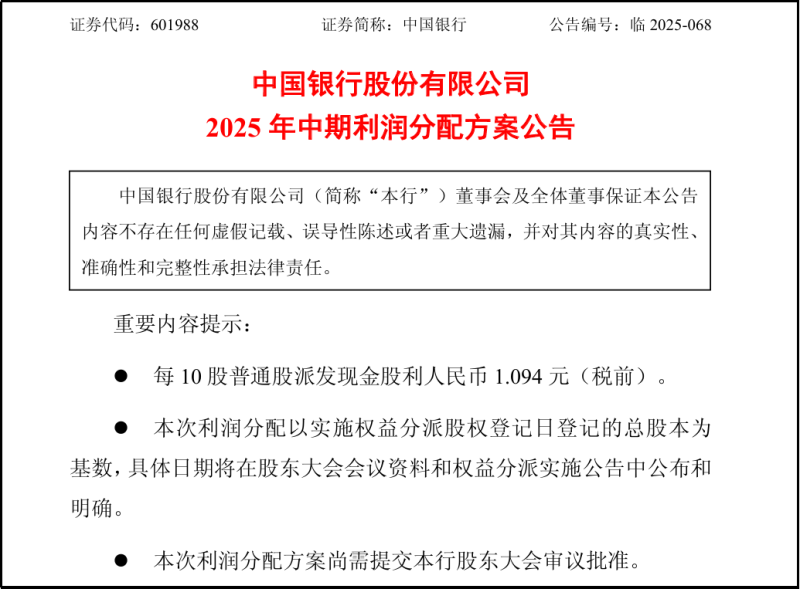
26家A股银行分红预案已出,总额突破2600亿元
Chang Sha Wan Bao· 2025-12-19 06:56
Group 1 - The core viewpoint of the news is that A-share listed banks are expected to distribute significant cash dividends, with a total expected amount exceeding 260 billion yuan, indicating a trend towards increased shareholder returns [1][2] - As of December 17, 2025, 26 A-share listed banks have disclosed their mid-term or quarterly dividend plans, surpassing the 24 banks that did so for 2024 [1][2] - The six major state-owned banks are the main contributors to this dividend distribution, with a total cash dividend expected to exceed 200 billion yuan, accounting for over 70% of the total dividends from all listed banks [2] Group 2 - The Industrial and Commercial Bank of China leads the dividend distribution with 50.396 billion yuan, followed by other major banks such as China Construction Bank and Agricultural Bank of China [2] - Several banks, including China Merchants Bank and Changsha Bank, are initiating mid-term dividends for the first time, with a total dividend amount of approximately 23 billion yuan [2] - The trend of high-frequency dividends aligns with national policy directives aimed at enhancing the quality of capital market development and protecting investor rights [3][4] Group 3 - The increase in dividend frequency is seen as a positive response to policy guidance, providing a model for other listed companies to improve their dividend mechanisms [4] - High-frequency dividends not only enhance shareholder satisfaction but also meet the investment needs of long-term funds such as social security and pension funds [4][5] - The banking sector's move towards mid-term dividends is expected to positively impact stock prices and the overall banking sector, signaling strong profitability and ample cash flow [6]




多家银行年末加速“甩包袱”→
Jin Rong Shi Bao· 2025-12-19 06:37
Group 1 - The core viewpoint of the articles highlights a significant increase in the transfer of non-performing retail assets by banks as they approach year-end, driven by financial optimization and risk clearance [1][2] - The number of non-performing asset packages listed for transfer has surged, with over 30 announcements made in just two days, indicating a rapid acceleration in the pace of asset disposals by major banks [1][2] - Retail non-performing loans have become the primary type of assets being transferred, as banks aim to optimize year-end financial statements by reducing non-performing loan ratios and improving capital indicators [2][3] Group 2 - The trend of transferring retail non-performing assets is supported by data showing a 761.4% year-on-year increase in the scale of personal non-performing loan batch transfers, with personal consumption loans making up over 70% of these transfers [2] - The current phase of retail banking is characterized by a shift from rapid expansion to structural adjustment and refined management, with a focus on high-quality customer operations and wealth management [3][4] - Experts predict that the wave of non-performing loan disposals may continue until mid-2026, with an expected increase in the scale of disposals and a shift towards regional small and medium-sized banks as the primary entities involved [3]





利率1.65%-2.07%!银行科创债破3000亿元,城商行成新主力
Xin Lang Cai Jing· 2025-12-19 05:29
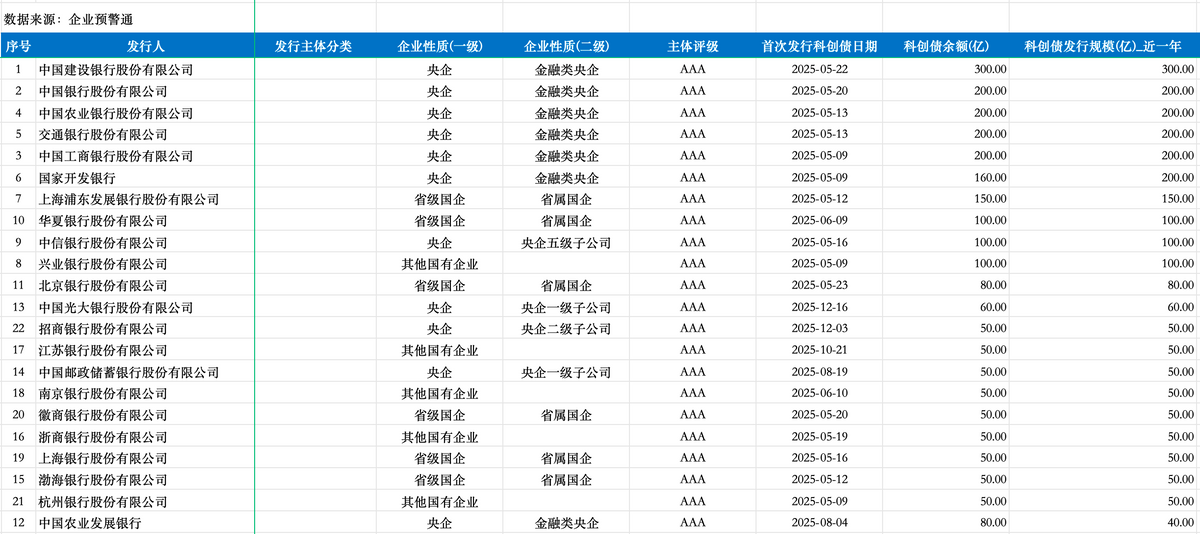
Core Viewpoint - The issuance of technology innovation bonds (科创债) by banks has significantly increased, with a total issuance scale reaching 301.4 billion yuan as of December 18, indicating a strong market response to the regulatory support initiated in May 2023 [3][14]. Issuance Scale - A total of 67 banks have issued 75 technology innovation bonds, with the largest share coming from state-owned banks, which account for 38.16% of the total issuance [3][15]. - The six major state-owned banks have collectively issued bonds worth 115 billion yuan, while city commercial banks and rural commercial banks have also become significant players, with issuance scales of 74.9 billion yuan and 15 billion yuan respectively [4][17]. Interest Rates - The interest rates for technology innovation bonds vary, with state-owned banks offering rates between 1.65% and 1.81%, while city and rural commercial banks have higher rates ranging from 1.67% to 2.07% [7][21]. - Notably, some city and rural commercial banks have rates exceeding 1.8%, indicating a competitive pricing environment [3][18]. Maturity Periods - The majority of the issued bonds have a maturity period concentrated around 5 years, which accounts for over 70% of the total, followed by 3-year bonds at over 20% [11][22]. - This maturity structure is designed to meet the medium to long-term funding needs of technology enterprises for research and development, as well as for project implementation [22]. Funding Allocation - The funds raised through these bonds are primarily directed towards technology innovation sectors, including the issuance of loans for technology projects and investments in innovative enterprises [6][17].
建行“内鬼”陈栋被查!
Xin Lang Cai Jing· 2025-12-19 04:18
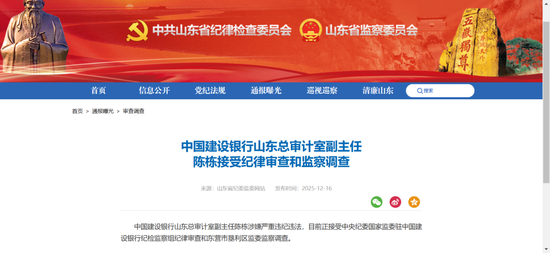
来源:行长男朋友 2025年12月16日,中国建设银行山东总审计室副主任陈栋涉嫌严重违纪违法,目前正接受中央纪委国家 监委驻中国建设银行纪检监察组纪律审查和东营市垦利区监委监察调查。 责任编辑:王进和 来源:行长男朋友 2025年12月16日,中国建设银行山东总审计室副主任陈栋涉嫌严重违纪违法,目前正接受中央纪委国家 监委驻中国建设银行纪检监察组纪律审查和东营市垦利区监委监察调查。 陈栋,2025年6月任山东总审计室副主任,曾任江苏省分行行长助理,建行德州分行行长。 当时活动还挺隆重,山东省分行行长文志军出席并致辞,还有总行金融科技部副总经理张晓东、数字化 建设办公室资深副经理刘皓、团委书记蔡丛露分别对参赛项目进行了点评,各二级分行都通过视频直播 参会,没想到一个月后,就出了被查的消息,实在让人意外。 陈栋,2025年6月任山东总审计室副主任,曾任江苏省分行行长助理,建行德州分行行长。 就在上个月,11月11号的时候,建行山东省分行办人工智能大赛决赛,陈栋还以山东总审计室副主任的 身份出席了活动。 当时活动还挺隆重,山东省分行行长文志军出席并致辞,还有总行金融科技部副总经理张晓东、数字化 建设办公室资深副经理 ...
大行评级丨大摩:上调建设银行目标价至9.9港元 评级“增持”
Ge Long Hui· 2025-12-19 03:40
摩根士丹利发表报告指,根据建设银行2025年第三季业绩,修订对该行的盈利预测。该行将2025年税后 净利润预测微调上调0.1%,而2026年及2027年税后净利润预测则分别下调0.3%及0.8%;目标价由9.5港 元上调至9.9港元,评级"增持"。 ...
“建行惠懂你”app4.0 焕新升级
Xin Hua Wang· 2025-12-19 03:28
struction Bank 建设银行 | 雷 湘信 发惠 优 "建行惠IIIn APP4.0 獎新升级 面向普惠客群打造的"信贷融资+综合金融 +经营管理"综合化生态服务平台 通心协力 共创美好 e 0 广告 体验更 | 通 | ◆"融易版"随心切换 更多选择更多精彩 ◆ (9 北京 ○ 规功能 搜服务 功能聚焦 40 . 100 800 后元 07,680 刷流的流 世界 理对剧 管 清远闻 我的积分 更多 贷款计算是 s 我是小微企业 我是个人经营者 我是科创企业 我是农户 信用快贷 纯信用无抵押 3.000.000 3 850/2 立即申请 顺畅操作 ◆ 客群专属优质服务 为经营发展保驾护航 ◆ ■ 面向各类普惠主体,适配差异化信贷产品 t the 填 配套客群服务方案,包括专属额度测算通道、 开户及收单服务优惠、利率优惠等专享好礼 简历量 V (0) 率均采用单利计算,不存在与贷款直接相关的任何费用。 公户服务费减免(套餐包) 账户选号费,账户维护费,印件? 本地特色 品是上分 *具体优惠信息详情详见"建行惠懂你"APP 服务更贴 [ 心 ] ◆ 旅程化陪伴式服务体系 ◆ 创新引入Al数字客户经理, ...

中国银行 2026 展望:重新评估房地产对银行的影响-China Banks_ 2026 Outlook_ Re-evaluating property impact on banks
2025-12-19 03:13
Summary of Key Points from the Conference Call on China Banks Industry Overview - The focus is on the **Chinese banking sector**, particularly its exposure to the **property market** and the implications of projected property price declines on bank earnings and capital adequacy [1][2][3]. Core Insights and Arguments 1. **Property Price Forecast**: - The **GS China Property team** has revised its property price forecast, predicting a **15% decline** over the next two years, with a stress scenario of a **30% drop** [1][7][16]. - This decline is expected to impact mortgage and property non-performing loans (NPLs), with total mortgage and property NPLs estimated at **Rmb 2.3 trillion** under the base case and **Rmb 4.0 trillion** under the stress test [7][12]. 2. **Mortgage Exposure and Risk Profile**: - The total mortgage exposure in the banking system is **16%** of the loan book, with a healthy risk profile due to well-collateralized loans [1]. - The mortgage NPL ratio is projected to rise to **2.4%** by 2027, with covered banks at **2.1%** and non-covered banks at **3.4%** [8][12]. 3. **Earnings and Capital Risks**: - Earnings risks are anticipated, with a potential **6-22% haircut** on covered bank earnings through 2027, but banks are expected to remain profitable [2]. - In a severe scenario, risks of dividend cuts or capital calls may arise, particularly for smaller banks [2][43]. 4. **Dividend Outlook**: - Dividend yields are projected at **4-5%**, providing valuation support, with payouts expected to remain at **20-35%** for 2026 [3]. - Larger banks like **BOC** and **CCB** are favored for their robust balance sheets and total return potential [3]. 5. **Capital Buffers and Provisions**: - The banking sector has raised **Rmb 880 billion** in capital over the past three years, leading to a comfortable average Texas ratio of **18%** for covered banks [2][43]. - Under the base case, banks can absorb potential losses without creating a capital shortfall, but under the stress test, a cumulative capital shortfall of **Rmb 241 billion** is projected by 2027 [46][66]. 6. **Risk Management Strategies**: - Banks are advised to optimize balance sheets, reduce risk-weighted asset (RWA) density, and seek external capital replenishment to maintain stability [43][72]. - The full recourse nature of mortgages in China is expected to mitigate actual loss rates compared to potential NPL ratios [8][24]. Additional Important Insights - The decline in high-risk property credit exposures, such as property bonds and shadow banking, has improved the overall risk profile of banks [26]. - The number of city and rural banks in China has decreased, indicating a potential reduction in asset quality tail risks for small and medium-sized banks [78]. - The banking system's ability to maintain adequate NPL coverage and CET-1 ratios is crucial for navigating the anticipated property downturn [46][51]. This summary encapsulates the critical aspects of the conference call regarding the Chinese banking sector's outlook amidst property market challenges, highlighting both risks and strategies for resilience.

公告速递:东方金元宝货币基金A类份额在部分代销渠道暂停大额申购、转换转入、定期定额投资业务
Sou Hu Cai Jing· 2025-12-19 02:15
注:为保护基金份额持有人的利益,保障基金平稳运作,自2025年12月19日起,本基金管理人暂停接受 投资者通过中国建设银行股份有限公司对本基金A类份额(基金代码:001987)的单笔金额1000万元以 上(不含1000万元)申购(包括日常申购和定期定额申购)、转换转入申请,且单个基金账户单日累计 申购(包括日常申购和定期定额申购)及转换转入金额不得超过1000万元以上(不含1000万元)。对于 超过限额的申请,本基金管理人有权拒绝,不予确认。 以上内容为证券之星据公开信息整理,由AI算法生成(网信算备310104345710301240019号),不构成 投资建议。 证券之星消息,12月19日东方基金管理股份有限公司发布《东方金元宝货币市场基金A类份额在部分代 销渠道暂停大额申购、转换转入、定期定额投资业务的公告》。公告中提示,为了保证基金的平稳运 作,保护基金份额持有人利益,自2025年12月19日起东方金元宝货币市场基金A类份额在部分代销渠道 暂停大额申购、转换转入、定期定额投资业务,下属分级基金调整明细如下: ...

银行科创债破3000亿元,六大国有行占比超 38%,部分城农商行利率破2%
Tai Mei Ti A P P· 2025-12-19 01:13
Core Viewpoint - The issuance of technology innovation bonds by banks has significantly increased since the announcement by the central bank and the China Securities Regulatory Commission on May 7, with a total issuance scale reaching 301.4 billion yuan by December 18, 2023 [1][2]. Issuance Scale - A total of 67 banks have issued 75 technology innovation bonds, with state-owned banks being the primary issuers, accounting for 38.16% of the total issuance [1][3]. - The six major state-owned banks have collectively issued bonds worth 115 billion yuan, while city commercial banks and rural commercial banks have issued 74.9 billion yuan and 15 billion yuan, respectively [1][5]. - The issuance period is mainly concentrated in 5-year bonds, followed by 3-year bonds, with a small number of 6-month and 7-year bonds [1][9]. Interest Rates - The interest rates for the issued bonds range from 1.67% to 2.07%, with state-owned banks having slightly lower rates between 1.65% and 1.81% [1][7]. - City commercial banks and rural commercial banks have higher rates, with many exceeding 1.8% [1][9]. - The policy banks have rates of 1.4% for the National Development Bank and 1.65% for the Agricultural Development Bank [1][7]. Fund Allocation - The funds raised from technology innovation bonds are directed towards technology innovation sectors, including issuing loans for technology and investing in technology innovation enterprises [6].
六大行监事会全部撤销,谁来继续承担监督职能?
Xin Lang Cai Jing· 2025-12-19 00:20
今年以来,中国银行业掀起了一场深刻的公司治理架构调整浪潮。 12月16日,邮储银行发布公告,近日收到金监总局相关批复,该行自公司章程修订获核准生 效之日起,不再设立监事会,由董事会审计委员会依法行使监事会相关职权,监事会相关制 度同时废止。在此之前,工商银行、农业银行、中国银行、建设银行及交通银行五家国有大 行均已完成相关工作。除了国有大行,近期另有多家商业银行已完成或正在推进监事会撤销 工作,包括华夏银行、浙商银行、渝农商行、北京银行、宁波银行、南京银行等。 从国有大行到股份行,再到城、农商行,随着愈来愈多的商业银行加入,运行近30年的监事 会制度正逐步淡出银行业公司治理舞台。那么,当监事会正式退出后,谁来继续承担监督职 能?原监事会成员又将如何安置? 邮储银行不再设立监事会, 六大行监事会全部撤销 12月16日,邮储银行发布公告称,该行于今年10月9日召开的2025年第二次临时股东大会审 议批准了《关于修订<中国邮政储蓄银行股份有限公司章程>的议案》和《关于中国邮政储 蓄银行不再设立监事会的议案》。近日,该行收到《国家金融监督管理总局关于邮储银行修 改公司章程的批复》,自公司章程修订获核准生效之日起,不再 ...