
Bank Of Chongqing(601963)

Search documents
城商行板块12月31日跌0.33%,厦门银行领跌,主力资金净流入2.01亿元
Zheng Xing Xing Ye Ri Bao· 2025-12-31 09:07
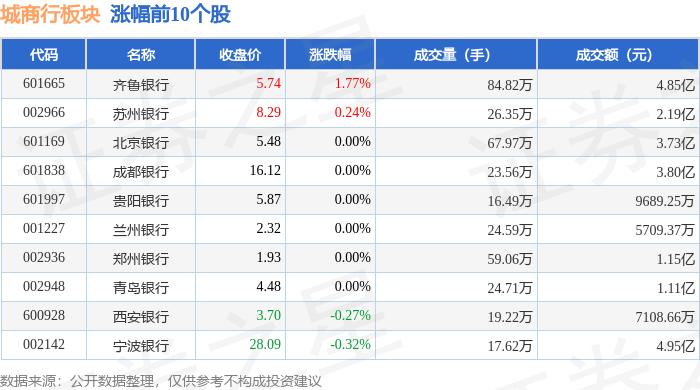
Market Overview - The city commercial bank sector experienced a decline of 0.33% on December 31, with Xiamen Bank leading the drop [1] - The Shanghai Composite Index closed at 3968.84, up 0.09%, while the Shenzhen Component Index closed at 13525.02, down 0.58% [1] Individual Bank Performance - Qilu Bank closed at 5.74, up 1.77% with a trading volume of 848,200 shares and a transaction value of 485 million [1] - Suzhou Bank closed at 8.29, up 0.24% with a trading volume of 263,500 shares and a transaction value of 219 million [1] - Xiamen Bank closed at 7.34, down 1.08% with a trading volume of 133,200 shares and a transaction value of 97.8 million [2] - Nanjing Bank closed at 11.43, down 0.78% with a trading volume of 235,600 shares and a transaction value of 270 million [2] Capital Flow Analysis - The city commercial bank sector saw a net inflow of 201 million from institutional investors, while retail investors experienced a net outflow of 9.56 million [2] - The capital flow for individual banks shows that Shanghai Bank had a net inflow of 48.9 million from institutional investors, while Hangzhou Bank had a net outflow of 50.55 million [3] - Suzhou Bank recorded a net inflow of 30.66 million from institutional investors, while retail investors had a net outflow of 27.1 million [3]


城商行板块12月29日涨0.79%,南京银行领涨,主力资金净流入7889.42万元
Zheng Xing Xing Ye Ri Bao· 2025-12-29 09:06
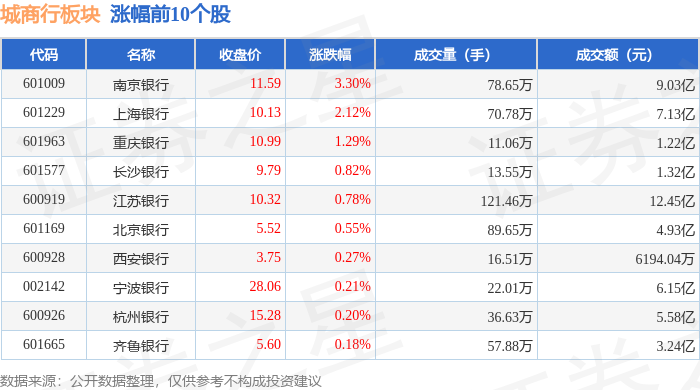
证券之星消息,12月29日城商行板块较上一交易日上涨0.79%,南京银行领涨。当日上证指数报收于 3965.28,上涨0.04%。深证成指报收于13537.1,下跌0.49%。城商行板块个股涨跌见下表: | 代码 | 名称 | 收盘价 | 涨跌幅 | 成交量(手) | 成交额(元) | | | --- | --- | --- | --- | --- | --- | --- | | 6000109 | 南京银行 | 11.59 | 3.30% | 78.65万 | | 9.03亿 | | 601229 | 上海银行 | 10.13 | 2.12% | 70.78万 | | 7.13亿 | | 601963 | 重庆银行 | 10.99 | 1.29% | 11.06万 | | 1.22亿 | | 601577 | 长沙银行 | 9.79 | 0.82% | 13.55万 | | 1.32亿 | | 616009 | 江苏银行 | 10.32 | 0.78% | 121.46万 | | 12.45 Z | | 601169 | 北京银行 | 5.52 | 0.55% | 89.65万 | | 4.93亿 | | ...




9家A股ESG强信披银行碳排同比上升
2 1 Shi Ji Jing Ji Bao Dao· 2025-12-29 08:20
Group 1: Climate Disclosure Standards - The Ministry of Finance, along with nine other departments, issued the "Corporate Sustainable Disclosure Standard No. 1 - Climate (Trial)" on December 25, marking a significant step towards a unified sustainable disclosure standard system in China [1] - The "Climate Standard" is currently positioned as a trial document, with voluntary implementation by companies until specific requirements are established [1] - The Ministry of Finance plans to adopt a gradual approach to implementation, expanding from listed companies to non-listed companies, and from large enterprises to small and medium-sized enterprises [1] Group 2: ESG Disclosure in A-Share Banks - The A-share ESG strong disclosure list has expanded to 27 banks, including 6 state-owned banks, 9 joint-stock banks, 10 city commercial banks, and 2 rural commercial banks [2] - Among the 27 banks, 16 reported a year-on-year decrease in carbon emissions, while 9 banks, including 1 state-owned bank and 6 city commercial banks, reported an increase in carbon emissions [2] - The top five banks with the highest year-on-year increase in carbon emissions are Beijing Bank (13.88%), Nanjing Bank (13.23%), Qingdao Bank (11.92%), Chongqing Bank (10.96%), and Hangzhou Bank (10.02%) [3] Group 3: Regulatory Actions and Penalties - First Capital's subsidiary was fined 12.7358 million yuan for failing to diligently supervise a convertible bond project [4] - Jinghua Pharmaceutical's subsidiary was fined 500,000 yuan for environmental pollution, which is not expected to significantly impact the company's net profit for 2025 [5] - Tianyi Medical is facing a potential fine of 8.7852 million yuan for not producing medical devices according to registered technical requirements [6][7] Group 4: Energy Sector ESG Developments - The "National Energy Sustainable Development Index" was officially launched, achieving a cumulative return rate of 40% [8] - Five thermal power companies have been included in the ESG strong disclosure category, which will require them to improve ESG governance and reporting by 2026 [9] - A report evaluated the low-carbon transition performance of 33 thermal power companies, indicating significant disparities in transition progress and a slower development of non-fossil energy compared to national averages [9]


重庆银行(01963) - 海外监管公告 - 关於根据2025年三季度利润预分配方案调整A股可转换公...
2025-12-28 10:27
香港交易及結算所有限公司及香港聯合交易所有限公司對本公告的內容概不負責,對其 準確性或完整性亦不發表任何聲明,並明確表示,概不就因本公告全部或任何部分內容 而產生或因倚賴該等內容而引致的任何損失承擔任何責任。 BANK OF CHONGQING CO., LTD.* 重慶銀行股份有限公司* ( 於 中 華 人 民 共 和 國 註 冊 成 立 的 股 份 有 限 公 司 ) (股份代號:1963) 海外監管公告 本公告乃重慶銀行股份有限公司*(「本行」)根據香港聯合交易所有限公司證券上市規則第 13.10B條而作出。 茲載列本行在上海證券交易所網站刊發之《關於根據2025年三季度利潤預分配方案調整A 股可轉換公司債券轉股價格的公告》,僅供參閱。 代表董事會 关于根据 2025 年三季度利润预分配方案 调整 A 股可转换公司债券转股价格的公告 重慶銀行股份有限公司* 董事長 楊秀明 中國重慶,2025年12月28日 於本公告刊發日期,本行的執行董事為楊秀明先生、高嵩先生及侯曦蒙女士;本行的非 執行董事為黃漢興先生、郭喜樂先生、吳珩先生、付巍先生、周宗成先生及余華先生; 本行的獨立非執行董事為朱燕建先生、劉瑞晗女士 ...
重庆银行(01963) - 海外监管公告- 2025年三季度权益分派实施公告
2025-12-28 10:22
重慶銀行股份有限公司* ( 於 中 華 人 民 共 和 國 註 冊 成 立 的 股 份 有 限 公 司 ) (股份代號:1963) 香港交易及結算所有限公司及香港聯合交易所有限公司對本公告的內容概不負責,對其 準確性或完整性亦不發表任何聲明,並明確表示,概不就因本公告全部或任何部分內容 而產生或因倚賴該等內容而引致的任何損失承擔任何責任。 BANK OF CHONGQING CO., LTD.* 海外監管公告 本公告乃重慶銀行股份有限公司*(「本行」)根據香港聯合交易所有限公司證券上市規則第 13.10B條而作出。 茲載列本行在上海證券交易所網站刊發之《2025年三季度權益分派實施公告》,僅供參閱。 可转债代码:113056 可转债简称:重银转债 代表董事會 重慶銀行股份有限公司* 董事長 楊秀明 中國重慶,2025年12月28日 於本公告刊發日期,本行的執行董事為楊秀明先生、高嵩先生及侯曦蒙女士;本行的非 執行董事為黃漢興先生、郭喜樂先生、吳珩先生、付巍先生、周宗成先生及余華先生; 本行的獨立非執行董事為朱燕建先生、劉瑞晗女士、汪欽琳女士、曾宏先生及陳鳳翔先 生。 * 本行經中國銀行業監督管理機構批准持有B ...
重庆银行股份有限公司关于根据2025年三季度利润预分配方案调整A股可转换公司债券转股价格的公告
Shang Hai Zheng Quan Bao· 2025-12-26 21:33
Core Viewpoint - Chongqing Bank has announced an adjustment to the conversion price of its convertible bonds following the profit distribution plan for the third quarter of 2025, which will take effect on January 7, 2026 [3][4][7]. Group 1: Convertible Bond Information - The convertible bond, named "Zhongyin Convertible Bond," was issued on March 23, 2022, with a total face value of RMB 13 billion and a maturity period of 6 years [3]. - The initial conversion price was set at RMB 11.28 per share, which has been adjusted to RMB 9.67 per share, and will further adjust to RMB 9.50 per share after the profit distribution [3][6][7]. Group 2: Profit Distribution Details - The profit distribution plan was approved at the first extraordinary general meeting of shareholders on November 28, 2025, with a cash dividend of RMB 1.684 per 10 shares (including tax) [4][10]. - The total cash dividend to be distributed amounts to RMB 585,120,249.06 (including tax), based on a total share capital of 3,474,585,802 shares as of September 30, 2025 [11][13]. - The cash dividend per A-share is set at RMB 0.1684 [12][13]. Group 3: Suspension and Resumption of Conversion - The conversion of "Zhongyin Convertible Bond" will be suspended from December 26, 2025, until the registration date of the profit distribution on January 6, 2026, and will resume on January 7, 2026 [2][7].
重庆银行公布2025年三季度利润分配方案:拟每股派发现金红利0.1684元
Xin Lang Cai Jing· 2025-12-26 11:24
Core Viewpoint - Chongqing Bank announced a profit distribution plan for the third quarter of 2025, with a cash dividend of 0.1684 yuan per A-share, totaling approximately 5.85 billion yuan to be distributed [1][14]. Distribution Plan - The cash dividend of 0.1684 yuan per A-share is inclusive of tax [5][19]. - The record date for shareholders is January 6, 2026, with the ex-dividend date and dividend payment date both set for January 7, 2026 [3][20]. - The total cash dividend to be distributed amounts to approximately 585.12 million yuan, based on a total share capital of 3,474,588,278 shares [6][19]. Shareholder Information - The distribution applies to all A-share shareholders registered with China Securities Depository and Clearing Corporation Limited, Shanghai Branch, as of the close of trading on the record date [4][17]. - The cash dividends for H-share shareholders are not covered in this announcement and will be detailed separately [4][17]. Implementation Method - The cash dividends will be distributed through the clearing system of China Securities Depository and Clearing Corporation Limited, with shareholders who have completed designated transactions able to receive their dividends on the payment date [8][21]. - Certain major shareholders, including Chongqing Yufu Capital Operation Group Co., Ltd., will receive their dividends directly from the bank [9][22]. Taxation Details - For individual and mutual fund shareholders, no personal income tax will be withheld at the time of dividend distribution, with the cash dividend remaining at 0.1684 yuan per share [10][23]. - Tax liabilities will be calculated based on the holding period of the shares, with specific rates applied depending on the duration of ownership [10][23].
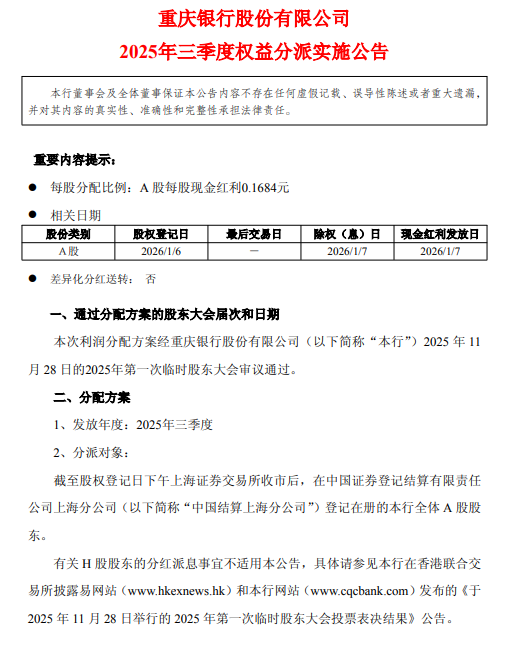
重庆银行:2025年三季度权益分派实施公告
Zheng Quan Ri Bao Zhi Sheng· 2025-12-26 11:10
证券日报网讯 12月26日,重庆银行发布公告称,重庆银行2025年三季度利润分配方案:A股每股派发现 金红利0.1684元(含税),股权登记日2026年1月6日,除权除息日及红利发放日均为2026年1月7日,合 计派发现金红利约5.85亿元。 (编辑 丛可心) ...
重庆银行(601963) - 关于根据2025年三季度利润预分配方案调整A股可转换公司债券转股价格的公告
2025-12-26 09:48
证券代码:601963 证券简称:重庆银行 公告编号:2025-076 可转债代码:113056 可转债简称:重银转债 重庆银行股份有限公司 调整 A 股可转换公司债券转股价格的公告 关于根据 2025 年三季度利润预分配方案 2025 年 11 月 28 日,本行 2025 年第一次临时股东大会审议通过了《关于〈2025 年三季度利润预分配方案〉的议案》,决定以实施权益分派股权登记日 A 股和 H 股总股本为基数,向登记在册的全体股东派发现金股息,每 10 股现金分红人民币 1.684 元(含税)。本次利润分配具体实施情况详见本行同日于上海证券交易所网 站(www.sse.com.cn)发布的《重庆银行股份有限公司 2025 年三季度权益分派实 施公告》(公告编号:2025-077)。本行 2025 年三季度权益分派实施后,将依据《重 庆银行股份有限公司公开发行 A 股可转换公司债券募集说明书》(以下简称"募集 说明书")发行条款及相关规定对 A 股可转换公司债券当期转股价格进行调整。 二、转股价格调整公式及本次调整结果 根据募集说明书相关条款及有关法规规定,在"重银转债"发行之后,当本 行派送现金股利时, ...
重庆银行(601963) - 2025年三季度权益分派实施公告
2025-12-26 09:45
证券代码:601963 证券简称:重庆银行 公告编号:2025-077 可转债代码:113056 可转债简称:重银转债 重庆银行股份有限公司 2025年三季度权益分派实施公告 本行董事会及全体董事保证本公告内容不存在任何虚假记载、误导性陈述或者重大遗漏, 并对其内容的真实性、准确性和完整性承担法律责任。 二、分配方案 1、发放年度:2025年三季度 2、分派对象: 截至股权登记日下午上海证券交易所收市后,在中国证券登记结算有限责任 公司上海分公司(以下简称"中国结算上海分公司")登记在册的本行全体 A 股股 东。 重要内容提示: 每股分配比例:A 股每股现金红利0.1684元 相关日期 | 股份类别 | 股权登记日 | 最后交易日 | 除权(息)日 | 现金红利发放日 | | --- | --- | --- | --- | --- | | A股 | 2026/1/6 | - | 2026/1/7 | 2026/1/7 | 差异化分红送转: 否 一、通过分配方案的股东大会届次和日期 本次利润分配方案经重庆银行股份有限公司(以下简称"本行")2025 年 11 月 28 日的2025年第一次临时股东大会审议通过。 ...