
BANK OF CHINA(601988)

Search documents
落实个人消费贷款最新财政贴息政策,六大行集体公告
第一财经· 2026-01-22 11:10
Core Viewpoint - Major Chinese banks have announced the implementation of an optimized personal consumption loan subsidy policy, extending its benefits and expanding its scope to support consumer spending [1] Summary by Relevant Sections Policy Implementation - The personal consumption loan subsidy policy will be extended until December 31, 2026 [1] - The scope of support has been expanded to include credit card bill installment services [1] Subsidy Expansion - The subsidy field has been broadened by removing the restriction on single transactions of 50,000 yuan and above [1] - The subsidy standard has been improved by eliminating the previous cap of 500 yuan on single transaction subsidies and the cumulative limit of 1,000 yuan for each borrower at a single institution for transactions below 50,000 yuan [1] Existing Agreements - For loans that have already signed the "Personal Consumption Loan Subsidy Service Agreement," any consumption occurring after January 1, 2026, will automatically apply the latest subsidy policy without the need for re-signing the agreement [1]








落实个人消费贷款最新财政贴息政策,六大行集体公告
Feng Huang Wang· 2026-01-22 11:01
Core Viewpoint - Major Chinese banks have announced the implementation of an optimized personal consumption loan subsidy policy, extending its duration and expanding its scope to support consumer spending [1] Group 1: Policy Implementation - The implementation period for the personal consumption loan subsidy policy has been extended to December 31, 2026 [1] - The scope of support has been expanded to include credit card installment payment services [1] Group 2: Subsidy Expansion - The subsidy field has been broadened by removing the restriction on single transactions of 50,000 yuan and above [1] - The subsidy standard has been improved by eliminating the cap of 500 yuan on single transaction subsidies and the previous limit of 1,000 yuan for cumulative subsidies under 50,000 yuan per borrower at a single institution [1] Group 3: Existing Agreements - For loans that have already signed the personal consumption loan subsidy service agreement, any consumption occurring after January 1, 2026, will automatically apply the latest subsidy policy without the need to re-sign the agreement [1]
Maaden kicks off dollar sukuk issuance
ArgaamPlus· 2026-01-22 10:59
Core Viewpoint - Saudi Arabian Mining Company (Maaden) has initiated the issuance of USD-denominated sukuk under its International Sukuk Issuance Program to meet its general corporate needs [2][6]. Group 1: Sukuk Issuance Details - The sukuk will be offered to qualified investors both inside and outside Saudi Arabia, with the size and terms of the issuance to be determined based on market conditions [3]. - The minimum subscription for the sukuk is set at $200,000, with increments of $1,000 [5]. - The issuance is scheduled to start on January 22, 2026, and end on January 29, 2026 [5]. Group 2: Management and Structure - The sukuk issuance will be managed by a consortium of financial institutions including Albilad Capital, AlJazira Capital, and others, with joint lead managers such as BNP Paribas, Citigroup Global, and Goldman Sachs International [5]. - The issue price and return of the sukuk will also be determined based on market conditions [5]. Group 3: Program Background - Maaden's International Sukuk Issuance Program was established on February 4, 2025, following a board decision made on December 15, 2025 [6].

多家银行发文明确信用卡账单分期贴息细节,开启补申请通道
Bei Jing Shang Bao· 2026-01-22 09:37
Core Viewpoint - The Chinese government has introduced a new personal consumption loan interest subsidy policy, which aims to enhance consumer spending and stimulate the economy by providing financial incentives through interest subsidies on personal loans and credit card installments [1][3]. Group 1: Policy Implementation - The new subsidy policy will be effective from September 1, 2025, to December 31, 2026, for personal consumption loans, while the credit card installment subsidy period will be from January 1, 2026, to December 31, 2026 [3]. - The policy expands the support scope by including credit card installment payments for the first time, with a subsidy rate of 1% per annum, and removes previous restrictions on consumption areas [3][4]. Group 2: Bank Responses - Major banks such as ICBC, ABC, BOC, CCB, and others have quickly responded by issuing operational guidelines and clarifications regarding the implementation of the subsidy policy [2][3]. - Banks have confirmed that customers who have already signed consumption loan subsidy agreements will automatically benefit from the new policy without needing to re-sign agreements [4][5]. Group 3: Customer Guidance - Customers are required to sign a supplementary agreement for credit card installment subsidies, with each card needing a separate agreement to benefit from the subsidy during the policy period [5][6]. - Banks are advised to streamline the process for customers to access the subsidy, including online application portals and clear communication of interest rates and subsidy limits [6][7]. Group 4: Market Impact - The minimum execution interest rate for consumption loans remains at 3%, but with the subsidy, the effective interest rate for eligible borrowers could potentially drop to the "2% range" [7].


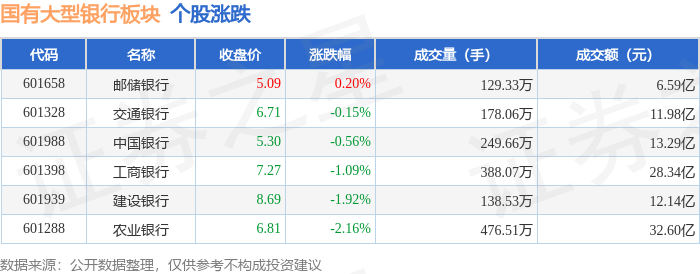
国有大型银行板块1月22日跌1.3%,农业银行领跌,主力资金净流出2.09亿元
Zheng Xing Xing Ye Ri Bao· 2026-01-22 09:01
Group 1 - The core viewpoint of the article indicates that the state-owned large bank sector experienced a decline of 1.3% on January 22, with Agricultural Bank leading the drop [1] - The Shanghai Composite Index closed at 4122.58, up 0.14%, while the Shenzhen Component Index closed at 14327.05, up 0.5% [1] - The trading volume and turnover for major state-owned banks are detailed, showing varying performance among individual banks [1] Group 2 - Agricultural Bank's stock price fell by 2.16% to 6.81, with a trading volume of 476.51 million shares and a turnover of 32.60 billion [1] - The net outflow of main funds from the state-owned large bank sector was 209 million, while retail investors saw a net inflow of 38.81 million [1] - The table shows the net inflow and outflow of funds for individual banks, highlighting the performance of each bank in terms of main, retail, and speculative funds [2]
中行白皮书重磅发布:近千份问卷解码高净值人群财富新诉求
2 1 Shi Ji Jing Ji Bao Dao· 2026-01-22 08:48
Core Insights - The evolving expectations of high-net-worth individuals in China reflect a shift towards personalized and professional wealth management services, emphasizing long-term relationships and trust [1][4] Group 1: Wealth Management Trends - The "2026 China High-Net-Worth Population Wealth Management White Paper" reveals that wealth management now encompasses not just value preservation and growth, but also intergenerational transfer, corporate strategy, and overall life planning [1][4] - High-net-worth individuals exhibit diverse characteristics in client structure, risk preferences, and service needs, necessitating tailored solutions from financial institutions [4][7] Group 2: Risk Preferences and Service Needs - A notable finding is the "inverted U-shaped" risk preference curve among high-net-worth individuals, with older generations (70s and 80s) being more risk-tolerant compared to younger generations (90s) and those from the 60s, who show higher risk aversion [9][10] - Service preferences vary by generation, with older clients valuing sincere service and long-term relationships, while younger clients prioritize the competence and communication skills of their advisors [9][10] Group 3: Asset Allocation Behavior - High-net-worth individuals prioritize a "steady first, attack and defend" approach in asset allocation, primarily holding financial products, deposits, and insurance, while over 30% also invest in stocks for enhanced returns [10] - There is a significant intention among over half of high-net-worth individuals to increase their holdings in financial products and cash deposits in the coming year, while opinions on stock investments are divided [10] Group 4: Service Demand and Brand Expectations - The core demands of high-net-worth individuals from private banks include personalization, professionalism, and security, with over 50% highlighting these aspects as essential [10] - The highest mention rate for "personalization" at 44.3% indicates a strong expectation for customized solutions and exclusive experiences from wealth management institutions [10] Group 5: Entrepreneurial Needs and Cross-Border Services - The needs of entrepreneurs within the high-net-worth demographic are driving the expansion of private banking services, requiring customized solutions that align personal wealth management with corporate cycles and strategies [11] - A significant 56.6% of surveyed entrepreneurs express a need for cross-border services related to trade finance, global investment, and capital management, particularly those with 30% to 50% of personal assets held overseas [11] Group 6: Integrated Solutions from Financial Institutions - China Bank's "China Bank Solution" aims to address the complex and diverse needs of high-net-worth individuals by integrating various financial services across domestic and international lines [12] - The "Entrepreneur Office" service model showcases China Bank's ability to cater to the intertwined needs of personal and corporate wealth management, exemplified by a case involving a biopharmaceutical company preparing for an IPO [14][15] Group 7: Wealth Transfer and Philanthropy - China Bank provides flexible and systematic tools for family wealth transfer, including insurance trusts that ensure asset transmission while isolating risks [16] - The bank's approach to charitable trusts illustrates its commitment to facilitating sustainable philanthropic efforts, ensuring that clients' charitable intentions are legally upheld and financially viable [15][16] Group 8: Cross-Border Investment Challenges - High-net-worth individuals face significant challenges in cross-border asset allocation, including a lack of understanding of foreign investment product regulations and limited access to quality products and professional advice [16] - China Bank leverages its global network and comprehensive financial product offerings to provide compliant cross-border investment channels and expert market insights [16]
十五五期间,中国银行业如何处置房地产不良资产
Sou Hu Cai Jing· 2026-01-22 08:20
Core Viewpoint - The article emphasizes the need for a comprehensive system to address non-performing real estate assets in China's banking sector during the 14th Five-Year Plan period (2026-2030), focusing on market-oriented, professional, legal, and social approaches, while drawing lessons from successful experiences in the US, Japan, South Korea, and Ireland [1]. Group 1: Policy Recommendations for Asset Disposal - Establish a national joint conference for the disposal of real estate non-performing assets, led by the Ministry of Finance, involving key financial and regulatory bodies, with a mandate for the four major Asset Management Companies (AMCs) to acquire and manage these assets [1]. - The Ministry of Finance will inject 500 billion yuan into each of the four major AMCs to facilitate the acquisition of non-performing real estate assets, with a target of acquiring at least 3 million units within three years [1]. - Create a cooperative mechanism between AMCs and local governments, establishing a special fund of approximately 2 trillion yuan to support the "guarantee delivery" of housing projects and the revitalization of quality assets [1]. Group 2: Legal and Policy Framework - Introduce a specific legislative framework for the disposal of non-performing real estate assets, including clear pricing rules and streamlined judicial processes to reduce disposal time from 18-24 months to 6-8 months [3]. - Implement differentiated tax incentives, including a 50%-100% reduction in taxes related to the disposal of non-performing assets, to lower costs and attract market participation [3]. - Establish a unified national real estate mortgage registration platform to enhance transparency and simplify property transfer processes [3]. Group 3: Market-Oriented Disposal Tools - Promote bulk transfers and asset securitization, expanding the scale of real estate asset securitization to attract long-term capital from insurance and pension funds [4]. - Develop a combination model of "debt restructuring + asset development" to support quality developers and revive stalled projects [4]. - Introduce international advanced disposal tools and experiences, including a fixed price plus performance sharing model to incentivize asset value enhancement [4]. Group 4: Targeted Risk Mitigation Strategies - Differentiate disposal strategies for developers based on risk levels, employing rapid recovery methods for high-risk assets and supportive measures for medium-risk assets [5]. - Implement humane solutions for individual housing loan defaults, prioritizing non-judicial methods and providing debt relief options for families in distress [5]. - Enhance the value of commercial real estate through transformation and professional management, utilizing asset securitization for efficient exits [5]. Group 5: Risk Prevention and Long-term Mechanisms - Establish a comprehensive risk management system for real estate loans, limiting concentration ratios for banks to prevent excessive risk accumulation [6]. - Encourage financial innovation in real estate, such as developing Real Estate Investment Trusts (REITs) to reduce reliance on bank credit [6]. - Create a monitoring and early warning mechanism for real estate market risks, including a risk indicator system to prevent risk accumulation [6]. Group 6: Balancing Financial Stability and Social Welfare - Prioritize the "guarantee delivery" of housing projects, establishing a collaborative mechanism among government, banks, developers, and contractors to protect buyers' rights [7]. - Guide the banking sector towards supporting affordable housing and new real estate development models, reducing reliance on traditional development loans [7]. - Allocate 30% of net proceeds from the disposal of non-performing assets to a housing security fund to support affordable rental housing and subsidies for struggling families [7].
数字人民币2.0:从M0到M1的质变
GF SECURITIES· 2026-01-22 05:07
Investment Rating - The report provides a "Buy" rating for all major banks analyzed, indicating a positive outlook for the banking sector [7]. Core Insights - The digital renminbi has entered its 2.0 era, transitioning from a central bank liability (M0) to a commercial bank liability (M1), allowing it to earn interest and be included in deposit insurance and reserve requirements [6][14]. - This transformation positions China as the first economy to offer interest on its central bank digital currency (CBDC), fundamentally altering its monetary attributes and creating a new financial paradigm in the digital economy [27]. - The digital renminbi's interest-bearing feature enhances user motivation to hold it, shifting its perception from a mere payment tool to a viable store of value, thus promoting its integration into everyday financial activities [27][28]. Summary by Sections 1. Digital Renminbi 2.0 Era - The digital renminbi (e-CNY) is now classified as a digital deposit currency, which can earn interest and is managed under a new regulatory framework [14]. - Major state-owned banks have begun offering interest on digital renminbi wallet balances, marking a significant shift in its utility and appeal [14][27]. 2. Development Progress and Application Status - The development of the digital renminbi began in 2014, with significant milestones including pilot tests in various cities and the establishment of a comprehensive operational framework by 2025 [32][33]. - As of November 2025, the digital renminbi has processed 34.8 billion transactions amounting to 16.7 trillion yuan, with extensive coverage across multiple provinces and cities [37]. 3. Global CBDC Development Trends - The report identifies three main trends in global CBDC development: active retail CBDC initiatives, innovation in payment systems, and cautious approaches in some countries like the U.S. [6]. - China's proactive stance in developing its CBDC positions it favorably in the global digital economy landscape, particularly in cross-border trade applications [30].


固收专题报告:银行自营债券投资有何特征?
Hua Yuan Zheng Quan· 2026-01-22 03:37
1. Report Industry Investment Rating No relevant content provided. 2. Core Viewpoints of the Report - In 2025, the bond market may mainly rely on increased allocation by bank self - operations. The balance of China's bond market increased by 19.7 trillion in the first 11 months of 2025, and the incremental investment in self - operated bonds by the banking industry in the same period reached 14.3 trillion, accounting for 72.7% of the bond scale increment [2][31]. - Bank self - operated bond investment is mainly in interest - rate bonds, which have a significant impact on the pricing of interest - rate bonds. As of Q3 2025, the proportion of interest - rate bond holdings in bank self - operated bonds was 80.7% [36]. - The bond investment behavior of banks is mainly affected by three types of indicators: capital adequacy ratio requirements, liquidity regulatory indicators, and bank book interest rate risk indicators [3][45]. - Joint - stock banks are the main players in the secondary trading of interest - rate bonds, while the trading scale of large - state - owned banks and policy banks is relatively small. Since Q1 2023, the overall market trading activity has increased, especially significantly after 2025 [3][52]. 3. Summary by Relevant Catalogs 3.1 Bank Self - Operated Financial Investment Composition, Scale Changes, and Structural Characteristics - **Composition and Scale Changes**: As of Q3 2025, the total financial investment scale of 42 listed banks was 101.5 trillion yuan. By statement account, the FVTPL account was 13.23 trillion yuan (13.0%), the FVOCI account was 29.87 trillion yuan (29.4%), and the AC account was 58.40 trillion yuan (57.5%). By asset category as of Q2 2025, bond investment was 79.08 trillion yuan (84.46%), equity investment was 0.86 trillion yuan (0.91%), and funds and other investments were 13.07 trillion yuan (13.96%). From Q4 2023 to Q3 2025, the investment scale of the FVOCI account increased significantly, mainly due to the growth of bond investment [8]. - **Structural Characteristics**: Credit bonds are mainly placed in the FVOCI account, and interest - rate bonds are mainly placed in the AC account. Among different types of banks, the proportion of the three accounts of large - state - owned banks and joint - stock banks is relatively stable, while the proportion of the AC category of city and rural commercial banks has decreased, and the FVOCI category of city commercial banks has increased, indicating a shift from allocation to trading thinking [2][14]. 3.2 Bond Market in 2025 - In 2025, the bond market may rely on increased allocation by bank self - operations. The government issued more bonds in 2025, and the weak credit demand led banks to significantly increase their bond investment. The year - on - year growth rate of the bond investment balance of various types of banks has increased significantly, and bond investment may become the main driving force for the expansion of bank asset scale [31][33]. 3.3 Bank Bond Investment Characteristics - **Investment Portfolio**: As of Q3 2025, bank self - operated bond holdings were 96.5 trillion yuan, mainly interest - rate bonds. Interest - rate bonds accounted for 80.7%, credit bonds accounted for 11.7%, negotiable certificates of deposit accounted for 5.7%, and other bonds accounted for 1.8%. Among interest - rate bonds, treasury bonds accounted for 33.3%, local government bonds accounted for 48.3%, and policy - bank bonds accounted for 17.8% [36]. - **Pricing Influence**: As of Q3 2025, bank self - operated bond holdings accounted for 48.21% of the total bond custody, having a significant impact on the bond market pricing, but the degree of influence varies by bond type. Bank self - operated interest - rate bond holdings accounted for 63.6% of the total interest - rate bond custody, having a significant impact on pricing [44]. 3.4 Bank Bond - Allocation Indicator Constraints - **Capital Adequacy Ratio Requirements**: The risk weights of treasury bonds and policy - bank bonds are 0, the risk weights of local general bonds and special bonds are 10% and 20% respectively, and the risk weights of general corporate bonds and non - bank financial institution ordinary bonds are 75% - 100% [3][47]. - **Liquidity Regulatory Indicators**: The liquidity coverage ratio is relatively relevant to bank self - operated bond investment behavior. Treasury bonds are included in qualified high - quality liquid assets at market price, while credit bonds are given a discount coefficient according to credit ratings [47]. - **Bank Book Interest Rate Risk Indicators**: For large - state - owned banks, joint - stock banks, and Postal Savings Bank, when the maximum economic value change exceeds 15% of their Tier - 1 capital (ΔEVE > 15%), regulatory attention will be drawn [47]. 3.5 Bank Self - Operated Secondary Trading Characteristics - **Interest - Rate Bond Secondary Trading**: Joint - stock banks are the main players in the secondary trading of interest - rate bonds. The trading activity of the whole market has increased since Q1 2023, especially significantly after 2025. The trading scale of large - state - owned banks and policy banks is relatively small [3][52]. - **Credit Bond Secondary Trading**: The trading scale of credit bonds is relatively limited, and the single - quarter trading amount of bank self - operations is generally below 1 trillion yuan [54]. - **Ultra - Long - Term Interest - Rate Bond Secondary Trading**: The secondary trading of ultra - long - term interest - rate bonds in the banking system shows the characteristics of "net reduction trend remains unchanged, and selling pressure converges marginally". Different types of banks have different trading behaviors [56].
强支撑 筑生态 破堵点 中国银行广东省分行党建领航 护航科创“破茧成蝶”
Jin Rong Shi Bao· 2026-01-22 02:03
Core Viewpoint - The Guangdong branch of the Bank of China is actively promoting the development of technology finance to support the transformation of scientific research into production, creating a comprehensive financial ecosystem for technology enterprises [1][2]. Group 1: Institutional and Organizational Developments - The Bank of China Guangdong branch has revised its guidelines to ensure compliance without moral risk, integrating technology finance into core assessments and forming dedicated approval teams to address lending challenges [2]. - The establishment of a primary technology finance center and five secondary centers in key innovation cities aims to enhance the bank's service capabilities for technology enterprises [2]. - A total of 34 technology branches have been set up in innovation zones to provide specialized services, with 9 branches recognized as "commitment-based technology branches" [2]. Group 2: Technological Empowerment - The bank has developed an intelligent service system based on data and models, launching the "Innovation Credit Loan" product to create precise credit assessments based on technological capabilities [2]. - As of September 2025, the credit balance for technology enterprises exceeded 270 billion, serving approximately 19,000 companies with a non-performing loan rate of less than 1% [2]. Group 3: Collaborative Ecosystem Building - The "Bank of China Innovation Ecosystem Partner Program" aims to create a collaborative financial service system involving government, research institutions, and investment entities, transitioning from isolated efforts to coordinated actions [3]. - A memorandum of cooperation was signed with the Guangdong Productivity Promotion Center to provide comprehensive lifecycle services for technology enterprises [3]. - Initiatives include a provincial technology credit risk compensation fund and tailored services for innovation hotspots like Dongguan and Zhuhai [3]. Group 4: Dual-Driven Financing Model - The bank has introduced a "production investment + credit" dual-driven model to provide long-term, low-cost capital for technology enterprises [4]. - A 14 billion equity investment fund has been established to support advanced manufacturing, with over 1 billion already invested in technology enterprises [4]. - A specialized service plan for pilot testing platforms has been launched, with significant loans approved for semiconductor research projects and related enterprises [4].