BANK OF CHINA(601988)

Search documents
多家银行公布消费贷“国补”升级方案 信用卡分期纳入贴息范围
Zhong Guo Zheng Quan Bao· 2026-01-21 23:41
Core Viewpoint - The Ministry of Finance has announced an optimization of the personal consumption loan interest subsidy policy, which includes expanding the scope of eligible loans and extending the policy period until the end of 2026, allowing each borrower to receive a maximum subsidy of 3000 yuan [1][2]. Group 1: Policy Changes - The new policy includes the inclusion of credit card installment payments in the subsidy support range and the removal of previous restrictions on certain consumption areas [1][2]. - The subsidy limit for individual borrowers has been increased to 3000 yuan per year, with the previous limits on single transaction amounts and total loan amounts being removed [2]. - The policy now allows for subsidies on all types of consumption loans, not just those in specific categories such as home appliances or education [2]. Group 2: Implementation and Participation - Major banks, including Agricultural Bank, Bank of China, and others, have begun to implement the new subsidy measures, with over 500 financial institutions now eligible to process these loans [1][2]. - The implementation period for the credit card installment subsidy is set for the entire year of 2026, and customers can apply for retroactive subsidies for transactions made between January 1, 2026, and the announcement date [3][4]. Group 3: Consumer Guidance - Banks have emphasized that there will be no fees charged for processing personal consumption loans and credit card installment subsidies, and they will not work with third-party intermediaries [5][6]. - Customers are advised to apply for loans through official channels and to be cautious of fraudulent activities related to loan applications [6].





多家银行公布 消费贷“国补”升级方案
Zhong Guo Zheng Quan Bao· 2026-01-21 21:42
Core Viewpoint - The Ministry of Finance has announced an optimization of the personal consumption loan interest subsidy policy, which includes expanding the scope of eligible loans and extending the policy period until the end of 2026, allowing each borrower to receive a maximum subsidy of 3,000 yuan [1][2]. Group 1: Policy Changes - The subsidy policy now includes credit card installment payments and removes previous restrictions on certain consumption areas, allowing all types of consumption loans to qualify for subsidies [1][2]. - The maximum subsidy limit of 500 yuan per single transaction and the previous cap of 1,000 yuan for loans under 50,000 yuan have been eliminated, enabling borrowers to receive a total of 3,000 yuan in subsidies annually [2]. Group 2: Implementation and Participation - Major banks such as Agricultural Bank of China, Bank of China, and others have already begun implementing the new subsidy measures, with over 500 financial institutions now eligible to process these loans [1][2]. - The policy aims to enhance accessibility for consumers in urban and rural areas by including city commercial banks, rural commercial banks, foreign banks, and consumer finance companies [2]. Group 3: Credit Card Installment Subsidy - The credit card installment subsidy policy will be effective throughout 2026, and customers can apply for retroactive subsidies for installments made between January 1, 2026, and the policy announcement date [3][4]. - Banks require customers to sign a supplementary agreement to benefit from the subsidy on credit card installments, ensuring compliance with the policy [3][4]. Group 4: Consumer Protection and Compliance - Banks emphasize that no fees will be charged for processing personal consumption loans and credit card installment subsidies, and they will not engage third-party intermediaries [5][6]. - Strict measures are in place to prevent fraudulent activities related to loan applications, and any violations will be recorded in the borrower's credit history [5][6].
多家银行公布消费贷“国补”升级方案
Zhong Guo Zheng Quan Bao· 2026-01-21 21:08
Core Viewpoint - The Ministry of Finance has announced an optimization of the personal consumption loan interest subsidy policy, which includes expanding the scope of eligible loans and extending the policy period until the end of 2026, allowing each borrower to receive a maximum subsidy of 3,000 yuan [1][2] Group 1: Policy Changes - The new policy includes the inclusion of credit card installment payments for interest subsidies and the removal of previous restrictions on certain consumption areas [1][2] - The subsidy limit for individual borrowers has been increased to 3,000 yuan per year, with no cap on single transaction subsidies [1][2] - The policy now allows for any type of consumption loan to qualify for interest subsidies, broadening the eligible categories significantly [2] Group 2: Implementation and Participation - Over 500 financial institutions, including city commercial banks and foreign banks, are now authorized to implement the new subsidy measures, with expectations for local small and medium banks to follow suit [2] - Banks are actively marketing consumption loans during the "opening season," with annualized interest rates starting at 3%, potentially dropping to as low as 2% with the subsidy [2] Group 3: Credit Card Subsidy Details - The credit card installment interest subsidy policy will be effective throughout 2026, applicable only to RMB bills [2][3] - Customers must sign a supplementary agreement to benefit from the subsidy, and banks will not charge any fees for processing these loans [3][4] - Banks emphasize the importance of legitimate transactions and warn against fraudulent activities related to loan applications [4]
个人消费贷“国补”升级 银行快速落地实操细则
Zheng Quan Ri Bao· 2026-01-21 16:13
Core Viewpoint - The recent announcement by the Ministry of Finance, the People's Bank of China, and the National Financial Regulatory Administration regarding the optimization of personal consumption loan interest subsidy policy marks a significant enhancement of the "national subsidy" policy for personal consumption loans, aiming to create a more inclusive and supportive consumption credit system [1] Group 1: Policy Enhancements - The policy extends the implementation period to the end of 2026, adding a four-month stability period to cover peak consumption seasons, alleviating market hesitation [2] - The support scope is expanded by removing restrictions on 15 key consumption areas and including credit card bill installments in the subsidy, thereby activating diverse consumption scenarios [2] - The subsidy incentive is strengthened by removing the cap on individual subsidies per transaction while maintaining an annual limit of 3,000 yuan per person per institution, increasing support for large purchases [2] - The number of participating financial institutions is increased by over 500, promoting policy implementation in county-level and niche markets [2] Group 2: Implementation and Impact - Banks have established convenient processes for handling credit card bill installment subsidies, with specific requirements for customers to sign supplementary agreements [3] - The subsidy funds will be directly deducted from interest during loan repayment or credit card billing, streamlining the financial process for consumers [3] - The policy is expected to significantly boost the consumption market, particularly in large purchases by reducing costs and stimulating demand for upgrades [4] - In daily consumption, the inclusion of credit card installment subsidies lowers the credit threshold for small, frequent purchases, enhancing the integration of consumption scenarios and payment tools [4]
多家银行落地消费贴息新政 并提示“未与任何贷款中介机构合作”
Zhong Guo Jing Ying Bao· 2026-01-21 14:20
Core Viewpoint - The recent policy optimization aims to lower consumer costs and activate consumption potential while reinforcing risk control measures to combat illegal arbitrage [1][5]. Group 1: Policy Implementation - Multiple banks, including Agricultural Bank, Bank of Communications, Postal Savings Bank, and China Merchants Bank, announced the implementation of the personal consumption loan interest subsidy policy as per the notification issued on January 16, 2026, effective from January 1, 2026 [1][2]. - The notification expands the scope of interest subsidies by removing previous restrictions on consumption areas, allowing residents to enjoy subsidies for various consumption fields and new credit card installment bills, provided they meet authenticity and compliance requirements [2][5]. Group 2: Application Process - Banks have clarified the application process for interest subsidies, with Agricultural Bank allowing customers to apply through mobile banking and customer service hotlines, while Bank of Communications offers an app for checking subsidy amounts and transaction details [3][4]. Group 3: Risk Control Measures - Banks have emphasized that they do not charge any fees for processing interest subsidies and will not engage third-party intermediaries for these services, aiming to protect customers from fraud [4][5]. - Experts have highlighted the risks posed by illegal intermediaries who may fabricate consumption purposes and documents to exploit the subsidy system, leading to potential financial disorder [5][6]. - A multi-layered risk control system has been established, involving banks, financial regulatory bodies, and the Ministry of Finance to monitor loan purposes and fund flows, ensuring compliance and accountability [6].
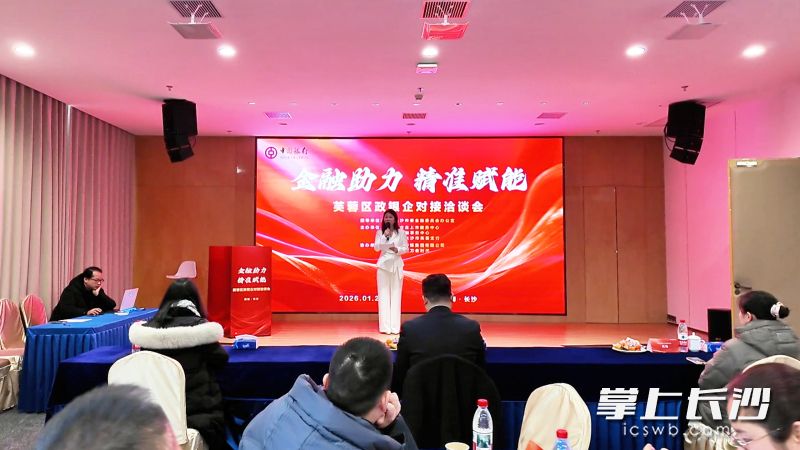
政银企齐聚一堂,以精准金融服务破解企业发展难题
Chang Sha Wan Bao· 2026-01-21 13:46
Core Viewpoint - The "Financial Assistance and Precision Empowerment" meeting in Furong District aims to facilitate direct communication between government, banks, and enterprises to address financing challenges faced by businesses [1]. Group 1: Event Overview - The meeting allows companies to engage directly with bank representatives, making it easier to understand financing options [1][3]. - The event focuses on providing tailored financial services to help businesses overcome development obstacles [1]. Group 2: Company Insights - Hunan Benhui Technology Co., Ltd. is undergoing a transformation, establishing a cross-border e-commerce and self-media company, indicating a need for financing [3]. - The company expressed satisfaction with the face-to-face interactions, which enhance clarity and efficiency in communication with banks [3]. Group 3: Bank Participation - China Bank's Furong Branch introduced exclusive inclusive financial products tailored for small and medium-sized enterprises, detailing application conditions and advantages [5]. - The bank's professional team aims to establish a regular communication mechanism to respond effectively to reasonable business needs [5]. Group 4: Outcomes and Future Plans - During the free negotiation phase, over ten outstanding entrepreneurs engaged in one-on-one discussions with bank managers, focusing on financing needs and cooperation models [7]. - The meeting resulted in cooperation intentions with a credit amount exceeding 30 million yuan, highlighting the effectiveness of the event [7].

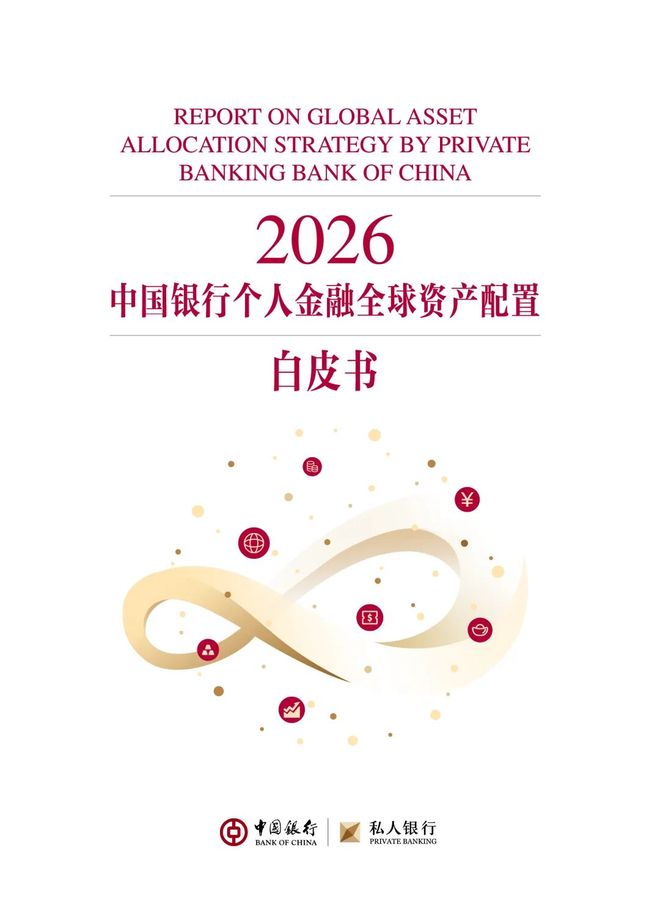
2026年股、汇、债、金如何演绎?中行白皮书给出全景答案
Di Yi Cai Jing Zi Xun· 2026-01-21 13:31
Group 1 - The global financial market in 2025 is characterized by significant changes, with gold emerging as a key asset due to rising geopolitical risks and challenges to the dollar's credit system [1][3] - International gold prices have reached historical highs over fifty times in the year, with London gold experiencing a remarkable annual increase of 64.56%, establishing its status as a core strategic asset [1][3] - The rise of gold is rooted in deep changes in the global economy and monetary order, with U.S. government debt at high levels and the dollar's share in global foreign exchange reserves dropping to a nearly 30-year low [3] Group 2 - The China Banking Corporation has shown exceptional foresight in its assessment of gold trends, consistently advocating for gold as a strategic asset since 2023, leading to cumulative investor returns of nearly 150% by the end of 2025 [4] - The 2025 Personal Financial Global Asset Allocation White Paper accurately predicted trends in the A-share market, RMB exchange rate, and bond market, confirming the bank's professional insights [5] - The report indicated that the A-share market would experience a slow bull pattern, with trading volume exceeding 420 trillion yuan and margin financing balances rising to 2.5 trillion yuan [5] Group 3 - The latest 2026 Personal Financial Global Asset Allocation White Paper provides clear guidance for asset allocation, prioritizing precious metals, non-ferrous metals, equities, and bonds [6] - Gold is expected to maintain its long-term potential for new highs, while the A-share market is anticipated to benefit from global easing and domestic capital inflows [6] - The report forecasts that the RMB exchange rate will continue to exhibit two-way fluctuations, and the yield on 10-year government bonds is expected to stabilize between 1.6% and 1.9% [6] Group 4 - The China Banking Corporation emphasizes a long-term investment philosophy, utilizing professional research and scientific methods to help clients build resilient asset portfolios that can withstand market cycles [7] - The bank aims to guide investors in seizing global asset opportunities through systematic and disciplined asset allocation strategies [7]
2026年股、汇、债、金如何演绎?中行白皮书给出全景答案
第一财经· 2026-01-21 13:18
Core Viewpoint - The global financial market in 2025 is characterized by significant changes and restructuring, with gold emerging as a key asset due to rising geopolitical risks and challenges to the US dollar credit system, leading to a historical price surge of 64.56% throughout the year [1][5]. Group 1: Gold's Performance and Market Dynamics - Gold's strong rise is rooted in deep changes in the global economy and monetary order, with US government debt at high levels and the dollar's share in global foreign exchange reserves dropping to a nearly 30-year low [5]. - The trend of "de-dollarization" is accelerating, with central banks globally purchasing 633.6 tons of gold in the first three quarters of 2025, and 95% of them planning to continue increasing their gold reserves in the coming year [5]. - Gold has become a solid "ballast" in turbulent markets, supported by its monetary attributes, safe-haven function, and financial value, reinforcing its status as hard currency during the main upward trend [5]. Group 2: Strategic Insights from Bank of China - Bank of China's "Global Asset Allocation White Paper" has consistently highlighted the diminishing credit of the dollar since 2023, maintaining a bullish outlook on gold for three consecutive years, with cumulative investor returns approaching 150% and an annualized return exceeding 31% by the end of 2025 [7]. - The white paper's predictions for the A-share market, RMB exchange rate, and bond market have been validated throughout the year, indicating a robust market resilience and a stable RMB against the dollar [9]. Group 3: Future Asset Allocation Strategy - The latest white paper for 2026 outlines a clear priority for global asset allocation, emphasizing precious metals, non-ferrous metals, equities, and bonds, with gold expected to maintain its upward potential despite short-term volatility [11]. - A-shares are anticipated to benefit from global easing and domestic capital inflows, while the RMB is expected to exhibit stable, two-way fluctuations [12].
最高可省3000元!信用卡分期也可享受贴息,怎么向银行申请?
Bei Ke Cai Jing· 2026-01-21 12:39
Core Viewpoint - The recent announcement by four departments regarding the optimization of personal consumption loan interest subsidy policy expands the support scope to include credit card bill installments, with a subsidy rate of 1% per annum [5][6]. Group 1: Policy Details - The subsidy policy allows each borrower to enjoy a maximum annual subsidy of 3,000 yuan, enabling a personal consumption loan limit of up to 300,000 yuan at a single financial institution [7]. - The subsidy period has been extended by four months, allowing eligible consumers to benefit from the policy from September 1, 2025, to December 31, 2026 [9]. - The policy removes previous restrictions on consumption categories, allowing loans for amounts of 50,000 yuan and above to be used for various purposes, including but not limited to automotive, tourism, and education [10]. Group 2: Implementation by Banks - Multiple banks, including Agricultural Bank, Bank of China, and Postal Savings Bank, have quickly released implementation details, emphasizing the direct deduction of subsidy funds from loan interest or installment payments for eligible customers [8][11]. - Customers must sign a supplementary agreement with the bank to benefit from the subsidy, and banks will not charge any fees for this process [14][17]. - Specific banks have set different rules for credit card bill installment subsidies, with Agricultural Bank capping the subsidy at 50% of the agreed annualized interest rate [13]. Group 3: Compliance and Fraud Prevention - Banks have emphasized strict measures against fraudulent activities, stating that any false consumption or non-compliance will result in the denial of subsidy benefits [15][16]. - The banks will not engage third parties for processing the subsidy applications, ensuring that all transactions are conducted through official channels [15][17].
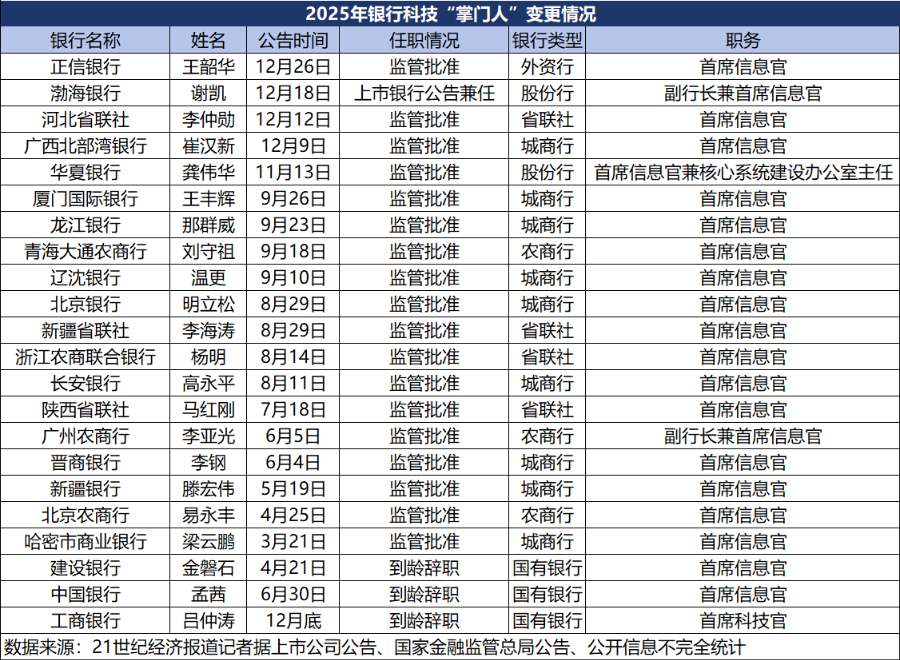
银行CIO变阵:大行“老将”到龄辞任,中小行加速抢人
2 1 Shi Ji Jing Ji Bao Dao· 2026-01-21 11:49
一方面,中行、建行、工行三家国有大行"老将"到龄退休交棒,中小银行也加速"抢人"步伐,从外部引进资深金融科技人才。 另一方面,多家银行副行长与首席信息官为同一人,为科技负责人给予更高的权责,从而深度参与战略决策,在上市银行业绩 发布会上,越来越多的首席信息官"亮相",从幕后走向台前。 "商业银行设立首席信息官,是银行数字化转型从'选择题'变为'必答题'的重要措施。"招联首席研究员、上海金融与发展实验室 副主任董希淼向记者表示,专设首席信息官有助于银行增强面向未来的发展能力与服务能力。 全年22家银行科技"一把手"变动 21世纪经济报道记者李览青 随着银行科技战略的不断推进,2025年,作为科技"掌门人"的首席信息官在银行数智化转型中承担着越来越重要的角色。 据21世纪经济报道记者不完全统计,2025年有22家银行科技"一把手"出现变更。 从中小银行的首席信息官聘任路径来看,既有内部提拔的业务骨干,亦有深耕金融科技领域的外部人才引进。 例如在龙江银行CIO那群威任职资格获批前,该行曾公开对外招聘,彼时其任职要求为,具有15年以上(含)信息科技相关工作 经验,曾任国有大型商业银行省级分行科技部门总经理;具有大学本 ...