ZHONGYIN BABI FOOD CO.(605338)

Search documents
巴比食品:2025年净利润2.73亿元,同比下降1.30%
Xin Lang Cai Jing· 2026-02-03 09:39
Core Viewpoint - The company reported a revenue of 1.859 billion yuan for the fiscal year 2025, reflecting a year-on-year growth of 11.22%, while net profit decreased by 1.30% to 273 million yuan [1] Group 1: Financial Performance - The company achieved an operating revenue of 1.859 billion yuan, marking an 11.22% increase compared to the previous year [1] - The net profit for the period was 273 million yuan, which represents a decline of 1.30% year-on-year [1] - The net profit attributable to shareholders, excluding non-recurring gains and losses, increased by 16.49% year-on-year [1] Group 2: Business Development - The company actively pursued business expansion and integration, enhancing its national layout [1] - The number of franchise stores steadily increased, contributing to the growth of the franchise business scale [1] - Successful acquisitions of projects such as "Qinglu" in Nanjing and "Manxiangren" in Zhejiang were completed, further improving regional market layout [1] Group 3: Operational Efficiency - The company focused on lean improvement, new product development, and supply chain management optimization [1] - Effective control of raw material costs was implemented, leading to a reasonable decrease in overall costs and expenses [1] - Overall operational efficiency was enhanced, ensuring stable and positive business development [1]

巴比食品20260129
2026-01-30 03:11
Summary of Baba Foods Conference Call Company Overview - Baba Foods is actively transforming its business model by opening new types of dumpling stores, with a payback period reduced to within six months, showing excellent performance. Currently, over 40 such stores have been opened, with plans to convert over 80% of its existing 6,000 stores into dumpling stores to enhance revenue scale [2][3][6]. Business Channels - The company's business is primarily divided into three channels: - Franchise (75% of revenue) - Directly operated stores (1.3%) - Group meal sales (23%) - As of the end of 2024, the number of franchise stores is expected to reach 5,143, with a target of around 6,000 by the end of 2025 [2][5]. Financial Performance - The average single-store revenue in different regions is as follows: - East China: 300,000 yuan - North China: 260,000 yuan - South China: 140,000 yuan - Central China: 100,000 yuan - Despite a decline in same-store sales due to the pandemic and national expansion, measures such as extending operating hours and increasing delivery services have led to gradual recovery [5][6]. New Dumpling Store Model - The new dumpling stores, which are larger (60-80 square meters), offer a variety of products and have a payback period shortened to six months. The average daily sales for new stores are stable at over 7,000 yuan, with potential increases from delivery services [6][9]. - The revenue contribution from dumpling stores averages around 30%, significantly enhancing overall profitability [8]. Growth Projections - Revenue growth for Baba Foods is projected to be around 20% in 2026, with non-GAAP net profit growth expected between 21% and 22%, translating to approximately 330 to 340 million yuan [3][4]. - The company aims to achieve a market capitalization of 8 billion to 10 billion yuan, with a historical market cap range of 12 billion to 14 billion yuan during its initial public offering [3][12]. Strategic Acquisitions - Baba Foods has expanded its market share through acquisitions, adding 548 new stores from brands like Nanjing Qinglu and Jiangxi Xunweilai, and completing a project to acquire 250 stores from the Manxiangren brand [4][7]. Future Development Plans - The company plans to accelerate the expansion of new dumpling stores and convert existing small takeaway stores into larger formats. Pilot projects for small takeaway models have shown stable daily sales of 6,000 to 7,000 yuan [10]. - The focus will be on optimizing product structure, improving product quality, and enhancing marketing management to further increase single-store sales [7][11]. Market Positioning - The success of the dumpling business model is attributed to its high cost-performance ratio, appealing to modern young consumers with affordable meal prices averaging 12-15 yuan per person [11]. Conclusion - Baba Foods is positioned for significant growth through its innovative store formats, strategic acquisitions, and a strong focus on enhancing customer experience, with a realistic target of achieving a market cap of 10 billion yuan in the near future [12].
食品加工板块1月27日跌1.35%,巴比食品领跌,主力资金净流出1.11亿元
Zheng Xing Xing Ye Ri Bao· 2026-01-27 08:49
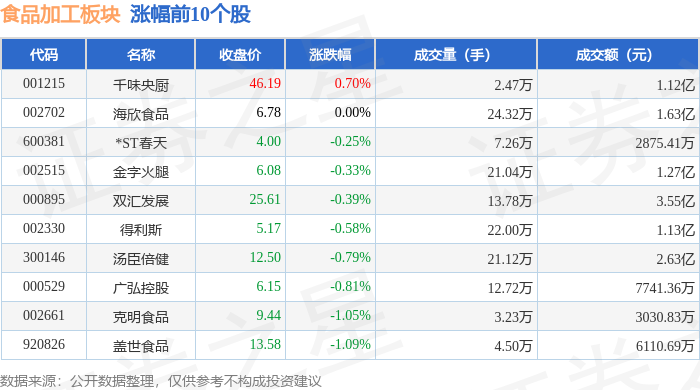
证券之星消息,1月27日食品加工板块较上一交易日下跌1.35%,巴比食品领跌。当日上证指数报收于 4139.9,上涨0.18%。深证成指报收于14329.91,上涨0.09%。食品加工板块个股涨跌见下表: | 代码 | 名称 | 收盘价 | 涨跌幅 | 成交量(手) | | 成交额(元) | | --- | --- | --- | --- | --- | --- | --- | | 001215 | 千味央厨 | 46.19 | 0.70% | 2.47万 | | 1.12亿 | | 002702 | 海欣食品 | 6.78 | 0.00% | 24.32万 | | + 1.63亿 | | 600381 | *ST春天 | 4.00 | -0.25% | 7.26万 | | 2875.41万 | | 002515 | 金字火腿 | 6.08 | -0.33% | 1 21.04万 | | 1.27亿 | | 000895 | 双汇发展 | 25.61 | -0.39% | 13.78万 | | 3.55亿 | | 002330 | 得利斯 | 5.17 | -0.58% | 22.00万 | | 1.13亿 ...

老乡鸡牵手国家体育总局训练局 筑牢国家队餐饮保障防线
Zhong Guo Xin Wen Wang· 2026-01-27 06:06
Core Insights - The partnership between Laoxiangji and the National Sports Administration Training Bureau aims to provide long-term support for the dietary and ingredient needs of national athletes during their training periods [1][2]. Group 1: Strategic Collaboration - Laoxiangji has been recognized as a dining partner for the national team, emphasizing its commitment to health, taste, and safety in food supply [2]. - The collaboration is rooted in Laoxiangji's dedication to quality and health, with plans for a "Health Year" initiative in 2026 that includes calorie and nutrient labeling [2][3]. Group 2: Nutritional Enhancement - The partnership allows Laoxiangji to refine its dining capabilities by integrating professional sports nutrition concepts, ultimately benefiting consumers with safer and healthier dining options [3]. - Laoxiangji will engage deeply in the national team's training support, leveraging its entire supply chain to ensure comprehensive food safety and nutritional quality [3]. Group 3: Value Creation - The collaboration aims to create a "sports empowering livelihood" model, where high-end dining experiences gained from serving the national team will be translated into offerings for Laoxiangji's nationwide outlets [4]. - The partnership is expected to enhance Laoxiangji's brand credibility and set a positive example for the Chinese fast-food industry in terms of health, standardization, and transparency [4].
食品饮料周报(26年第4周):各品类春节备货有序进行,预制菜国标将征求意见-20260126
Guoxin Securities· 2026-01-26 02:59
Investment Rating - The report maintains an "Outperform the Market" rating for the food and beverage sector [4][5][11]. Core Views - The food and beverage sector is expected to perform well in 2026, driven by cost advantages, efficiency improvements, innovation, and potential recovery opportunities in the liquor segment [3][11][15]. - The report highlights a diversified performance across sub-sectors, with beverages outperforming food and liquor categories [2][11]. Summary by Relevant Sections 1. Sector Overview - The food and beverage sector saw a cumulative decline of 1.37% this week, with A-shares down 1.57% and H-shares up 1.21% [1]. - Key performers included companies like Hao Xiang Ni and Wei Zhi Xiang, with significant weekly gains [1]. 2. Sub-sector Insights - **Liquor**: - Moutai's price remains stable with an upward trend, and the focus is on sales momentum during the Spring Festival. Recommendations include Moutai, Shanxi Fenjiu, and Luzhou Laojiao [2][11]. - **Beverages**: - The dairy segment is seeing orderly preparations for the Spring Festival, with a focus on leading companies like Yili. Recommendations include Nongfu Spring and Dongpeng Beverage [2][15]. - **Snacks**: - The report emphasizes strong alpha stocks in the snack sector, particularly in konjac products, with companies like Weidong and Yanjinpuzi showing strong innovation [2][13]. - **Catering Supply Chain**: - The sector is entering a peak season for inventory and sales, with new standards for prepared dishes being solicited for public opinion [2][14]. 3. Investment Recommendations - The report suggests a focus on four main lines for investment: cost advantages, efficiency improvements, innovation-driven companies, and potential recovery in the liquor sector [3][11]. - Recommended stocks include Baba Foods, Dongpeng Beverage, Weidong, and Shanxi Fenjiu, which have shown resilience and growth potential [17][19]. 4. Earnings Forecasts - Key companies are projected to maintain strong earnings growth, with Moutai expected to achieve a stable performance and Yili showing significant recovery potential [4][15][19]. - The report provides detailed earnings forecasts for several companies, indicating a positive outlook for the food and beverage sector [4][19].




巴比食品20260125
2026-01-26 02:49
Summary of Baba Foods Conference Call Company Overview - Baba Foods primarily operates through franchise stores, supplemented by direct sales, group meals, and new retail channels. By the end of 2024, the number of franchise stores is expected to approach 6,000, with a compound annual growth rate (CAGR) of approximately 11%-12% in revenue from 2016 to 2024, and a 12% CAGR in net profit excluding non-recurring items [2][3]. Key Insights - **Business Model and Growth**: Baba Foods was established in 2003, focusing on the research, production, and sales of Chinese buns and related foods. The company has expanded its franchise stores from about 2,000 in 2016 to nearly 6,000 by 2024, maintaining a revenue CAGR of 11%-12% and a net profit CAGR of 12% [3]. - **Pandemic Response**: During the pandemic, Baba Foods recognized challenges in its traditional franchise model and developed a group meal business as a secondary growth avenue. The company also pursued acquisitions to expand, with plans to continue this strategy into 2024 and 2025 [4][20]. - **New Store Model**: The introduction of a new dining model for small buns has significantly increased daily sales per store, with sales rising from over 3,000 yuan to 7,000-9,000 yuan, and average transaction values increasing from 5-10 yuan to 10-15 yuan. This model is expected to enhance profitability and reduce operational risks for franchisees [4][6][14]. - **Market Potential**: The Chinese breakfast market is substantial, with a market size of 1.8 trillion yuan in 2019 and a CAGR of 7%. The takeaway breakfast market is estimated to be around 700-800 billion yuan, while the national bun market is projected to exceed 700 billion yuan, reaching over 740 billion yuan by 2025 [2][8][9]. Competitive Landscape - **Industry Characteristics**: The breakfast industry is highly competitive and fragmented, with over 15.1 million on-site dining establishments nationwide. The trend favors chain brands, although regional taste differences pose challenges for national brand standardization [10]. - **Baba's Competitive Advantages**: Baba Foods possesses significant brand advantages and an initial national supply chain layout, which enhances product quality and safety, aligning with consumer demands for hygienic brands. This positioning offers franchisees greater sales stability and profit assurance compared to smaller brands [11][12]. Future Plans and Projections - **Expansion Plans**: Baba Foods plans to open approximately 2,000 new dining model stores in East and Central China by 2026. If daily sales average 7,500 yuan, these new stores could contribute 1.29 billion yuan in revenue and over 180 million yuan in profit [16]. - **Production Capacity**: The company has substantial potential for capacity release, with expectations of generating 900 million to 1.8 billion yuan in revenue from new and remodeled stores, with conservative profit estimates in the hundreds of millions [17]. - **Acquisition Impact**: Recent acquisitions have integrated supply chains and improved factory utilization rates, accelerating expansion outside the province and contributing significantly to the company's growth [20]. - **Group Meal Business**: The group meal segment has grown to account for 25% of total revenue, serving as both a revenue supplement and a means to enhance production efficiency [21]. - **Profitability Outlook**: The new dining model for small buns is positioned in the value dining segment, with expectations of opening over 2,000 locations. This could yield a net profit of 180 million yuan, with a projected profit of 320 million yuan in 2027, indicating a potential 60% growth relative to the current market capitalization of 7.7 billion yuan [22].
湖北和广东调研反馈、周观点:啤酒推新蓄力,烘焙旺季稳健-20260125
GOLDEN SUN SECURITIES· 2026-01-25 11:22
Investment Rating - The report maintains an "Accumulate" rating for the food and beverage industry [5] Core Insights - The upcoming Spring Festival is expected to boost sales in the liquor sector, with Moutai leading the industry towards an unexpected improvement. Short-term focus should be on the demand for the Spring Festival, while medium-term investments should target leading brands across various price segments [1] - In the beer segment, new product launches are being prepared, with a focus on high-growth channels and consumer trends towards personalized and diversified consumption [2] - The baking sector is showing stable performance, with companies like Lihigh Foods preparing for the sales peak and benefiting from favorable policies regarding cream products [3] Summary by Relevant Sections Liquor Sector - The Spring Festival is driving demand, with Moutai expected to lead the market. Key short-term stocks include Guizhou Moutai, Guo Jiu Gong Jiu, and others, while medium-term focus should be on Wuliangye and Shanxi Fenjiu [1] Beer Sector - Current beer sales are in a low season, but new product launches and high growth in instant retail channels are promising. Companies like Chongqing Beer are launching new 1L cans to meet consumer preferences [2] Food Sector - Lihigh Foods is preparing for the sales peak with a focus on quality over quantity, while Anqi Yeast is benefiting from declining sugarcane prices, enhancing profit margins [3] - Yizhi Konjac is experiencing rapid demand growth, with a stable supply chain and product innovation driving its market position [4]



食品加工板块1月22日涨0.41%,交大昂立领涨,主力资金净流出2882.63万元
Zheng Xing Xing Ye Ri Bao· 2026-01-22 09:01
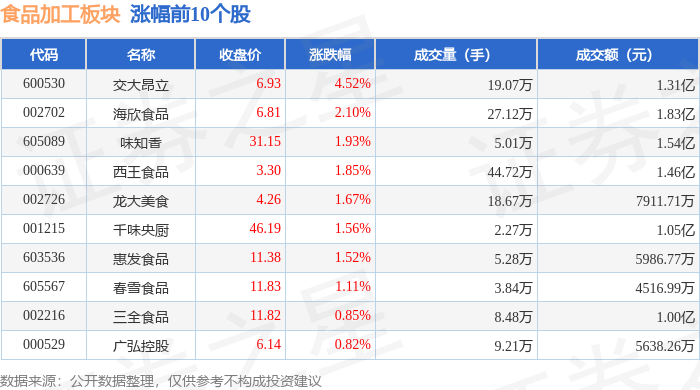
Group 1 - The food processing sector increased by 0.41% on January 22, with Jiaoda Onlly leading the gains [1] - The Shanghai Composite Index closed at 4122.58, up 0.14%, while the Shenzhen Component Index closed at 14327.05, up 0.5% [1] - Key stocks in the food processing sector showed various performance, with Jiaoda Onlly closing at 6.93, up 4.52%, and Hai Xin Food at 6.81, up 2.10% [1] Group 2 - The food processing sector experienced a net outflow of 28.83 million yuan from main funds, while retail investors saw a net inflow of 51.78 million yuan [2] - The trading volume and turnover for key stocks varied, with Jiaoda Onlly having a trading volume of 190,700 shares and a turnover of 131 million yuan [1][2] - The stock performance of several companies showed mixed results, with some stocks like ST Chuntian and Xianle Health declining by 1.39% and 1.27% respectively [2] Group 3 - Main fund inflows were observed in stocks like Jiaoda Onlly with a net inflow of 14.38 million yuan, while retail investors showed a net inflow of 11.80 million yuan [3] - Stocks such as Shuanghui Development and Jinzi Ham also saw significant main fund inflows of 11.39 million yuan and 10.64 million yuan respectively [3] - The overall sentiment in the food processing sector appears mixed, with some stocks attracting retail interest despite main fund outflows [3]


食品加工板块1月20日涨1.3%,味知香领涨,主力资金净流入6656.33万元
Zheng Xing Xing Ye Ri Bao· 2026-01-20 08:51
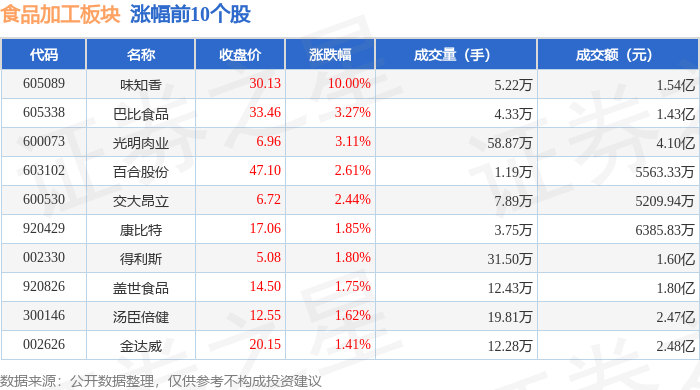
Group 1 - The food processing sector increased by 1.3% on January 20, with Weizhi Xiang leading the gains [1] - The Shanghai Composite Index closed at 4113.65, down 0.01%, while the Shenzhen Component Index closed at 14155.63, down 0.97% [1] - Weizhi Xiang's stock price rose by 10.00% to 30.13, with a trading volume of 52,200 shares and a transaction value of 154 million yuan [1] Group 2 - The food processing sector saw a net inflow of 66.56 million yuan from main funds, while retail investors experienced a net outflow of 51.02 million yuan [2] - Major stocks like Shuanghui Development and Anjixin Food had significant net inflows of 56.07 million yuan and 54.04 million yuan, respectively [3] - Weizhi Xiang had a net inflow of 34.38 million yuan from main funds, but retail investors withdrew 14.73 million yuan [3]


未知机构:东吴食饮苏铖团队0120Q1消费看大众旺季零食闪亮餐饮餐供季节性饮-20260120
未知机构· 2026-01-20 02:25
Summary of Conference Call Notes Industry Overview - The focus is on the consumer sector, particularly in the food and beverage industry, highlighting a seasonal uptick in demand during spring [1][2]. - The report emphasizes the recovery of service consumption, particularly in the restaurant and food supply sectors, supported by government initiatives to boost consumer spending [2]. Key Companies and Recommendations - **Snack Food Companies**: - Recommended leading snack brands include Wanchen Group, Yanjinpuzi, Weilong, Youyou, and Ganyuan [1][2]. - **Restaurant Supply Chain**: - Key players include Babi, Anjins, Guoquan, and Yihai International, along with Baoli Foods and Lihai Foods [1][2]. - **Beverage Companies**: - Notable recommendations are Yangyuan Beverage and Dongpeng Beverage [1][2]. Company-Specific Insights - **Babi**: Focused on diversified growth strategies to recreate its business model [2]. - **Anjins**: Confirming a bottoming out phase and restarting growth initiatives [2]. - **Guoquan**: Demonstrating a resilient business model with accelerated store openings [2]. Market Trends and Predictions - Historical data indicates that Q1 typically shows positive performance for many restaurant companies, with factors such as market profitability, delayed corporate events, and favorable seasonal reporting expected to drive growth in Q1 2026 [3]. - The report anticipates a multi-factor resonance effect in Q1 2026, which may positively impact metrics like customer spending, same-store sales, and table turnover rates [3]. Government Initiatives - The government has implemented a series of fiscal and financial policies aimed at stimulating domestic demand, which includes measures to clear overdue payments to businesses and ensure wage payments to migrant workers [2]. Additional Insights - The report highlights the cyclical nature of the consumer sector and its role as a leader in consumption recovery, with key companies showing continued improvement [4]. - Emphasis on valuation switching as a strategy to recommend high-quality stocks such as Ximai, Babi, Guoquan, and Yanjinpuzi [4].