TCT(688015)

Search documents
交控科技(688015) - 北京德恒律师事务所关于交控科技股份有限公司2025年第一次临时股东大会的法律意见书
2025-09-26 10:00
2025 年第一次临时股东大会的 北京德恒律师事务所 关于交控科技股份有限公司 法律意见书 北京市西城区金融街 19 号富凯大厦 B 座 12 层 电话:010-52682888 传真:010-52682999 邮编:100033 北京德恒律师事务所 关于交控科技股份有限公司 2025 年第一次临时股东大会的法律意见书 北京德恒律师事务所 关于交控科技股份有限公司 受交控科技股份有限公司(以下简称公司)之委托,北京德恒律师事务所(以 下简称本所)指派律师出席了公司 2025 年第一次临时股东大会(以下简称本次 股东大会),对本次股东大会的合法性进行见证并出具本《法律意见书》。 为出具本《法律意见书》,本所律师审查了公司提供的《交控科技股份有限 公司章程》(以下简称《公司章程》)、《交控科技股份有限公司股东大会议事 规则》(以下简称《股东大会议事规则》)、公司董事会为召开本次股东大会所 作出的决议及公告文件、本次股东大会的会议文件、出席会议股东及股东代表的 登记证明等必要的文件和资料。 本所律师得到如下保证:公司已提供了本所律师认为出具本《法律意见书》 所必需的材料,所提供的原始材料、副本、复印件等材料、口头证 ...

交控科技(688015) - 交控科技股份有限公司2025年第一次临时股东大会决议公告
2025-09-26 10:00
证券代码:688015 证券简称:交控科技 公告编号:2025-029 交控科技股份有限公司 者重大遗漏,并对其内容的真实性、准确性和完整性依法承担法律责任。 重要内容提示: 本次会议是否有被否决议案:无 一、会议召开和出席情况 (一)股东大会召开的时间:2025 年 9 月 26 日 (二)股东大会召开的地点:北京市丰台区智成北街 3 号院交控大厦 1 号楼 5 层 501 室 (三)出席会议的普通股股东、特别表决权股东、恢复表决权的优先股股东 及其持有表决权数量的情况: 2025年第一次临时股东大会决议公告 本公司董事会及全体董事保证公告内容不存在任何虚假记载、误导性陈述或 | 1、出席会议的股东和代理人人数 | 53 | | --- | --- | | 普通股股东人数 | 53 | | 2、出席会议的股东所持有的表决权数量 | 85,045,731 | | 普通股股东所持有表决权数量 | 85,045,731 | | 3、出席会议的股东所持有表决权数量占公司表决权数量的比例(%) | 54.2722 | | 普通股股东所持有表决权数量占公司表决权数量的比例(%) | 54.2722 | (四)表决方式是 ...
郜春海:现在我国有一半新建地铁已经实现了无人驾驶
Feng Huang Wang Cai Jing· 2025-09-25 11:54
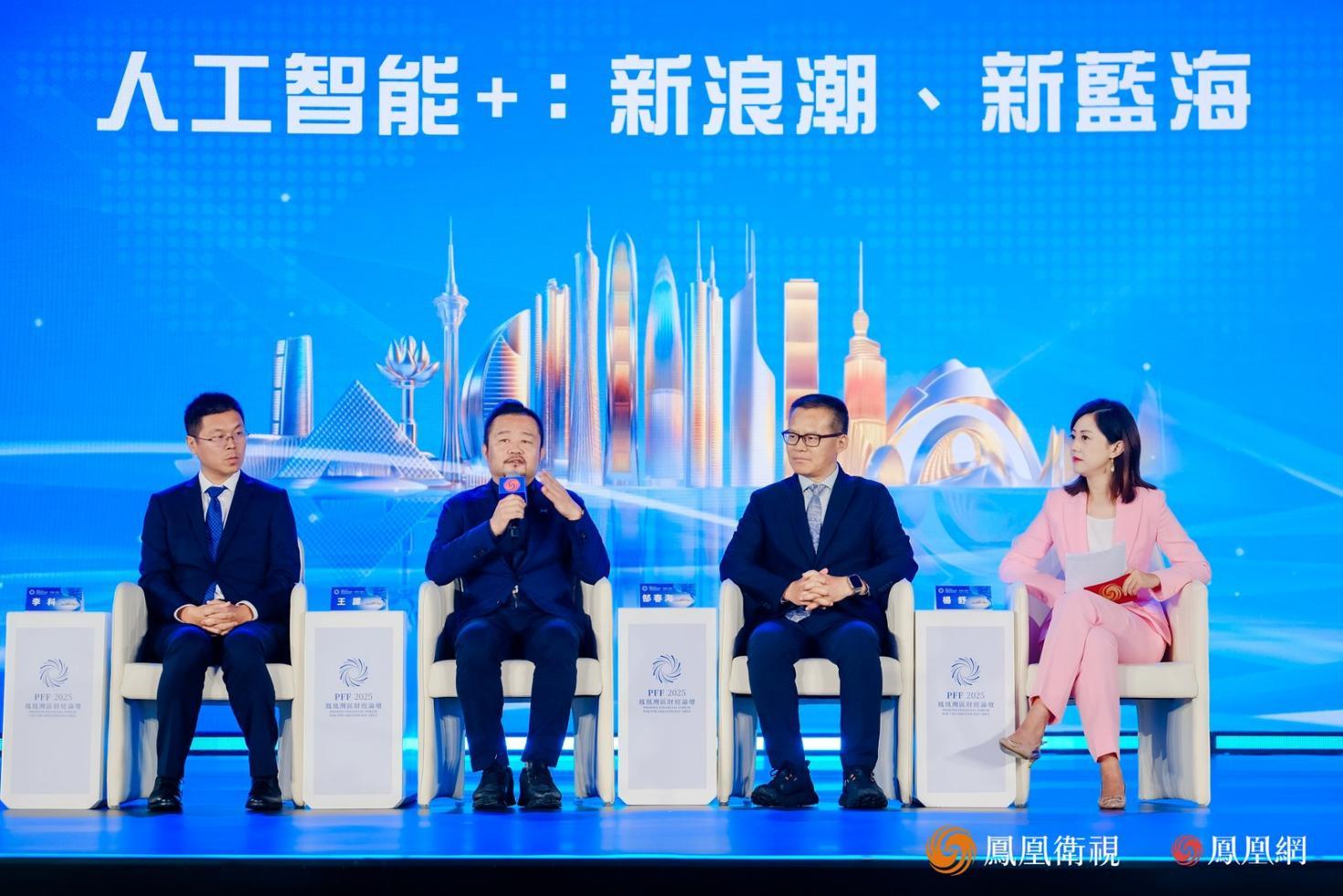
Group 1 - The "Phoenix Bay Area Finance Forum 2025" was held in Guangzhou on September 23-24, focusing on the theme "New Pattern, New Path" and gathering global elites from politics, business, and academia to explore development trends [1] Group 2 - Gao Chunhai, Vice President of the China Listed Companies Association and Chairman of Jiangkou Technology Co., Ltd., shared insights on the current status and future trends of artificial intelligence and low-altitude economy during a roundtable forum [2] Group 3 - Gao Chunhai highlighted that artificial intelligence has deeply integrated into daily life, noting that half of the newly built subways in China have already implemented unmanned driving [3] - He emphasized that the perception of unmanned driving being limited to closed areas is evolving, as safety measures are being enhanced with the installation of radar and camera systems on trains, allowing for monitoring of the area up to 300 meters ahead [3] - This technology ensures timely stopping of trains in case of obstacles, thereby providing an additional layer of safety through artificial intelligence [3]


低空经济为啥能火?郜春海:核心就两字
Feng Huang Wang Cai Jing· 2025-09-25 11:47
Group 1 - The "Phoenix Bay Area Financial Forum 2025" was held in Guangzhou, focusing on the theme "New Pattern, New Path," gathering global elites from politics, business, and academia to explore development trends [1] Group 2 - Gao Chunhai, Vice President of the China Listed Companies Association and Chairman of Jiaokong Technology, discussed the current status and future trends of artificial intelligence and low-altitude economy at a roundtable forum [3] - Gao compared the development of the low-altitude economy to the early stages of the automotive industry, suggesting it will undergo a process from exploration to maturity [3] - He proposed a "two-step" evolution path: the first step involves empowering traditional industries with applications like inspection and coffee delivery; the second step anticipates an explosion in the logistics sector, leveraging high efficiency and low costs for transporting small to medium-weight goods [3] - Gao highlighted the disruptive advantages of low-altitude economy, particularly electric vertical takeoff and landing vehicles, emphasizing that the core issue preventing helicopter proliferation is the high costs associated with pilots and fuel [3] - He stated that the essence of the low-altitude economy is the unprecedented release of airspace as a production factor, which significantly reduces infrastructure costs compared to building subways or roads, enabling efficient point-to-point connections [3] - Gao further emphasized that the low-altitude economy represents a new economic form that is cheaper and more inclusive compared to traditional helicopters [3]

中国低空经济有后发优势?郜春海:因为我们天空“干净”
Feng Huang Wang Cai Jing· 2025-09-25 11:47
Group 1 - The "Phoenix Bay Area Financial Forum 2025" was held in Guangzhou, focusing on the theme "New Pattern, New Path" and gathering global political, business, and academic elites to explore development trends [1] Group 2 - Gao Chunhai, Vice President of the China Listed Companies Association and Chairman of Jiangkou Technology, discussed the current status and future trends of artificial intelligence and low-altitude economy at a roundtable forum [3] - Gao highlighted China's potential "latecomer advantage" in planning low-altitude air routes compared to countries like the United States, which have complex airspace management due to numerous manned private aircraft [3] - He emphasized that starting with a fully unmanned aviation system could reduce systemic risks and improve management efficiency compared to mixed operations of manned and unmanned aircraft [3] - The discussion pointed out the importance of top-level design in managing airspace as a complete ecosystem, leveraging technology and social systems to ensure the safe and scalable development of the low-altitude economy [3]
郜春海:AI“干的活”越多,就越“聪明”
Feng Huang Wang Cai Jing· 2025-09-25 11:41
Group 1 - The "Phoenix Bay Area Finance Forum 2025" was held in Guangzhou, focusing on the theme "New Pattern, New Path" and gathering global elites from politics, business, and academia to explore development trends [1] Group 2 - Gao Chunhai, Vice President of the China Listed Companies Association and Chairman of JiaoKong Technology, discussed the current status and future trends of artificial intelligence (AI) and the low-altitude economy at a roundtable forum [3] - Gao highlighted the challenges of using drones for tunnel inspections in closed environments, emphasizing the need for high safety standards in rail transit systems [3] - JiaoKong Technology is collaborating with Hong Kong MTR to develop a drone inspection solution tailored for tunnel environments, which involves overcoming significant technical challenges [3] - The company employs AI-driven flight control and navigation systems, allowing drones to autonomously map and optimize their flight paths over time [3] - Gao compared the learning process of drones to that of a person finding their way home, illustrating the importance of repeated exposure for improving accuracy [3] - He noted that AI represents a watershed moment for automation and intelligence, as products enhanced by AI can learn continuously and become more intelligent over time [3] - Gao emphasized that the more tasks an AI system, such as a drone, performs, the smarter it becomes, advocating for maximizing operational efficiency [3]
论道AI与低空经济,如何引领下一轮产业革命?
Feng Huang Wang Cai Jing· 2025-09-25 06:12
Group 1: Artificial Intelligence Insights - Artificial intelligence (AI) is deeply integrated into daily life and is becoming a crucial force in the intelligent transformation of traditional industries, with half of new subways in China already implementing unmanned driving [3][5] - AI's value lies in its continuous learning and evolution capabilities, which enhance operational precision over time, as illustrated by the use of AI-driven drone systems for tunnel inspections [5][11] - The development of large language models faces challenges due to insufficient Chinese language data, but leveraging high-quality data sources can improve model performance [7][10] Group 2: Low-altitude Economy Perspectives - The low-altitude economy is likened to the early stages of the automotive industry, with expectations of transitioning from empowering traditional industries to widespread logistics and eventual universal adoption [12] - The emergence of electric vertical takeoff and landing (eVTOL) aircraft aims to reduce costs associated with pilots and fuel, making air travel more accessible and efficient compared to traditional ground infrastructure [12] - China possesses a "latecomer advantage" in the low-altitude economy due to its relatively clean airspace, which facilitates the establishment of a management system primarily for unmanned aerial vehicles, supporting safe and scalable development [12]
从“中国淡水鱼”到“全球巨鲸”:一场闭门会揭示出海突围密码
Feng Huang Wang Cai Jing· 2025-09-24 01:03
Core Insights - The focus of Chinese companies' overseas expansion has shifted from "whether to go abroad" to "how to achieve high-quality globalization" [1] - The "Phoenix Bay Area Finance Forum 2025" held in Guangzhou gathered global elites to explore new paths for development under changing globalization [1][3] - The current era of "going out" is essential for long-term development, especially for companies in the Guangdong-Hong Kong-Macao Greater Bay Area [1][3] Challenges and Bottlenecks - Chinese companies are at a critical transition from quantity to quality in their overseas expansion [4] - China has maintained its position as the world's largest trading nation for seven consecutive years, with a total import and export volume increase of approximately 2 trillion yuan [4] - Despite the scale of expansion, brand quality remains a significant shortcoming, with Chinese companies' average profit only about 40% of that of U.S. companies [6] - The global landscape has shifted to a "mosaic" globalization 2.0 era, requiring companies to adopt a true "going abroad" strategy [6][8] Pathways and Practices - Successful internationalization practices from leading Chinese companies were shared, highlighting strategic foresight and comprehensive capabilities [11] - BYD has established a global sales network covering 108 countries and has aligned its overseas strategy with its "three green dreams" [13] - Companies like Southern Power Grid emphasize the importance of technology and operational efficiency in their overseas ventures [14] - Cultural integration and social responsibility are crucial for sustainable overseas paths, as demonstrated by companies like Dong'e Ejiao [18] Future Outlook - The next five to ten years are predicted to be a golden period for the emergence of global brands from China, with hundreds of global brands expected to arise [19] - Companies must enhance seven core capabilities to transition from "freshwater fish in China's lakes" to "whales in the global ocean" [20] - The integration of ESG principles into business practices is essential for enhancing brand sustainability and cross-cultural recognition [26]


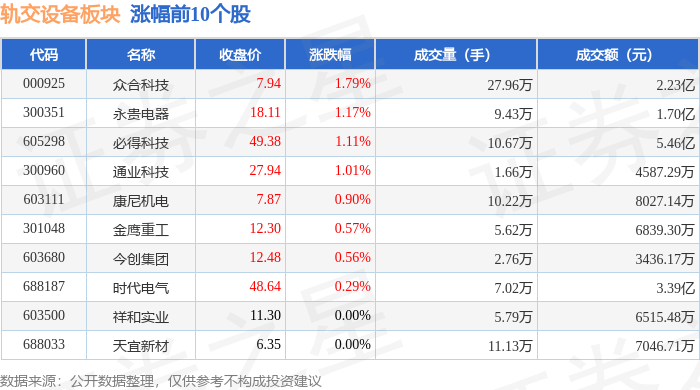
轨交设备板块9月22日跌0.51%,工大高科领跌,主力资金净流出1.37亿元
Zheng Xing Xing Ye Ri Bao· 2025-09-22 08:47
Market Overview - On September 22, the rail transit equipment sector declined by 0.51%, with Gongda High-Tech leading the drop [1] - The Shanghai Composite Index closed at 3828.58, up 0.22%, while the Shenzhen Component Index closed at 13157.97, up 0.67% [1] Stock Performance - Notable gainers in the rail transit equipment sector included: - Zhonghe Technology (Code: 000925) with a closing price of 7.94, up 1.79% and a trading volume of 279,600 shares [1] - Yonghui Electric (Code: 300351) with a closing price of 18.11, up 1.17% and a trading volume of 94,300 shares [1] - Bidetech (Code: 605298) with a closing price of 49.38, up 1.11% and a trading volume of 106,700 shares [1] - Conversely, Gongda High-Tech (Code: 688367) experienced the largest decline, closing at 19.60, down 5.95% with a trading volume of 61,500 shares [2] Capital Flow - The rail transit equipment sector saw a net outflow of 137 million yuan from institutional investors, while retail investors contributed a net inflow of 119 million yuan [2] - The detailed capital flow for selected stocks showed: - Zhonghe Technology had a net inflow of 20.92 million yuan from institutional investors [3] - Bidetech experienced a net outflow of 13.26 million yuan from retail investors [3] - Yonghui Electric had a significant net inflow of 26.51 million yuan from retail investors [3]





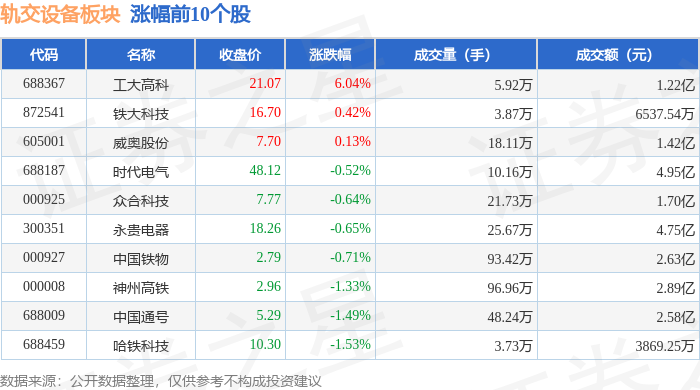
轨交设备板块9月18日跌1.82%,祥和实业领跌,主力资金净流出2.32亿元
Zheng Xing Xing Ye Ri Bao· 2025-09-18 08:52
Group 1 - The rail transit equipment sector experienced a decline of 1.82% on September 18, with Xianghe Industrial leading the drop [1] - The Shanghai Composite Index closed at 3831.66, down 1.15%, while the Shenzhen Component Index closed at 13075.66, down 1.06% [1] - Key stocks in the rail transit equipment sector showed mixed performance, with Gongda Gaoke rising by 6.04% to a closing price of 21.07 [1] Group 2 - The main funds in the rail transit equipment sector saw a net outflow of 232 million yuan, while retail investors had a net inflow of 190 million yuan [2] - Notable declines included Xianghe Industrial, which fell by 4.74% to a closing price of 11.45, and Bidetech, which decreased by 4.40% to 50.46 [2] - The trading volume for Xianghe Industrial was 159,900 shares, contributing to a transaction amount of 188 million yuan [2]