SQM(688138)

Search documents
清溢光电:双翼齐飞抢占掩膜版产业新高地
Shang Hai Zheng Quan Bao· 2026-02-24 17:49
◎记者 何治民 掩膜版被称为半导体与显示制造环节的"精密底片",其技术成熟度直接影响下游终端产品的质量与良 率。作为国内掩膜版行业的龙头,清溢光电以平板显示掩膜版起家,目前约七成营收来自该领域,同 时,半导体掩膜版产品的收入占比正逐年提升。 加快高端掩膜版,特别是半导体高端掩膜版的国产化进程,已成为清溢光电的重要战略方向。 "高端掩膜版行业需要耐心资本与长期投入,我们不追求短期回报,而是专注于攻克技术难点,最终目 标是助力产业链实现自主可控。"清溢光电副董事长庄鼎鼎告诉上海证券报记者,公司计划通过"平板显 示+半导体"双翼齐飞战略,未来五年力争平板显示领域市场份额做到全球第一,半导体领域的市场份 额跻身国内前三。 技术攻坚 突破高端掩膜版国产化壁垒 掩膜版的技术迭代与下游需求密切相关。近年来,随着下游需求逐渐高端化、多样化,掩膜版技术也在 向更高精度、更复杂工艺的新材料升级。"这是公司必须加速实现高端掩膜版国产化的背景。"庄鼎鼎 说。 HTM(高规格半透膜掩膜版)和PSM(高规格相移掩膜版)是当前行业内高端掩膜版产品。庄鼎鼎告 诉记者,2009年,清溢光电开始布局和储备HTM及PSM相关技术。目前,公司已实现 ...

清溢光电股价波动上涨,半导体行业关注度提升
Jing Ji Guan Cha Wang· 2026-02-13 01:59
经济观察网近期半导体行业关注度提升,特别是AI芯片领域。2月11日有报道称字节跳动正在推进自研 AI芯片并与三星洽谈代工合作,计划年内量产,这可能间接提振半导体材料板块情绪。清溢光电作为 掩膜版供应商,业务涉及半导体芯片领域,但公司未在近7天发布重大事件公告。 公司最新财务数据为2025年1-9月业绩:营业收入9.28亿元,同比增长12.28%;归母净利润1.44亿元,同 比增长19.33%。该数据反映公司稳健增长,但非近7天新发布信息,对短期股价影响有限。 股票近期走势 以上内容基于公开资料整理,不构成投资建议。 清溢光电近7天股价呈现波动上涨趋势,区间累计涨幅4.42%。具体来看:2月9日收盘29.52元,单日涨 2.75%;2月10日微跌0.14%;2月11日上涨1.22%,主力资金净流入94.96万元;2月12日收盘30.00元,涨 0.54%,但主力资金转为净流出534.37万元。截至2月13日最新数据,股价为29.71元,较前日跌0.97%。 资金面显示主力趋势不明显,筹码分散,技术面提示股价接近支撑位29.78元。 财报分析 ...
东方证券:供需格局向好 大尺寸面板涨价有望持续
Zhi Tong Cai Jing· 2026-02-05 02:07
Core Viewpoint - The electronic industry panel manufacturers are continuing their production control strategies, leading to price increases for large-sized panels, which are expected to persist due to demand from events like the World Cup [1][2]. Group 1: Panel Price Trends - Large-sized panel prices are expected to continue rising as manufacturers maintain production control, with demand remaining stable [2]. - AVC data indicates that all sizes of TV panels saw price increases in late January, with some monitor panels also experiencing price hikes [1][2]. - The tight supply-demand situation for TV panels is extending to monitor panels, with expectations of price increases in February [2]. Group 2: Capital Expenditure Trends - The large-scale capital expenditure cycle in the panel industry is nearing its end, with leading manufacturers expected to significantly reduce future spending [3]. - According to BOE's announcement, 2025 will be the peak year for capital expenditure, with a significant decline anticipated starting in 2027 [3]. - TCL Technology is focusing on investments aligned with the accelerated penetration of OLED in the mid-size market, with no major new production line investments planned beyond the T8 line [3]. Group 3: Mobile OLED Panel Market - Mobile OLED panel prices are under short-term pressure, but the impact is expected to be manageable [4]. - The penetration rate of mobile OLED panels is anticipated to continue increasing, which may offset the decline in overall smartphone shipments [4]. - Omdia forecasts that global smartphone AMOLED panel shipments will decrease slightly to 810 million units in 2026, a minor decline from 817 million in 2025 [4]. Group 4: Investment Recommendations - The favorable supply-demand relationship and the expected continuation of price increases for large-sized panels suggest potential investment opportunities in panel manufacturers such as TCL Technology, BOE A, and others [5]. - Related material manufacturers and display driver chip manufacturers are also highlighted as potential investment targets [5].





全球半导体材料市场复苏提速 中国产业突围 “卡脖子” 难题
Quan Jing Wang· 2026-01-20 07:23
Core Insights - The global semiconductor materials market is experiencing a strong recovery, with a market size of $66.7 billion in 2023 and expected to exceed $73 billion by 2025, driven by demand from AI and wafer fab expansions [1] - China is becoming a key growth engine in the semiconductor materials market, with a sales figure of $13.1 billion in 2023, marking a year-on-year growth of 3.8% and increasing its global market share to 20% [1] Market Structure - Semiconductor materials are divided into wafer manufacturing materials and packaging materials, with wafer manufacturing materials dominating the market at 62.2% share ($41.5 billion) in 2023 [2] - Silicon wafers hold the largest share in wafer manufacturing materials at 33%, followed by electronic specialty gases (14%) and photomasks (13%) [2] - The market is highly concentrated, with major players in silicon wafers and photolithography materials predominantly from Japan and the U.S. [2] Core Material Breakthroughs - Domestic companies are making significant progress in wafer manufacturing materials, with local firms achieving breakthroughs in 12-inch silicon wafers and photolithography materials [3][4] - The domestic market for electronic specialty gases is also advancing, with companies like Huate Gas entering the TSMC supply chain [4] Packaging Materials - The global packaging materials market saw a decline of 10.1% to $25.2 billion in 2023, but advanced packaging is driving growth, with a projected increase of 19.62% [5] - Domestic companies are rapidly iterating technology in advanced packaging materials, with significant market shares in lead frames and packaging substrates [5] Import Dependency and Policy Support - China still faces significant import dependency in key categories like photolithography materials and electronic specialty gases, with over 90% reliance on imports for high-end materials below 14nm [6][8] - The government is focusing on critical areas through initiatives like the National Big Fund, aiming for 70% self-sufficiency in core materials by 2030 [6][8] Challenges and Future Outlook - Despite notable advancements, the industry faces challenges such as reliance on foreign technology for EUV-grade silicon wafers and high-end photolithography materials [7] - The advanced packaging materials market is expected to reach $39.3 billion by 2025, indicating a significant growth opportunity for domestic companies [7]



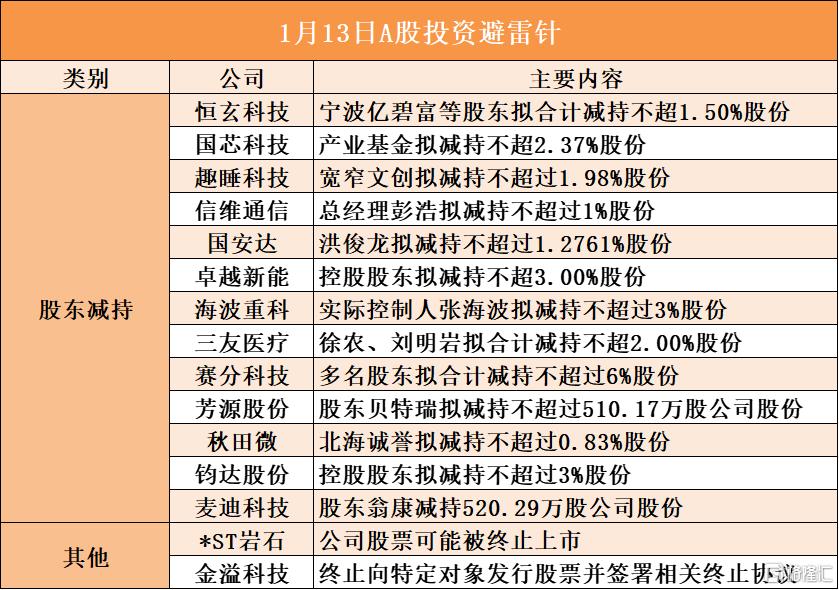
1月13日A股投资避雷针︱*ST岩石:公司股票可能被终止上市




Ge Long Hui A P P· 2026-01-12 14:40
Summary of Key Points Core Viewpoint - Multiple shareholders across various companies are planning to reduce their stakes, indicating potential shifts in ownership and investor sentiment in the market [1]. Shareholder Reductions - Hengxuan Technology: Shareholders including Ningbo Yibifu plan to reduce their holdings by up to 1.50% [1]. - Guoxin Technology: Industry fund shareholders intend to reduce their stakes by up to 2.37% [1]. - Qusleep Technology: Shareholder Kuanzhai Cultural plans to reduce holdings by no more than 1.98% [1]. - Xinwei Communication: General Manager Peng Hao aims to reduce his stake by up to 1% [1]. - Guoanda: Shareholder Hong Junlong plans to reduce his holdings by up to 1.2761% [1]. - Zhuoyue New Energy: Controlling shareholders intend to reduce their stakes by up to 3.00% [1]. - Haibo Heavy Industry: Actual controller Zhang Haibo plans to reduce his stake by up to 3% [1]. - Sanyou Medical: Shareholders Xu Nong and Liu Mingyan plan to reduce their holdings by up to 2.00% [1]. - Saifen Technology: Multiple shareholders intend to reduce their stakes by up to 6% [1]. - Fangyuan Shares: Shareholder Betterry plans to reduce holdings by no more than 510.17 million shares [1]. - Qiutian Micro: Beihai Chengyu plans to reduce holdings by up to 0.83% [1]. - Diaoda Shares: Controlling shareholders plan to reduce their stakes by up to 3% [1]. - Maidi Technology: Shareholder Weng Kang plans to reduce holdings by 520.29 million shares [1]. Other Notable Events - *ST Yanshi: The company's stock may face delisting [1]. - Jin Yi Technology: The company has terminated the issuance of shares to specific targets and signed relevant termination agreements [1].

东方证券:电视面板涨价 LCD与中尺寸OLED有望引领需求向好
智通财经网· 2026-01-08 08:06
Core Viewpoint - The LCD demand is expected to improve by 2026 due to factors such as sports events, with leading manufacturers likely to drive supply-demand balance through production control [1][2] Group 1: LCD Market Outlook - The demand for LCD is anticipated to rebound, supported by major manufacturers maintaining production control to enhance supply-demand dynamics [1] - The upcoming FIFA World Cup and the continuation of trade-in policies in China are expected to boost demand for LCD TVs [1] - The average size of TV panels is projected to continue increasing, contributing to overall demand growth [2] Group 2: Supply Dynamics - Major panel manufacturers, including BOE, TCL Huaxing, and Huike, have achieved significant market share and are expected to continue production control, including reductions during the Lunar New Year [2] - According to TrendForce, TV panel prices are forecasted to rise by $1 across various sizes in January 2026 compared to the previous month [2] Group 3: OLED Market Potential - The potential demand for mid-size OLED panels is gaining attention, with expectations for significant cost reductions and increased penetration in laptops and tablets by 2026 [3] - Major manufacturers are optimistic about market demand, as evidenced by BOE's early activation of the first 8.6-generation AMOLED production line in China [3] Group 4: Domestic Manufacturers' Breakthroughs - Domestic manufacturers are accelerating technological breakthroughs in materials and driver chips, which may benefit from improving downstream demand [4] - New products in OLED materials are entering the market, and companies like Xiahe Technology are achieving commercial production of key materials [4] Group 5: Related Companies - Key panel manufacturers include TCL Technology (000100.SZ), BOE A (000725.SZ), and Rainbow Technology (600707.SH) [5] - Notable panel materials manufacturers are Lite-On Optoelectronics (688150.SH) and Ruvi Optoelectronics (688401.SH) [5]


清溢光电股价涨5.02%,东兴基金旗下1只基金重仓,持有1.69万股浮盈赚取2.51万元
Xin Lang Cai Jing· 2026-01-07 03:21
Group 1 - The core point of the news is that Qingyi Optoelectronics experienced a stock price increase of 5.02%, reaching 30.99 CNY per share, with a trading volume of 181 million CNY and a turnover rate of 1.89%, resulting in a total market capitalization of 9.756 billion CNY [1] - Qingyi Optoelectronics, established on August 25, 1997, and listed on November 20, 2019, is primarily engaged in the research, design, production, and sales of photomasks [1] - The company's main revenue sources are quartz photomasks (93.16%), soda photomasks (6.04%), and other products (0.8%) [1] Group 2 - Dongxing Fund has one fund heavily invested in Qingyi Optoelectronics, specifically Dongxing Xingsheng Mixed A (009327), which held 16,900 shares, accounting for 1.67% of the fund's net value, making it the sixth-largest holding [2] - The fund has a total size of 20.8469 million CNY, with a year-to-date return of 2.83% and a one-year return of 43.15%, ranking 2718 out of 8083 in its category [2] - The fund managers, Li Chenhui and Li Bingwei, have both been in their positions for 9 years and 211 days, with total assets under management of 270 million CNY and 585 million CNY respectively [2]
清溢光电涨2.02%,成交额2378.46万元,主力资金净流入77.49万元
Xin Lang Cai Jing· 2025-12-23 01:50
Core Viewpoint - Qingyi Optoelectronics has shown a positive stock performance with a year-to-date increase of 26.85% and a recent uptick of 2.02% in stock price, indicating strong market interest and potential growth in the semiconductor materials sector [1][2]. Company Overview - Qingyi Optoelectronics, established on August 25, 1997, and listed on November 20, 2019, specializes in the research, design, production, and sales of photomasks, with a revenue composition of 93.16% from quartz photomasks and 6.04% from soda photomasks [1][2]. - The company operates within the electronic industry, specifically in the semiconductor materials sector, and is involved in various concept sectors including third-generation semiconductors and flexible electronics [2]. Financial Performance - For the period from January to September 2025, Qingyi Optoelectronics reported a revenue of 928 million yuan, reflecting a year-on-year growth of 12.28%, and a net profit attributable to shareholders of 144 million yuan, which is a 19.33% increase compared to the previous year [2]. - The company has distributed a total of 217 million yuan in dividends since its A-share listing, with 156 million yuan distributed over the last three years [3]. Shareholder Information - As of December 19, 2025, the number of shareholders for Qingyi Optoelectronics is 11,400, a decrease of 10.37% from the previous period, while the average number of circulating shares per shareholder has increased by 31.65% to 27,669 shares [2]. - Notable changes in institutional holdings include an increase in shares held by Hong Kong Central Clearing Limited and new entries from two funds, indicating growing institutional interest [3].
清溢光电:截至2025年12月19日公司股东总户数为11377户
Zheng Quan Ri Bao Wang· 2025-12-22 12:12
Core Viewpoint - Qingyi Optoelectronics reported that as of December 19, 2025, the total number of shareholders is 11,377 (excluding merged margin trading accounts) [1] Summary by Category Company Information - Qingyi Optoelectronics has a total of 11,377 shareholders as of December 19, 2025 [1]
清溢光电:150nm工艺掩膜版已实现小规模量产
Ju Chao Zi Xun· 2025-12-05 15:45
Core Viewpoint - Qingyi Optoelectronics (688138.SH) is focusing on expanding its semiconductor mask business, which currently accounts for approximately 20% of its revenue, while also maintaining its leading position in the flat panel display mask market [1][5]. Group 1: Business Overview - The total investment in the Foshan production base is 3.5 billion yuan, with 2 billion yuan allocated for high-precision flat panel display mask production and 1.5 billion yuan for high-end semiconductor mask production [1]. - The company has achieved mass production of semiconductor masks for the 180nm process node and small-scale production for the 150nm process node, while also developing masks for 130nm-65nm PSM and OPC processes, as well as planning for 28nm semiconductor masks [5]. Group 2: Market Position and Strategy - Qingyi Optoelectronics aims to maintain its leading market share in the domestic flat panel display mask market and strives to rank among the top three globally, while accelerating the fulfillment of domestic substitution demands in the semiconductor mask sector [6]. - The company emphasizes the significant potential for domestic substitution in semiconductor masks, with current self-sufficiency at around 10%, and plans to enhance local supply capabilities and supply chain security through technological upgrades and capacity expansion [5][6]. Group 3: Customer Base and Future Outlook - Key customers in the semiconductor mask business include BYD Semiconductor and Chiplink Integration, with some client information restricted due to confidentiality agreements [5]. - The company believes that the increasing demand for domestic mask substitutes from local wafer fabs will lay a solid foundation for future business growth [5].