
Cambricon(688256)

Search documents
胡润发布中国AI企业50强,前10有7家芯片公司
Guan Cha Zhe Wang· 2026-01-19 07:38
Core Insights - The 2025 Hurun China AI Companies Top 50 report highlights the rapid growth and prominence of AI chip companies in China, with the top three companies being Cambricon, Moore Threads, and Muxi, all of which are AI chip-related firms [1][2][6] Group 1: Company Performance - Cambricon ranks first with a valuation of 630 billion RMB, experiencing a 165% increase from the previous year. In Q3 2025, the company reported revenue of 1.727 billion RMB, a year-on-year growth of 1332.52%, and a net profit of 567 million RMB, marking its fourth consecutive profitable quarter [1][6] - Moore Threads, established in 2020, ranks second with a valuation of 310 billion RMB. The company achieved a revenue of 785 million RMB in the first three quarters of 2025, a 182% increase compared to the previous three years combined, although it reported a net loss of 724 million RMB [1][2] - Muxi ranks third with a valuation of 250 billion RMB, reporting revenue of 1.236 billion RMB in the first three quarters of 2025, a 453.52% year-on-year increase, while its net loss narrowed to 346 million RMB [2][6] Group 2: Industry Trends - The report indicates a significant increase in the number of AI chip companies on the list, with 14 firms represented, an increase of 9 from the previous year. This growth is attributed to the tightening of high-end AI chip export controls by the U.S., prompting domestic companies to accelerate their capabilities [6][7] - The AI user base in China is substantial, with 515 million users reported by mid-2025, indicating that nearly 40% of the population are users of generative AI [6] - The top 50 list features a total of 14 companies in the computing hardware sector, the largest category, followed by 11 in data analysis and decision-making, and 8 each in content generation, visual recognition, and autonomous driving [3][4] Group 3: Market Position - The combined market value of the top three Chinese computing power companies is approximately 1.2 trillion RMB, which is only 4% of Nvidia's market value, suggesting a significant gap that may narrow in the next five years as China's computing power industry advances [7] - Major cities dominate the list, with Beijing leading with 19 companies, followed by Shanghai with 14, indicating that over 80% of the listed companies are based in first-tier cities [4]



222只,百元股数量创历史新高,科技新贵扎堆
Zheng Quan Shi Bao Wang· 2026-01-19 07:16
Group 1 - The A-share market has reached a historical high with 222 stocks closing above 100 yuan as of January 19, 2026 [1] - On January 12, 2026, there were 219 stocks above 100 yuan, nearly matching the previous peak of 219 stocks on November 29, 2021 [1] - The top three stocks by closing price are Cambrian-U at over 1400 yuan, Kweichow Moutai at 1376 yuan, and Yuanjie Technology at 748.29 yuan [1] Group 2 - Several stocks, including Moer Thread-U, Zhongji Xuchuang, Guodun Quantum, and Muxi Shares-U, have also surpassed 500 yuan [1] - The majority of the top ten stocks above 100 yuan are from the technology sector, with Kweichow Moutai being the only non-tech stock in the top ten [1]




ETF盘中资讯|寒武纪登顶中国AI企业50强!科创人工智能ETF华宝(589520)近5日狂揽1.5亿元!机构:或迎1-10加速放量阶段
Sou Hu Cai Jing· 2026-01-19 06:33
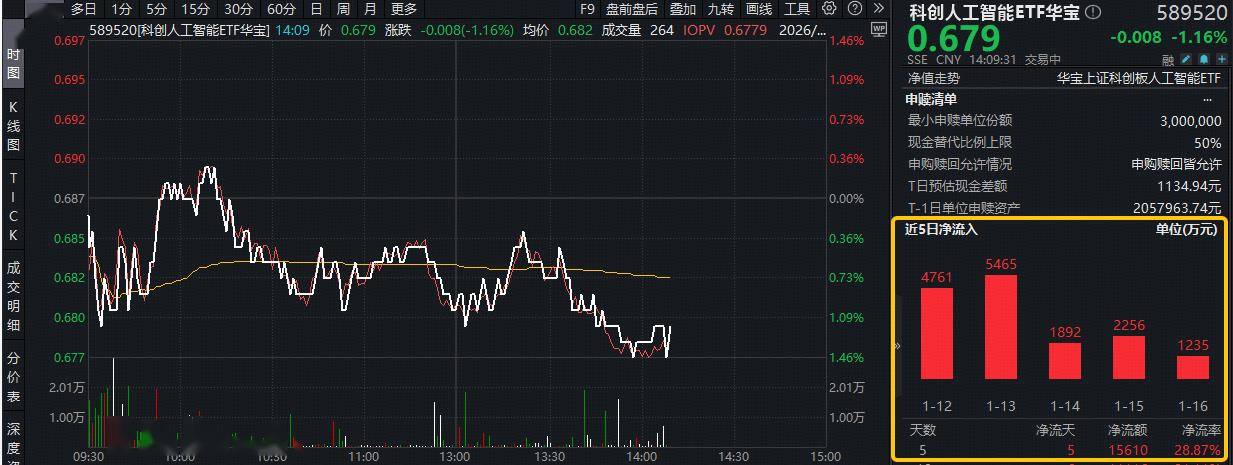
Group 1 - The core viewpoint of the news highlights the positive sentiment towards the domestic AI industry chain, as evidenced by the inflow of 156 million yuan into the Huabao AI ETF over the past five days, despite a slight decline of 1.16% on January 19 [1] - The top-performing stocks within the ETF include Xinghuan Technology, which rose over 6%, and other companies like Aobi Zhongguang and Haitan Ruisheng, which saw gains exceeding 4% [1] - Conversely, stocks such as Hehe Information and Yaxin Security experienced significant declines, with drops exceeding 6% and 5% respectively, impacting the overall index performance [1] Group 2 - The HuRun Research Institute released the "2025 HuRun China AI Enterprises Top 50" list, with AI chip company Cambricon ranking first with a company value of 630 billion yuan, reflecting a 165% increase from the previous year [3] - The AI chip sector is poised for growth due to supportive policies from local governments, including energy consumption indicators, subsidies, and tax incentives, which are facilitating the establishment of intelligent computing centers in key regions [3] - Analysts from Zhongtai Securities predict that the domestic AI supply chain will enter a phase of accelerated growth, while CITIC Securities anticipates strong performance in related sectors driven by self-control and AI synergy through 2026 [3] Group 3 - The Huabao AI ETF focuses on the domestic AI industry chain, with over 70% of its top ten holdings concentrated in semiconductor-related sectors, indicating a high concentration and aggressive investment strategy [4] - The ETF serves as an efficient tool for investors looking to gain exposure to domestic computing power, being a financing and margin trading target [4] - The ETF's index is designed to balance allocations across application software, terminal applications, terminal chips, and cloud chips, reflecting the current trend of the AI industry moving from cloud to edge computing and towards self-sufficiency [3][4]
寒武纪登顶中国AI企业50强!科创人工智能ETF华宝(589520)近5日狂揽1.5亿元!机构:或迎1-10加速放量阶段
Xin Lang Cai Jing· 2026-01-19 06:24
Group 1 - The core focus is on the domestic AI industry chain, with the Huabao Science and Technology Artificial Intelligence ETF (589520) experiencing a slight decline of 1.16% amid market consolidation, despite attracting 156 million yuan in investments over the past five days, indicating strong investor confidence in the future performance of the domestic AI sector [1][6] - Key stocks within the ETF include Xinghuan Technology, which rose over 6%, and other companies like Obsidian Technology and Haitan Ruisheng, which saw gains exceeding 4%. Conversely, companies such as Hehe Information and AsiaInfo Security experienced declines of over 6% and 5%, respectively, negatively impacting the index performance [1][6] Group 2 - The Hurun Research Institute released the "2025 Hurun China AI Enterprises Top 50" list, highlighting AI chip company Cambricon, valued at 630 billion yuan, marking a 165% increase from the previous year. This indicates a growing opportunity in the chip industry [3][8] - The chip sector is benefiting from favorable policies, including energy consumption indicators, subsidies, and tax incentives, which are facilitating the establishment of intelligent computing centers in cities like Wuhan and Hefei. This policy support is expected to continue driving growth [3][8] - Analysts from Zhongtai Securities predict that the domestic AI supply chain will enter a rapid growth phase, while CITIC Securities anticipates that the synergy between self-control and AI will lead to strong performance in related sectors through 2026 [3][8] Group 3 - The Huabao Science and Technology Artificial Intelligence ETF and its linked funds focus on the domestic AI industry chain, with over 70% of the top ten holdings concentrated in semiconductor-related sectors, indicating a high concentration and aggressive investment strategy [4][9] - The ETF serves as an efficient tool for investors looking to gain exposure to domestic computing power, reflecting the importance of achieving self-sufficiency in AI technology amid rising concerns over information and industrial security [4][9]
中国人工智能50强榜单出炉!寒武纪、摩尔线程、沐曦股份位列前三
Zheng Quan Shi Bao· 2026-01-19 04:53
Core Insights - The "2025 Hurun China AI Companies Top 50" report highlights the increasing valuation and significance of AI companies in China, particularly in the AI chip sector [1][6] - The threshold for inclusion in the list has risen significantly, indicating a growing market and competition within the AI industry [1] Valuation and Rankings - The average value of listed companies is 54 billion RMB, which is 2.4 times higher than the previous year [1] - The top ten companies have a valuation threshold of 73 billion RMB, more than three times the previous year's 22 billion RMB [1] - The top three companies are all AI chip-related, with Cambrian Technology leading at 630 billion RMB, followed by Moore Threads at 310 billion RMB, and Muxi Technology at 250 billion RMB [4][5] Company Performance - Cambrian Technology reported a revenue of 2.88 billion RMB in the first half of 2025, a 43-fold increase year-on-year [4] - Moore Threads achieved a revenue of 780 million RMB in the first three quarters of 2025, marking a 182% year-on-year growth [5] - Muxi Technology has focused on high-end GPU development and is among the first to achieve full domestic production [5] Geographic Distribution - Beijing leads with 19 companies on the list, followed by Shanghai with 14, indicating a concentration of AI talent and resources in major cities [7] - Over 80% of the listed companies are based in first-tier cities, showcasing their importance in the AI sector [7] Industry Trends - The number of AI chip companies on the list has increased to 14, up by 9 from the previous year, driven by domestic demand due to U.S. export controls [6] - The AI sector is reshaping wealth distribution in China, with notable increases in the wealth of key figures in the industry [9]

《2025胡润中国人工智能企业50强》重磅发布 寒武纪以6300亿价值位居榜首
Zhi Tong Cai Jing· 2026-01-19 04:51
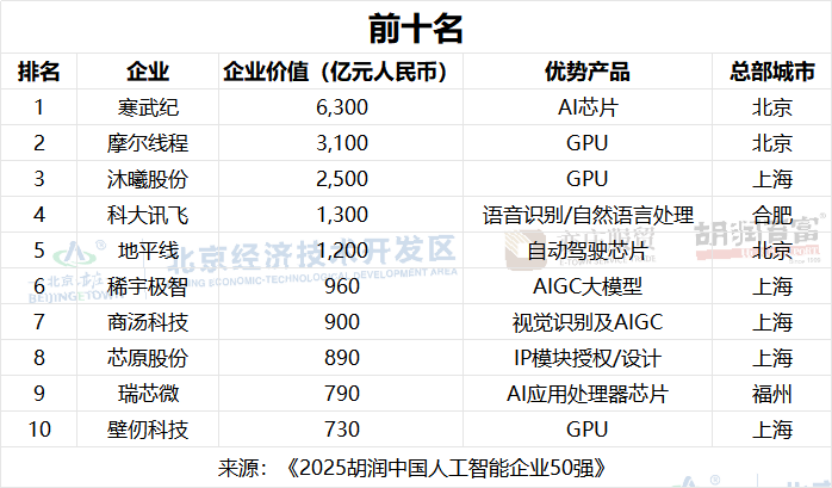
Core Insights - The 2025 Hurun China AI Companies Top 50 list highlights the growth and valuation of AI-focused companies in China, with a significant increase in the number of AI chip companies due to tightening U.S. export controls on high-end AI chips [1][2] Company Rankings - Cambricon leads the list with a valuation of 630 billion RMB, marking a 165% increase from the previous year [1][2] - Moore Threads ranks second with a valuation of 310 billion RMB, achieving a 182% year-on-year revenue growth [3] - Muxi ranks third with a valuation of 250 billion RMB, recognized as one of the first high-end GPU companies to achieve full domestic production [3] - iFlytek, a leader in intelligent voice technology, ranks fourth with a valuation of 130 billion RMB [4] - Horizon Robotics ranks fifth with a valuation of 120 billion RMB, focusing on automotive AI chips [4] Market Trends - The list shows a total of 21 non-listed companies, with the entry threshold raised to 9.5 billion RMB, an increase of 3.5 billion RMB from last year [1] - The average valuation of listed companies is 54 billion RMB, which is 2.4 times higher than the previous year [1] - The number of AI chip companies on the list has increased to 14, up from 5 last year, indicating a shift towards domestic AI chip production [1] Geographic Distribution - Beijing leads with 19 companies on the list, followed by Shanghai with 14, and Shenzhen with 6, indicating a concentration of AI talent and resources in first-tier cities [1] Sector Breakdown - The majority of companies on the list are focused on AI chip hardware, with 14 companies in this category, reflecting the growing importance of AI infrastructure [5] - Other sectors include data analysis and decision-making with 11 companies, and content generation with 8 companies [5]
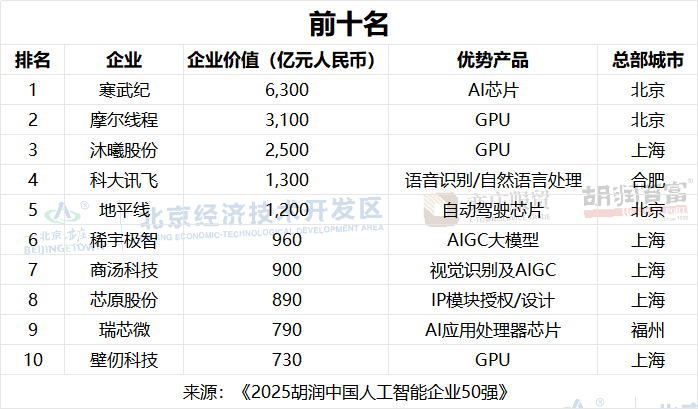
中国人工智能50强榜单出炉!寒武纪、摩尔线程、沐曦股份位列前三
证券时报· 2026-01-19 04:46
Core Insights - The article discusses the release of the "2025 Hurun China AI Companies Top 50" list, highlighting the significant growth in valuations and the increasing importance of AI companies in China [1]. Group 1: AI Companies Overview - The list features 50 companies focused on AI computing power or algorithms, with a minimum valuation of 9.5 billion RMB, an increase of 3.5 billion RMB from the previous year [1]. - The average value of the listed companies is 54 billion RMB, which is 2.4 times higher than last year [1]. - The top ten companies have a minimum valuation of 73 billion RMB, more than three times the previous year's threshold of 22 billion RMB [1]. Group 2: Leading Companies - Cambricon Technologies ranks first with a valuation of 630 billion RMB, focusing on AI core processor chip development, achieving a revenue of 2.88 billion RMB in the first half of 2025, a 43-fold increase year-on-year [4][6]. - Moore Threads, established in 2020, ranks second with a valuation of 310 billion RMB and reported a revenue of 780 million RMB in the first three quarters of 2025, a 182% year-on-year increase [5]. - Muxi Co., Ltd. ranks third with a valuation of 250 billion RMB, specializing in full-stack GPU development [6]. Group 3: Industry Trends - The AI chip sector shows a significant valuation advantage over other fields, with 14 AI chip companies making the list, an increase of 9 from the previous year [6]. - The concentration of AI companies is primarily in first-tier cities, with Beijing leading with 19 companies, followed by Shanghai with 14, indicating a strong urban cluster effect in the AI sector [8]. - The article notes that AI is reshaping China's wealth landscape, with notable increases in the wealth of individuals in the AI sector, such as Chen Tian Shi of Cambricon, whose wealth grew by nearly 150 billion RMB [10].


《2025胡润中国人工智能企业50强》重磅发布 寒武纪(688256.SH)以6300亿价值位居榜首
Zhi Tong Cai Jing· 2026-01-19 03:41
Core Insights - The "2025 Hurun China AI Companies Top 50" list highlights the growth and valuation of AI-focused companies in China, with a significant increase in the number of AI chip companies due to tightening U.S. export controls on high-end AI chips [1][3]. Group 1: Rankings and Valuations - Cambricon leads the list with a valuation of 630 billion RMB, marking a 165% increase from the previous year [1][3]. - Moer Technology ranks second with a valuation of 310 billion RMB, experiencing a 182% year-on-year revenue growth [1][3]. - Muxi ranks third with a valuation of 250 billion RMB, being one of the first companies to achieve full domestic production of high-end GPUs [1][3]. - The average valuation of listed companies is 54 billion RMB, which is 2.4 times higher than last year [1]. Group 2: Market Trends - The number of AI chip companies on the list has increased to 14, up from 5 last year, indicating a growing focus on AI chip development in China [1]. - The entry threshold for the list has risen to 9.5 billion RMB, an increase of 3.5 billion RMB from the previous year [1]. - The top ten companies have a combined valuation significantly higher than last year, reflecting the rapid growth in the AI sector [1]. Group 3: Geographic Distribution - Beijing leads with 19 companies on the list, followed by Shanghai with 14, indicating a concentration of AI talent and resources in first-tier cities [1]. - Over 80% of the listed companies are based in first-tier cities, showcasing their importance in the AI industry [1]. Group 4: Company Profiles - Cambricon has achieved a revenue of 2.88 billion RMB in the first half of 2025, a 43-fold increase year-on-year [3]. - Moer Technology's rapid IPO process has garnered significant attention, with a record approval time of 88 days [3]. - iFlytek, ranked fourth, has a valuation of 130 billion RMB and is a leader in intelligent voice and natural language processing technologies [3].
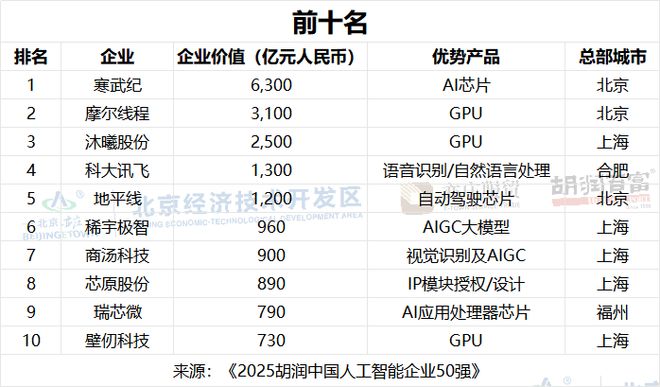
胡润发布中国人工智能50强
Jing Ji Guan Cha Wang· 2026-01-19 03:33
经济观察网 胡润研究院发布的《2025胡润中国人工智能企业50强》显示,AI芯片企业寒武纪以6300亿 元的价值位居榜首,比上年增长165%;国产GPU第一股摩尔线程排名第二,价值3100亿元;中国首批 实现全流程国产化的高端GPU企业沐曦排名第三,价值2500亿元。 ...
胡润发布中国人工智能50强 寒武纪以6300亿元价值居首
Zheng Quan Shi Bao Wang· 2026-01-19 03:17
人民财讯1月19日电,1月19日,胡润研究院发布的《2025胡润中国人工智能企业50强》显示,AI芯片 企业寒武纪以6300亿元的价值位居榜首,比上年增长165%;国产GPU第一股摩尔线程排名第二,价值 3100亿元;中国首批实现全流程国产化的高端GPU企业沐曦排名第三,价值2500亿元。 ...