
Guobo Electronics (688375)

Search documents
国博电子(688375):T/R组件龙头,商业航天及军品订单共同驱动增长
KAIYUAN SECURITIES· 2026-02-09 05:23
Investment Rating - The investment rating for the company is "Buy" (maintained) [1] Core Views - The company is positioned as a leader in active phased array T/R components, with growth driven by commercial aerospace and military orders [1] - The company is expected to benefit from a significant market opportunity in low Earth orbit satellite networks, with a potential market size of hundreds of billions [2] - The "14th Five-Year Plan" military procurement cycle is anticipated to drive the company's military T/R component business back to peak levels [3] - The company has successfully mass-produced silicon-based gallium nitride (GaN) RF chips for mobile phones, with over 1 million units delivered, indicating strong growth potential [4] Financial Summary and Valuation Indicators - Revenue is projected to grow from 2.63 billion in 2025 to 4.54 billion in 2027, with a year-on-year growth rate of 34.9% [5] - Net profit attributable to shareholders is expected to increase from 484 million in 2025 to 831 million in 2027, with a year-on-year growth rate of 24.9% [5] - The company's EPS is forecasted to rise from 0.81 in 2025 to 1.39 in 2027, with corresponding P/E ratios decreasing from 146.6 to 85.4 [5] - The current stock price is 119.00, with a market capitalization of approximately 70.93 billion [6] Business Overview - The company has over 20 years of experience in the microwave device field, establishing itself as a key supplier of active phased array T/R components [13] - The main business involves the R&D, production, and sales of active phased array T/R components and RF integrated circuits, which are critical for radar systems [17] - The company has a strong focus on high-frequency, high-density T/R components, primarily serving military and satellite communication markets [61] Growth Drivers - The commercial aerospace sector is expected to accelerate, with the company positioned to benefit from the upcoming breakthroughs in reusable rocket technology [2][36] - The military procurement cycle under the "15th Five-Year Plan" is likely to lead to increased orders for the company's military T/R components [62] - The third-generation semiconductor RF chip business is anticipated to open new growth avenues, particularly in mobile phone applications and satellite direct connection technologies [64][65]

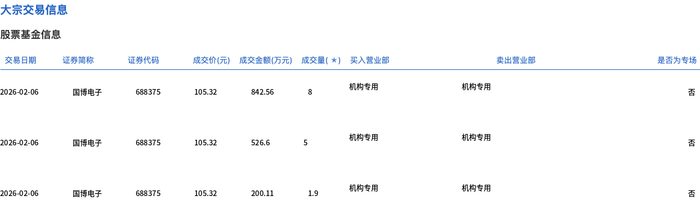
国博电子今日大宗交易折价成交14.9万股,成交额1569.27万元
Xin Lang Cai Jing· 2026-02-06 09:44
Summary of Key Points Core Viewpoint - On February 6, Guobo Electronics executed a block trade of 149,000 shares, amounting to 15.6927 million yuan, which represented 2.88% of the total trading volume for the day. The transaction price was 105.32 yuan, reflecting an 11.5% discount compared to the market closing price of 119 yuan [1]. Group 1 - The block trade involved a total of 149,000 shares of Guobo Electronics [1]. - The total transaction value for the block trade was 15.6927 million yuan [1]. - The transaction price of 105.32 yuan was significantly lower than the market closing price, indicating a discount of 11.5% [1]. Group 2 - The trading date for the transaction was February 6, 2026 [2]. - The shares were traded under the stock code 688375 [2]. - The transaction was conducted through institutional trading departments, indicating a focus on institutional investors [2].

国防军工2026年度策略:商业航天前景明朗,发射能力亟需提升
Shanxi Securities· 2026-02-06 07:25
Market Trends - A new upturn in the defense industry is underway, with the military trade expectations continuously enhancing due to events like the India-Pakistan air battle and military parades[2] - The defense industry index increased by 58.5% from the beginning of 2025 to its peak on January 12, 2026[18] - The global geopolitical situation is tense, leading to an unprecedented increase in military spending worldwide[3] Commercial Aerospace Development - The launch of multiple new medium and large rockets is expected to accelerate in 2026, breaking the bottleneck in launch capacity for commercial aerospace[4] - The Taiyuan Satellite Launch Center will play a crucial role in the high-frequency deployment of satellite internet[4] Investment Recommendations - Recommended sectors include the missile weapon industry chain, new aviation equipment industry chain, unmanned equipment industry chain, and commercial aerospace industry chain[4] - Key companies to focus on include: - Beifang Navigation (600435.SH) - Buy-A[7] - AVIC Shenyang Aircraft (600760.SH) - Buy-A[7] - AVIC High-Tech (600862.SH) - Hold-A[7] - Inner Mongolia First Machinery Group (600967.SH) - Hold-A[7] - Aerospace Electric (002025.SZ) - Hold-A[7] - Guobo Electronics (688375.SH) - Hold-A[7] Risks - Potential risks include delays in domestic military equipment deployment, overseas orders falling short of expectations, and setbacks in rocket development and satellite constellation construction[10]


趋势研判!2026年中国有源相控阵雷达行业政策、发展历程、运行现状、细分市场及未来发展趋势分析:军民融合加速,场景多元拓展空间广阔[图]
Chan Ye Xin Xi Wang· 2026-02-05 01:13
Core Insights - The active phased array radar (APAR) is a cornerstone of national defense and a key infrastructure for the digital economy, featuring advantages such as non-inertial scanning and multi-target tracking [1][2] - China's policies are promoting the technological iteration and civilian application of APAR, accelerating its penetration into the civilian economy [1][5] - The industry is characterized by a foundation in military applications, explosive growth in civilian markets, and leading technology, with the market expected to reach approximately 43.5 billion yuan by 2025 [1][5] Industry Overview - Active phased array radar (AESA) utilizes independent T/R components for each antenna unit, allowing for flexible beam steering and high data rates, overcoming the limitations of traditional mechanical scanning radars [2][3] - The classification of AESA includes analog, digital, and software-defined types, with applications spanning military and civilian sectors [3][4] Policy Environment - Recent policies in China, such as the "General Aviation Equipment Innovation Application Implementation Plan (2024-2030)" and others, support the development of APAR technology and its integration into civilian applications [5] - These policies aim to enhance core technology, expand application scenarios, and foster collaboration between academia and industry, facilitating the transition from military to civilian use [5] Current Industry Status - The APAR industry in China is in a golden development phase, characterized by technological independence, accelerated military-civilian integration, and steady market expansion [5][6] - The military market is expected to reach 44.8 billion yuan by 2030, with a compound annual growth rate (CAGR) of 10.7% from 2024 to 2030, while the civilian market is projected to reach 36.7 billion yuan with a CAGR of 21.5% [5][6] Industry Chain - The APAR industry has established a complete upstream, midstream, and downstream ecosystem, with significant domestic production capabilities [6] - Upstream focuses on core materials like GaN and GaAs, while midstream involves system integration and manufacturing led by state-owned enterprises [6] Development Trends - Future advancements in the APAR industry will focus on technological iteration, industrial upgrades, and application expansion, fostering a positive development environment [11][12] - Key trends include the widespread adoption of GaN materials, the integration of AI in radar technology, and the expansion of application scenarios in both military and civilian sectors [11][12][13]




国博电子股价跌5.01%,易方达基金旗下1只基金位居十大流通股东,持有285.61万股浮亏损失1825.03万元
Xin Lang Cai Jing· 2026-02-04 05:29
Group 1 - Core viewpoint: Guobang Electronics experienced a 5.01% decline in stock price, closing at 121.21 yuan per share, with a trading volume of 533 million yuan and a turnover rate of 0.72%, resulting in a total market capitalization of 72.243 billion yuan [1] - Company overview: Nanjing Guobang Electronics Co., Ltd. was established on November 27, 2000, and listed on July 22, 2022. The company primarily engages in the research, development, production, and sales of active phased array T/R components and RF integrated circuits [1] - Revenue composition: The main business revenue breakdown is as follows: T/R components and RF modules account for 88.19%, RF chips for 8.49%, other chips for 2.04%, and other revenues for 1.28% [1] Group 2 - Major shareholder activity: E Fund's ETF, the E Fund Shanghai Stock Exchange Sci-Tech Innovation Board 50 ETF (588080), reduced its holdings by 349,600 shares in the third quarter, now holding 2.8561 million shares, which represents 0.48% of the circulating shares [2] - Estimated loss: The estimated floating loss for E Fund's ETF today is approximately 18.2503 million yuan [2] - Fund performance: E Fund's ETF was established on September 28, 2020, with a latest scale of 70.597 billion yuan. Year-to-date return is 9.43%, ranking 1060 out of 5562 in its category, while the one-year return is 54.77%, ranking 947 out of 4285 [2]
今日共80只个股发生大宗交易,总成交22.36亿元


Di Yi Cai Jing· 2026-02-03 09:49
Summary of Key Points Core Viewpoint - The A-share market experienced significant block trading activity on February 3, with a total transaction value of 2.236 billion yuan, highlighting notable trading in specific stocks such as Shanghai Airport, Zijin Mining, and Longjing Environmental Protection [1]. Group 1: Block Trading Activity - A total of 80 stocks underwent block trading, with Shanghai Airport leading at 349 million yuan, followed by Zijin Mining at 274 million yuan and Longjing Environmental Protection at 161 million yuan [1]. - Among the stocks traded, 7 were sold at par value, 2 at a premium, and 71 at a discount, indicating a predominance of discounted trades [1]. Group 2: Premium and Discount Rates - The stocks with the highest premium rates were DeMa Technology at 5.67% and Shen High-Speed at 2.01% [1]. - The stocks with the highest discount rates included Kai Fa Technology at 29.94%, New Wave Shares at 23.56%, and Ai Meike at 23.43% [1]. Group 3: Institutional Buying and Selling - The top institutional buying positions included Shanghai Airport at 349 million yuan, Longxin Zhongke at 116 million yuan, and Xinyuan Shares at 60.575 million yuan [2]. - The leading institutional selling positions were Nanxin Technology at 8.4 million yuan and Guobo Electronics at 4.1784 million yuan [2].
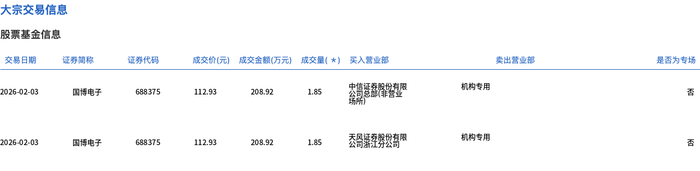
国博电子今日大宗交易折价成交3.7万股,成交额417.84万元
Xin Lang Cai Jing· 2026-02-03 09:39
2月3日,国博电子大宗交易成交3.7万股,成交额417.84万元,占当日总成交额的0.47%,成交价112.93 元,较市场收盘价127.6元折价11.5%。 | 交易日期 | 证券简称 | 证券代码 | 成交价(元) 成交金额(万元) 成交量(*) 买入营业部 | | | | 类出营业部 | 是否为专场 | | --- | --- | --- | --- | --- | --- | --- | --- | --- | | 2026-02-03 | 国博电子 | 688375 112.93 | 208.92 | 1.85 | を開催します。 | 机构专用 | | 图 | | 2026-02-03 | 国博电子 | 688375 112.93 | 208.92 | 1.85 | 조恩摄烈劈觉有限 | 机构专用 | | Ka | ...
卫星ETF鹏华(563790)涨超3.6%,“引力二号”预计2026年年中完成首飞
Xin Lang Cai Jing· 2026-02-03 07:07
Core Viewpoint - The commercial aerospace sector is experiencing significant activity, with the launch of the self-developed Gravitational No. 2 rocket by Dongfang Space, aimed at meeting the demand for medium to large satellite networks and commercial high-orbit launches, expected to complete its maiden flight by mid-2026 [1] Group 1: Industry Developments - The demand for rockets is surging, prompting attention to upstream materials, while the midstream equipment sector is expected to see significant changes in engine technology and 3D printing, which are characterized by scarcity and long-term inflationary logic [1] - The domestic market is anticipated to enter a new era of reusable rockets in 2026, driven by the synergy between commercial companies and state-owned enterprises [1] Group 2: Market Performance - As of February 3, 2026, the Zhongzheng Satellite Industry Index (931594) rose by 4.28%, with notable increases in constituent stocks such as Hailanxin (up 15.91%), XW Communication (up 11.58%), and Chip Origin (up 10.07%) [1] - The Penghua Satellite ETF (563790), which closely tracks the Zhongzheng Satellite Industry Index, increased by 3.61%, with a latest price of 1.23 yuan [1] Group 3: Index Composition - As of January 30, 2026, the top ten weighted stocks in the Zhongzheng Satellite Industry Index include Aerospace Electronics, China Satellite, Zhenlei Technology, and others, collectively accounting for 64.36% of the index [2]




重视商业航天、大飞机、商发景气成长空间
GF SECURITIES· 2026-02-01 12:51
Core Insights - The report emphasizes the growth potential in the commercial aerospace and large aircraft sectors, highlighting the importance of the defense and military industry in these areas [2][3] Group 1: Industry Overview - The Chinese aerospace sector is set to advance with initiatives like the "Tian Gong Kai Wu" plan, focusing on space tourism, smart infrastructure, and resource development [13] - The commercial aircraft and aerospace sectors are experiencing sustained high demand, with a focus on self-reliance in aviation engine development and the establishment of a strong aviation industry [14] Group 2: Investment Recommendations - The report identifies three key investment themes based on the "S-curve" evolution: 1. Supply chain reform and maintenance growth, recommending companies like AVIC Power and AVIC Control [15] 2. Expansion into overseas markets and civilian applications, recommending companies such as Guorui Technology and China Power [15] 3. New emerging industries like commercial aerospace and AI, recommending companies like Ruichuang Micro-Nano and Feilihua [15] Group 3: Company Analysis - AVIC Power is positioned as a core supplier in the aviation sector, benefiting from high-end aircraft production and potential market share growth in the civil aviation engine sector [21] - AVIC Heavy Machinery is expected to see revenue growth due to its comprehensive product offerings in aviation and engine sectors, with a focus on high-value components [23] - Guorui Technology is leveraging its radar business and low-altitude safety solutions, with projected revenue growth driven by defense modernization and low-altitude economic development [20] - Feilihua is a leading supplier of quartz materials for aerospace and semiconductor industries, benefiting from ongoing demand in both sectors [19] - Ziguang Guowei is focusing on the IC industry, with significant growth expected in the AI and communication sectors, emphasizing its competitive advantages in domestic and international markets [18]


国博电子股价跌5.05%,易方达基金旗下1只基金位居十大流通股东,持有285.61万股浮亏损失1887.86万元
Xin Lang Cai Jing· 2026-01-30 02:50
Group 1 - The core point of the news is that Guobang Electronics experienced a decline in stock price, dropping by 5.05% to 124.39 yuan per share, with a trading volume of 420 million yuan and a turnover rate of 0.55%, resulting in a total market capitalization of 74.138 billion yuan [1] - Guobang Electronics, established on November 27, 2000, and listed on July 22, 2022, is primarily engaged in the research, production, and sales of active phased array T/R components and RF integrated circuits [1] - The revenue composition of Guobang Electronics includes T/R components and RF modules at 88.19%, RF chips at 8.49%, other chips at 2.04%, and other revenues at 1.28% [1] Group 2 - From the perspective of the top ten circulating shareholders, E Fund's fund holds a position in Guobang Electronics, having reduced its holdings by 349,600 shares to 2.8561 million shares, representing 0.48% of the circulating shares, resulting in an estimated floating loss of approximately 18.8786 million yuan [2] - E Fund's Shanghai Stock Exchange Sci-Tech Innovation Board 50 ETF (588080) was established on September 28, 2020, with a latest scale of 70.597 billion yuan, achieving a year-to-date return of 12.15% and a one-year return of 58.62% [2] - The fund manager Lin Weibin has a tenure of 12 years and 334 days, with a total fund asset size of 119.408 billion yuan, achieving a best return of 82.52% and a worst return of -22.14% during his tenure [3]