
VeriSilicon(688521)

Search documents
格隆汇公告精选︱卧龙新能:拟8亿元建设包头威俊20万千瓦/120万千瓦时电网侧独立储能示范项目
Ge Long Hui A P P· 2025-12-01 14:10
Key Points - The article highlights various significant announcements from companies, including investment projects, share buybacks, and contract wins [1][2][3] Group 1: Company Announcements - Qin'an Co., Ltd. has a small external circulation and a high recent turnover rate, indicating potential risks [1][2] - Rongtai Health plans to acquire a 21% stake in Youmo Youyang for 42 million yuan [2] - Huaitong Holdings intends to invest 1 billion yuan to construct 900,000 high-end new energy vehicle styling components and acoustic products [1][2] Group 2: Investment Projects - COFCO Technology plans to invest in a new project for 250,000 tons/year of starch sugar and 10,000 tons/year of alulose in Pingliang [1] - Haili Wind Power aims to collaborate on the construction and operation of the Wenzhou mother port phase one project [1] - Wolong New Energy proposes an 800 million yuan investment for a 200,000 kW/1.2 million kWh grid-side independent energy storage demonstration project in Baotou [1] Group 3: Contract Wins - Wansheng Intelligent has won a contract worth 42.9866 million yuan from the State Grid [1] - Teruid has a pre-bid for a railway project valued at 94.8792 million yuan [1] - China Electric Environmental Protection signed a contract for a 125.7 million yuan water treatment project for Shanxi Coal Chemical [1] Group 4: Share Buybacks - Huaitong Holdings plans to repurchase shares worth 30 million to 50 million yuan [2] - Yongtai Energy intends to repurchase shares for 300 million to 500 million yuan for cancellation [2] Group 5: Shareholding Changes - Hengyi Petrochemical's controlling shareholder and its concerted parties plan to increase their holdings by 1.5 billion to 2.5 billion yuan [3] - Multiple shareholders of Green通科技 plan to reduce their holdings by up to 4% [3] - Shareholders of Chip Origin plan to reduce their holdings by up to 1.15% [3]





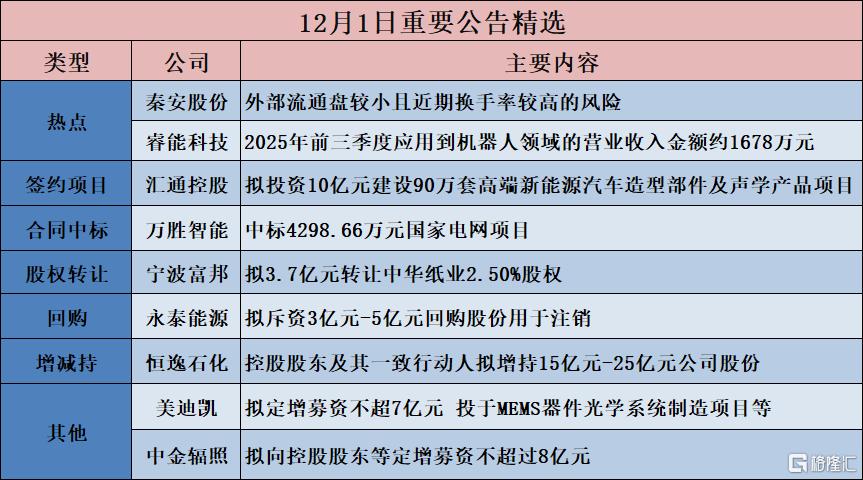
公告精选︱卧龙新能:拟8亿元建设包头威俊20万千瓦/120万千瓦时电网侧独立储能示范项目
Ge Long Hui A P P· 2025-12-01 13:59
Key Points - Qin'an Co., Ltd. has a small external circulation and a high recent turnover rate, indicating potential risks [1][2] - Rongneng Technology expects to generate approximately 16.78 million yuan in revenue from the robotics sector in the first three quarters of 2025, accounting for about 1.02% of the company's total revenue [1] - Huaitong Holdings plans to invest 1 billion yuan to construct 900,000 high-end new energy vehicle styling components and acoustic products [1] - Wansheng Intelligent has won a bid for a State Grid project worth 42.9866 million yuan [1] - Ningbo Fubang intends to transfer 2.50% equity of China Paper for 370 million yuan [1][2] - Yongtai Energy plans to repurchase shares worth 300 million to 500 million yuan for cancellation [1][2] - Hengyi Petrochemical's controlling shareholder and its concerted parties plan to increase their holdings by 1.5 billion to 2.5 billion yuan [1][3] - Meidike intends to raise no more than 700 million yuan through a private placement for MEMS device optical system manufacturing projects [1][3] - Zhongjin Irradiation plans to raise no more than 800 million yuan through a private placement to its controlling shareholder and others [1][3]


12月指数定期调样的影响估算




HTSC· 2025-12-01 12:34
Quantitative Models and Construction Methods 1. Model Name: Liquidity Impact Coefficient Model - **Model Construction Idea**: This model measures the liquidity impact of index adjustments on individual stocks by calculating the ratio of net fund flows to the stock's recent average daily trading volume[12][13] - **Model Construction Process**: The liquidity impact coefficient for a stock is calculated as follows: $$ impact_{i} = \sum_{k=1}^{N} \frac{\Delta weight_{k,i} \times AUM_{k}}{amt\_avg_{i,20}} $$ - \( \Delta weight_{k,i} \): Estimated weight change of stock \( i \) in index \( k \) - \( AUM_{k} \): Total assets under management of passive products tracking index \( k \) as of the end of November - \( amt\_avg_{i,20} \): Average daily trading volume of stock \( i \) over the past 20 trading days as of the end of November[12][13] - **Model Evaluation**: The model provides a quantitative framework to estimate short-term liquidity shocks caused by index adjustments, but it is subject to data discrepancies and assumptions, which may lead to deviations from actual results[13] --- Model Backtesting Results Liquidity Impact Coefficient Model - **Top 5 Stocks with Highest Positive Impact Coefficients**: - Zhangjiagang Bank (002839 CH): 11.55[15] - Jiangzhong Pharmaceutical (600750 CH): 11.44[15] - Tower Group (002233 CH): 11.04[15] - Jichuan Pharmaceutical (600566 CH): 10.14[15] - Zhengbang Technology (002157 CH): 9.99[15] - **Top 5 Stocks with Highest Negative Impact Coefficients**: - Shenzhen Expressway (600548 CH): -24.95[16] - Vanward Electric (002543 CH): -20.90[16] - Aviation Materials (688563 CH): -14.06[16] - Huaxi Biology (688363 CH): -10.81[16] - Ninghu Expressway (600377 CH): -10.54[16] --- Quantitative Factors and Construction Methods 1. Factor Name: Net Fund Flow Factor - **Factor Construction Idea**: This factor estimates the net fund inflow or outflow for stocks due to index adjustments, based on changes in index weights and the total AUM of passive products tracking the index[9][10] - **Factor Construction Process**: - Outflow Amount: Total AUM of linked products multiplied by the stock's actual weight in the index as of the end of November - Inflow Amount: Total AUM of linked products multiplied by the estimated weight of the stock in the index post-adjustment - Weight estimation is based on free-float market capitalization and index-specific weighting rules, such as dividend yield weighting or market capitalization weighting[9][10] - **Factor Evaluation**: The factor provides a transparent and systematic approach to estimate fund flows, but it is sensitive to assumptions about future index weights and AUM changes[9][10] --- Factor Backtesting Results Net Fund Flow Factor - **Top 5 Stocks with Highest Net Fund Inflows**: - Victory Precision (300476 CH): 112.61 billion CNY[10] - Dongshan Precision (002384 CH): 99.32 billion CNY[10] - Guangqi Technology (002625 CH): 77.81 billion CNY[10] - Sugon Information (603019 CH): 65.44 billion CNY[10] - Top Group (601689 CH): 53.07 billion CNY[10] - **Top 5 Stocks with Highest Net Fund Outflows**: - China Mobile (600941 CH): -40.02 billion CNY[11] - CRRC Corporation (601766 CH): -36.40 billion CNY[11] - Aluminum Corporation of China (601600 CH): -34.29 billion CNY[11] - TCL Zhonghuan (002129 CH): -30.07 billion CNY[11] - Huagong Tech (000988 CH): -27.44 billion CNY[11]
A股公告精选 | 比亚迪(002594.SZ)1-11月汽车销量418.2万辆 同比增长11.3%
智通财经网· 2025-12-01 12:13
Group 1: BYD Performance - BYD announced a production of 474,200 new energy vehicles (NEVs) and sales of 480,200 NEVs in November 2025 [1] - Cumulative production for the year reached 4,117,600 units, representing a year-on-year increase of 7.29% [1] - Cumulative sales for the year totaled 4,182,000 units, with a year-on-year growth of 11.30% [1] - In November, BYD exported 131,900 NEVs and installed approximately 27.669 GWh of power batteries and energy storage batteries [1] Group 2: Investment Initiatives - Lushin Venture Capital plans to establish a 400 million yuan investment fund focusing on life sciences, advanced manufacturing, and AI [2] - Chint Electric's wholly-owned subsidiary intends to invest up to 201 million yuan in a green private equity investment fund with a total scale of 700 million yuan [8] Group 3: Corporate Actions - Qianwei Central Kitchen will conduct a shareholder reward activity, offering a product package worth 200 yuan to individual shareholders holding 100 shares or more [3] - Huaxia Happiness plans to use trust beneficiary rights to offset financial debts totaling up to 24 billion yuan as part of its debt restructuring plan [4] - Tailong Pharmaceutical's controlling shareholder is planning a share transfer, leading to a temporary suspension of the company's stock [5] - ST Xianhe has applied to revoke other risk warnings, pending approval from the Shenzhen Stock Exchange [6] - *ST Yuancheng's stock will be delisted due to a market value below 500 million yuan for 20 consecutive trading days [7] Group 4: Sales and Contracts - SAIC Group reported sales of 4,108,000 vehicles from January to November 2025, a year-on-year increase of 16.4% [10] - Geely Automobile's total sales in November reached 310,428 units, marking a 24% increase year-on-year [11] - Far East Holdings' subsidiaries secured contracts worth 2.383 billion yuan in November, positively impacting future earnings [18] - Samsung Medical's subsidiary signed a contract for an annual bidding project in Indonesia worth approximately 160 million yuan [19] - Zhongchao Holdings' subsidiaries recently won contracts totaling 1.318 billion yuan [20] - Changhua Group received a project development notice from a domestic automaker, with an expected total sales amount of approximately 732 million yuan [21]



芯原股份:国开基金等拟合计减持不超1.15%股份
Zhi Tong Cai Jing· 2025-12-01 11:30
Core Viewpoint - The company, Chip Original Co., Ltd. (688521.SH), announced that its shareholders, Xingcheng Investment and Guokai Fund, plan to reduce their holdings due to personal funding needs [1] Shareholder Reduction Plans - Xingcheng Investment plans to reduce its holdings by up to 5.2586 million shares, representing a maximum reduction of 1% of the company's total shares [1] - Guokai Fund intends to reduce its holdings by up to 788,600 shares, which accounts for a maximum reduction of 0.15% of the company's total shares [1]

芯原股份:兴橙投资方和国开基金拟减持股份不超过1.15%
Hua Er Jie Jian Wen· 2025-12-01 10:28
风险提示 • 本次减持不会对公司治理结构及持续经营产生重大影响 • 减持时间、数量和价格存在不确定性 • 不会 导致公司控制权变更 •兴橙投资方(三家合伙企业)合计持股39,710,211股,占总股本7.55% •国开基金持股2,101,927股,占总 股本0.40% • 上述股份均为IPO前取得,已全部解除限售 历史减持情况 • 2025年8月28日,上述股东曾进行减持,减持价格均为105.21元/股 • 兴橙投资方合计减持5,507,064股 (1.05%),国开基金减持257,252股(0.05%) 芯原股份股东减持计划公告要点解读 减持主体及持股情况 减持计划核心要点 •减持数量:兴橙投资方拟减持不超过5,258,582股(1.00%),国开基金拟减持不超过788,569股 (0.15%) •减持方式:集中竞价和大宗交易 •减持期间:2025年12月23日至2026年3月20日(3个月) • 减持原因:股东自身资金需求 ...
芯原股份(688521.SH):股东兴橙投资方、国开基金拟合计减持不超1.15%股份
Ge Long Hui A P P· 2025-12-01 10:20
Group 1 - The core point of the article is that Chip Origin Technology Co., Ltd. (688521.SH) announced share reduction plans from its shareholders due to personal funding needs [1] Group 2 - Shareholder Xingcheng Investment plans to reduce up to 5.2586 million shares, accounting for no more than 1.00% of the company's total shares, through centralized bidding and block trading [1] - Shareholder National Development Fund plans to reduce up to 788,600 shares, accounting for no more than 0.15% of the company's total shares, also through centralized bidding and block trading [1] - The reduction plans are set to take place within three months after the announcement, starting 15 trading days from the date of the announcement, with the reduction price referencing market prices [1]
芯原股份:兴橙投资方及国开基金拟合计减持不超1.15%公司股份
Xin Lang Cai Jing· 2025-12-01 10:20
芯原股份12月1日晚间公告,公司股东嘉兴时兴创业投资合伙企业(有限合伙)、嘉兴海橙创业投资合 伙企业(有限合伙)、共青城文兴投资合伙企业(有限合伙)(合称"兴橙投资方")及济南国开科创产 业股权投资合伙企业(有限合伙)计划自公告披露之日起15个交易日后的3个月内,通过集中竞价和大 宗交易方式减持公司股份。其中,兴橙投资方拟减持不超过525.86万股,占公司总股本的1%;国开基 金拟减持不超过78.86万股,占公司总股本的0.15%。减持价格将参考市场价格确定,减持原因均为自身 资金需求。 ...
芯原股份:国开基金等拟合计减持公司不超1.15%股份
Zheng Quan Shi Bao Wang· 2025-12-01 10:17
Core Viewpoint - The announcement from Chip Origin Co., Ltd. (688521) indicates that certain investors plan to reduce their holdings in the company, which may impact the stock's market performance [1] Group 1: Shareholder Actions - The investors known as "Xingcheng Investment Parties" collectively hold 7.55% of the company's shares and plan to reduce their holdings by up to 5.2586 million shares, representing a reduction of no more than 1% [1] - The "Guokai Fund" holds 0.40% of the company's shares and intends to reduce its holdings by up to 788,600 shares, which is a reduction of no more than 0.15% [1] - The total planned reduction from both groups amounts to a maximum of 1.15% of the company's shares [1]
芯原股份(688521) - 股东减持股份计划公告
2025-12-01 10:17
证券代码:688521 证券简称:芯原股份 公告编号:2025-076 芯原微电子(上海)股份有限公司 股东减持股份计划公告 本公司董事会、全体董事及相关股东保证本公告内容不存在任何虚假记载、 误导性陈述或者重大遗漏,并对其内容的真实性、准确性和完整性依法承担法律 责任。 重要内容提示: 股东持股的基本情况 截至本公告披露日,嘉兴时兴创业投资合伙企业(有限合伙)、嘉兴海橙创 业投资合伙企业(有限合伙)、共青城文兴投资合伙企业(有限合伙)(以下合 称"兴橙投资方")合计持有芯原微电子(上海)股份有限公司(以下简称"公司") 39,710,211 股,占公司总股本的 7.5515%;济南国开科创产业股权投资合伙企业 (有限合伙)(以下简称"国开基金")持有公司 2,101,927 股,占公司总股本的 0.3997%。 上述股份均为公司首次公开发行前取得,已全部解除限售并上市流通。 减持计划的主要内容 公司于近日收到股东兴橙投资方、国开基金分别发送的《上市公司股东股份 减持计划告知函》及《关于股份减持计划的告知函》,因股东自身资金需求,兴 橙投资方计划通过集中竞价和大宗交易方式合计减持不超过 5,258,582 股 ...