
VeriSilicon(688521)

Search documents
芯原股份(688521.SH):前三季度净亏损3.47亿元
Ge Long Hui A P P· 2025-10-27 13:00
格隆汇10月27日丨芯原股份(688521.SH)发布三季报,2025年前三季度实现营业总收入22.55亿元,同比 增长36.64%;归属母公司股东净利润-3.47亿元,较上年同期亏损减少4915.88万元;基本每股收益 为-0.68元。 ...

同比增长95%!700亿芯片细分龙头发布三季报
Xin Lang Cai Jing· 2025-10-27 12:09
Company Announcements - Tongfu Microelectronics reported a net profit growth of 95.08% in Q3, with revenue of 7.08 billion yuan, up 17.94% year-on-year [1] - Guizhou Moutai's chairman Zhang Deqin resigned, with Chen Hua recommended as the new chairman [3] - Victory Shares is planning to acquire gas-related assets controlled by its major shareholder, leading to a stock suspension [3] - Northern Rare Earth's net profit increased by 280% in the first three quarters, driven by higher sales volume [5] - China Nuclear Engineering signed contracts for the construction of the Haiyang Nuclear Power Units 5 and 6 [5] - Kingsoft Office's net profit grew by 35.42% in Q3, with WPS 365 revenue increasing by 71.61% [6] - Postal Savings Bank received approval to establish a financial asset investment company with a registered capital of 10 billion yuan [8] - West Mining's subsidiary won exploration rights for a copper polymetallic mine for 8.609 billion yuan [4] Financial Performance - High德红外 reported a net profit increase of 1059% in Q3, with revenue of 1.134 billion yuan, up 71.07% year-on-year [17] - Purtai's net profit grew by 69% in Q3, supported by strong demand in the power and energy storage battery markets [18] - Yubo Technology's net profit surged by 384% in the first three quarters, driven by rapid growth in AIDC market orders [14] - Sichuan Gold's net profit increased by 184% in Q3, attributed to rising gold prices [16] - Hailey Wind Power's net profit skyrocketed by 779% in Q3, with revenue up 134.73% [7] - Huazhi Technology's net profit rose by 51% in Q3, mainly due to business expansion [5] Strategic Investments - Zhenyu Technology plans to invest 2.11 billion yuan in humanoid robot precision module and component projects [9] - China Aluminum's subsidiary plans to invest 500 million yuan in Yunnan Aluminum Foil [20] - Zhongfu Industrial intends to invest 356 million yuan in a new energy aluminum foil project [19] - Kaishan Group signed contracts for an 800 million USD green ammonia project in Kenya [19]





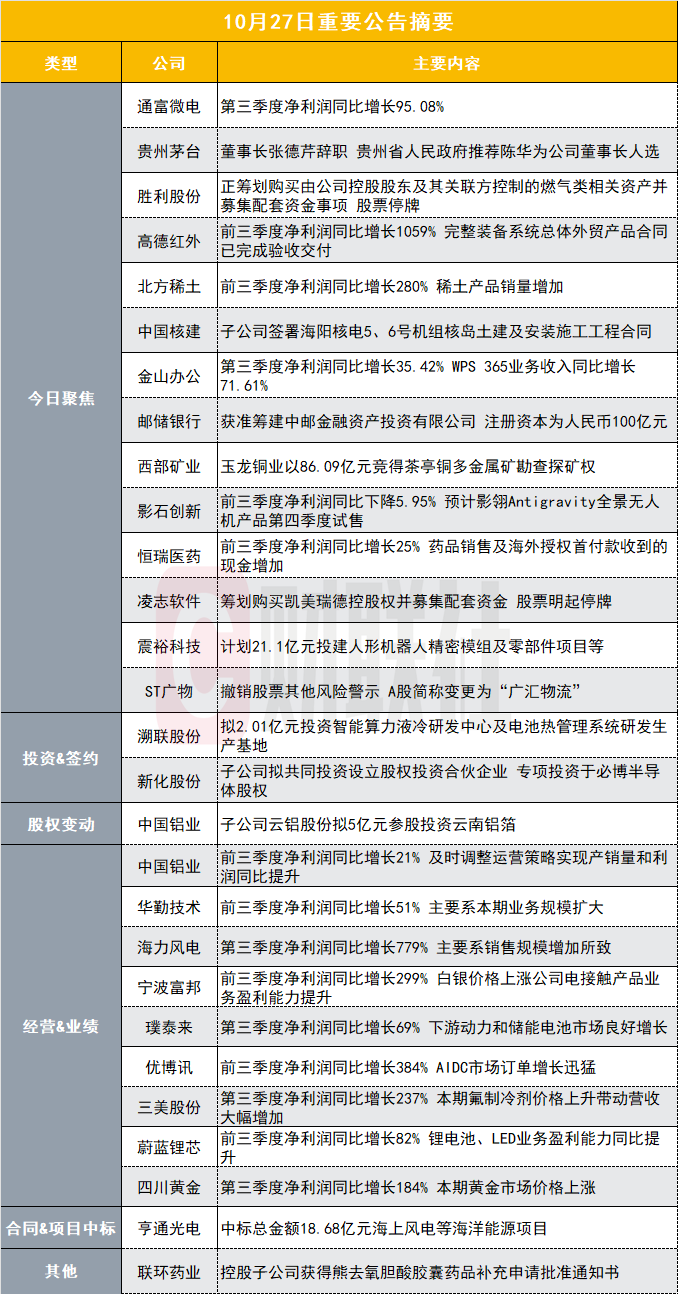
A股公告精选 | 北方稀土(600111.SH)、恒瑞医药(600276.SH)等公司前三季度净利润同比增长
智通财经网· 2025-10-27 12:09
Group 1 - Northern Rare Earth reported a net profit increase of 280% year-on-year for the first three quarters, driven by higher sales volume and prices of rare earth products [1] - Postal Savings Bank has received approval to establish a financial asset investment company with a registered capital of 10 billion yuan, aimed at enhancing comprehensive service capabilities and supporting technological innovation [2] - Silyus announced a maximum price of HKD 131.5 per share for its H-share issuance, with a total of 100.2 million shares available for global offering [3] Group 2 - Hengtong Optic-Electric won a bid for marine energy projects with a total contract value of 1.868 billion yuan, including the supply and construction of undersea cables [4] - Western Mining's subsidiary Yulong Copper won exploration rights for the Chating copper polymetallic mine for 8.609 billion yuan, which is expected to enhance the company's resource reserves [5] - China Bank appointed Liu Chenggang as vice president, effective from October 24, 2025 [6] Group 3 - ST Guangwu announced the removal of other risk warnings for its stock, changing its name to Guanghui Logistics, which will allow for a wider trading limit [7] - Wireless Media set an initial transfer price of 29.11 yuan per share for its inquiry transfer, with a subscription multiple of 2.01 times [8][9] - Jiangshan Oupai's subsidiaries in Henan and Chongqing will cease operations due to insufficient orders, with business transferred to its Zhejiang base [10] Group 4 - Zhenyu Technology plans to invest 2.11 billion yuan in precision component manufacturing and humanoid robot projects, with the first phase of investment to be signed soon [11] - Jinyuan Co. announced the resignation of its general manager, with Qiu Yongping appointed as the new general manager [12] Group 5 - CanSino reported a net profit of 27.93 million yuan for Q3, a year-on-year increase of 842.01% [13] - Jiangshan Co. reported a net profit of 86.73 million yuan for Q3, a year-on-year increase of 11,890.01% [14] - Yingshi Innovation reported a net profit of 272 million yuan for Q3, a year-on-year decrease of 15.90% [15] Group 6 - Chip Origin reported a net loss of 26.85 million yuan for Q3, despite a revenue increase of 78.38% [16] - Tonghua Dongbao reported a net profit of 984 million yuan for Q3, a year-on-year increase of 499.86% [17] - Hengrui Medicine reported a net profit of 1.301 billion yuan for Q3, a year-on-year increase of 9.53% [18] Group 7 - Zhongguang Lightning reported a net profit of 6.46 million yuan for Q3, a year-on-year increase of 382.66% [19] - Ice River Network reported a net profit of 166 million yuan for Q3, a year-on-year increase of 244.58% [20] - Daheng Technology reported a net profit of 71.48 million yuan for Q3, a year-on-year increase of 1,960.72% [21] Group 8 - Yanjin Puzhi reported a net profit of 232 million yuan for Q3, a year-on-year increase of 33.55% [22] - Sichuan Gold reported a net profit of 160 million yuan for Q3, a year-on-year increase of 184.38% [23] - Sanbo Brain Science reported a net profit of 13.93 million yuan for Q3, a year-on-year decrease of 63.26% [24] Group 9 - Hengli Petrochemical reported a net profit of 1.972 billion yuan for Q3, a year-on-year increase of 81.47% [25] - Deepin Technology reported a net profit of 147 million yuan for Q3, a year-on-year increase of 1,097.40% [26] - Huisheng Biological reported a net profit of 70.72 million yuan for Q3, a year-on-year increase of 1,575.79% [27] Group 10 - Gaode Infrared reported a net profit of 401 million yuan for Q3, a year-on-year increase of 1,143.72% [28] - Qingdao Beer reported a net profit of 1.37 billion yuan for Q3, a year-on-year increase of 1.62% [29] - Nanjing Public Utilities reported a net profit of 84.62 million yuan for Q3, a year-on-year increase of 2,492.12% [30] Group 11 - Zhangyuan Tungsten reported a net profit of 75.02 million yuan for Q3, a year-on-year increase of 118.56% [31] - Yongmaotai reported a net profit of 30.41 million yuan for Q3, a year-on-year increase of 6,319.92% [32] Group 12 - Tongrun Equipment announced that two shareholders plan to reduce their holdings by 1.50% each, totaling a maximum of 3.00% [33] - High-speed Rail Electric announced a pre-bid for a city rail transit project worth 62.39 million yuan [34]




芯原股份第三季度营收环比增长119% 在手订单连续八个季度保持高位
Zheng Quan Shi Bao Wang· 2025-10-27 11:53
Core Insights - The company reported a record high revenue of 1.281 billion yuan in Q3 2025, with a quarter-on-quarter increase of 119.26% and a year-on-year increase of 78.38% [1] - The company has maintained a high order backlog for eight consecutive quarters, with an order amount of 3.286 billion yuan at the end of Q3 2025, marking a historical high [2] - The company’s net loss narrowed significantly in Q3 2025, with a loss of 26.8511 million yuan, a reduction of 75.82% year-on-year and 73.02% quarter-on-quarter [2] Revenue Breakdown - In Q3 2025, the company achieved revenue of 428 million yuan from chip design, a quarter-on-quarter increase of 290.82% and a year-on-year increase of 80.23% [1] - The mass production business generated revenue of 609 million yuan in Q3 2025, with a quarter-on-quarter increase of 132.77% and a year-on-year increase of 157.84% [1] - The company’s intellectual property licensing revenue was 212 million yuan in Q3 2025, with a quarter-on-quarter increase of 13.43% [1] Order and Client Insights - In Q3 2025, the company signed new orders worth 1.593 billion yuan, a year-on-year increase of 145.80%, with approximately 65% of these orders related to AI computing power [1] - The order backlog at the end of Q3 2025 included 83.52% from system manufacturers, large internet companies, cloud service providers, and automotive companies [2] - Nearly 90% of the order backlog was from one-stop chip customization services, with an expected conversion rate of about 80% within a year [2] Business Performance - For the first three quarters of 2025, the company achieved a total revenue of 2.255 billion yuan, a year-on-year increase of 36.64% [2] - The semiconductor IP licensing business saw a year-on-year growth of 3.86%, while the one-stop chip customization business grew by 53.51% [2] - Domestic sales accounted for 67.57% of total revenue in the first three quarters of 2025, with significant contributions from the data processing sector, which represented 33.14% of total revenue [3] Segment Analysis - In the first three quarters of 2025, the company generated 660 million yuan from chip design, a year-on-year increase of 27.53%, with 94.70% of this revenue coming from 28nm and below process nodes [4] - The mass production business generated 1.016 billion yuan in revenue, a year-on-year increase of 76.93%, surpassing the total revenue for the previous year [4] - The company’s AI-related chip design business accounted for approximately 73% of the chip design revenue in the first three quarters of 2025 [4]
报名火热进行中丨全方位解读ICCAD Expo,洞见产业“芯”未来
半导体芯闻· 2025-10-27 10:45
Core Insights - The ICCAD Expo serves as a significant platform for the semiconductor industry, gathering over 400 leading companies in EDA, IP, IC design services, foundry, and packaging [3] - The event aims to facilitate collaboration and exchange among industry leaders and experts, providing insights into the latest trends and developments in the semiconductor sector [8][9] Industry Overview - In 2023, the total sales revenue of China's chip design industry is approximately 646.04 billion RMB, with regional contributions from the Yangtze River Delta (382.84 billion RMB), Pearl River Delta (166.21 billion RMB), and Central and Western regions (98.55 billion RMB) [5] - There are 731 companies in the industry with revenues exceeding 100 million RMB, an increase of 106 companies from the previous year, accounting for 87.15% of the total industry sales [5] Event Highlights - The ICCAD Expo 2025 will take place on November 20-21, 2025, in Chengdu, featuring a high-level forum and multiple sub-forums focusing on cutting-edge technologies and innovations in the semiconductor industry [7][12] - The event will host over 8,000 industry professionals, including 2,000 IC design companies and 300 service providers, ensuring high-level networking opportunities [16] Key Presentations - Professor Wei Shaojun, Chairman of the Integrated Circuit Design Branch of the China Semiconductor Industry Association, will present the "2025 China Integrated Circuit Design Industry Status and Development Report," providing authoritative statistics on sales and regional development [15] - The forum will feature presentations from CEOs and CTOs of leading companies, sharing insights on technology and industry development [16]





芯原股份:2025年前三季度净利润约-3.47亿元
Mei Ri Jing Ji Xin Wen· 2025-10-27 10:13
每经头条(nbdtoutiao)——独家丨民营船王入主杉杉集团横生枝节 重整联合体浮现神秘组局人 (记者 曾健辉) 每经AI快讯,芯原股份(SH 688521,收盘价:175.38元)10月27日晚间发布三季度业绩公告称,2025 年前三季度营收约22.55亿元,同比增加36.64%;归属于上市公司股东的净利润亏损约3.47亿元。 截至发稿,芯原股份市值为922亿元。 ...
芯原股份(688521) - 第三届董事会第五次会议决议公告
2025-10-27 10:00
证券代码:688521 证券简称:芯原股份 公告编号:2025-067 芯原微电子(上海)股份有限公司 第三届董事会第五次会议决议公告 1、审议通过《关于审议公司 2025 年第三季度报告的议案》 董事会同意《芯原微电子(上海)股份有限公司 2025 年第三季度报告》的 内容。 本议案已经董事会审计委员会审议通过,审计委员会同意本议案内容,并同 意将其提交公司董事会审议。 本公司董事会及全体董事保证本公告内容不存在任何虚假记载、误导性陈述 或者重大遗漏,并对其内容的真实性、准确性和完整性依法承担法律责任。 一、董事会会议召开情况 芯原微电子(上海)股份有限公司(以下简称"公司")第三届董事会第五次 会议通知已于 2025 年 10 月 20 日发出,会议于 2025 年 10 月 27 日在公司会议室 以现场结合通讯方式召开。本次董事会应出席会议的董事 11 人,实际出席董事 11 人。本次会议由董事长 Wayne Wei-Ming Dai(戴伟民)先生主持。本次会议 召开符合《中华人民共和国公司法》等有关法律、法规和《芯原微电子(上海) 股份有限公司章程》(以下简称"《公司章程》")的规定,表决形成的决议合 ...
芯原股份Q3营收同比增长78.38%,净利润收窄至2685.11万元 | 财报见闻
Hua Er Jie Jian Wen· 2025-10-27 09:59
Core Insights - The company reported record-high revenue in Q3, driven by strong order conversion and a surge in AI-related demand [1] - The net loss significantly narrowed year-on-year and quarter-on-quarter, indicating a strong rebound in performance [1] Financial Performance - Q3 revenue reached 1.281 billion yuan, a year-on-year increase of 78.38%, while the net loss attributable to shareholders reduced to 26.85 million yuan, a decrease of 75.82% compared to the same period last year and a 73.02% reduction quarter-on-quarter [1] - For the first three quarters, total revenue was 2.255 billion yuan, up 36.64%, with a net loss of 347 million yuan [1] Order Growth and AI Demand - New orders signed in Q3 amounted to 1.593 billion yuan, a substantial year-on-year increase of 145.80%, with cumulative new orders for the first three quarters reaching 3.249 billion yuan, surpassing the total for the entire year of 2024 [1] - Approximately 65% of the new orders in Q3 were related to AI computing power, highlighting its role as a key driver of growth [1] Order Backlog and Quality - As of the end of Q3, the company's order backlog rose to 3.286 billion yuan, marking a historical high for eight consecutive quarters [2] - High-quality orders from system manufacturers, large internet companies, cloud service providers, and automotive companies accounted for 83.52% of the total [2] - About 80% of these orders are expected to convert into revenue within a year, providing strong support for short-term performance [2] Revenue Composition - In Q3, the volume business generated 609 million yuan, a remarkable year-on-year increase of 157.84% and a quarter-on-quarter growth of 132.77% [2] - The chip design business also performed well, achieving revenue of 428 million yuan, up 80.23% year-on-year [2] - In contrast, revenue from intellectual property licensing remained stable at 212 million yuan year-on-year [2] - For the first three quarters, the one-stop chip customization business (including chip design and volume production) saw a revenue increase of 53.51%, significantly outpacing the 3.86% growth in semiconductor IP licensing [2]
芯原股份(688521) - 2025 Q3 - 季度财报
2025-10-27 09:55
Financial Performance - In Q3 2025, the company achieved a record revenue of CNY 1.28 billion, representing a 119.26% increase quarter-over-quarter and a 78.38% increase year-over-year[7]. - For the first three quarters of 2025, the company reported a total revenue of CNY 2.255 billion, a year-over-year increase of 36.64%[15]. - Operating revenue for the current reporting period increased by 78.38% compared to the previous period[27]. - Year-to-date operating revenue rose by 36.64%[27]. - Total operating revenue for the first three quarters of 2025 reached ¥2,254,536,764.72, a significant increase of 36.6% compared to ¥1,649,971,464.11 in the same period of 2024[37]. - Total operating costs increased to ¥2,650,174,560.08, up 30.0% from ¥2,039,426,765.96 year-over-year[37]. Order and Backlog - The company signed new orders worth CNY 1.593 billion in Q3 2025, a significant year-over-year increase of 145.80%, with AI-related orders accounting for approximately 65%[10]. - As of the end of Q3 2025, the company's backlog of orders reached CNY 3.286 billion, with 83.52% coming from system manufacturers, large internet companies, cloud service providers, and automotive companies[11]. Profit and Loss - The company's net loss attributable to shareholders narrowed to CNY 26.85 million in Q3 2025, a reduction of 75.82% year-over-year and 73.02% quarter-over-quarter[14]. - Net profit for the first three quarters of 2025 was a loss of ¥346,699,657.97, slightly improved from a loss of ¥395,858,494.37 in the same period of 2024[38]. - The company reported a total profit loss of ¥328,806,608.03 for the first three quarters of 2025, an improvement from a loss of ¥387,855,829.71 in 2024[38]. - Basic earnings per share for the first three quarters of 2025 was -¥0.68, compared to -¥0.79 in the same period of 2024[39]. Research and Development - The company's R&D expenditure for Q3 2025 was CNY 350.80 million, accounting for 27.39% of revenue, a decrease of 15.99 percentage points year-over-year[5]. - Research and development expenses rose to ¥957,578,092.73, reflecting a 8.8% increase from ¥880,249,163.34 in the previous year[37]. Assets and Liabilities - The company's total assets increased by 39.94% year-over-year, reaching CNY 6.479 billion by the end of Q3 2025[5]. - Total assets at the end of the reporting period increased by 39.94% due to funds raised from a specific stock issuance[27]. - The company's current assets totaled RMB 4,452,604,512.18, up from RMB 2,638,195,990.33 at the end of 2024, indicating a growth of about 69%[32][34]. - The company's total liabilities amounted to RMB 2,927,663,699.43, compared to RMB 2,507,541,641.81 at the end of 2024, reflecting an increase of around 17%[34]. - The equity attributable to the owners of the parent company rose to RMB 3,551,423,624.63 from RMB 2,122,317,675.16, showing a substantial increase of approximately 67%[34]. Cash Flow - The net cash flow from operating activities improved, benefiting from increased cash received from sales of goods and services[27]. - The net cash flow from operating activities was negative at ¥391,103,061.24, compared to a loss of ¥393,381,013.48 in the previous year[41]. - The company generated cash inflows from operating activities totaling ¥2,351,999,475.12, an increase from ¥1,674,393,846.34 in 2024[41]. - Cash inflow from financing activities totaled $2.18 billion, significantly up from $406.20 million year-over-year[42]. - The net increase in cash and cash equivalents was $548.32 million, compared to $41.65 million in the prior period[42]. - Cash and cash equivalents at the end of the period reached $1.19 billion, up from $726.91 million[42]. Shareholder Information - The number of ordinary shareholders at the end of the reporting period was 49,372[29]. - The company has not reported any significant changes in its shareholder structure or participation in margin financing activities during the reporting period[30][31].
芯原股份:第三季度净利润亏损2685.11万元
Zheng Quan Shi Bao Wang· 2025-10-27 09:49
Core Insights - The company reported a record high revenue of 1.281 billion yuan for Q3 2025, marking a year-on-year increase of 78.38% and a quarter-on-quarter growth of 119.26% [1] - Despite the revenue growth, the company incurred a net loss of 26.85 million yuan in Q3 2025, with a total net loss of 347 million yuan for the first three quarters of 2025 [1] Revenue Breakdown - The chip design business generated 428 million yuan in revenue for Q3 2025, reflecting a quarter-on-quarter increase of 290.82% and a year-on-year increase of 80.23% [1] - The mass production business achieved revenue of 609 million yuan in Q3 2025, with a quarter-on-quarter growth of 132.77% and a year-on-year growth of 157.84% [1] Order Intake - The company secured new orders worth 1.593 billion yuan in Q3 2025, representing a significant year-on-year increase of 145.80%, with approximately 65% of these orders related to AI computing power [1] - For the first three quarters of 2025, the total new orders reached 3.249 billion yuan, surpassing the total new orders for the entire year of 2024 [1]