Moore Threads Technology(688795)

Search documents
东华软件(002065.SZ):未直接或间接持有摩尔线程的股份

Ge Long Hui· 2026-01-06 07:54
Core Viewpoint - Donghua Software (002065.SZ) has stated that it currently does not hold any shares, either directly or indirectly, in Moer Thread [1] Company Summary - Donghua Software has clarified its position regarding its investment in Moer Thread, confirming no ownership of shares [1]
东华软件:未直接或间接持有摩尔线程的股份
Ge Long Hui· 2026-01-06 07:51
格隆汇1月6日丨东华软件(002065.SZ)在互动平台表示,截至目前,公司未直接或间接持有摩尔线程的 股份。 ...
东华软件:暂无摩尔线程笔记本产线的生产计划
Zheng Quan Shi Bao Wang· 2026-01-06 07:47
人民财讯1月6日电,东华软件(002065)1月6日在互动平台表示,截至目前,公司暂无摩尔线程笔记本 产线的生产计划,后续将根据市场实际情况动态调整业务规划。 ...
市值回落近40%,国产GPU神话终结?
Sou Hu Cai Jing· 2026-01-06 07:20
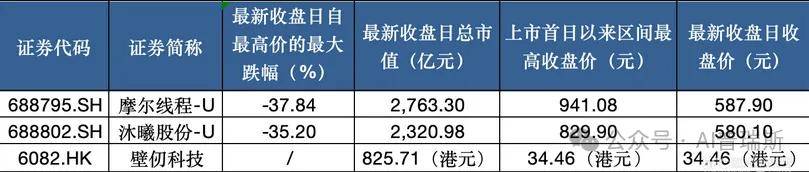
Core Viewpoint - The domestic GPU sector is experiencing a rare capital-intensive period, with companies like Moore Threads, Muxi Co., and Birran Technology achieving significant market attention and initial public offering (IPO) success, but investor enthusiasm has quickly cooled, leading to substantial stock price corrections [1][8]. Group 1: Market Performance - Moore Threads and Muxi Co. saw their stock prices drop nearly 40% from their respective peaks shortly after their IPOs, indicating a significant market correction [1][2]. - Birran Technology's market capitalization is notably lower than that of Moore Threads and Muxi Co., despite a strong initial performance, with a first-day increase of 75.82% but a market value only one-third of the other two companies [1][2]. - The domestic GPU sector transitioned from a state of "extreme enthusiasm" to "rational cooling" within a month [1]. Group 2: Financial Metrics - As of the latest data, Moore Threads has a market capitalization of approximately 2887 billion, down from an initial 4400 billion, reflecting a 37% decline [2][3]. - Muxi Co. reported a market value of 2418 billion, with a stock price decline of about 35% from its highest point [2][6]. Group 3: Industry Challenges - All three companies are in a "high investment, low revenue, unprofitable" phase, with combined R&D expenditures in the tens of billions over the past three years, yet their revenue remains limited [8]. - The GPU industry is characterized by high capital requirements and long development cycles, particularly for complex chips, which leads to significant cash consumption [8]. - The competitive landscape is dominated by major players like NVIDIA, AMD, and ASIC, which hold a combined market share of 91.1% in the AI chip market, leaving little room for domestic manufacturers [9]. Group 4: Ecosystem and Competition - The competition in the GPU market extends beyond performance metrics to include the developer ecosystem, with NVIDIA's CUDA framework being a de facto industry standard [10]. - Domestic manufacturers are exploring different strategies, such as compatibility with CUDA or building their own ecosystems, but face challenges in disrupting the existing market dynamics [10]. Group 5: Future Outlook - The recent stock price corrections reflect a market reassessment of the "imagination space" of domestic alternatives versus the reality of their operational timelines [11]. - The true test for these companies will come in subsequent financial reporting periods, focusing on order sustainability, product integration into core applications, ecosystem development, and cash flow management [11]. - The stock price decline may not signify the end of the narrative but could represent the beginning of a long-term competitive journey for domestic GPU companies [11].

摩尔线程1月5日获融资买入3.75亿元,融资余额16.98亿元
Xin Lang Cai Jing· 2026-01-06 01:52
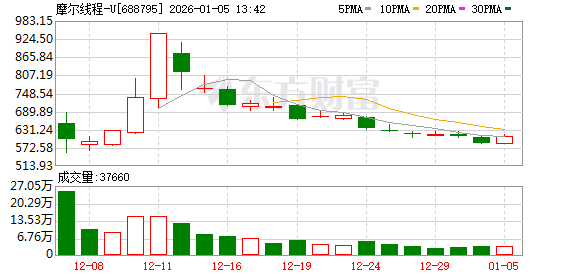
资料显示,摩尔线程智能科技(北京)股份有限公司位于北京市朝阳区东湖街道望京国际研发园I座3层, 成立日期2020年6月11日,上市日期2025年12月5日,公司主营业务涉及主要从事GPU及相关产品的研 发、设计和销售。主营业务收入构成为:集群70.75%,板卡17.74%,一体机9.05%,其他2.41%,芯片 0.05%。 截至12月5日,摩尔线程股东户数3.92万,较上期增加45515.12%;人均流通股748股,较上期增加 0.00%。2025年1月-9月,摩尔线程实现营业收入7.85亿元,同比增长181.99%;归母净利润-7.24亿元, 同比增长18.71%。 责任编辑:小浪快报 1月5日,摩尔线程涨5.40%,成交额30.86亿元。两融数据显示,当日摩尔线程获融资买入额3.75亿元, 融资偿还2.97亿元,融资净买入7823.57万元。截至1月5日,摩尔线程融资融券余额合计16.98亿元。 融资方面,摩尔线程当日融资买入3.75亿元。当前融资余额16.98亿元,占流通市值的9.32%。 融券方面,摩尔线程1月5日融券偿还0.00股,融券卖出0.00股,按当日收盘价计算,卖出金额0.00元; 融券余 ...
“打新定期跟踪”系列之二百四十三:2025年A类2亿规模账户理论打新收益率3.80%
Huaan Securities· 2026-01-05 13:08
- Theoretical new stock yield for Class A accounts with a scale of 2 billion is 3.80%[2][10] - Theoretical new stock yield for Class B accounts with a scale of 2 billion is 2.88%[2][10] - Theoretical new stock yield for Class A accounts with a scale of 10 billion is 1.74%[2][10] - Theoretical new stock yield for Class B accounts with a scale of 10 billion is 1.03%[2][10] - The average first-day increase for STAR Market stocks is 258.09%[2][20] - The average first-day increase for ChiNext stocks is 231.27%[2][20] - The number of valid quotation accounts for the latest STAR Market new stock is 4687 for Class A and 2065 for Class B[2][26] - The number of valid quotation accounts for the latest ChiNext new stock is approximately 3879 for Class A and 2610 for Class B[2][26] - The number of valid quotation accounts for the latest Shanghai Main Board new stock is 5200 for Class A and 2944 for Class B[2][26] - The number of valid quotation accounts for the latest Shenzhen Main Board new stock is 4683 for Class A and 2918 for Class B[2][26] - The highest first-day increase among newly listed stocks in the past month is 600.07% for Muxi Shares-U[37] - The highest fundraising amount among newly listed stocks in the past month is 80 billion for Moore Threads-U[37] - The highest full subscription yield among newly listed stocks in the past month is 671.65 thousand yuan for Moore Threads-U[41][43] - The full subscription yield for Muxi Shares-U is 343.75 thousand yuan[41][43] - The full subscription yield for Angrui Micro-UW is 42.24 thousand yuan[41][43] - The full subscription yield for China Uranium Industry is 36.49 thousand yuan[41][43] - The full subscription yield for Baiao Saitu is 14.67 thousand yuan[41][43] - The full subscription yield for Youxun Shares is 24.68 thousand yuan[41][43] - The full subscription yield for Tiansu Measurement is 5.54 thousand yuan[41][43] - The full subscription yield for Nabai Chuan is 7.86 thousand yuan[41][43] - The full subscription yield for Xihua Technology is 4.51 thousand yuan[41][43] - The full subscription yield for Jianxin Superconducting is 12.53 thousand yuan[41][43] - The full subscription yield for C Shuangxin is 12.56 thousand yuan[41][43] - The full subscription yield for C Yufan is 2.35 thousand yuan[41][43] - The full subscription yield for C Qiangyi is 40.15 thousand yuan[41][43] - The full subscription yield for C Xinguangyi is 9.93 thousand yuan[41][43] - The monthly offline new stock yield for Class A accounts with a scale of 2 billion in December 2025 is 195.55 thousand yuan[48][49] - The monthly offline new stock yield for Class B accounts with a scale of 2 billion in December 2025 is 94.99 thousand yuan[53][54] - The cumulative offline new stock yield for Class A accounts with a scale of 2 billion in 2025 is 3.80%[48][49] - The cumulative offline new stock yield for Class B accounts with a scale of 2 billion in 2025 is 2.88%[53][54]
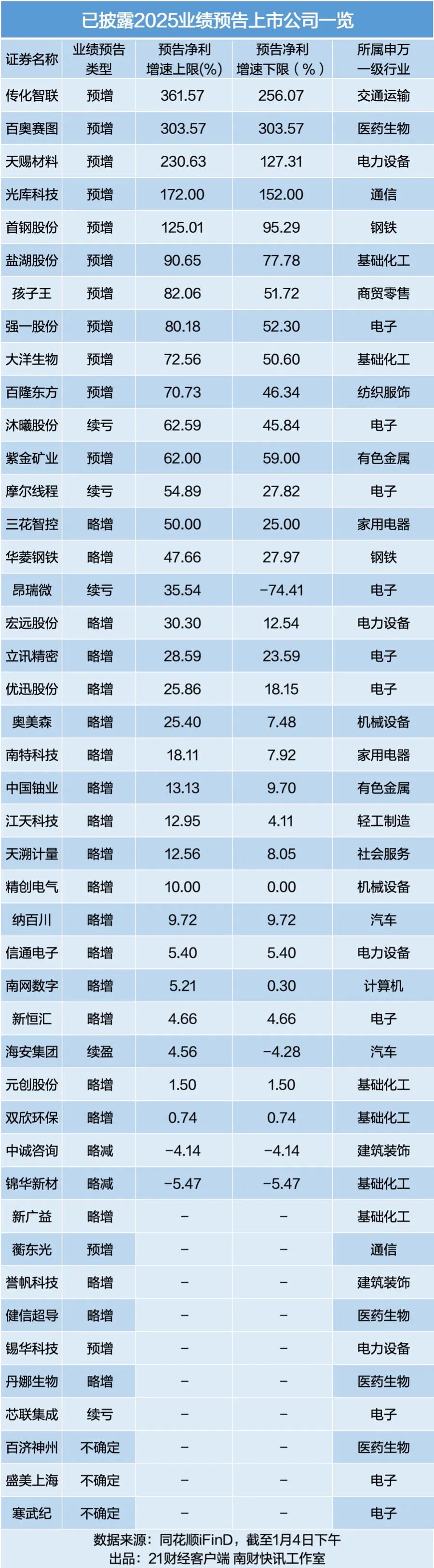
最高预增超360%!44家A股公司披露2025年度业绩预告
2 1 Shi Ji Jing Ji Bao Dao· 2026-01-05 13:00
值得注意的是,传化智联(002010)(002010.SZ)以高达256.07%至361.57%的净利润预计增幅,暂列目前"预增王"。公司预计 2025年归母净利润为5.4亿至7亿元。公告显示,业绩大幅增长除因主营业务取得良好增长外,也受益于转让部分子公司股权确认 的投资收益及回购子公司股权提升持股比例等因素。 传统制造业在此轮业绩预告中表现尤为亮眼。钢铁行业方面,首钢股份(000959)(000959.SZ)预计2025年归母净利润为9.2亿元 至10.6亿元,同比增长95.29%至125.01%,增速上限在已披露公司中位居前列。公司表示,业绩增长得益于产品结构优化、高端 化发展及"极低成本"管理理念的贯彻。 同样属于钢铁板块的华菱钢铁(000932)(000932.SZ)在消化了补缴环保税及滞纳金约6.57亿元的情况下,依然预计净利润增长 27.97%至47.66%。对此,公司解释,主要得益于降本增效以及高端化、绿色化、智能化、精益化"四化转型等工作的开展。 以电子、医药生物为代表的高景气赛道则呈现批量报喜的态势。其中,电子行业的强一股份(688809.SH)预计净利润增长52.30% 至80.18%;医 ...


散户打新最高赚16倍!去年A股百家企业IPO,总募资1300亿元,最赚钱的不是摩尔线程
Sou Hu Cai Jing· 2026-01-05 08:13
Summary of Key Points Core Viewpoint - The A-share IPO market in 2025 saw significant growth, with 116 companies completing their IPOs, raising a total of 131.71 billion yuan, marking a 95.64% increase from 2024. The market exhibited structural characteristics with a mix of large-scale and small-scale IPOs, and the profitability of new stocks was notably high, with no stocks experiencing a "break" in their initial public offering prices [2][4][8]. Group 1: IPO Performance - In 2025, a total of 116 companies successfully completed their IPOs, an increase of 16 companies compared to 2024 [2] - The total amount raised through these IPOs reached 131.71 billion yuan, representing a 95.64% increase year-on-year [2][4] - The highest fundraising company was Huadian New Energy, which raised 18.17 billion yuan, followed by Moore Threads with nearly 8 billion yuan [2][4] Group 2: Market Structure - The majority of IPOs were concentrated in the ChiNext board with 33 companies, followed by the Beijing Stock Exchange with 26, the Shanghai Main Board with 23, the Sci-Tech Innovation Board with 19, and the Shenzhen Main Board with 15 [2] - The fundraising scale of IPOs showed a clear structural differentiation, with large projects coexisting with numerous small IPOs [4][7] Group 3: Profitability and Stock Performance - All 116 new stocks maintained prices above their issue prices, with an average increase of over 224% since listing [3] - Notable performers included Xingtou Measurement and Control, which achieved a cumulative increase of over 1600%, making it the most profitable new stock of 2025 [3][10] - The average turnover rate for new stocks was 1411.96%, with some stocks exceeding 3000%, indicating high trading activity [10] Group 4: Issuance Costs - The total issuance costs for the 116 companies amounted to 9.705 billion yuan, with an average cost of 83.66 million yuan per company, reflecting an increase from 67.41 million yuan in 2024 [7] - The issuance cost as a percentage of the total fundraising showed significant variation, with large projects like Huadian New Energy having a low cost ratio of 1.25%, while many smaller IPOs had ratios exceeding 10% [7]

从情绪迸发到价值审视 摩尔线程、沐曦股份已回调近40%
2 1 Shi Ji Jing Ji Bao Dao· 2026-01-05 05:42
国产GPU公司迎来IPO融资热潮。 1月2日,壁仞科技(6082.HK)上市首日盘中一度涨近120%,成为"港股GPU第一股"。 上个月,号称"国产GPU第一股"的摩尔线程(688795.SH)上市首日股价涨超4倍,12月11日收盘股价超 900元/股,远超发行价114.28元/股。 另一家GPU公司——沐曦股份(688802.SH)2025年12月17日上市首日,投资者中一签浮盈最高逼近40 万元,刷新近十年A股上市首日单签盈利纪录。 2025年12月5日,摩尔线程正式登陆A股,首日上市开盘价报650元/股,较发行价上涨468.78%,总市值 突破3000亿元,随后几个交易日市值一度高达4422亿元。 然而,资本狂追热捧的背后却是故事另一面,GPU公司股票市值大幅回落。 摩尔线程、沐曦股份上市之日狂飙后,目前已经大幅回调近40%,分别自最高价回落约37%、35%。壁 仞科技上市首日最终收涨不超过80%,总市值不到千亿港元,只有摩尔、沐曦市值的三分之一左右。 激情燃烧的高估值迎来"折扣",背后是GPU创新叙事的商业化现实难题,还需突破。 目前,上述三家公司过去三年营收都在增长,但都未实现盈利。因芯片行业的高研 ...
摩尔线程、沐曦股份已回调近40%
Xin Lang Cai Jing· 2026-01-05 05:34
炒股就看金麒麟分析师研报,权威,专业,及时,全面,助您挖掘潜力主题机会! 作者丨吴佳楠 编辑丨朱益民 国产GPU公司迎来IPO融资热潮。 1月2日,壁仞科技(6082.HK)上市首日盘中一度涨近120%,成为"港股GPU第一股"。 上个月,号称"国产GPU第一股"的摩尔线程(688795.SH)上市首日股价涨超4倍,12月11日收盘股价超 900元/股,远超发行价114.28元/股。 激情燃烧的高估值迎来"折扣",背后是GPU创新叙事的商业化现实难题,还需突破。 另一家GPU公司——沐曦股份(688802.SH)2025年12月17日上市首日,投资者中一签浮盈最高逼近40 万元,刷新近十年A股上市首日单签盈利纪录。 然而,资本狂追热捧的背后却是故事另一面,GPU公司股票市值大幅回落。 摩尔线程、沐曦股份上市之日狂飙后,目前已经大幅回调近40%,分别自最高价回落约37%、35%。壁 仞科技上市首日最终收涨不超过80%,总市值不到千亿港元,只有摩尔、沐曦市值的三分之一左右。 短短一月内,"国产GPU四小龙"其中的摩尔线程、沐曦股份、壁仞科技都先后走向了公开市场融资,并 在资本市场创下数项新的纪录。 2025年12 ...