
SMIC(688981)

Search documents
东方证券:AI带动功率IC等需求成长 有望持续推动成熟制程需求提升
智通财经网· 2026-01-16 01:54
Core Viewpoint - The report from Dongfang Securities highlights that while investors are focused on AI computing power chips driving advanced process foundry demand, there is insufficient attention on the demand for mature process foundries driven by AI. The firm believes that AI will continue to boost the demand for power-related ICs, thereby enhancing the demand for mature process foundries [1]. Group 1: Demand Insights - AI is expected to drive growth in power IC demand, which will continue to enhance the demand for mature processes. The demand increase is attributed to AI server power ICs and the localization trend in mainland China, leading to higher demand for local foundries' BCD/PMIC [3]. - The utilization rate of eight-inch capacity at some foundries has significantly increased since mid-2025, driven by the demand from AI applications [3]. Group 2: Supply Dynamics - TSMC is gradually reducing its eight-inch capacity starting in 2025, with plans for some facilities to cease operations by 2027. Samsung is also initiating eight-inch production cuts in 2025 [4]. - TrendForce forecasts a 0.3% year-on-year reduction in global eight-inch capacity in 2025, with the reduction expected to expand to 2.4% in 2026. This reduction, coupled with rising demand, is projected to increase the average utilization rate of eight-inch capacity to 85-90% in 2026, up from 75-80% in 2025 [4]. Group 3: Domestic Foundry Benefits - The trend of localization in IC manufacturing in mainland China is ongoing, with companies like SMIC reporting growth in market share for various products during the domestic replacement process. This trend is expected to provide continued order growth for domestic foundries [5]. Group 4: Investment Recommendations - The report suggests that the price increase in mature processes and the demand growth driven by AI present investment opportunities. Recommended investment targets include wafer manufacturing companies such as SMIC, Hua Hong Semiconductor, and others, as well as semiconductor equipment companies [6].


半导体龙头ETF(159665)开盘涨1.51%,重仓股寒武纪涨0.35%,中芯国际涨2.46%
Xin Lang Cai Jing· 2026-01-16 01:41
Core Viewpoint - The semiconductor leading ETF (159665) has shown a positive performance with a 1.51% increase at the opening, reflecting strong market interest in semiconductor stocks [1] Group 1: ETF Performance - The semiconductor leading ETF (159665) opened at 2.013 yuan, marking a 1.51% increase [1] - Since its establishment on December 22, 2022, the ETF has achieved a return of 98.90%, with a monthly return of 15.57% [1] Group 2: Key Holdings Performance - Notable stocks within the ETF include: - Cambrian (寒武纪) up 0.35% - SMIC (中芯国际) up 2.46% - Haiguang Information (海光信息) up 1.08% - Northern Huachuang (北方华创) up 1.24% - Lattice Semiconductor (澜起科技) up 2.14% - GigaDevice (兆易创新) up 1.99% - Zhongwei Company (中微公司) up 1.62% - OmniVision (豪威集团) up 0.82% - JCET (长电科技) up 2.30% - Unisoc (紫光国微) up 6.11% [1]




港股开盘 | 恒指高开0.64% 芯片股走强 中芯国际(00981)等涨近2%
智通财经网· 2026-01-16 01:39
Group 1 - The Hang Seng Index opened up 0.64% and the Hang Seng Tech Index rose by 0.94%, with strong performance in chip stocks like SMIC and Hua Hong Semiconductor, which both increased by nearly 2% [1] - According to China Merchants Securities, the lagging performance of Hong Kong stocks compared to A-shares is due to overseas liquidity dynamics, with a 95.6% probability of the Federal Reserve pausing interest rate cuts in January [1] - Huatai Securities noted that after a month of pessimistic consolidation, the Hong Kong market sentiment index has entered a panic zone, historically leading to a significant increase in the probability of rising prices in the following month [1] Group 2 - Industrial opportunities in the AI sector are highlighted, with a focus on leading internet companies, suggesting a potential resonance of buying interest from both domestic and foreign investors [2] - The report emphasizes the importance of dividend assets in a low-interest-rate environment, recommending sectors such as insurance, banking, energy, property management, and public utilities [2] - New consumption trends are identified, focusing on three main lines: traditional service-oriented consumption transformation led by chain hotels, Z-generation consumption including trendy toys and beauty products, and high-end consumption [2]
中信证券:AI超高景气带动电子涨价潮 AI敞口高或供需有改善的细分赛道受益确定性更强
智通财经网· 2026-01-16 01:08
Core Viewpoint - The recent price increase in various segments of the electronics industry is driven by significant upstream metal cost increases and strong demand from AI applications, despite some pressure on consumer and automotive electronics demand [1][2][6] Group 1: Price Increase Drivers - Since the second half of 2025, multiple segments in electronic components have experienced a price surge primarily due to significant cost pressures from rising metal prices, with some segments also benefiting from strong AI demand [2][3] - Key metals such as gold, silver, and copper have seen futures prices increase by over 50%, 150%, and 50% respectively since 2025, with expectations for continued high prices into 2026 due to loose global liquidity and supply-side constraints [2][3] Group 2: Beneficiary Segments - Segments with high AI exposure, such as storage, CCL, and BT substrates, are expected to benefit the most from the current price increase cycle [3][6] - For storage, TrendForce forecasts a 55% to 60% increase in traditional DRAM contract prices and a 33% to 38% increase in NAND Flash contract prices by Q1 2026, with a potential shortage lasting until the first half of 2027 [3] - CCL manufacturers are expected to successfully pass on price increases to the PCB segment, with anticipated price hikes of 5% to 10% in 2025 and a peak in the first half of 2026 [3] - BT substrates are projected to see a price increase of approximately 30% in the second half of 2025, with further increases of 15% to 20% expected in 2026 [3] Group 3: Supply-Demand Improvements - Segments with improved supply-demand dynamics, such as wafer foundries and panels, are also expected to benefit significantly [4][6] - Wafer foundries are experiencing capacity reductions in overseas mature processes, while domestic leading companies maintain high utilization rates, leading to price increases of about 10% for certain processes by December 2025 [4] - The panel segment is expected to see improved profitability due to the lifting of tariff impacts and increased demand from major events like the Winter Olympics and World Cup [4]

更长存续 更少返投 更硬科技 撬动耐心资本 创投“国家队”打法升级
Zhong Guo Zheng Quan Bao· 2026-01-15 22:50
Core Insights - The National Venture Capital Guiding Fund, launched at the end of 2025, has a 20-year duration and aims to support hard technology sectors without regional investment return requirements, marking a significant shift in China's venture capital landscape [1][2]. Group 1: Fund Characteristics - The guiding fund is designed to leverage a substantial amount of fiscal resources, aiming to mobilize trillions in social capital, focusing on strategic emerging industries and early-stage innovative small and medium enterprises [2]. - The fund's long duration and flexible return requirements are seen as beneficial for fostering a unified national market and aligning with the developmental needs of technology enterprises [2][5]. Group 2: Investment Trends - There is a noticeable trend of state-owned capital funds increasing their investments in hard technology, with significant investments in semiconductor and AI sectors, indicating a long-term commitment to strengthening key industrial chains [2][6]. - The guiding fund's approach emphasizes early and small investments, which aligns with the growth trajectories of innovative companies, as evidenced by the involvement of state-owned funds in various successful startups [1][6]. Group 3: Changes in Investment Strategy - The investment strategy has evolved to allow longer fund durations and more flexible return mechanisms, moving away from rigid return requirements that previously distorted investment decisions [4][5]. - A focus on a more patient capital approach is emerging, with an emphasis on supporting the entire lifecycle of investments rather than prioritizing quick returns [4][6]. Group 4: Sector-Specific Investments - The state-owned venture capital "national team" is actively investing in critical sectors such as semiconductors, advanced manufacturing, artificial intelligence, and new materials, reflecting a strategic focus on enhancing domestic capabilities [6][7]. - Investments in aerospace and robotics are also highlighted, showcasing the diverse interests of the national team in fostering innovation across various high-tech fields [7].
部分成熟制程涨价,AI拉动需求增长
Orient Securities· 2026-01-15 14:45
Investment Rating - The report maintains a "Positive" investment rating for the electronic industry in China [5] Core Insights - The demand growth driven by AI is expected to lead to price increases in certain mature processes, with wafer foundries anticipating a price hike of 5-20% for 8-inch wafers due to tightening capacity [7] - The report highlights that AI is boosting the demand for power ICs, which will continue to enhance the demand for mature process wafer foundries [7] - Domestic wafer foundries are expected to benefit from the ongoing trend of localization in the IC manufacturing industry, with companies like SMIC seeing increased market share and orders [7] Summary by Sections Investment Recommendations and Targets - The report suggests several investment targets in the semiconductor sector, including: - Wafer manufacturing companies: SMIC (688981, Buy), Huahong Semiconductor (01347, Buy), Jinghong Integrated Circuit (688249, Buy), Huarun Microelectronics (688396, Buy), Yandong Microelectronics (688172, Not Rated), and Xilian Integrated-U (688469, Not Rated) [3][8] - Semiconductor equipment companies: Zhongwei Company (688012, Buy), Northern Huachuang (002371, Buy), Tuojing Technology (688072, Buy), Shengmei Shanghai (688082, Buy), Huahai Qingke (688120, Not Rated), and Zhongke Feice (688361, Not Rated) [3][8] Market Dynamics - According to TrendForce, the global 8-inch capacity is expected to decrease by approximately 0.3% in 2025 and further by 2.4% in 2026, leading to an increase in average capacity utilization rates to 85-90% in 2026 [10] - The report indicates that the demand for power ICs will continue to grow due to the increasing computational power and energy efficiency requirements of AI applications, which will further stimulate the demand for mature process wafer foundries [7]



港股收盘|恒指跌0.28% 半导体板块走强
Xin Lang Cai Jing· 2026-01-15 14:19
Market Performance - The Hang Seng Index closed at 26,923.62 points, down 0.28% [1] - The Hang Seng Tech Index closed at 5,828.35 points, down 1.35% [1] Semiconductor Sector - The semiconductor sector showed strength in the afternoon, with notable gains [1] - Hua Hong Semiconductor increased by 6.31% [1] - InnoStar Technologies rose by 2.9% [1] - SMIC (Semiconductor Manufacturing International Corporation) gained 1.84% [1]
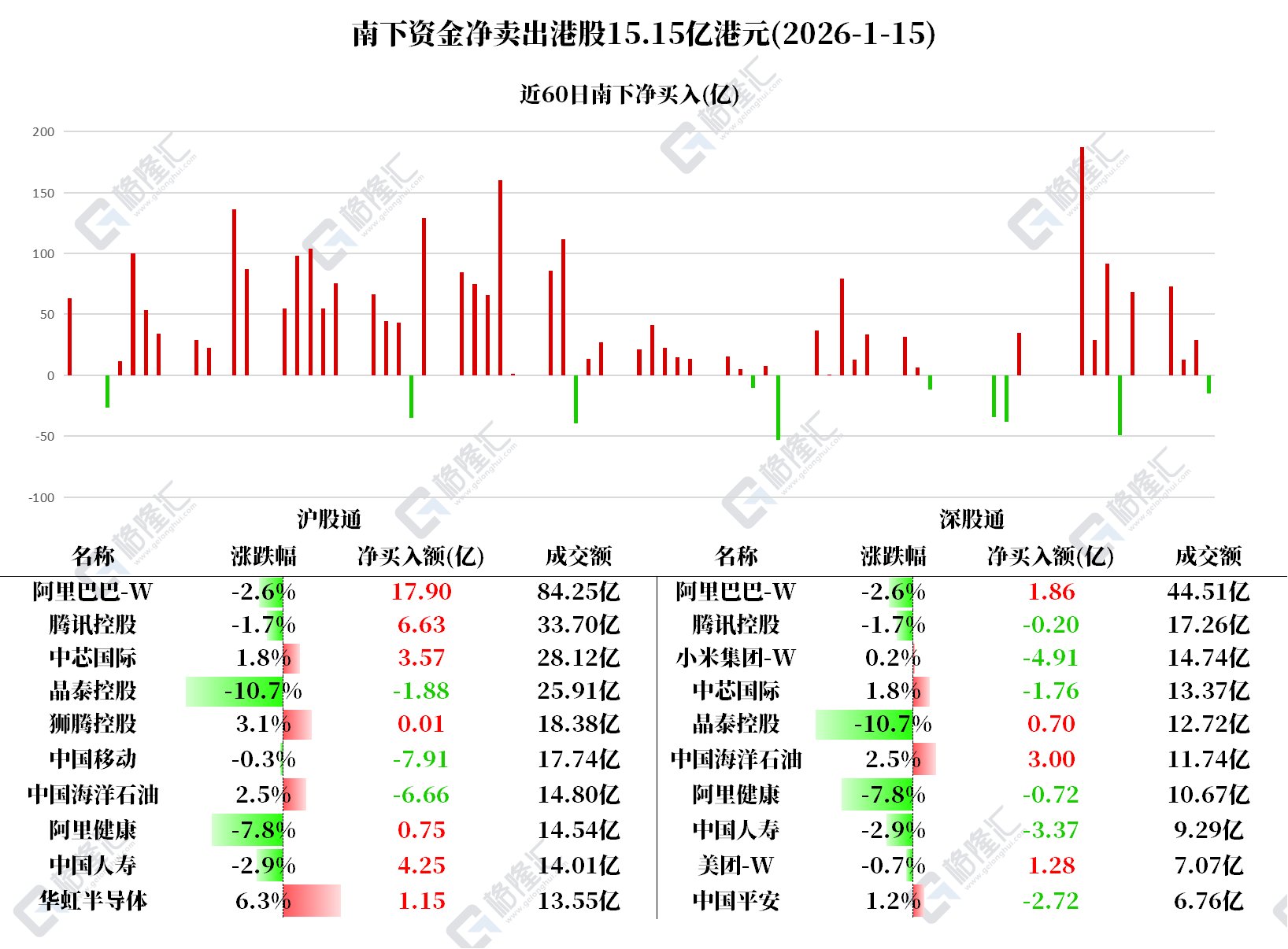
图解丨南下资金大幅入手阿里近20亿港元
Ge Long Hui A P P· 2026-01-15 09:58
Group 1 - Southbound funds recorded a net sell of HKD 1.515 billion in Hong Kong stocks today [1] - Notable net purchases included Alibaba-W at HKD 1.976 billion, Tencent Holdings at HKD 0.642 billion, and SMIC at HKD 0.18 billion [1] - Significant net sales were observed in China Mobile at HKD 0.791 billion, Xiaomi Group-W at HKD 0.491 billion, and China National Offshore Oil at HKD 0.365 billion [1] Group 2 - Southbound funds have net bought Tencent for seven consecutive days, totaling HKD 9.65029 billion [1] - Alibaba has seen net purchases for four consecutive days, amounting to HKD 4.38486 billion [1] - China Mobile has been net sold for nine consecutive days, with a total of HKD 6.98848 billion [1] Group 3 - In the Shanghai Stock Connect, Alibaba-W experienced a decline of 2.6% with a net purchase of HKD 1.79 billion [3] - Tencent Holdings saw a decrease of 1.7% with a net purchase of HKD 0.663 billion [3] - SMIC had an increase of 1.8% with a net purchase of HKD 0.357 billion [3]






电子行业今日涨1.67%,主力资金净流入120.83亿元
Zheng Quan Shi Bao Wang· 2026-01-15 09:55
Market Overview - The Shanghai Composite Index fell by 0.33% on January 15, with 11 sectors experiencing gains, led by the electronics and basic chemicals sectors, which rose by 1.67% and 1.40% respectively [1] - The sectors with the largest declines were comprehensive and defense industries, which fell by 3.35% and 2.80% respectively [1] Capital Flow Analysis - The net outflow of capital from the two markets was 62.864 billion yuan, with six sectors seeing net inflows [1] - The electronics sector had the highest net inflow of capital, amounting to 12.083 billion yuan, while the non-ferrous metals sector followed with a net inflow of 1.936 billion yuan [1] Electronics Sector Performance - The electronics sector rose by 1.67%, with a total of 476 stocks in the sector, of which 283 increased in value and 7 hit the daily limit [2] - The leading stocks in terms of net capital inflow included Luxshare Precision, which saw an inflow of 2.936 billion yuan, followed by Wolong Nuclear Materials and Jiangbolong with inflows of 1.705 billion yuan and 909 million yuan respectively [2] Electronics Sector Capital Inflow - The top stocks by capital inflow in the electronics sector included: - Luxshare Precision: +7.07%, turnover rate 3.62%, capital flow 2.935 billion yuan - Wolong Nuclear Materials: +10.01%, turnover rate 14.35%, capital flow 1.705 billion yuan - Jiangbolong: +9.39%, turnover rate 9.05%, capital flow 908.607 million yuan [2] Electronics Sector Capital Outflow - The stocks with the highest capital outflow in the electronics sector included: - Zhenray Technology: -2.12%, turnover rate 11.27%, capital outflow -462.808 million yuan - Lingyi Technology: -1.16%, turnover rate 2.70%, capital outflow -431.998 million yuan - SMIC: -0.04%, turnover rate 2.78%, capital outflow -415.740 million yuan [3]



41.16亿主力资金净流入,中芯国际概念涨2.59%
Zheng Quan Shi Bao Wang· 2026-01-15 09:20
Group 1 - The core viewpoint of the news is that the SMIC concept stocks experienced a significant increase, with a notable rise in the stock prices of several companies within the sector, indicating positive market sentiment towards semiconductor-related investments [1][2][3]. Group 2 - The SMIC concept stocks rose by 2.59%, ranking second in the concept sector, with 66 stocks increasing in value, including Tongcheng New Materials, which hit the daily limit, and Shanghai Xinyang, Su Da Weige, and Chip Source Micro, which rose by 16.60%, 15.05%, and 10.63% respectively [1]. - The main inflow of funds into the SMIC concept sector was 4.116 billion yuan, with 54 stocks receiving net inflows, and 14 stocks seeing inflows exceeding 100 million yuan, led by Changdian Technology with a net inflow of 721 million yuan [1][2]. - The top three stocks by net inflow ratio were Tongcheng New Materials at 16.85%, Changdian Technology at 13.37%, and Demingli at 11.65% [2].