
SMIC(688981)

Search documents
中芯国际A股涨近6%,H股一度涨超4%报78.3港元,均创2个月新高!国家大基金持有中芯股权由4.79%增加至9.25%
Ge Long Hui· 2026-01-05 03:27
格隆汇1月5日|中芯国际AH股齐涨,其中,A股涨近6%报129.94元,H股一度涨超4%报78.3港元,均 创逾2个月新高。消息面上,港交所权益披露,中芯获被称为"国家大基金"的国家集成电路产业投资基 金,于去年12月29日以每股平均价74.2元人民币,增持逾3.57亿股,涉资约265.15亿元人民币。"国家大 基金"持有中芯股权由4.79%增加至9.25%,超过5%持股披露门槛。 ...

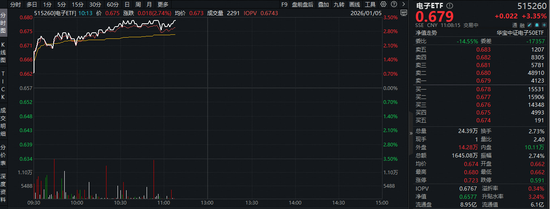
存储芯片概念爆发!电子ETF(515260)大涨3%!长鑫科技申报科创板IPO获受理,国家大基金增持中芯国际H股
Xin Lang Cai Jing· 2026-01-05 03:24
Market Performance - The electronic sector is experiencing a strong market performance with a net inflow of 26.8 billion yuan, leading among 31 primary industries [1][7] - The electronic ETF (515260) has seen a price increase of 3.35%, indicating strong buying interest and potential new investments [1][7] Key Stocks - Notable stocks include Zhaoyi Innovation, which hit the daily limit, and Zhongwei Company, which surged over 12% [9][10] - Other significant gainers include Lanke Technology, Lens Technology, and Tuojing Technology, all rising over 6% [9][10] - Major weighted stocks like SMIC and Luxshare Precision also showed positive performance, increasing over 5% and 3% respectively [9][10] Industry Developments - Changxin Technology has submitted an IPO application to the Sci-Tech Innovation Board, aiming to raise 29.5 billion yuan for various technology upgrades, with a total investment of 34.5 billion yuan [2][11] - The National Integrated Circuit Industry Investment Fund has increased its stake in SMIC from 4.79% to 9.25%, indicating strong institutional support [2][11] - The semiconductor industry is expected to benefit from the rise of domestic chip design companies and localization trends, with opportunities anticipated to open up by 2026 [2][11] AI and Market Trends - Major North American cloud service providers are significantly increasing investments in AI infrastructure, with total investments projected to reach a historical high of $600 billion by 2026 [2][11] - The demand for storage chips is expected to surge, with prices for DDR4 16Gb chips projected to rise by 1800% and DDR5 16Gb chips by 500% in 2025 [2][11] - The electronic industry is in an innovation phase, with expectations for rapid growth driven by AI demand and subsequent breakthroughs in terminal innovation and profit release [3][11] Investment Tools - The electronic ETF (515260) and its linked funds are designed to passively track the electronic 50 index, focusing on sectors like semiconductors, consumer electronics, and AI chips [3][12] - This ETF serves as an efficient tool for investors looking to gain exposure to core assets in the electronic sector [3][12]




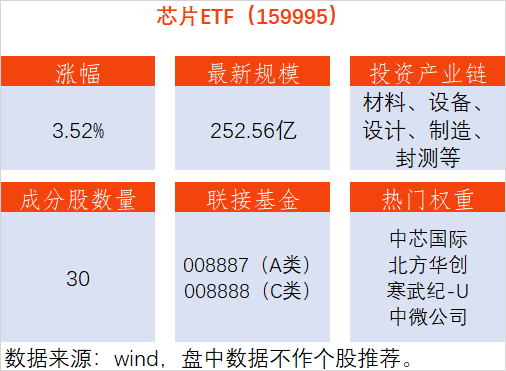
供不应求!芯片ETF(159995)上涨3.52%,中微公司上涨11.48%
Mei Ri Jing Ji Xin Wen· 2026-01-05 02:53
Group 1 - The A-share market saw a collective rise in the three major indices on January 5, with the Shanghai Composite Index increasing by 0.64%. The insurance, semiconductor, and healthcare sectors led the gains, while oil and gas, as well as highways, experienced declines [1] - The semiconductor ETF (159995) rose by 3.52%, with notable increases in component stocks such as Zhongwei Company (up 11.48%), Zhaoyi Innovation (up 7.99%), Beijing Junzheng (up 6.31%), Lanke Technology (up 6.01%), and Huahai Qingke (up 5.60%) [1] Group 2 - Driven by strong demand for AI, storage chip prices are expected to surge by 1800% for DDR4 16Gb, 500% for DDR5 16Gb, and 300% for 512Gb NAND flash by 2025 [3] - Guojin Securities forecasts that the global supply of storage chips will remain insufficient in 2026, leading to continued price increases. The expected growth in DRAM bit supply is around 15% to 20%, while demand growth is projected to reach 20% to 25% [3] - The semiconductor ETF (159995) tracks the Guozheng Semiconductor Index, which includes 30 leading companies in the A-share semiconductor industry across materials, equipment, design, manufacturing, packaging, and testing, such as SMIC, Cambricon, Changdian Technology, and Northern Huachuang [3]


国产AI芯片与大模型接连上市,数字经济ETF(560800)强势上涨2.44%
Sou Hu Cai Jing· 2026-01-05 02:21
Group 1 - The core viewpoint of the news highlights the strong performance of the digital economy theme index, which rose by 2.48% as of January 5, 2026, with significant gains from constituent stocks such as Zhongwei Company (up 11.62%) and Zhaoyi Innovation (up 7.24%) [1] - The digital economy ETF (560800) also saw an increase of 2.44%, reflecting the overall positive sentiment in the digital economy sector [1] - Baidu Group announced the spin-off of its AI chip subsidiary, Kunlun Chip, for an independent listing in Hong Kong, which is expected to enhance its market presence [1] - The "Chinese AI Six Little Dragons," including Zhiyuan AI and MiniMax, have initiated their Hong Kong IPOs, marking a significant step for domestic AI companies in accessing capital markets [1] - The semiconductor market is projected to reach a record high of $760.7 billion in 2026, driven by AI advancements, with a 9% growth expected from 2025 [2] - Domestic wafer fabs are experiencing a recovery in capacity utilization, supported by AI-driven demand for high-end storage solutions [2] - The demand for HBM and advanced storage is driving technological advancements in 3D NAND stacking and DRAM, leading to increased usage and value of etching and thin-film deposition equipment [2] Group 2 - As of December 31, 2025, the top ten weighted stocks in the digital economy theme index accounted for 52.63% of the index, with notable companies including Dongfang Fortune and Cambricon [3] - The digital economy ETF closely tracks the digital economy theme index, selecting companies with high digital infrastructure and application levels [2]


A股 开门红!四大主线走强
Zhong Guo Zheng Quan Bao· 2026-01-05 02:17
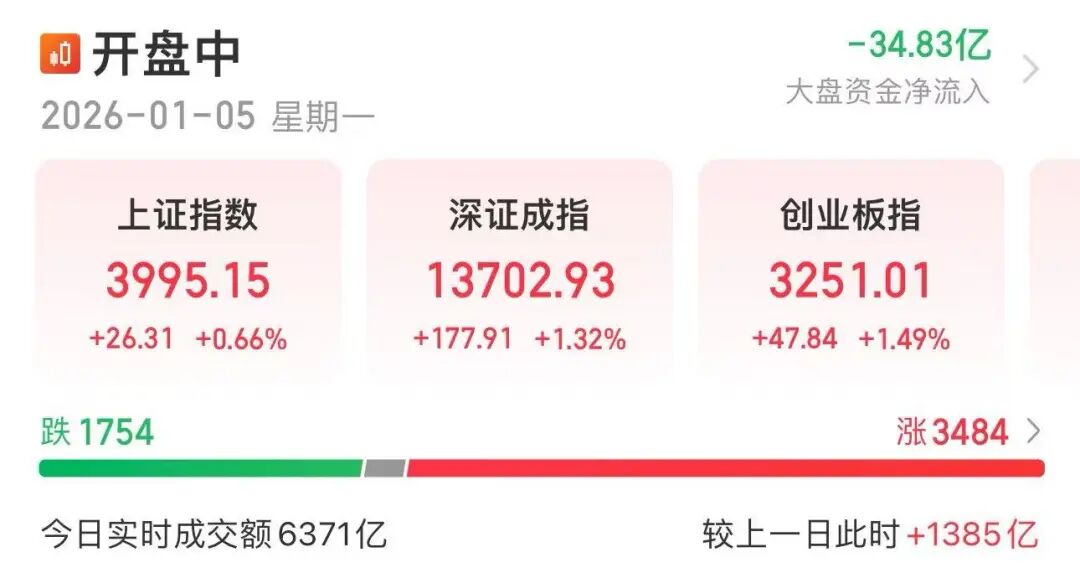
A股2026年首个交易日,三大股指集合竞价集体高开,上证指数高开0.46%,深证成指高开0.8%,创业板指高开0.84%。截至发稿时,上证指数上涨 0.66%,深证成指上涨1.32%,创业板指上涨1.49%。 | NYMEX WTI原油 | ICE布油 | ICE轻质低硫原油 | | --- | --- | --- | | 57.48 | 60.98 | 57.00 | | +0.16 +0.28% | +0.23 +0.38% | -0.01 -0.02% | | INE原油 | INE低硫燃料油 | NYMEX天然气 | | 429.4 | 2932 | 3.459 | | -7.1 -1.63% | -24 -0.81% | -0.159 -4.39% | 三是科技股走强,半导体产业链和消费电子概念领涨,AI应用主线表现活跃。具体来看,半导体产业链中,存储芯片板块大涨,香农芯创(300475)、 江波龙(301308)等个股大涨。 盘面上,市场主要有以下几条主线走强: 一是新兴产业类主题赛道。脑机接口板块早盘大涨,倍益康、三博脑科(301293)等个股大涨。商业航天、可控核聚变等板块上涨。 消息面上,埃 ...
永安期货股指期货早报-20260105
Xin Yong An Guo Ji Zheng Quan· 2026-01-05 02:11
Market Overview - The Shanghai Composite Index closed at 3968.84 points, up 0.09%[1] - The Shenzhen Component Index fell by 0.58%[1] - The Hang Seng Index rose by 2.76% to 26338.47 points, with the Hang Seng Tech Index increasing by 4%[1] - The total market turnover in Hong Kong was 140.9 billion HKD[1] U.S. Market Performance - The Dow Jones Industrial Average increased by 0.66% to 48382.39 points[1] - The S&P 500 Index rose by 0.19% to 6858.47 points[1] - The Nasdaq Composite Index decreased by 0.03% to 23235.63 points[1] Venezuela Situation - U.S. military operations captured Venezuelan President Nicolás Maduro, who is now in the U.S. for trial[8] - Trump announced that U.S. oil companies would invest billions in Venezuela's energy infrastructure[12] - The Venezuelan Supreme Court appointed Vice President Delcy Rodríguez as acting president[12] OPEC+ Response - OPEC+ decided to maintain its production cut strategy in Q1 to address global oil supply surplus risks[8] - The organization is monitoring the situation in Venezuela for potential impacts on oil supply[12] China-Korea Relations - Chinese President Xi Jinping met with South Korean President Yoon Suk-yeol, emphasizing the importance of bilateral relations[8] - Yoon reaffirmed South Korea's respect for the "One China" principle regarding Taiwan[12]



半导体ETF南方(159325)开盘涨1.00%,重仓股中芯国际涨3.26%,寒武纪涨1.43%
Xin Lang Cai Jing· 2026-01-05 01:43
Core Viewpoint - The semiconductor ETF from Southern (159325) opened with a gain of 1.00%, indicating positive market sentiment towards the semiconductor sector [1] Group 1: ETF Performance - The Southern Semiconductor ETF (159325) opened at 1.509 yuan, reflecting a 1.00% increase [1] - Since its establishment on October 31, 2024, the fund has achieved a return of 49.44% [1] - The fund's performance over the past month has been a return of 5.54% [1] Group 2: Major Holdings - Key stocks in the Southern Semiconductor ETF include: - SMIC (中芯国际) with a gain of 3.26% [1] - Cambrian (寒武纪) up by 1.43% [1] - Haiguang Information (海光信息) increased by 1.38% [1] - Northern Huachuang (北方华创) rose by 1.94% [1] - Lanke Technology (澜起科技) up by 1.44% [1] - Zhaoyi Innovation (兆易创新) increased by 3.30% [1] - Zhongwei Company (中微公司) up by 1.94% [1] - OmniVision (豪威集团) rose by 0.37% [1] - Changdian Technology (长电科技) increased by 1.14% [1] Group 3: Management Information - The fund is managed by Southern Fund Management Co., Ltd. [1] - The fund managers are Zhao Zhuoxiong and He Dianhong [1] - The benchmark for the ETF's performance is the CSI Semiconductor Industry Select Index [1]
国内半导体行业并购浪潮全面来袭,龙头企业密集出手整合产业链
Jin Rong Jie· 2026-01-05 01:33
近期国内半导体行业重磅重组并购方案密集出炉,行业整合节奏显著加快。2025年12月30日,中芯国际 发布公告,拟通过发行股份方式,收购国家集成电路产业投资基金等5家机构合计持有的中芯北方49% 股权,交易总价达406.01亿元。 次日,两家半导体企业同步披露并购计划。其中,停牌10个工作日后的中微公司公告称,拟采用发行股 份及支付现金相结合的方式,收购杭州众芯硅等41名交易对方合计持有的杭州众硅64.69%股权,同时 拟向不超过35名特定投资者发行股份募集配套资金;华虹半导体则同步公告,计划通过发行股份收购华 虹集团等4名交易对方持有的华力微97.4988%股权,同样拟向不超过35名符合条件的特定对象发行股票 募集配套资金。 这一系列密集落地的并购动作,既彰显了头部企业强化产业链布局、提升核心竞争力的战略意图,更标 志着国内半导体行业重组并购浪潮全面来袭。 半导体行业并购活跃度走高,核心驱动力源于行业景气度持续回暖、企业盈利能力显著提升,以及复杂 国际环境下强化本土产业链韧性的迫切需求。从"点"上的技术突破到"链"上的协同发展,这一系列资本 运作背后,是在人工智能(AI)等多因素推动下,行业正通过资源整合寻求 ...
AI驱动存储大周期,半导体设备确定性凸显,半导体设备ETF(561980)5日吸金2.2亿元
Sou Hu Cai Jing· 2026-01-05 01:21
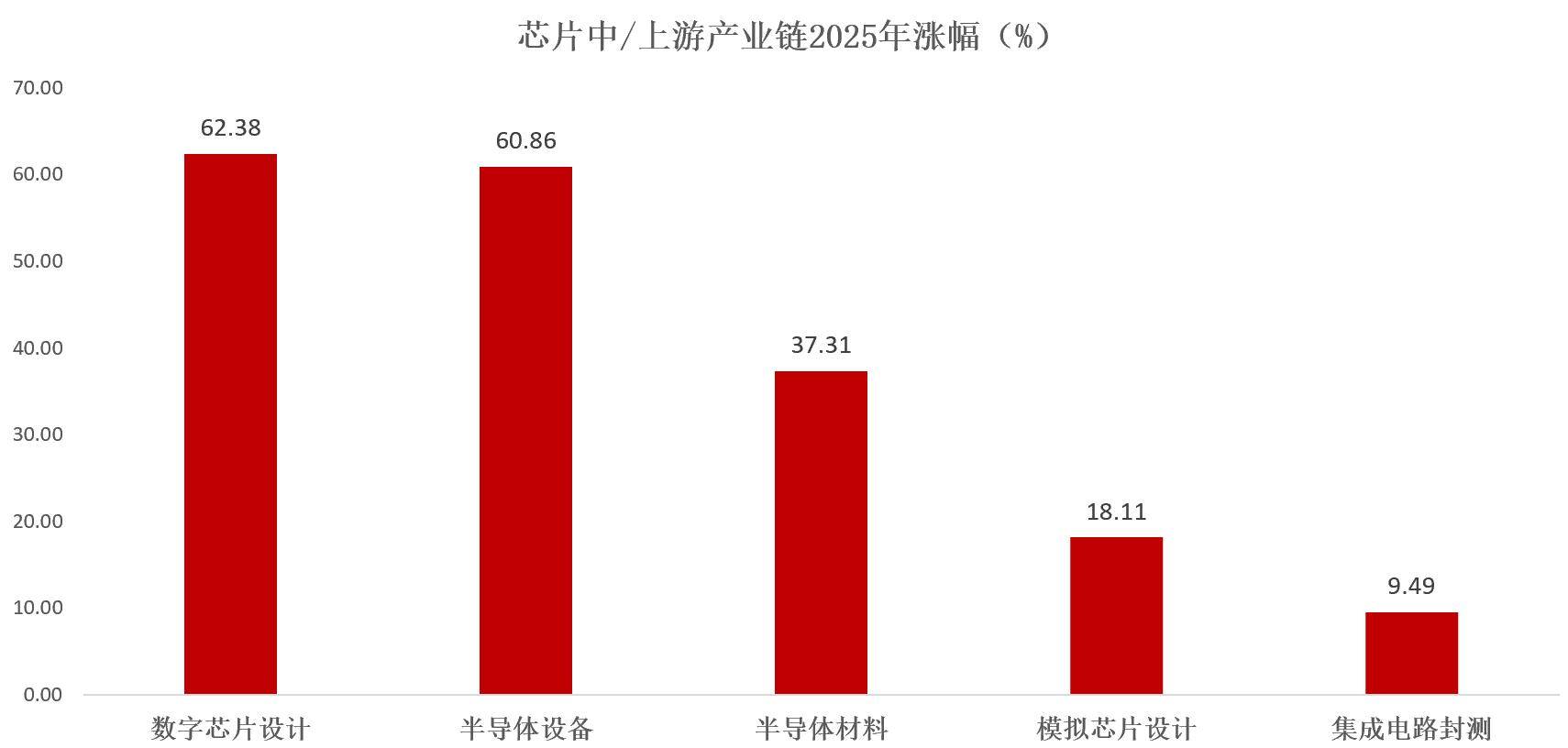
Group 1 - The semiconductor industry is expected to see significant growth, with chip design, semiconductor equipment, and materials projected to rise by 62.38%, 60.86%, and 37.31% respectively by 2025 [2] - The semiconductor theme index, focusing on the aforementioned three sectors, is anticipated to achieve a growth rate of 62.33% in 2025, with the semiconductor equipment ETF (561980) experiencing a net inflow of over 220 million yuan in the last five trading days [2] - The demand for semiconductor equipment is driven by advancements in AI and domestic substitution, particularly in the storage chip sector, which is reshaping the global pricing cycle [4][5] Group 2 - The storage chip segment accounts for approximately 30% of the integrated circuit market, making it a significant area for semiconductor equipment demand [5] - The global storage industry is entering a new upcycle, with DRAM and NAND prices rising since September 2024, and this trend is expected to continue through 2026 [5] - The shift towards 3D architecture in DRAM and NAND is projected to increase the service market for related equipment by approximately 1.7 times and 1.8 times respectively [6] Group 3 - The semiconductor equipment ETF (561980) tracks the CSI semiconductor index, which has a high concentration of leading companies in the semiconductor supply chain, with the top five companies accounting for over 50% of the index [6][8] - The CSI semiconductor index has shown a maximum increase of over 570% since the last upcycle, with a notable 63.92% increase in 2025, outperforming other semiconductor indices [7][8] - The high concentration of equipment, materials, and design sectors in the CSI semiconductor index indicates a strong potential for domestic substitution and ongoing market and policy support [8]
三连发!中芯国际、中微公司、华虹公司接连披露重大资产重组新进展
Zheng Quan Ri Bao Wang· 2026-01-05 01:01
本报讯 (记者毛艺融)2026年1月1日,两家半导体领域龙头企业并购重组迎来关键进展。华虹半导体 有限公司(以下简称"华虹公司")发布发行股份收购上海华力微电子有限公司(以下简称"华力微") 97.5%股权的交易草案,中微半导体设备(上海)股份有限公司(以下简称"中微公司")则披露发行股 份及支付现金购买杭州众硅电子科技有限公司64.69%股权的预案,并将于1月5日复牌。 此前2025年12月30日,中芯国际集成电路制造有限公司(以下简称"中芯国际")也披露了发行股份收购 控股子公司中芯北方集成电路制造(北京)有限公司(以下简称"中芯北方")49%股权的交易草案。 据统计,自"科创板八条"政策发布以来,科创板公司已累计披露近170单股权收购交易,其中2025年超 过100单,政策助推效果显著。重大资产重组达50单,其中2025年达37单,远超2019年至2023年累计的 17单。 科创板股权收购交易均围绕产业整合展开,半导体、生物医药、软件行业交易数量位居前三。随着行业 头部企业陆续上市,资本市场正成为并购重组的主渠道。龙头企业积极把握政策机遇与市场窗口,通过 并购补齐产业链关键环节,增强核心竞争力。 上述三 ...