
PAB(000001)

Search documents
“金融强省”有多强,粤17家银行跻身全球1000强
2 1 Shi Ji Jing Ji Bao Dao· 2025-07-09 04:17
Core Insights - The 2025 Global Bank Top 1000 list published by "The Banker" magazine highlights the strong performance of Guangdong's banking sector, with 17 banks making the list, representing 11.9% of the total Chinese banks included [1][2]. Group 1: Bank Rankings and Performance - Among the 17 banks from Guangdong, there are 3 national joint-stock banks, 1 private bank, 5 city commercial banks, and 8 rural commercial banks [3]. - The three national joint-stock banks are ranked globally as follows: China Merchants Bank at 8th with total assets of 12.15 trillion yuan, Ping An Bank at 33rd with total assets of 5.77 trillion yuan, and Guangfa Bank at 60th with total assets of 3.64 trillion yuan [3]. - The private bank, WeBank, rose 28 places to rank 227th [3]. Group 2: Regional Distribution and Characteristics - The majority of the 17 banks are registered in the Greater Bay Area, with 15 located in nine cities, including Shenzhen and Guangzhou, which lead in the number of banks [5][6]. - Shenzhen hosts two major joint-stock banks and a notable private bank, while Guangzhou is home to Guangfa Bank and the top rural commercial bank in the province [5][6]. Group 3: Financial Contributions and Growth - In 2024, Guangdong's financial industry added value reached 1.24 trillion yuan, accounting for 8.8% of the province's GDP [4]. - As of the end of the first quarter, Guangdong's total loans amounted to 29.3 trillion yuan, with a year-on-year growth of 3.9%, and total deposits reached 37.3 trillion yuan, growing by 2.6% [7].


净息差和不良率“倒挂”,银行盈利承压如何破局?
Di Yi Cai Jing· 2025-07-07 12:49
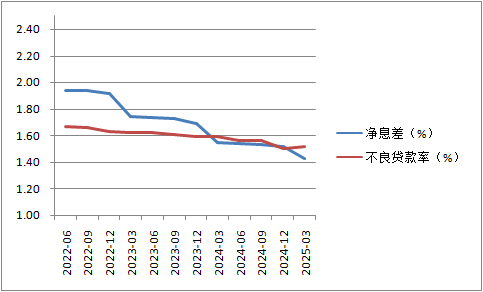
Core Viewpoint - The banking industry is facing significant pressure as net interest margins have fallen below non-performing loan ratios for the first time, indicating a critical need for banks to diversify their income sources beyond interest income [1][2][4]. Group 1: Financial Performance Indicators - In Q1, the net interest margin for Chinese commercial banks decreased to 1.43%, down 9 basis points from the previous quarter, while the non-performing loan ratio rose to 1.51%, an increase of 0.01 percentage points [2][4]. - Among the major banks, state-owned banks had the lowest non-performing loan ratios at 1.22% and 1.23%, while rural commercial banks faced the highest at 2.86% [4]. - A total of 9 out of 42 listed banks reported net interest margins lower than their non-performing loan ratios, highlighting the growing financial strain within the sector [4][5]. Group 2: Challenges and Market Dynamics - The banking sector is experiencing ongoing challenges due to declining asset quality, which is affecting profitability and the ability to cover costs associated with credit, operations, and capital [4][6]. - Analysts indicate that the pressure on net interest margins is exacerbated by weak credit demand and a shift towards lower-yielding short-term loans, leading to a decline in asset yields [6][7]. - The average net interest margin for listed banks has been on a downward trend for five consecutive years, with many banks now below the 1.8% warning line set by market pricing mechanisms [7][8]. Group 3: Strategic Responses - To address the challenges posed by low interest rates, banks are encouraged to diversify their income sources, focusing on non-interest income and other financial services [8][9]. - Recommendations include reducing deposit interest subsidies and hidden costs associated with deposits to alleviate margin pressures [8]. - Banks are advised to adopt a more resilient and balanced income structure, optimizing their liabilities and controlling costs to enhance profitability [9].



跨境支付(CIPS)概念涨2.36%,主力资金净流入33股
Zheng Quan Shi Bao Wang· 2025-07-07 10:32
Core Viewpoint - The cross-border payment (CIPS) concept has shown a significant increase of 2.36%, ranking fifth among concept sectors, with notable stocks experiencing substantial gains [1][2]. Group 1: Market Performance - As of July 7, the CIPS concept saw 51 stocks rise, with Zhongyi Technology hitting a 20% limit up, followed by Xunxing Co., Shiji Information, and Jingbeifang also reaching their limit up [1]. - The top gainers in the CIPS sector included Huafeng Superfiber, New Guodu, and Lakala, which increased by 10.66%, 7.43%, and 4.33% respectively [1]. - Conversely, the biggest losers were *ST Tianyu, *ST Rindong, and Zhongke Software, which fell by 3.39%, 2.63%, and 1.70% respectively [1]. Group 2: Capital Inflow - The CIPS concept attracted a net inflow of 2.052 billion yuan, with 33 stocks receiving net inflows, and 9 stocks exceeding 100 million yuan in net inflow [2]. - Qingdao Jinwang led the net inflow with 680 million yuan, followed by China Merchants Bank, Zhongyi Technology, and Ping An Bank with net inflows of 303 million yuan, 265 million yuan, and 246 million yuan respectively [2]. - The top stocks by net inflow ratio included Qingdao Jinwang at 44.37%, Zhongyi Technology at 20.32%, and Shiji Information at 19.96% [3].




广发银行一副行长任职资格获核准!曾在建行和平安银行任职
Nan Fang Du Shi Bao· 2025-07-07 07:07
Core Viewpoint - The approval of Zhang Kai's appointment as Vice President of Guangfa Bank by the National Financial Supervision and Administration indicates a strategic move to enhance the bank's leadership with experienced personnel [2][5]. Group 1: Appointment and Background - Zhang Kai, born in August 1971, holds a master's degree in economics and has extensive experience in the banking sector, having worked in both state-owned and national joint-stock banks [3]. - His career includes various leadership roles at China Construction Bank and Ping An Bank before joining Guangfa Bank in 2018, where he has served as the General Manager of the Corporate Finance Department [3][5]. - The recent approval of his vice president qualification formalizes the leadership structure at Guangfa Bank, which now consists of one president and four vice presidents [5]. Group 2: Performance and Growth - Guangfa Bank's corporate finance business has shown significant growth, with medium to long-term loans in the manufacturing sector increasing by 35.68%, loans to strategic emerging industries rising by 25.78%, and green credit growing by 42.30% compared to the beginning of the year [3]. Group 3: Leadership Structure - The executive team at Guangfa Bank is composed of individuals aged between 50 and 58, creating a balanced mix of experience and innovation, which is essential for stable decision-making and future transformation [8].

“智能中国2025”基金?实为银行股“集中营”:九年跑赢基准155%,近八年重仓银行,散户持有近99%
Xin Lang Cai Jing· 2025-07-07 06:41
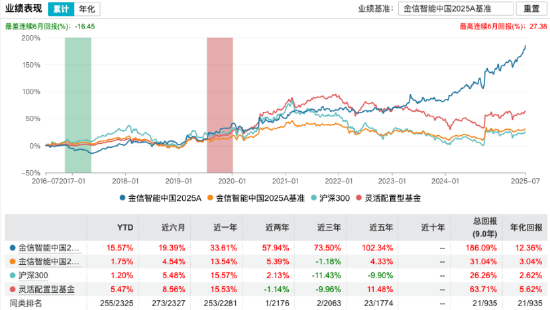
Core Viewpoint - The Jinxin Intelligent China 2025A Fund has shown strong performance, significantly outperforming its benchmark, but its investment strategy has deviated from its stated goals, focusing heavily on bank stocks instead of technology and intelligent enterprises as indicated by its name and contract [1][3][14]. Performance Summary - The fund has increased by 15.57% this year, surpassing its benchmark by 13.82 percentage points [1]. - Over various time frames, including six months, one year, two years, three years, five years, and since inception (July 1, 2016), the fund has achieved a total return of 186.09%, with cumulative excess returns of 155.05% [1]. Investment Portfolio - The fund's top ten holdings are exclusively bank stocks, including major banks such as Bank of Communications, Bank of China, and Agricultural Bank of China, which contrasts sharply with its thematic focus on technology and intelligent enterprises [3][4]. - The fund's investment contract specifies a focus on companies providing intelligent production, design, and services, yet the current portfolio does not align with this objective [5][14]. Historical Context - Initially, the fund's holdings included technology-oriented companies like Jianghuai Automobile and Longdian Technology, with no bank stocks present [8][11]. - A significant shift occurred in Q1 2017, where bank stocks began to dominate the portfolio, culminating in a complete transition to bank stocks by Q1 2020 [11][12]. Fund Management and Strategy - The fund manager has not provided a clear rationale for the ongoing style drift, despite mentioning AI's role in enhancing financial services [12][14]. - The fund's heavy concentration in bank stocks, particularly state-owned and joint-stock banks, raises questions about the alignment between its investment strategy and its stated goals [14][15]. Investor Composition - The fund has a highly retail investor base, with individual investors holding 98.85% of the fund, indicating a potential lack of institutional oversight [6]. Regulatory and Market Implications - The fund has been placed on a "no evaluation" list by professional rating agencies due to its style drift, reflecting growing regulatory scrutiny on such deviations [6][15]. - The case of Jinxin Intelligent China 2025 raises broader questions about the balance between performance and compliance, particularly when a fund's success is achieved through strategies that diverge from its stated objectives [14][15].





13家国有行股份行:上半年17高管职位换新 体现哪些用人特点
Nan Fang Du Shi Bao· 2025-07-06 23:08
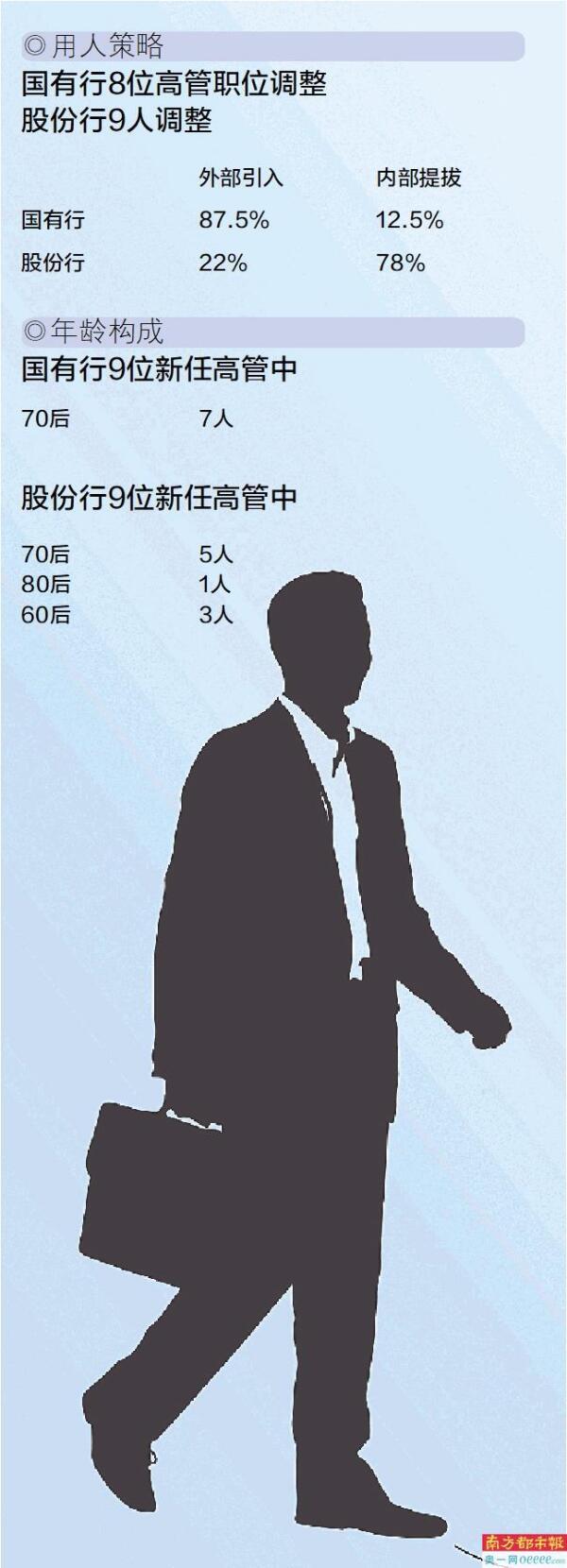
Core Insights - The banking industry is experiencing significant executive turnover in 2025, with 13 banks changing leadership and 17 executives transitioning roles, particularly in the position of vice president, which accounts for 53% of all changes [4][5][6] Group 1: Executive Changes - In the first half of 2025, 13 banks, including 6 state-owned and 12 joint-stock banks, reported executive changes, with 5 state-owned banks and 8 joint-stock banks announcing leadership adjustments [5][6] - The most frequent changes occurred in the vice president role, with 9 new appointments [5][6] - Three banks saw changes in their chairpersons, and three banks appointed new presidents [5][6] Group 2: Recruitment Strategies - State-owned banks predominantly recruit externally, with 87.5% of new executives coming from outside the organization, while joint-stock banks favor internal promotions, with 78% of new executives promoted from within [4][8][9] - Notably, the Agricultural Bank of China had the highest number of executive changes among state-owned banks, appointing three new vice presidents [6][8] Group 3: Age Demographics - The new executive cohort is primarily composed of individuals born in the 1970s, who represent 78% of the new appointments in state-owned banks [12][14] - The age distribution shows that chairpersons are mostly from the 1960s generation, while vice presidents and presidents are predominantly from the 1970s [12][14] - In joint-stock banks, the age structure includes experienced leaders and younger talent, with a significant presence of 1970s-born executives [12][14] Group 4: Implications for Strategy - The shift in executive leadership is seen as a response to the pressures faced by the banking sector, aiming to better align with economic development needs and enhance service to the real economy [11] - The contrasting recruitment strategies between state-owned and joint-stock banks reflect their differing operational needs and talent management approaches [8][11]


银行业周报(20250630-20250706):CIPS规则修订,为何改?改了什么?-20250706
Huachuang Securities· 2025-07-06 12:16
Investment Rating - The report maintains a "Recommended" investment rating for the banking sector, expecting the sector index to outperform the benchmark index by more than 5% in the next 3-6 months [24]. Core Insights - The report highlights the recent revisions to the CIPS (Cross-border Interbank Payment System) rules, which aim to enhance the management of participants and adapt to the growing cross-border e-commerce trade, projected to reach approximately 2.71 trillion yuan in 2024, a 14% year-on-year increase [3][4]. - The CIPS system processed 8.2169 million transactions amounting to 175.49 trillion yuan in 2024, reflecting a significant year-on-year growth of 42.60% [3]. - The report emphasizes the flexibility introduced in the new CIPS rules, allowing financial market infrastructure participants to open CIPS accounts based on business needs rather than strict management requirements [4]. Summary by Sections CIPS Overview - CIPS is a clearing system for cross-border payments in RMB, distinct from SWIFT's messaging system, and has seen a substantial increase in participation, with 174 direct participants and 1,509 indirect participants across 120 countries [2][3]. Recent Developments - The new rules include relaxed entry conditions for system participants, allowing for a more flexible approach to participant management [4]. - The rules specify that foreign direct participants must select domestic direct participants as fund custodians, as foreign banks lack CNAPS accounts [4]. Risk Management Enhancements - The updated regulations detail business processing and risk management requirements, mandating that participants establish robust risk management frameworks and adhere to international anti-money laundering standards [4]. Market Performance - The banking sector index rose by 3.77% during the reporting period, outperforming the CSI 300 index by 2.23 percentage points [8]. - The report suggests a focus on banks with high dividend yields and strong asset quality, recommending major state-owned banks and select regional banks for investment [9]. Company Forecasts - Key banks such as Ningbo Bank, Jiangsu Bank, and China Merchants Bank are highlighted with positive earnings forecasts and investment ratings, indicating strong potential for returns [10].

银行行业资金流入榜:浦发银行等6股净流入资金超亿元
Zheng Quan Shi Bao Wang· 2025-07-04 09:13
Market Overview - The Shanghai Composite Index rose by 0.32% on July 4, with 13 out of 28 sectors experiencing gains, led by the banking and media sectors, which increased by 1.84% and 0.91% respectively [1] - The banking sector topped the gainers list for the day [1] Fund Flow Analysis - The net outflow of capital from the two markets was 21.926 billion yuan, with 8 sectors seeing net inflows [1] - The computer sector had the largest net inflow of 2.811 billion yuan, despite a slight decline of 0.05% [1] - The banking sector also saw a net inflow of 758 million yuan, with a daily increase of 1.84% [1] Banking Sector Performance - The banking sector increased by 1.84% with a total net inflow of 758 million yuan, and all 42 stocks in this sector rose [2] - Among the stocks, 24 experienced net inflows, with 6 stocks receiving over 100 million yuan in net inflows, led by Shanghai Pudong Development Bank with 164 million yuan [2] - Major banks with significant net inflows included Ping An Bank and Minsheng Bank, with net inflows of 159 million yuan and 136 million yuan respectively [2] Individual Bank Stock Performance - The top-performing bank stocks included: - Shanghai Pudong Development Bank: +2.82%, 163.69 million yuan net inflow [2] - Ping An Bank: +2.02%, 158.73 million yuan net inflow [2] - Minsheng Bank: +2.83%, 135.90 million yuan net inflow [2] - Conversely, banks with significant net outflows included: - Everbright Bank: -3.06%, 628.79 million yuan net outflow [3] - China Construction Bank: -1.24%, 519.97 million yuan net outflow [3] - Guiyang Bank: -1.87%, 510.52 million yuan net outflow [3]

平安银行(000001) - 关联交易公告
2025-07-03 09:30
根据《银行保险机构关联交易管理办法》《深圳证券交易所股票上市规则》等相 关规定,本行董事、监事、高级管理人员,以及前述人员的近亲属,董事、监事、高 级管理人员或者其近亲属直接或者间接控制的企业,以及与董事、监事、高级管理人 员有其他关联关系的关联人(以下简称董事、监事、高级管理人员及其相关关联方) 为本行关联方。本行与前述关联方之间的交易构成关联交易。 (三)审议表决情况 根据《公司法》《银行保险机构关联交易管理办法》《深圳证券交易所股票上市 规则》,本次关联交易需经董事会独立董事专门会议、董事会关联交易控制委员会审 议通过后,提交董事会批准,并对外披露。 本行董事会独立董事专门会议和关联交易控制委员会审议通过了《关于与董事、 监事、高级管理人员及其相关关联方关联交易的议案》。本行第十二届董事会第四十 一次会议审议通过了前述关联交易议案。董事对本人、本人近亲属、本人或本人近亲 属直接或者间接控制的企业,以及与本人有其他关联关系的关联人有关的关联交易回 避表决,有表决权的董事一致同意该项议案。 证券代码:000001 证券简称:平安银行 公告编号:2025-031 优先股代码:140002 优先股简称:平银优 ...
平安银行(000001) - 董事会决议公告
2025-07-03 09:30
证券代码:000001 证券简称:平安银行 公告编号:2025-030 优先股代码:140002 优先股简称:平银优 01 平安银行股份有限公司董事会决议公告 本公司及董事会全体成员保证信息披露的内容真实、准确、完整,没有虚假记载、误导 性陈述或重大遗漏。 平安银行股份有限公司(以下简称本行)第十二届董事会第四十一次会议以 书面传签方式召开。会议通知以书面方式于 2025 年 6 月 30 日向各董事发出,表 决截止时间为 2025 年 7 月 3 日。本次会议的召开符合有关法律、法规、规章和 本行章程的规定。会议应到董事 13 人(包括独立董事 5 人),董事长谢永林, 董事冀光恒、郭晓涛、付欣、蔡方方、郭建、项有志、杨志群、杨军、艾春荣、 吴志攀、刘峰和潘敏共 13 人参加了会议。 本次会议审议通过了如下议案: 一、审议通过了《关于修订互联网贷款相关管理办法的议案》。 本行董事会风险管理委员会已审议通过本议案。 本议案同意票 13 票,反对票 0 票,弃权票 0 票。 二、审议通过了《关于与董事、监事、高级管理人员及其相关关联方关联交 易的议案》。 三、审议通过了《关于 2025 年度机构发展规划的议案》 ...