PAB(000001)

Search documents
丈量地方性银行(1):江苏127家区域性银行全梳理-20260123
GF SECURITIES· 2026-01-23 11:08
Investment Rating - The industry investment rating is "Buy" [2] Core Insights - The report provides a comprehensive analysis of 127 regional banks in Jiangsu Province, highlighting their asset and liability structures, profitability, and asset quality [6][18] - Jiangsu's regional banks have shown a significant increase in asset growth, with major city commercial banks growing at 19.4%, surpassing the growth of listed city commercial banks at 14.2% [24][26] - The report indicates that the loan-to-asset ratio for city commercial banks is projected to reach 48.4% in 2024, reflecting a gradual increase in lending activities [30] - Jiangsu's regional banks exhibit better return on assets (ROA) compared to listed banks, with city commercial banks outperforming by 16 basis points and rural commercial banks by 9 basis points [6][42] - The asset quality of Jiangsu's regional banks is superior to that of listed banks, with lower non-performing loan ratios and higher provision coverage ratios [6][42] Summary by Sections 1. Economic Structure of Jiangsu Province - Jiangsu Province is focusing on new industrialization and strategic emerging industries, with significant contributions from cities like Nanjing and Suzhou [13][14] 2. Overview of 127 Regional Banks in Jiangsu - The report categorizes the banks into city commercial banks, rural commercial banks, and others, with a total of 127 banks established between 2006 and 2015 [18][20] 3. Asset/Liability Structure - The asset growth of major city commercial banks is accelerating, while rural commercial banks are experiencing a decline in growth rates [24][26] - The loan-to-asset ratio for city commercial banks is expected to increase to 48.4% by 2024, indicating a shift towards more lending [30] 4. Profitability - Jiangsu's regional banks have a higher ROA compared to listed banks, with city commercial banks showing a 16 basis point advantage [6][42] 5. Asset Quality/Capital Levels - Jiangsu's regional banks maintain a lower non-performing loan ratio compared to listed banks, with city commercial banks having a 30 basis point lower ratio [6][42]



平安银行(000001) - 关联交易公告
2026-01-23 11:00
证券代码:000001 证券简称:平安银行 公告编号:2026-003 优先股代码:140002 优先股简称:平银优 01 平安银行股份有限公司关联交易公告 本公司及董事会全体成员保证信息披露的内容真实、准确、完整,没有虚假记载、误导 性陈述或重大遗漏。 一、关联交易概述 (一)本次关联交易主要内容 平安银行股份有限公司(以下简称平安银行或本行)第十三届董事会第二次 会议审议通过了《关于与部分关联方开展关联交易的议案》,同意给予平安证券 股份有限公司(以下简称平安证券)增额续作同业综合授信额度人民币49亿元, 额度期限1年;同意给予方正证券股份有限公司(以下简称方正证券)增额续作 同业综合授信额度人民币30亿元,额度期限1年;同意给予中国平安保险(集团) 股份有限公司(以下简称中国平安)综合授信额度人民币72亿元,可由中国平安 及其控股的成员公司使用,额度期限1年。同意与平安国际融资租赁有限公司(以 下简称平安租赁)进行授信业务及协定存款业务合作,给予增额续作综合授信额 度人民币95亿元,额度期限1年;协定存款业务预计2026年-2028年间存入本金 不超过人民币150亿元,国家金融监督管理总局规则下,协定存 ...

平安银行(000001) - 董事会决议公告
2026-01-23 11:00
证券代码:000001 证券简称:平安银行 公告编号:2026-002 优先股代码:140002 优先股简称:平银优 01 平安银行股份有限公司董事会决议公告 本公司及董事会全体成员保证信息披露的内容真实、准确、完整,没有虚假记载、误导 性陈述或重大遗漏。 平安银行股份有限公司(以下简称本行)第十三届董事会第二次会议以书面 传签方式召开。会议通知以书面方式于 2026 年 1 月 20 日向各董事发出,表决截 止时间为 2026 年 1 月 23 日。本次会议的召开符合有关法律、法规、规章和本行 章程的规定。会议应参会董事 12 人(包括独立董事 5 人),董事长谢永林,董事 冀光恒、郭晓涛、付欣、蔡方方、项有志、杨志群、杨军、艾春荣、吴志攀、刘 峰和潘敏共 12 人参加了会议。 本次会议审议通过了如下议案: 一、审议通过了《关于优先股股息发放方案的议案》。 同意优先股(简称"平银优 01")2026 年股息发放方案,具体如下: 1、发放金额:以优先股发行量 2 亿股(每股面值人民币 100 元)为基数, 按照票面股息率 4.37%计算,每股优先股派发股息人民币 4.37 元(含税)。本行 本次派发股息合计人 ...
平安银行:拟与关联方开展合计396亿元关联交易
Xin Lang Cai Jing· 2026-01-23 10:52
平安银行公告称,该行第十三届董事会二次会议同意给予平安证券、方正证券、中国平安增额续作同业 综合授信额度49亿元、30亿元、72亿元,期限均为1年;同意与平安租赁开展授信及协定存款业务合 作,增额续作综合授信额度95亿元,期限1年;协定存款业务2026-2028年存入本金不超150亿元。年初 至披露日,该行与上述关联方累计已发生关联交易总金额分别为0.35亿元、0.60亿元、849.96元、0.15亿 元。 ...
银行行业今日净流出资金10.91亿元,招商银行等5股净流出资金超5000万元
Zheng Quan Shi Bao Wang· 2026-01-23 09:36
资金面上看,两市主力资金全天净流出85.76亿元,今日有12个行业主力资金净流入,电力设备行业主 力资金净流入规模居首,该行业今日上涨3.50%,全天净流入资金123.23亿元,其次是有色金属行业, 日涨幅为2.73%,净流入资金为54.32亿元。 主力资金净流出的行业有19个,电子行业主力资金净流出规模居首,全天净流出资金130.25亿元,其次 是通信行业,净流出资金为69.11亿元,净流出资金较多的还有机械设备、公用事业、建筑装饰等行 业。 沪指1月23日上涨0.33%,申万所属行业中,今日上涨的有23个,涨幅居前的行业为电力设备、有色金 属,涨幅分别为3.50%、2.73%。跌幅居前的行业为通信、银行,跌幅分别为1.52%、0.90%。银行行业 位居今日跌幅榜第二。 | 代码 | 简称 | 今日涨跌幅(%) | 今日换手率(%) | 主力资金流量(万元) | | --- | --- | --- | --- | --- | | 600036 | 招商银行 | -0.92 | 0.92 | -90149.12 | | 601166 | 兴业银行 | -1.19 | 0.81 | -26498.17 | | ...



汽车金融精准“添柴” 燃爆“两新”消费热潮
2 1 Shi Ji Jing Ji Bao Dao· 2026-01-23 05:13
Group 1 - The core viewpoint of the articles emphasizes the importance of the automotive industry in driving domestic demand and promoting exports, while highlighting the need for a transition from quantity to quality in the sector, particularly towards new energy and intelligent vehicles [1][8] - The 2026 automotive replacement subsidy policy will be adjusted to a percentage of the new car price, with a maximum subsidy of 20,000 yuan, aimed at stimulating consumer demand and supporting the green transition of the automotive industry [2][5] - The new subsidy structure favors electric vehicles with higher percentages compared to traditional fuel vehicles, targeting the mainstream consumer market and enhancing the penetration of new energy vehicles [2][7] Group 2 - Ping An Bank has established a direct sales model for automotive finance, bypassing traditional dealership distribution, which enhances the efficiency and transparency of the car purchasing process [3][4] - The bank's innovative "public-private linkage" mechanism integrates corporate and retail finance, addressing the funding challenges faced by new energy vehicle manufacturers [5][6] - The bank's marketing strategy includes a comprehensive customer acquisition system, utilizing various channels such as live streaming and social media to generate leads for car dealerships [6][8] Group 3 - The automotive finance sector is positioned as a crucial link between industry and consumer, playing a significant role in promoting green development and fulfilling social responsibilities [6][8] - The ongoing policy support and market trends are expected to sustain the momentum of the new energy vehicle replacement wave into 2026, with financial institutions like Ping An Bank poised to lead in this transformation [8]
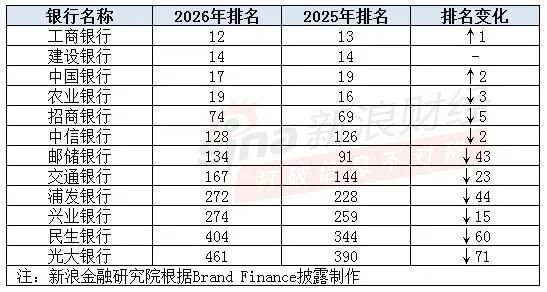
谁能跻身全球品牌价值500强?光大银行下滑71名,民生银行降60名
Xin Lang Cai Jing· 2026-01-23 01:08
1月20日,《Brand Finance 2026年全球品牌价值500强榜单报告》在瑞士达沃斯正式发布。 具体来看,此次有多家银行进入上述榜单,包括工商银行、建设银行、中国银行、农业银 行、招商银行、中信银行、邮储银行、交通银行、浦发银行、兴业银行、民生银行、光大银 行等。与2025年榜单相比,光大银行排名下滑最多,降71个名次至461位;其次是民生银 行,降60个名次至404位。 此外,另有中国平安、中国人寿、中国人保、太平洋保险、友邦保险、保诚保险、国泰人寿 7家中国保险公司上榜。其中,保诚保险排名下滑明显,较上年排位下降117个名次。 | 排名变化 | 2026年排名 | 2025年排名 | 银行名称 | 工商银行 | 12 | 13 | 11 | | --- | --- | --- | --- | --- | --- | --- | --- | | 建设银行 | 1 d | I d | 1 | 12 | 中国银行 | 17 | 19 | | 农业银行 | 19 | J3 | 16 | 招商银行 | 74 | 69 | 1 5 | | 中信银行 | 126 | 128 | V2 | 邮储银行 | 134 ...



多家银行开启 信用卡分期贴息补申请通道
Bei Jing Shang Bao· 2026-01-23 01:05
Core Viewpoint - The new personal consumption loan interest subsidy policy aims to enhance consumer spending by expanding the scope of eligible loans and simplifying the application process for consumers [1][4]. Group 1: Policy Implementation - The Ministry of Finance, the People's Bank of China, and the financial regulatory authority jointly issued a notice to optimize the implementation of the personal consumption loan interest subsidy policy [1]. - The subsidy period for personal consumption loans is set from September 1, 2025, to December 31, 2026, while the credit card installment subsidy period is from January 1, 2026, to December 31, 2026 [1]. - Major banks, including ICBC, ABC, Bank of China, and others, have quickly responded by issuing operational guidelines and FAQs regarding the subsidy services [1][2]. Group 2: Eligibility and Application Process - Customers who have previously signed consumption loan subsidy agreements do not need to re-sign; the new policy will automatically apply to their existing loans [2]. - For credit card installment services newly included in the subsidy, banks like Postal Savings Bank and Agricultural Bank have outlined specific application paths for customers [2][3]. - Agricultural Bank requires customers to sign a supplementary agreement for credit card installment subsidies, with each card needing a separate agreement [3]. Group 3: Impact on Interest Rates - The new policy includes a 1% annual subsidy rate for credit card installments, which could lower the effective interest rate for eligible borrowers to the "2% range" after subsidies [4]. - The minimum execution interest rate for consumption loans remains at 3%, indicating potential benefits for borrowers with good credit ratings [4].



银行信贷的冷与热
Sou Hu Cai Jing· 2026-01-22 23:10
Core Viewpoint - The recent changes in bank credit lending rates reflect a strategic shift by banks towards more stable lending options, with operational loans seeing a decline in interest rates while personal consumption loans remain stable at around 3% [1][2]. Group 1: Operational Loans - The decline in operational loan rates is attributed to banks' current asset logic, as lower deposit rates reduce funding costs, allowing banks to offer more competitive rates [1]. - Operational loans are preferred due to their collateral backing, flexible terms, and ability to integrate with business operations, which helps banks maintain customer relationships and overall profitability [1][3]. - Despite lower interest rates, banks are willing to compress margins on operational loans to increase volume, indicating a strategic focus on securing stable lending opportunities [1]. Group 2: Personal Consumption Loans - Personal consumption loans face constraints due to risk and demand factors, with banks being more sensitive to risks in the current economic climate [2]. - The stability of personal consumption loan rates at around 3% is close to the risk pricing floor, making further reductions potentially unwise [2]. - Regulatory scrutiny and previous issues with low-cost consumption loans have led banks to tighten risk controls, making it difficult for consumption loans to become cheaper [2][3]. Group 3: Credit Structure and Market Response - The differentiation in credit lending is a response to policy boundaries, with fiscal subsidies and targeted support for consumption loans not leading to unrestricted lending [2]. - The current credit structure reflects banks' adaptation to economic changes, with operational loans supporting supply-side stability while consumption loans await improved consumer confidence [3]. - The tightening of approval processes for consumption loans, alongside competitive pricing for operational loans, illustrates banks' balancing act between maintaining loan volumes and managing risks [3].
多家银行发文明确信用卡账单分期贴息细节,开启补申请通道
Bei Jing Shang Bao· 2026-01-22 09:37
Core Viewpoint - The Chinese government has introduced a new personal consumption loan interest subsidy policy, which aims to enhance consumer spending and stimulate the economy by providing financial incentives through interest subsidies on personal loans and credit card installments [1][3]. Group 1: Policy Implementation - The new subsidy policy will be effective from September 1, 2025, to December 31, 2026, for personal consumption loans, while the credit card installment subsidy period will be from January 1, 2026, to December 31, 2026 [3]. - The policy expands the support scope by including credit card installment payments for the first time, with a subsidy rate of 1% per annum, and removes previous restrictions on consumption areas [3][4]. Group 2: Bank Responses - Major banks such as ICBC, ABC, BOC, CCB, and others have quickly responded by issuing operational guidelines and clarifications regarding the implementation of the subsidy policy [2][3]. - Banks have confirmed that customers who have already signed consumption loan subsidy agreements will automatically benefit from the new policy without needing to re-sign agreements [4][5]. Group 3: Customer Guidance - Customers are required to sign a supplementary agreement for credit card installment subsidies, with each card needing a separate agreement to benefit from the subsidy during the policy period [5][6]. - Banks are advised to streamline the process for customers to access the subsidy, including online application portals and clear communication of interest rates and subsidy limits [6][7]. Group 4: Market Impact - The minimum execution interest rate for consumption loans remains at 3%, but with the subsidy, the effective interest rate for eligible borrowers could potentially drop to the "2% range" [7].