PAB(000001)

Search documents
3.5亿诈骗案最新进展!招商银行、平安银行等被光大银行起诉
Xin Lang Cai Jing· 2026-01-26 00:55
历经多年,一桩涉及多家银行的3.5亿诈骗案迎来最新进展! 近日,锦龙股份披露,其子公司中山证券收到一份《应诉通知书》,其中显示,光大银行长 春分行作为原告,向中山证券、招商银行无锡分行、平安银行深圳分行、深圳国民基金等五 名被告要求连带赔偿3.5亿元本金,以及1.394亿元资金占用费,涉案金额高达4.89亿元。 5月30日,光大银行长春分行以同业存款形式向招商银行无锡分行存入3.5亿元。招商银行无 锡分行根据与光大银行长春分行签订的《委托定向投资协议》及《投资指令》、与中山证券 事实上,上述案件已历经多次开庭审理,甚至已达最高人民法院,至今仍未尘埃落定。而此 案的背后,是一名公司法人与银行职员"里应外合",通过虚假材料等制造的一场刑事案件。 公司法人"精心策划"3.5亿诈骗案,行长助理擅自修改财报数据 回溯过往,上述案件的开端,始于柳河聚鑫源米业有限公司(以下简称 "聚鑫源公司")及 其法定代表人刘某某。相关判决书显示,2013年下半年,刘某某通过他人介绍,认识了时任 光大银行长春分行汽车厂支行行长助理的张某。 而后,刘某某以聚鑫源公司需购粮资金等为由,隐瞒该公司具有巨额债务需要偿还及其本人 炒作期货的事实, ...



这家券商陷3.5亿“通道”迷局漩涡!谁该为“假公章”买单?
券商中国· 2026-01-25 23:25
Core Viewpoint - The article discusses a legal dispute involving Jinlong Co., Ltd. and Zhongshan Securities, stemming from a channel business transaction that occurred a decade ago, highlighting the ongoing risks and responsibilities associated with such financial arrangements [2][3][4]. Group 1: Background of the Dispute - The dispute originated from a 3.5 billion yuan transaction where Everbright Bank's Changchun branch claims its funds were misappropriated through fraudulent activities involving employees and the actual controller of the financing party [2][4]. - The lawsuit seeks a total of 489 million yuan, including damages for the occupied funds, as Everbright Bank alleges that the involved parties should bear joint liability for the losses incurred [4][11]. Group 2: Legal Proceedings and Historical Context - This is not the first lawsuit; Everbright Bank previously sued the Wuxi branch of China Merchants Bank in 2015 over the same issue but lost the case [6][8]. - The Supreme Court ruled that the agreements involved were fraudulent and did not reflect the true intentions of Everbright Bank, leading to a dismissal of their claims [8][9]. Group 3: Implications for Channel Business - The article emphasizes the ongoing scrutiny of channel business practices, particularly after the introduction of asset management regulations aimed at curbing such activities [11][12]. - Judicial precedents indicate that channel providers may be held liable for losses, as seen in cases where trust companies were required to compensate investors for negligence in managing channel business [10][12].



黄金跌价,金条跌价,26年1月21日,各大金店黄金、金条最新价格
Sou Hu Cai Jing· 2026-01-25 16:51
Group 1: Gold Market Dynamics - International gold prices are experiencing fluctuations, leading to adjustments in domestic high-end jewelry brand prices, with Chow Tai Fook quoting 1455 CNY/gram, Lao Feng Xiang at 1456 CNY/gram, and others around 1453 CNY/gram for gold [1] - Platinum prices remain high at around 940 CNY/gram, while discounts on gold jewelry are increasing, reflecting a cautious consumer sentiment and a relatively quiet market [1] Group 2: RMB Gold Prices - The Shanghai Gold Exchange reports the RMB-denominated gold spot price at 1047.60 CNY/gram, a slight increase of 2.33 CNY or 0.223% from the previous day, with a trading range between 1042.74 CNY and 1048.50 CNY [6] - Retail prices for gold jewelry or bars are higher than the exchange prices due to additional costs such as design and processing, influenced by international market fluctuations, exchange rates, and domestic supply and demand [6] Group 3: Financial Institutions Gold Bar Prices - Various financial institutions have set their gold bar prices, with China Construction Bank at 1050.74 CNY/gram, Industrial and Commercial Bank at 1050.58 CNY/gram, and others ranging from 1049.2 CNY to 1096.5 CNY per gram [7][8][9][10][11][12][13] Group 4: Wholesale and Retail Price Differences - The wholesale price for gold in Shui Bei is approximately 1203 CNY/gram, with significant price differences compared to retail prices, which can be attributed to store rent, operational costs, and brand premiums [14] - The pricing structure for jewelry includes "gold value + processing fee + brand premium," indicating a need for consumers to be aware of the price alignment with base gold prices when investing [14] Group 5: Domestic Gold Price Trends and Market Analysis - Current gold prices are reported at 1047.00 CNY/gram, with a slight increase of 0.11%, while platinum prices are at 606.79 CNY/gram, reflecting a 0.72% increase [15] - Despite rising gold prices, consumer purchasing enthusiasm is declining, with a reported 7.95% year-on-year decrease in gold consumption and a 32.50% drop in gold jewelry consumption in the first three quarters of 2025 [15] Group 6: Retail Strategies and Market Outlook - Brands are adopting strategies like trade-in programs to lower consumer purchase barriers, while research indicates that retailers need to enhance profit margins per gram of gold jewelry and optimize product offerings [16] - The technical structure of gold prices remains in an upward channel, but with weakening momentum, influenced by a strong dollar and rising real interest rates, which increase the opportunity cost of holding gold [17]




3家股份银行的卫星先后上天 除了楼盘风险监测,还有什么神通?
Mei Ri Jing Ji Xin Wen· 2026-01-25 12:44
Core Viewpoint - The successful launch of "Zhaoyin Jinkui" and "Puyin Shuzhi" satellites marks a significant advancement in the banking sector's integration of satellite technology, enhancing financial services and risk management capabilities [1][2]. Group 1: Satellite Launches and Applications - The "Zhaoyin Jinkui" satellite and "Puyin Shuzhi" satellite are part of China's first global low-orbit satellite IoT constellation, "Tianqi Constellation," developed by Beijing Guodian Gaoke Technology Co., Ltd [1]. - Prior to this, China Merchants Bank launched "Zhaoyin 1" and "Zhaoyin 2" satellites in 2024 and 2025, respectively, while Ping An Bank launched "Ping An 1" and "Ping An 2" in 2020 and 2022 [1][2]. - The satellites are utilized in various fields such as supply chain finance, real estate risk monitoring, and cross-border asset and trade supervision, creating a digital risk control system and emergency communication network [1][2]. Group 2: Specific Applications and Innovations - Ping An Bank's "Ping An 1" satellite enables data transmission from remote areas, enhancing the bank's ability to monitor operational data from factories and farms [2]. - The "Ping An 2" satellite improves communication stability and helps the bank access real-time supply chain data, thereby enhancing its financial service capabilities [2][3]. - China Merchants Bank employs satellite technology for high-precision monitoring of real estate construction progress, achieving over 95% accuracy in risk management for mortgage projects [4]. Group 3: Emergency Communication and Risk Management - The banks emphasize the importance of satellite communication for emergency scenarios, allowing data transmission even in areas without ground signal coverage [6]. - China Merchants Bank has initiated tests for low-orbit satellite communication technology in its financial disaster recovery systems, enhancing business continuity in extreme situations [6]. - Ping An Bank and Shanghai Pudong Development Bank plan to leverage the "Tianqi Constellation" for innovative applications in financial asset lifecycle management and rapid recovery of essential financial services during disasters [6]. Group 4: Industry Trends and Future Directions - The banking sector's investment in satellite technology aligns with the rapid development of China's commercial space industry, with banks exploring various applications to enhance service delivery and reduce costs [7]. - China Merchants Bank's subsidiary has initiated the first domestic SPV satellite leasing business, addressing the financing needs of commercial space enterprises [7]. - Other banks, such as Industrial and Commercial Bank of China and Xingye Bank, are also integrating satellite remote sensing technology into their operations to improve risk management and monitoring capabilities [8].

金融行业周报(2026、01、25):业绩比较基准新规正式落地,坚定保险中长期向好逻辑-20260125
Western Securities· 2026-01-25 10:30
Investment Rating - The report maintains a positive long-term outlook for the insurance sector, indicating a strong continuity in market performance despite recent fluctuations [2][12][16]. Core Insights - The financial sector experienced a mixed performance this week, with the non-bank financial index down by 1.45%, underperforming the CSI 300 index by 0.83 percentage points. The insurance sector saw a decline of 4.02%, while the brokerage sector decreased by 0.61% [1][10]. - The insurance sector's performance is driven by two main factors: policy support leading to economic recovery and liquidity easing combined with a strong stock market. The report suggests a shift from liquidity-driven growth to a focus on macro policy support and economic recovery expectations [2][13][16]. - The brokerage sector is expected to benefit from new regulations that enhance investment management quality, with a recommendation to focus on larger, undervalued firms and those involved in mergers and acquisitions [3][18]. - The banking sector is facing a slight decline, but there are signs of recovery in profitability for leading banks, with recommendations to focus on banks with high dividend yields and those expected to benefit from market conditions [19][21]. Summary by Sections Insurance Sector - The insurance sector's recent decline is attributed to short-term market sentiment and liquidity changes, but the long-term outlook remains positive due to strong support from both the liability and asset sides [2][12][16]. - Key recommendations include focusing on companies like China Pacific Insurance, China Ping An, China Life (H), and China Taiping, with a specific recommendation for New China Life [4][16]. Brokerage Sector - The brokerage sector's performance is slightly better than the overall market, with a focus on the new guidelines from the regulatory body that aim to improve fund management quality [3][17]. - Recommended firms include Guotai Junan, Huatai Securities, and others, particularly those with strong merger and acquisition prospects [4][18]. Banking Sector - The banking sector has shown a decline but is expected to stabilize, with recommendations to focus on banks with high earnings elasticity and strong dividend yields [19][21]. - Specific banks to watch include Hangzhou Bank, Ningbo Bank, and others, with a focus on those that have previously been undervalued [4][21].




个人贷款不良率骤增 银行超低折竞抛
经济观察报· 2026-01-25 04:58
Core Viewpoint - The article discusses the increasing trend of personal non-performing loan (NPL) transfers in the banking sector, driven by regulatory changes and the rising pressure of bad debts on financial institutions [1][5]. Group 1: Market Dynamics - The personal NPL transfer market is experiencing a surge, with transaction volumes rising from 186.48 billion in 2021 to 965.30 billion in 2023, and projected to reach 1583.50 billion in 2024 [3][4]. - As of January 22, 2026, there were 20 new announcements for personal NPL transfers within the month, indicating heightened activity in the market [2][8]. - The average discount rate for personal NPL packages has significantly decreased, with rates dropping from 8%-10% before 2023 to around 5% in 2026 [10][11]. Group 2: Regulatory Impact - A regulatory notification extended the trial period for bulk transfers of personal NPLs until December 31, 2026, allowing a wider range of financial institutions to participate in the transfer process [2][4]. - The expansion of trial institutions to include city commercial banks and rural commercial banks has led to a notable increase in the volume of NPL transfers [5][17]. Group 3: Borrower Profile and Economic Context - The borrower demographic for personal NPLs includes failed entrepreneurs, unemployed individuals relying on credit cards for living expenses, and consumers with excessive debt [4][20]. - The economic backdrop, characterized by macroeconomic fluctuations and income instability, has exacerbated the bad debt situation, compelling banks to offload risk assets [5][20]. Group 4: Challenges in Asset Recovery - The recovery rates for NPLs have declined, with some packages facing average recovery rates below 6%, marking the lowest in five years [12][13]. - Financial institutions are facing challenges in asset valuation and recovery due to incomplete documentation and inefficient legal processes [26][28]. Group 5: Strategic Adjustments - Banks are adapting their strategies by improving the quality of NPL packages, such as reducing overdue times and increasing the concentration of borrowers in economically developed areas [24][25]. - There is a push for enhanced transparency and standardization in the NPL transfer process to improve market confidence and asset pricing [28].

金融行研系列:17 中国私人银行业2025发展报告
Xin Lang Cai Jing· 2026-01-24 23:03
Core Insights - The Chinese private banking industry is undergoing a historic shift from "scale expansion" to "value cultivation," with high-quality growth expected by 2025 [3][4] - The number of high-net-worth individuals (HNWIs) in China has surpassed 3 million, with assets under management (AUM) reaching 24.6 trillion yuan, projected to grow to 42 trillion yuan by 2030, reflecting a compound annual growth rate (CAGR) of 9.5% [3][6] - The market is characterized by a dual trend of "head concentration and distinctive breakthroughs," with major state-owned banks dominating the sector [3][8] Industry Overview - The private banking sector in China continues to show steady growth, with AUM reaching 18.8 trillion yuan by mid-2025, a 9.3% increase from the end of 2024 [5][6] - The number of clients served by 16 banks reached 1.649 million, a year-on-year growth of 13.17% [5] - The market is highly concentrated, with the top four state-owned banks holding nearly 70% of the total AUM among the 12 major private banks [8][7] Market Dynamics - Business innovation is becoming a new driving force for industry development, with family trusts and insurance trusts experiencing rapid growth [4][19] - By Q3 2025, the total scale of family trusts exceeded 950 billion yuan, while insurance trusts reached 420 billion yuan, reflecting growth rates of 5.6% and 19.1% respectively [4][19] - The industry faces challenges such as stricter regulations, talent shortages, and intensified competition [4][29] Client Demographics - The number of high-net-worth families in China reached 2.066 million by 2025, with the total wealth of billionaires growing to 1.8 trillion USD, a 22.2% increase [12][6] - The average age of high-net-worth individuals is 35, with a significant portion being young entrepreneurs [13][12] - The income sources of high-net-worth individuals are diverse, with business income being the primary source [13][16] Business Model Innovations - Family office services are rapidly developing, with over 85% of private banking departments establishing independent family office service systems by the end of 2023 [22] - The demand for family office services is expected to grow, with annual expenditures on tax planning projected to reach 2.8 million yuan by 2025 [23] - ESG investments are becoming a key focus, with ESG-themed financial products seeing significant growth [24][25] Digital Transformation - The digital transformation of the private banking sector is entering a deepening phase, with at least 60% of institutions expected to adopt AI-driven advisory systems by 2025 [26][27] - Technology investments are projected to exceed 4.8 billion yuan, with a CAGR of 27.3% [26] - The integration of digital services is crucial for enhancing customer experience and operational efficiency [28] Regulatory Environment - The regulatory environment is becoming stricter, leading to increased compliance costs, which are expected to rise by 23 percentage points of operating income [29][30] - The implementation of new asset management regulations is reshaping product design and increasing the entry barriers for new players [29][30] Talent Shortage - The private banking industry faces a significant talent shortage, with a demand gap of approximately 24,000 professional bankers by 2025 [33][34] - The ratio of talent supply to demand is 1:8, indicating a critical need for skilled professionals [33] - The industry is increasingly focusing on talent training and recruitment to address this gap [34]




多家银行公告!落实个人消费贷款最新财政贴息政策
Sou Hu Cai Jing· 2026-01-23 19:43
Core Viewpoint - The implementation of the latest fiscal interest subsidy policy for personal consumption loans aims to boost consumption and expand domestic demand, with several major banks actively participating in this initiative [1][6][7][8][9]. Group 1: Policy Implementation - The fiscal interest subsidy policy for personal consumption loans has been extended until December 31, 2026, covering the period from September 1, 2025, to December 31, 2026 [6][10]. - The credit card installment payment subsidy policy will be effective from January 1, 2026, to December 31, 2026 [6]. Group 2: Policy Optimization - The policy has been optimized to include credit card installment payments, expanding the support range [9][11]. - The subsidy criteria have been broadened by removing the restriction on single transactions of 50,000 yuan and above [9][12]. - The subsidy standards have been improved by eliminating the 500 yuan cap on single transaction subsidies and the 1,000 yuan cap for individual borrowers at the same financial institution [9][12]. - Customers who have previously signed the personal consumption loan subsidy agreement will automatically benefit from the new subsidy policy starting January 1, 2026, without needing to re-sign the agreement [12].

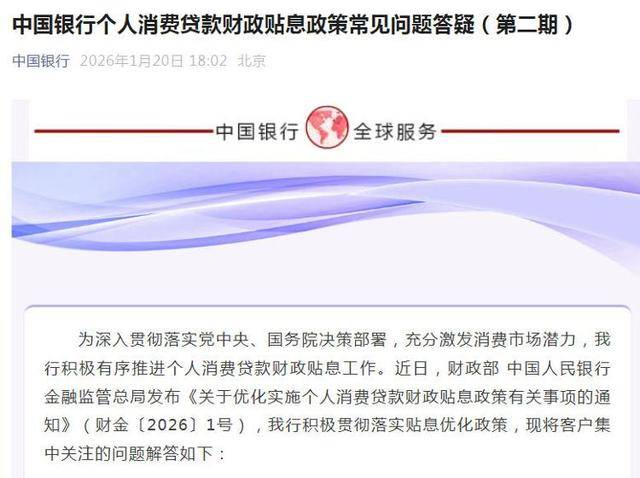
超10家银行落地消费贷贴息细则!多家农商行加入
Guo Ji Jin Rong Bao· 2026-01-23 14:27
Core Viewpoint - Major banks are rapidly implementing optimized personal consumption loan interest subsidy policies, with over 10 banks having released operational guidelines as of January 23, 2023, indicating a strong response to the government's initiative [1][2]. Group 1: Implementation of Policies - The Ministry of Finance and other departments introduced an optimized personal consumption loan interest subsidy policy on January 20, 2023, leading to immediate responses from six major state-owned banks and several joint-stock banks [2]. - Banks will provide services under the adjusted interest subsidy policy starting January 1, 2026, for eligible personal consumption loan and credit card installment customers, with automatic application of the new policy for existing agreements [2]. - Credit card installment services have been included in the subsidy scope, with banks offering convenient application methods for customers [2]. Group 2: Compliance and Security Measures - Banks have stated that no additional fees will be charged during the processing of personal consumption loans and credit card installment interest subsidy services, emphasizing the importance of safeguarding personal property and information against fraud [3]. - The Industrial and Commercial Bank of China has prohibited the provision of false documentation or illegal loan applications, with strict penalties for those who attempt to fraudulently obtain subsidy funds [3]. Group 3: Expansion of Participating Institutions - The policy optimization has expanded the range of participating institutions, allowing local financial institutions, including city commercial banks and rural cooperative financial institutions with a rating of 3A or above, to be included in the subsidy program [4][5]. - Several local financial institutions, such as Shangyu Rural Commercial Bank and Linhai Rural Commercial Bank, have joined the subsidy initiative, indicating a broader implementation of the policy [5]. Group 4: Industry Insights - Analysts suggest that the current fiscal subsidy, combined with recent structural interest rate cuts, may help mitigate downward pressure on asset yields and support banks' net interest margins [5][6]. - The upcoming maturity and repricing of high-interest fixed-term deposits in 2026, along with accelerated optimization of funding costs, are expected to narrow the decline in banks' interest margins and improve the certainty of stabilization [6].
25Q4基金对银行持仓点评:主动基金环比持平,被动基金增持
GUOTAI HAITONG SECURITIES· 2026-01-23 11:10
股票研究 /[Table_Date] 2026.01.23 票 研 究 主动基金环比持平,被动基金增持 [Table_Industry] 商业银行 | [姓名table_Authors] | 电话 | 邮箱 | 登记编号 | | --- | --- | --- | --- | | 马婷婷(分析师) | 021-23185608 | matingting@gtht.com | S0880525100001 | | 陈惠琴(分析师) | 021-38676666 | chenhuiqin@gtht.com | S0880525100003 | 本报告导读: 25Q4 主动基金对银行持仓比例环比持平于 1.9%,被动基金持仓比例环比+1.6pct 至 7.0%,其中宁波银行、兴业银行、中国银行、建设银行等获主动基金增配。 25Q4 基金对银行持仓点评 投资要点: [Table_Summary] 2025 年四季度基金重仓持股情况披露(主动基金包括普通股票型、 偏股混合型、灵活配置型,被动基金包括被动指数型、指数增强型): [Table_Report] 相关报告 商业银行《国有大行投放力度较大,不良压力或 企稳》20 ...