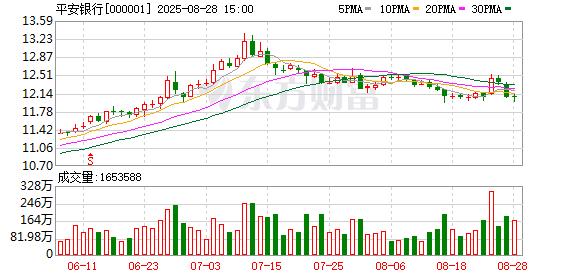
PAB(000001)

Search documents
货币市场日报:8月29日
Xin Hua Cai Jing· 2025-08-29 15:34
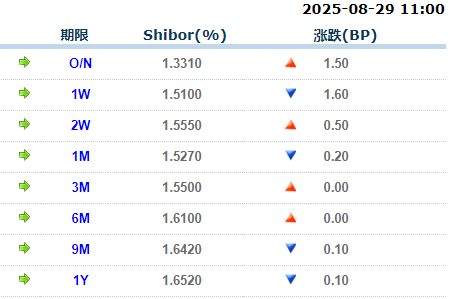
Monetary Policy and Market Operations - The People's Bank of China conducted a 7-day reverse repurchase operation of 782.9 billion yuan at an interest rate of 1.40%, maintaining the previous rate; with 361.2 billion yuan of reverse repos maturing, the net injection was 421.7 billion yuan [1] - This week, the central bank performed a total of 2.2731 trillion yuan in reverse repos and 600 billion yuan in one-year Medium-term Lending Facility (MLF) operations, resulting in a total net injection of 496.1 billion yuan after accounting for maturing operations [1] Interbank Market Rates - The Shanghai Interbank Offered Rate (Shibor) for short-term products remained stable, with the 7-day Shibor slightly declining; specifically, the overnight Shibor rose by 1.50 basis points to 1.3310%, while the 7-day Shibor fell by 1.60 basis points to 1.5100% [2][3] - The weighted average rates for various repo products showed mixed movements, with DR001 and R001 increasing by 1.6 basis points and 5.4 basis points respectively, while DR007 and R007 decreased by 2.4 basis points and 4.7 basis points [4] Funding Conditions - The funding environment on August 29 was characterized by a balanced and slightly loose stance; overnight rates for non-bank institutions were around 1.65%, while 7-day rates were approximately 1.55% [9] - Following the central bank's operations, the funding market became more relaxed, with overnight rates stabilizing around 1.45% and 7-day rates between 1.48% and 1.50% [9] Banking Sector Performance - Industrial and Commercial Bank of China reported a revenue of 409.08 billion yuan for the first half of 2025, a year-on-year increase of 1.8%, with a net profit of 168.80 billion yuan and a non-performing loan ratio of 1.33% [12] - Postal Savings Bank achieved a revenue of 179.45 billion yuan, up 1.5%, with a net profit of 49.23 billion yuan, reflecting a growth of 0.85% [12] - Bank of China reported a revenue of 329.4 billion yuan, a 3.61% increase, with a net profit of 126.1 billion yuan, showing stable performance [12] - Agricultural Bank of China posted a revenue of 369.8 billion yuan, up 0.7%, and a net profit of 139.9 billion yuan, reflecting a 2.5% increase [12] - China Merchants Bank's revenue decreased by 1.73% to 169.92 billion yuan, while its net profit increased by 0.25% to 74.93 billion yuan [13] - Everbright Bank reported a revenue of 65.92 billion yuan and a net profit of 24.74 billion yuan, marking a 0.5% increase [14]







上海多家银行房贷细则落地,新增二套房利率最低3.09%
2 1 Shi Ji Jing Ji Bao Dao· 2025-08-29 13:27
Core Viewpoint - Shanghai's housing market has introduced new mortgage interest rate pricing mechanisms, eliminating the distinction between first and second home loans, aiming to optimize the real estate policy and stimulate market activity [2][3]. Group 1: New Mortgage Policies - Multiple banks in Shanghai have released announcements regarding the optimization of commercial personal housing loan interest rate pricing mechanisms, aligning with the recent government notification [2]. - The new policy states that the specific interest rate for each customer's commercial personal housing loan will be determined based on the Shanghai market interest rate pricing self-discipline mechanism, along with the bank's operational status and customer risk profile [2][4]. Group 2: Existing Loan Adjustments - For existing loans, banks will continue to follow the previous year's guidelines, allowing adjustments for certain second home loans that exceed the average interest rate of newly issued loans by more than 30 basis points [3]. - The weighted average interest rate for newly issued commercial personal housing loans in China was reported at 3.09% for Q2 2025, a decrease of 2 basis points from Q1, indicating potential for lower rates for second home loans in Shanghai [3][4]. Group 3: Regulatory Framework - The central bank's adjustments include four main points, notably the removal of the distinction between first and second home loan interest rates and the emphasis on banks to adhere to market conditions and government regulations [3][4]. - Banks are required to ensure compliance with the new policies, providing adequate communication and support to borrowers regarding their rights and the implications of the new interest rate structures [4].


上海多家银行房贷细则落地,新增二套房利率最低3.09%
21世纪经济报道· 2025-08-29 12:42
Core Viewpoint - The article discusses the recent adjustments to the housing loan interest rate pricing mechanism in Shanghai, which aims to optimize the real estate policy and enhance market stability [2][4]. Group 1: New Housing Loan Policies - The new pricing mechanism for commercial personal housing loans no longer distinguishes between first and second homes, allowing for a more unified approach to interest rates [3][4]. - The specific interest rate for each customer's loan will be determined based on the Shanghai market interest rate pricing self-discipline mechanism, along with the bank's operational conditions and customer risk profiles [3][4]. Group 2: Existing Housing Loan Adjustments - Existing housing loans will continue to follow the guidelines established in October of the previous year, allowing for adjustments in the interest rates of certain second-home loans based on market conditions [3][4]. - If the interest rate increase for existing loans exceeds 30 basis points above the average rate of newly issued loans, borrowers can apply for a rate adjustment [3][4]. Group 3: Market Context and Implications - As of July, the weighted average interest rate for newly issued commercial personal housing loans in China was 3.09%, a slight decrease from the previous quarter, while the 5-year LPR was 3.5% [3]. - For second-home owners in Shanghai, applying for a loan after September 1 could result in a minimum interest rate of 3.09%, aligning with first-home rates, while existing loans at 3.45% could potentially be reduced to 3.36% [3].

上海多家银行房贷利率细则落地 新增二套房贷利率最低3.09%
Xin Lang Cai Jing· 2025-08-29 12:13
8月25日上海市六部门联合印发《关于优化调整本市房地产政策措施的通知》。8月29日晚间,有中国银 行、农业银行、建设银行、招商银行、平安银行、光大银行、北京银行、江苏银行、南京银行等多家银 行上海市分行通过官方微信公众号发布《关于优化调整商业性个人住房贷款利率定价机制的公告》,各 家银行《公告》内容一致。新增方面,在利率定价机制安排上,各行不再区分首套住房和二套住房。每 位客户商业性个人住房贷款的具体利率水平,将根据上海市市场利率定价自律机制要求,并结合本行经 营状况、客户风险状况等因素合理确定。对于上海二套房业主来说,如果在9月1日以后申请房贷,最低 利率有望达到3.09%,与首套房房贷利率保持一致。而存量房贷利率为3.45%的二套房贷款可申请降低 房贷利率至3.36%。这与人民银行上海市分行此前发布的调整要求相一致。(21财经) ...
新增二套房贷利率最低3.09%!上海多家银行房贷利率细则落地
2 1 Shi Ji Jing Ji Bao Dao· 2025-08-29 11:46
Core Viewpoint - Shanghai's housing market has introduced new mortgage interest rate pricing mechanisms, eliminating the distinction between first and second home loans, aiming to optimize the real estate policy in the city [1][4]. Group 1: New Mortgage Policies - The new mortgage interest rate pricing mechanism will no longer differentiate between first and second homes, with rates determined based on the Shanghai market interest rate self-discipline mechanism and individual bank conditions [2][4]. - For new loans, the specific interest rate will be set according to market conditions and customer risk profiles [2][4]. Group 2: Existing Loan Adjustments - Existing loan policies will continue to follow the adjustments made in October of the previous year, allowing for the adjustment of interest rates on certain second home loans if they exceed the average new loan rate by 30 basis points [2][3]. - The minimum interest rate for second home loans applied after September 1 is expected to align with the first home loan rate at 3.09%, while existing loans at 3.45% could be reduced to 3.36% [3]. Group 3: Regulatory Framework - The central bank's adjustments include guidelines for banks to ensure compliance with market order and to provide clear communication regarding the new policies to borrowers [4]. - Banks are expected to enhance their pricing autonomy while maintaining consistency in mortgage pricing across the sector [4].
国企共赢ETF: 平安富时中国国企开放共赢交易型开放式指数证券投资基金2025年中期报告
Zheng Quan Zhi Xing· 2025-08-29 11:29
Core Viewpoint - The report provides an overview of the performance and management of the Ping An FTSE China State-Owned Enterprises Open Win ETF for the first half of 2025, highlighting its investment strategy, financial performance, and market outlook. Fund Overview - Fund Name: Ping An FTSE China State-Owned Enterprises Open Win ETF - Fund Manager: Ping An Fund Management Co., Ltd. - Fund Custodian: Ping An Bank Co., Ltd. - Total Fund Shares at Period End: 61,195,986 shares [1] - Fund Contract Effective Date: December 17, 2021 [1] Investment Strategy - The fund primarily employs a full replication method to closely track the performance of the underlying index, aiming to minimize tracking deviation and error [1]. - The fund's investment strategy includes stock investments, bond and money market instruments, financial derivatives, and asset-backed securities [1]. Financial Performance - Realized income for the period: -6,271,980.04 RMB - Total profit for the period: -19,729,568.80 RMB - Weighted average net value profit rate: -8.88% [3] - Net asset value at period end: 93,995,204.25 RMB - Fund share net value growth rate: -4.50% [3] Performance Comparison - The fund's annualized tracking error was 0.98%, indicating effective management in tracking the index [9]. - The fund's share net value at the end of the reporting period was 1.5360 RMB, with a cumulative net value growth rate of 53.60% since inception [3][9]. Market Outlook - The report anticipates a stable economic growth rate of around 5% for the year, supported by fiscal and monetary policies aimed at expanding domestic demand [9]. - The A-share market is expected to show resilience against external negative factors, indicating a potential for sustained investment value in Chinese assets [9].
国开债券ETF: 平安中债-0-3年国开行债券交易型开放式指数证券投资基金2025年中期报告
Zheng Quan Zhi Xing· 2025-08-29 11:22
Fund Overview - The fund is named "Ping An Zhongzhai-0-3 Year National Development Bank Bond ETF" and is managed by Ping An Fund Management Co., Ltd. [1] - The fund aims to closely track the underlying index, targeting an average tracking deviation of no more than 0.25% and an annualized tracking error of no more than 3% [1][2]. - The fund was established on September 1, 2022, and its shares are traded on the Shenzhen Stock Exchange [1]. Financial Performance - The fund achieved a realized income of CNY 15,116,613.31 and a profit of CNY 2,851,224.44 during the reporting period from January 1, 2025, to June 30, 2025 [2][3]. - The weighted average net value profit rate for the period was 0.21%, with a net asset value of CNY 1,008,139,154.66 at the end of the reporting period [2][3]. - The fund's share net value growth rate was 0.29%, while the cumulative net value growth rate since inception was 6.25% [2][3]. Investment Strategy - The fund employs a passive management strategy using representative stratified sampling to replicate the characteristics of the underlying index [1][6]. - The average daily tracking deviation during the reporting period was 0.02%, with an annualized tracking error of 0.33%, indicating effective tracking of the underlying index [6]. Market Conditions - The bond market faced challenges due to a conservative stance from the central bank regarding liquidity, with the 10-year government bond yield reaching 1.9% [7][8]. - The market is expected to remain volatile, with the 10-year government bond likely to experience fluctuations in the second half of the year [8]. Management and Governance - Ping An Fund Management Co., Ltd. has been managing the fund in compliance with relevant laws and regulations, ensuring the protection of investors' interests [5][9]. - The fund management team is composed of experienced professionals, with a focus on maintaining fair trading practices and transparency [5][6].
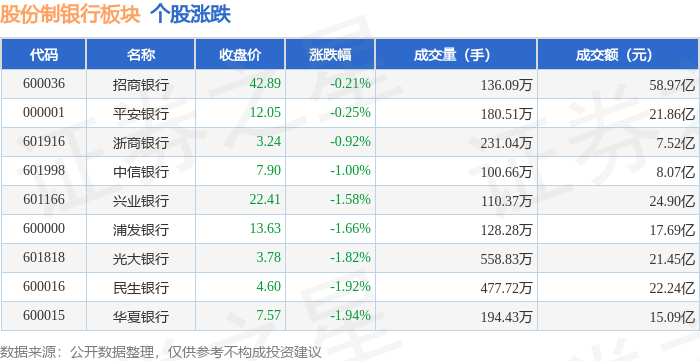
股份制银行板块8月29日跌1.03%,华夏银行领跌,主力资金净流出23.93亿元
Zheng Xing Xing Ye Ri Bao· 2025-08-29 08:48
Core Viewpoint - The banking sector experienced a decline of 1.03% on August 29, with Huaxia Bank leading the drop, while the Shanghai Composite Index rose by 0.37% and the Shenzhen Component Index increased by 0.99% [1] Group 1: Market Performance - The closing price of major banks showed a downward trend, with notable declines in shares such as Huaxia Bank (-1.94%) and Minsheng Bank (-1.92%) [1] - The trading volume for the banking sector was significant, with Ping An Bank recording a transaction amount of 2.186 billion yuan [1] Group 2: Capital Flow - The banking sector saw a net outflow of 2.393 billion yuan from institutional investors, while retail investors contributed a net inflow of 1.314 billion yuan [1] - Individual banks experienced varied capital flows, with Huaxia Bank facing a substantial net outflow of 3.52 billion yuan from institutional investors, indicating a 23.34% decrease in their net share [2]





平安银行为民办实事,专业服务优营商、暖银发、助小微
Jing Ji Ri Bao· 2025-08-29 01:38
Group 1 - The core mission of Ping An Bank is to serve the public by improving the business environment, enhancing services for the elderly, and alleviating difficulties faced by enterprises [1][2] - Ping An Bank has developed over a hundred bilingual service points to address the challenges faced by foreign nationals in China, such as difficulties in account opening and payment [1] - The bank has launched a three-in-one solution encompassing "Account Access," "Language Access," and "Service Access" to optimize the cross-border financial ecosystem [1][2] Group 2 - In terms of elderly care, Ping An Bank has implemented measures such as "green channels" and "love windows" to provide priority services for elderly customers [2] - The bank has upgraded self-service and smart devices with larger interfaces to facilitate transactions for older clients [2] - Ping An Bank has opened over 2 million pension accounts and continues to promote financial literacy and fraud prevention among the elderly [2][3] Group 3 - Ping An Bank emphasizes support for small and micro enterprises, recognizing their role in economic resilience and innovation [3][5] - The bank has streamlined the account opening process for small businesses, reducing paperwork and time required [2][3] - Over the past four years, Ping An Bank has waived over 12 million yuan in bank inquiry fees for small and micro enterprises, effectively lowering their financial burden [2]

平安银行零售业务蹚过“灰暗时期”
Shang Hai Zheng Quan Bao· 2025-08-28 19:36
Core Viewpoint - Ping An Bank's retail business has shown signs of stabilization after two years of adjustment, with improved asset quality and a slowdown in the decline of retail asset balances, although short-term revenue and profit support remains limited due to narrowing net interest margins and pressure on non-interest income [2][4]. Retail Loan Structure Optimization - In 2025, Ping An Bank continued to optimize its retail loan structure, shifting focus from high-risk, high-yield loans to lower-risk, higher-quality loan types. As of June 30, 2025, personal loan balances were approximately 17.26 trillion yuan, a decrease of 2.3% from the end of the previous year [4][6]. - The bank's retail financial assets accounted for 28.2% of total assets, down from 29.4% at the end of the previous year. Housing mortgage loans grew by 6.2%, while credit card and consumer loans declined by 9.2% and 3.5%, respectively [4][6]. Risk Clearance Progress - Ping An Bank has significantly reduced high-risk products, with "New One Loan" balances dropping from over 150 billion yuan to around 10 billion yuan, and credit card balances decreasing from over 500 billion yuan to approximately 390 billion yuan. The personal loan non-performing rate was 1.27%, down 0.12 percentage points from the beginning of the year [6][7]. - The bank's retail financial business saw a reduction in credit and other asset impairment loss rates from 105.4% to 96.9%, indicating improved asset quality [6][7]. Revenue and Cost Management - In the first half of 2025, Ping An Bank's retail financial business revenue was 31.08 billion yuan, accounting for 44.8% of total revenue, down from 50.7% in the same period last year. The bank has implemented cost-cutting measures, reducing operating expenses by 9% to 19.2 billion yuan [7][8]. - The average interest rate on deposits was 1.79%, a decrease of 46 basis points year-on-year, while income from financial management fees increased by 12.8% [8]. Future Outlook - The bank aims to maintain a competitive net interest margin within the industry, targeting a position among the top three in net interest margin among joint-stock banks, with a goal of maintaining a 30 to 40 basis point advantage [8].