UDC(000036)

Search documents
华联控股(000036) - 华联控股关于修订《内部审计管理制度》的公告
2025-10-30 07:55
本公司及董事会全体成员保证信息披露的内容真实、准确、完整,没有虚假记载、误 导性陈述或重大遗漏。 为进一步规范华联控股股份有限公司及其下属公司(以下简称"公司")的 内部审计工作,明确内部审计的职责和权限,发挥内部审计在强化内部控制、改 善经营管理、提高经济效益中的作用,促进公司经营效率、经济效益的提高,确 保内部控制持续有效实施,维护投资者的权益,实现内部审计的制度化和规范化, 根据《中华人民共和国审计法》《审计署关于内部审计工作的规定》《深圳证券 交易所上市公司自律监管指引第 1 号——主板上市公司规范运作》《中国内部审 计准则》及其他相关法律法规和《公司章程》等有关规定,结合公司实际情况, 修订本制度。具体内容如下: 证券代码:000036 证券简称:华联控股 公告编号:2025-065 华联控股股份有限公司董事会 关于修订《内部审计管理制度》的公告 除上述修订内容外,其他不涉及实质性内容的非重要修订,如条款编号变化、 援引条款序号的相应调整、标点符号及格式的调整等,未在上述表格中对比列示。 特此公告 华联控股股份有限公司董事会 二○二五年十月三十日 2 | 修订前 | 修订后 | | --- | -- ...

华联控股(000036) - 华联控股内部审计管理制度(2025年10月修订)
2025-10-30 07:55
华联控股股份有限公司 内部审计管理制度 华联控股股份有限公司 内部审计管理制度 (经公司于 2025 年 10 月 29 日召开的第十二届董事会第四次会议审议通过) 第一章 总 则 第一条 为规范华联控股股份有限公司及其下属公司(以下简称"公司")的内 部审计工作,明确内部审计的职责和权限,发挥内部审计在强化内部控制、改善经 营管理、提高经济效益中的作用,促进公司经营效率、经济效益的提高,确保内部 控制持续有效实施,维护投资者的权益,实现内部审计的制度化和规范化,根据《中 华人民共和国审计法》《审计署关于内部审计工作的规定》《深圳证券交易所上市公 司自律监管指引第 1 号——主板上市公司规范运作》《中国内部审计准则》及其他相 关法律法规和《公司章程》等有关规定,结合公司实际,制定本制度。 本制度所称"内部审计",是公司内部独立、客观的确认与咨询活动,它通过运 用系统、规范的方法,审查和评价公司的业务活动、内部控制和风险管理的适当性 和有效性,即对公司财务收支、经济活动、内部控制、风险管理实施独立、客观的 监督、评价和建议,以促进公司完善治理、增加价值和实现目标。 本制度所称"审计人员",是指在公司从事审计工作 ...
华联控股(000036) - 华联控股关于修订《募集资金管理制度》的公告
2025-10-30 07:55
证券代码:000036 证券简称:华联控股 公告编号:2025-063 华联控股股份有限公司董事会 关于修订《募集资金管理制度》的公告 本公司及董事会全体成员保证信息披露的内容真实、准确、完整,没有虚假记载、误 导性陈述或重大遗漏。 为进一步规范华联控股股份有限公司(以下简称"公司")募集资金管理与 运用,最大限度地保障投资者利益,根据《中华人民共和国公司法》《中华人民 共和国证券法》《上市公司募集资金监管规则》《深圳证券交易所股票上市规则》 《深圳证券交易所上市公司自律监管指引第 1 号——主板上市公司规范运作》等 法律、法规和规范性文件以及《华联控股股份有限公司章程》的规定和要求,结 合公司实际情况,修订本制度。具体内容如下: | 修订前 | 修订后 | | --- | --- | | 第二条 本制度所称募集资金是指公司通 | 第二条 本制度所称募集资金是指公司通 | | 过发行股票(包括首次公开发行股票、上市后 | 过发行股票或者其他具有股权性质的证券,向 | | 配股、增发)、可转换公司债券、公司债券 | 投资者募集用于特定用途的资金,不包括公司 | | 或其他根据有关法律、法规、《公司章程》 | 为 ...
华联控股(000036) - 华联控股募集资金管理制度(2025年10月修订)
2025-10-30 07:55
华联控股股份有限公司 募集资金管理制度 华联控股股份有限公司 募集资金管理制度 (经公司于 2025 年 10 月 29 日召开的第十二届董事会第四次会议审议通过) 第七条 募集资金必须严格按照《招股(或配股)说明书》、《募集说明书》承 诺的投资项目、投资金额和投入时间来使用。 第一章 总 则 第一条 为了规范华联控股股份有限公司(以下简称"公司")募集资金管 理与运用,最大限度地保障投资者利益,根据《中华人民共和国公司法》《中华 人民共和国证券法》(以下简称《证券法》)《上市公司募集资金监管规则》《深 圳证券交易所股票上市规则》《深圳证券交易所上市公司自律监管指引第 1 号— —主板上市公司规范运作》等法律、法规和规范性文件以及《华联控股股份有 限公司章程》(以下简称"《公司章程》")的规定和要求,结合公司实际情况, 制定本制度。 第二条 本制度所称募集资金是指公司通过发行股票或者其他具有股权性质 的证券,向投资者募集用于特定用途的资金,不包括公司为实施股权激励计划 募集的资金。 第三条 公司应当根据现行法律、法规规定和要求,及时完整地披露募集资 金的使用情况和使用效果。 第四条 违反国家法律、法规、公司章 ...
华联控股(000036) - 华联控股内部控制制度(2025年10月修订)
2025-10-30 07:55
华联控股股份有限公司 内部控制制度 华联控股股份有限公司 第一章 总 则 第一条 为了进一步强化华联控股股份有限公司(以下简称"公司")内部管理, 提高公司规范治理水平,提高信息披露质量,防范和化解经营风险,实现规范、健 康与稳定发展的治理目标,特制定本制度。本制度适用于公司及公司下属控股子公 司。 第二条 公司内部控制的目标: 第三条 为保障内部控制的顺利实施,公司根据自身经营管理的特点,建立架 构清晰、控制有效的内部控制机制;制定全面系统、切实可行的内部控制制度。 第四条 公司董事会对公司内部控制的建立、完善和有效运行负责。 第二章 内部控制的内容 第五条 公司内部控制主要包括环境控制、业务控制、会计系统控制、电子信 息系统控制、信息传递控制、风险管理控制、内部审计控制等内容。 第一节 环境控制 内部控制制度 (经公司于 2025 年 10 月 29 日召开的第十二届董事会第四次会议审议通过) 第六条 环境控制包括授权控制和员工素质控制。 (一) 公司应建立合理的组织架构、健全逐级授权制度,确保公司的各项规 章制度得以贯彻执行。各级授权要适当,对已获授权的部门和人员应建立有效的评 价和反馈机制,对已不适用 ...
一个拉扯了32年的新房打逆风局
Ge Long Hui· 2025-10-15 08:42
Core Viewpoint - The recent launch of the Yipin Luanshan Yayuan project in Shenzhen's Baoan district, after nearly 32 years, has raised concerns about its pricing and market positioning, as it exceeds market expectations despite offering discounts [3][4][8]. Group 1: Project Overview - The Yipin Luanshan Yayuan project consists of 218 residential units ranging from 94 to 162 square meters, with a registered average price of 66,100 yuan per square meter and a total price range of 5.16 million to 13.26 million yuan per unit [3][10]. - The project was developed by Hualian Holdings and has faced significant delays, with construction resuming only recently after being stalled since 2016 [7][8]. - Hualian Holdings holds a 70% stake in the project and has emphasized its importance for generating new revenue and improving financial conditions [10][14]. Group 2: Financial Implications - Hualian Holdings has set a sales target of 1.5 billion yuan for the Yipin Luanshan Yayuan project, indicating its critical role in the company's financial recovery [10][14]. - The company reported a total asset value of 7.619 billion yuan and a net asset value of 5.08 billion yuan as of the end of 2024, with a significant decline in revenue and net profit due to the ongoing downturn in the real estate market [13][14]. Group 3: Market Reception - There is a notable market divide regarding the project's pricing and positioning, with some analysts questioning whether the project can sustain its luxury branding given its pricing strategy [15][40]. - The project's average price after discounts is 61,500 yuan per square meter, which is higher than nearby developments, raising concerns about its competitiveness in the current market [41][40]. - The project has been criticized for its design and layout, with some potential buyers expressing dissatisfaction with the perceived quality and spacing of the units [17][38][39].


首现国有大行关停信用卡App
2 1 Shi Ji Jing Ji Bao Dao· 2025-10-13 13:24
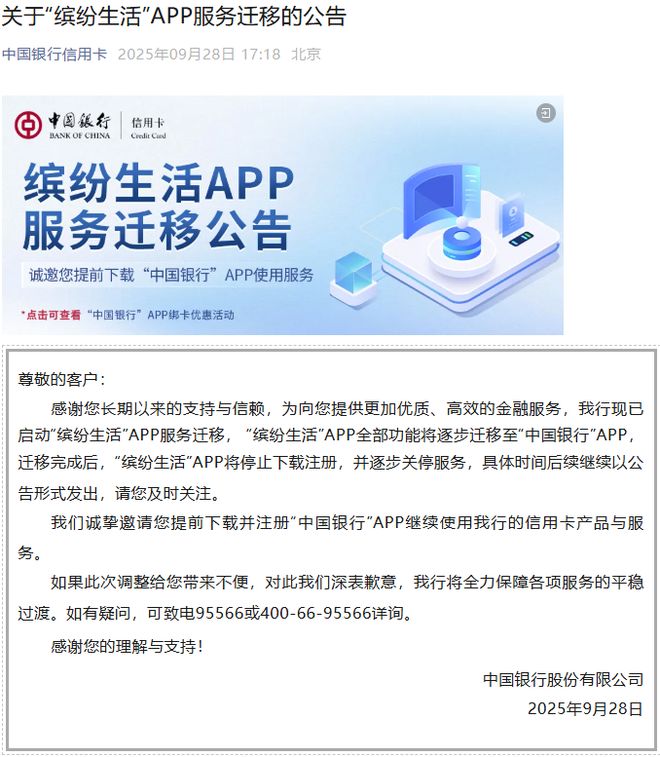
Core Viewpoint - The recent announcement by Bank of China to gradually shut down its "Bountiful Life" app and migrate its functions to the main "Bank of China" app highlights a shift in the credit card app landscape, moving from smaller banks to major state-owned banks amid a backdrop of declining credit card business and cost-cutting measures in the banking industry [1][5][17]. Summary by Sections Credit Card App Shutdown - Bank of China announced the gradual shutdown of its "Bountiful Life" app, which will have all its functions transferred to the main "Bank of China" app [1]. - This trend of shutting down credit card apps is not new, as several banks, including Shanghai Rural Commercial Bank and Beijing Rural Commercial Bank, have previously made similar moves [5]. Market Dynamics - The credit card app market is experiencing increasing differentiation, with a clear ranking in monthly active users [7]. - As of June 2025, the top 20 credit card apps include 5 state-owned banks, 9 joint-stock banks, and 2 city commercial banks, with the highest monthly active users exceeding 14 million for several apps [7][8]. - Bank of China's "Bountiful Life" app had only 1.55 million monthly active users, ranking 13th among state-owned bank credit card apps [7][9]. Credit Card Loan Scale - State-owned banks maintain a significant advantage in credit card loan scales, with China Construction Bank being the only bank with a credit card loan scale exceeding 1 trillion yuan, reaching 1,054.95 billion yuan as of June [10][11]. - Other major state-owned banks also report credit card loan scales above 500 billion yuan, while joint-stock banks like China Merchants Bank show strong performance with a credit card loan balance of 924.49 billion yuan [10][11]. User Engagement and Competition - The focus of credit card apps has shifted from acquiring new customers to retaining existing ones, as many consumers already hold multiple credit cards [14][15]. - The competition for user engagement is intensifying, with various lifestyle service apps entering the market, making it challenging for credit card apps to attract new users [15][19]. Operational Efficiency - The closure of independent credit card apps reflects a broader trend towards centralized management of banking channels [17]. - Regulatory guidance has prompted banks to streamline their mobile applications, focusing on user engagement and operational efficiency [18][19].

首现国有大行关停信用卡App
21世纪经济报道· 2025-10-13 12:35
Core Viewpoint - The recent shutdown of credit card apps, particularly by major state-owned banks like Bank of China, reflects a broader trend in the banking industry towards consolidating digital services and reducing operational costs amid a shrinking credit card business [1][5][16]. Group 1: Credit Card App Shutdowns - Bank of China announced the gradual shutdown of its "Bountiful Life" app, migrating its functions to the main "Bank of China" app, which has drawn market attention [1][4]. - Several banks, including Shanghai Rural Commercial Bank and Beijing Rural Commercial Bank, have previously shut down their credit card apps, indicating a trend towards integrating these services into existing banking apps [5][6]. Group 2: Market Dynamics and User Engagement - The credit card app market is experiencing significant differentiation, with major state-owned banks and some joint-stock banks dominating user engagement metrics [7][8]. - As of June 2025, the top credit card apps by monthly active users include those from major banks, with Bank of China's "Bountiful Life" app ranking 13th with 1.5454 million active users, significantly lower than leading apps [7][8]. Group 3: Credit Card Loan Performance - State-owned banks maintain a strong position in credit card loan volumes, with China Construction Bank reporting a credit card loan scale of 1.0549 trillion yuan, the only bank exceeding 1 trillion yuan [9][10]. - Joint-stock banks also show robust performance, with China Merchants Bank's credit card loan balance reaching 924.49 billion yuan, accounting for 12.99% of its total loans [9][10]. Group 4: Digital Transformation and App Management - The closure of independent credit card apps is part of a broader strategy for centralized management of banking applications, as mandated by regulatory authorities to optimize user experience and reduce redundancy [16][17]. - Banks are increasingly focusing on comprehensive apps that integrate various financial services, moving away from multiple standalone apps to enhance operational efficiency and customer engagement [17].






银行股的保险资金配置:有望持续提升
ZHONGTAI SECURITIES· 2025-10-12 12:46
Investment Rating - The report maintains an "Overweight" rating for the banking sector [1]. Core Insights - The scale of insurance capital investment is steadily increasing, with a significant rise in stock investment proportion, which has outpaced bond growth [3][4]. - Bank stocks have consistently held the largest share in insurance capital's heavy stock holdings, with a notable recovery in their proportion post-2023, reaching 41.9% of total stock purchases in 2025 [3][4]. - Current policies are promoting long-term capital market entry, with adjustments in insurance company assessment mechanisms to enhance equity investment ratios, a strategy validated by experiences in the US and Japan [3][4]. Summary by Sections Insurance Capital Investment: Steady Growth and Increased Stock Proportion - As of 1H25, the total insurance capital investment balance in China reached 36.2 trillion yuan, marking a year-on-year growth of 17.4%, with life insurance companies accounting for 90% of this balance [6][8]. - Stock investment growth has outpaced bond investment, with stock investment proportion rising to 8.8% in 1H25, reflecting a significant increase compared to previous years [10][12]. - The decline in long-term interest rates has been a crucial factor driving insurance companies to increase stock investments, as they seek to mitigate risks associated with interest rate spreads [24][26]. Increased Proportion of Bank Stocks in Insurance Capital Holdings - Bank stocks have maintained the highest proportion in the heavy stock holdings of insurance capital, accounting for 47.2% in 1H25, significantly higher than other sectors [29][30]. - The number of stock purchases (or "takeovers") in the banking sector surged in 2025, with bank stocks representing 41.9% of total purchases, a marked increase from previous years [29][30]. Policy Support for Increased Equity Investment by Insurance Capital - Recent policies have been implemented to facilitate the entry of long-term capital into the market, with a focus on enhancing the willingness of insurance companies to invest in equities [31][32]. - The experiences of the US and Japan demonstrate that increasing equity investment during periods of declining long-term interest rates is a viable strategy for maintaining the health of insurance companies [33][37]. Projected New Insurance Investment Funds - It is anticipated that new insurance investment funds will exceed 4 trillion yuan in both 2025 and 2026, with stock investment proportions expected to rise to 9.3% and 10.9%, respectively [41][42]. Investment Recommendations - In the current policy and macroeconomic environment, it is recommended to focus on bank stocks, particularly those with regional advantages and high dividend yields, as insurance capital is likely to increase its holdings in this sector [48].



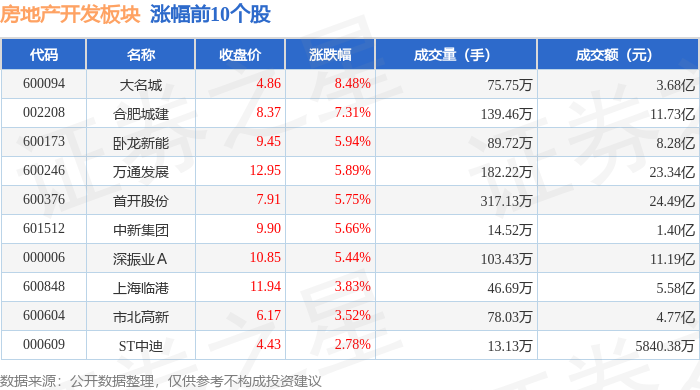
房地产开发板块10月9日跌1.34%,深深房A领跌,主力资金净流出8.82亿元
Zheng Xing Xing Ye Ri Bao· 2025-10-09 09:03
Core Insights - The real estate development sector experienced a decline of 1.34% on October 9, with Shen Shen Fang A leading the drop [1] - The Shanghai Composite Index closed at 3933.97, up 1.32%, while the Shenzhen Component Index closed at 13725.56, up 1.47% [1] Stock Performance - Notable gainers in the real estate sector included: - Daming City (600094) with a closing price of 4.86, up 8.48% on a trading volume of 757,500 shares and a turnover of 368 million [1] - Hefei Urban Construction (002208) closed at 8.37, up 7.31% with a trading volume of 1,394,600 shares and a turnover of 1.173 billion [1] - Wolong New Energy (600173) closed at 9.45, up 5.94% with a trading volume of 897,200 shares and a turnover of 828 million [1] - Major decliners included: - Shen Shen Fang A (000029) with a closing price of 30.22, down 10.01% on a trading volume of 112,700 shares and a turnover of 348 million [2] - Zhangjiang Changke (600895) closed at 49.46, down 9.99% with a trading volume of 1,475,800 shares and a turnover of 741.5 million [2] - New Town Holdings (601155) closed at 15.32, down 5.72% with a trading volume of 357,200 shares and a turnover of 54.9 million [2] Capital Flow - The real estate development sector saw a net outflow of 882 million from institutional investors, while retail investors contributed a net inflow of 49.1 million [2] - Key stocks with significant capital flow included: - Wolong New Energy (600173) with a net inflow of 1.19 billion from institutional investors, but a net outflow of 1.05 billion from retail investors [3] - Wanfang Development (600246) had a net inflow of 89.19 million from institutional investors, but a net outflow of 75.61 million from retail investors [3] - Hefei Urban Construction (002208) saw a net inflow of 82.03 million from institutional investors, with a net outflow of 16.89 million from retail investors [3]