
GUJING(000596)

Search documents
透过双节酒市窥见行业的“三重变革”时代:价格带分化、区域重构与渠
Sou Hu Cai Jing· 2025-10-12 00:42
Core Insights - The dual festival period of National Day and Mid-Autumn Festival in 2025 did not yield the expected sales peak for the liquor industry, with retail and catering sales only growing by 3.3% year-on-year, indicating a significant slowdown compared to the May Day holiday [1][3] - The liquor market is experiencing a structural transformation driven by rational consumption, channel revolution, and brand resilience, highlighting both challenges and opportunities for the industry [3] Market Performance - High-end liquor brands showed stable sales during the dual festival period, benefiting from effective volume control and price maintenance strategies, which helped stabilize core product pricing [3][4] - In contrast, mid-range and lower mid-range liquors faced significant challenges, with many products seeing price drops from the 400 yuan range to 200-300 yuan, and sales volumes declining by over 30% for most brands [4][6] - Low-end liquor performed relatively well, with some star products experiencing over 20% year-on-year sales growth, reflecting a shift towards value-for-money consumption [6][8] Regional Variations - The overall liquor market in Sichuan saw a year-on-year sales decline of approximately 20%, with significant drops in the Chengdu market [9][11] - In Guangdong, liquor sales also fell by 20-30% year-on-year, with a notable reduction in corporate group orders and a shift towards lower-priced products [9][11] - The Anhui market saw an increase in banquet events, but the average spending per table decreased, indicating a shift in consumer behavior [11][12] - The Henan market displayed structural opportunities, with some brands achieving growth through product innovation and cultural marketing [12] - Northern provinces like Shandong and Hebei showed signs of recovery, benefiting from a faster rebound in banquet markets [12] Channel Evolution - The liquor industry is undergoing a digital transformation in its channel ecosystem, with major brands adopting instant retail strategies to enhance consumer access [13][15] - Instant retail channels saw significant growth during the dual festival period, with sales on platforms like Meituan increasing by 8 times year-on-year [13][15] - The rise of instant retail reflects a shift in consumer habits towards immediate satisfaction, with younger consumers (aged 25-35) making up over 45% of buyers on these platforms [15][16] Future Trends - The liquor industry's competition is shifting from traditional brand and channel advantages to a more comprehensive competition based on digital capabilities, including data insights and supply chain efficiency [16] - The future of liquor consumption is expected to be characterized by rational, diverse, and instant purchasing behaviors, necessitating a reevaluation of product positioning and marketing strategies by companies [16]








2025年9月安徽A股上市公司市值TOP100:8家公司市值超过500亿元
3 6 Ke· 2025-10-11 08:08
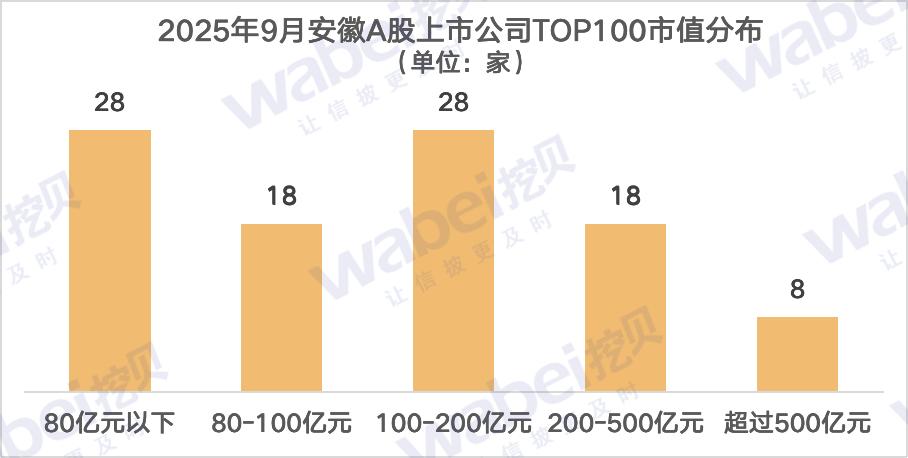
Core Insights - The "Top 100 A-share Listed Companies in Anhui Province by Market Capitalization as of September 2025" has been compiled, with a minimum market cap threshold of 5.1 billion yuan, and 8 companies exceeding 50 billion yuan in market cap [1][2]. Group 1: Market Capitalization Overview - The total market capitalization of the 100 companies listed is approximately 2.31 trillion yuan [2]. - The leading company, 阳光电源 (Sungrow Power Supply), has a market cap of 342.08 billion yuan, followed by 科大讯飞 (iFlytek) at 124.72 billion yuan, and 海螺水泥 (Anhui Conch Cement) at 123.74 billion yuan [2][7]. Group 2: Company Distribution by Market Cap - Among the top 100 companies, 8 have market caps exceeding 50 billion yuan, 18 companies are in the range of 20-50 billion yuan, and 28 companies fall between 10-20 billion yuan, while another 28 companies have market caps below 8 billion yuan [2][4]. Group 3: Industry Representation - The industry with the highest representation in the list is the computer, communication, and other electronic equipment manufacturing sector, which includes 12 companies [6]. - The chemical raw materials and chemical products manufacturing sector follows with 9 companies, and the electrical machinery and equipment manufacturing sector has 7 companies represented [6].



白酒板块10月10日跌0.47%,古井贡酒领跌,主力资金净流出7.6亿元
Zheng Xing Xing Ye Ri Bao· 2025-10-10 08:46
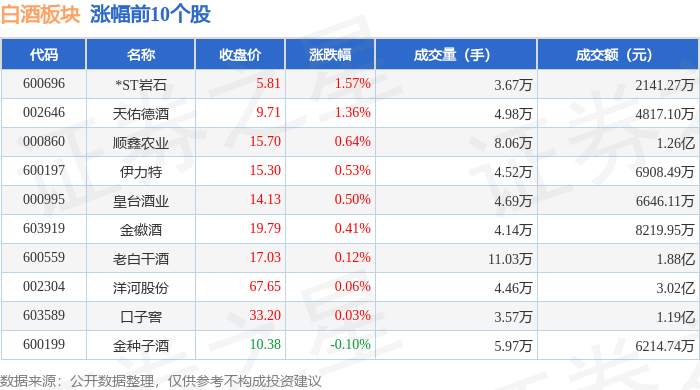
Core Insights - The liquor sector experienced a decline of 0.47% on October 10, with Gujing Gongjiu leading the drop [1][2] - The Shanghai Composite Index closed at 3897.03, down 0.94%, while the Shenzhen Component Index closed at 13355.42, down 2.7% [1] Stock Performance - Gujing Gongjiu closed at 154.28, down 1.04%, with a trading volume of 16,600 shares and a transaction value of 258 million [2] - Other notable declines include Shanxi Fenjiu at 188.70 (-0.89%), Luzhou Laojiao at 128.87 (-0.76%), and Kweichow Moutai at 1430.00 (-0.47%) [2] - The overall trading volume for the liquor sector showed a net outflow of 760 million from main funds, while retail investors contributed a net inflow of 219 million [2][3] Fund Flow Analysis - Shanxi Fenjiu saw a net inflow of 16.18 million from main funds, while it experienced a net outflow of 67.02 million from speculative funds [3] - Gujing Gongjiu had a net inflow of 2.45 million from main funds but faced a significant outflow of 18.77 million from speculative funds [3] - The overall trend indicates a mixed sentiment among different investor types, with main funds showing a net outflow across the sector [3]
问泉千年何为酒,古井秋酿是答卷
Qi Lu Wan Bao· 2025-10-10 07:36
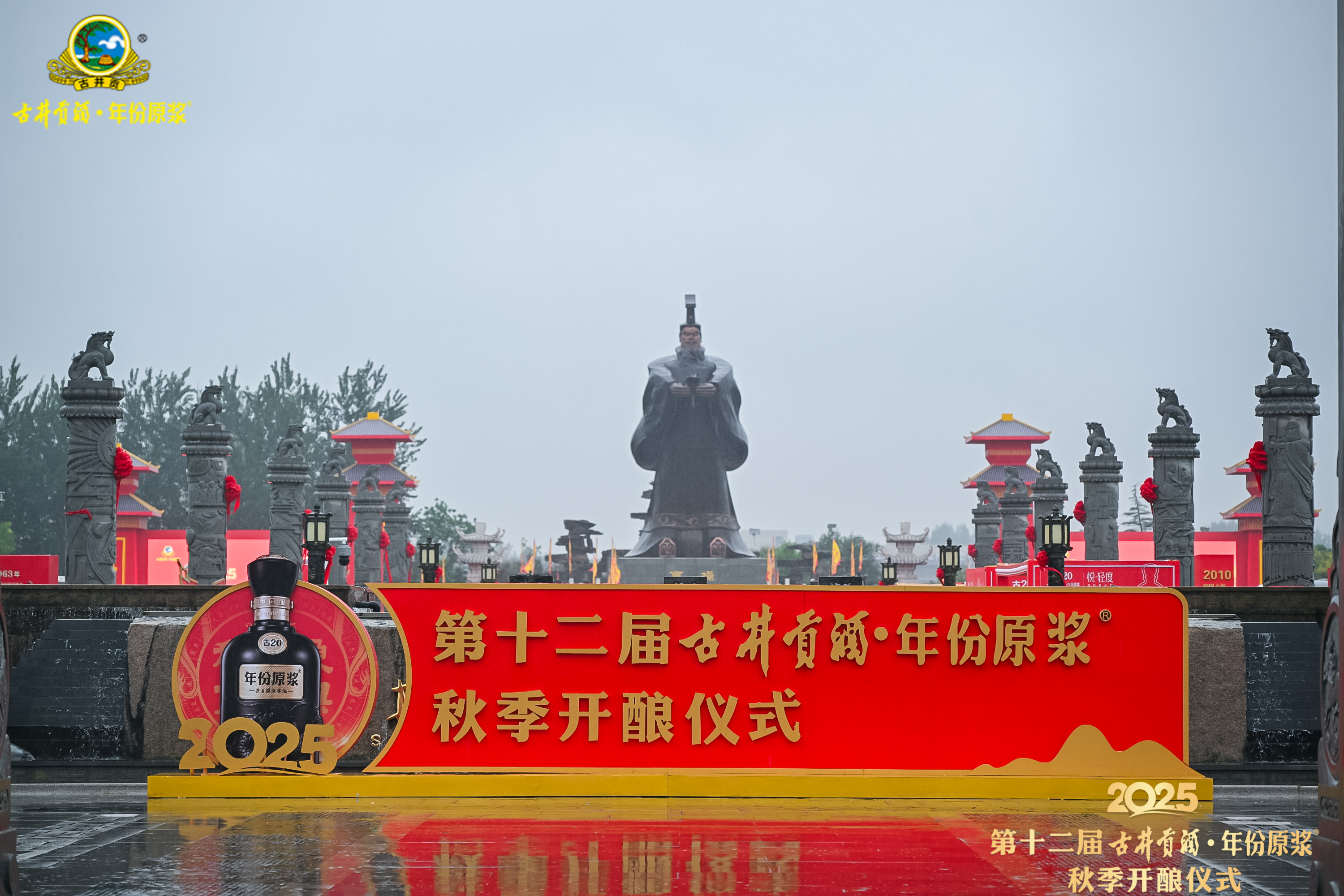
Core Viewpoint - The 2025 Autumn Brewing Ceremony of Gujinggongjiu marks the twelfth consecutive year of this tradition, emphasizing the brand's commitment to quality and cultural heritage in the liquor industry [1][4]. Group 1: Tradition and Cultural Significance - The ceremony includes a public worship of the "Wine God" Cao Cao, highlighting the historical significance of Gujinggongjiu as a tribute wine since the Han Dynasty [4][8]. - The event is not just about brewing but also about expressing gratitude towards nature, ancestors, and the adherence to traditional brewing methods [4][9]. Group 2: Innovation and Modernization - This year's ceremony has evolved into the "Autumn Brewing Cultural Week," extending the event to a week-long celebration that integrates with the World Manufacturing Conference in Hefei [5]. - The introduction of "Four Regions Brewing" signifies a strategic expansion, enhancing brand presence and market strategy through a diversified product matrix [9][10]. Group 3: Technological Integration - Gujinggongjiu is leveraging smart technology in its brewing process, combining traditional methods with modern automation to enhance efficiency and quality [10][14]. - The "1+1" production model emphasizes the balance between traditional craftsmanship and modern digital techniques, aiming for a seamless integration of both [10][14]. Group 4: Market Adaptation and Consumer Engagement - The brand is responding to evolving consumer trends by offering a diverse range of products that cater to contemporary preferences for health and personal expression [15][17]. - The focus on cultural innovation reflects Gujinggongjiu's understanding of the changing landscape of liquor consumption, moving beyond mere product offerings to creating immersive experiences [15][17]. Group 5: Strategic Vision for Future Growth - The ceremony encapsulates Gujinggongjiu's philosophy of "perseverance, transformation, and elevation," which is essential for achieving high-quality development in the liquor industry [18].
白酒板块10月9日跌0.72%,古井贡酒领跌,主力资金净流出16.86亿元
Zheng Xing Xing Ye Ri Bao· 2025-10-09 08:53
Core Insights - The liquor sector experienced a decline of 0.72% on October 9, with Gujing Gongjiu leading the drop [1] - The Shanghai Composite Index closed at 3933.97, up 1.32%, while the Shenzhen Component Index closed at 13725.56, up 1.47% [1] Liquor Sector Performance - Gujing Gongjiu's stock price fell by 2.91% to 155.90, with a trading volume of 31,800 shares and a transaction value of 495 million [2] - Other notable declines included Shanxi Fenjiu (-1.87% to 190.39), Luzhou Laojiao (-1.56% to 129.86), and Jiu Gui Jiu (-1.86% to 61.15) [2] - The overall liquor sector saw a net outflow of 1.686 billion from institutional investors, while retail investors contributed a net inflow of 830 million [2][3] Capital Flow Analysis - Major stocks like Kweichow Moutai and Luzhou Laojiao experienced significant net outflows of 887 million and 161 million respectively from institutional investors [3] - Retail investors showed a preference for stocks like Jiu Gui Jiu, which saw a net inflow of 122 million [3] - The data indicates a mixed sentiment in the market, with institutional investors pulling back while retail investors are more active [3]
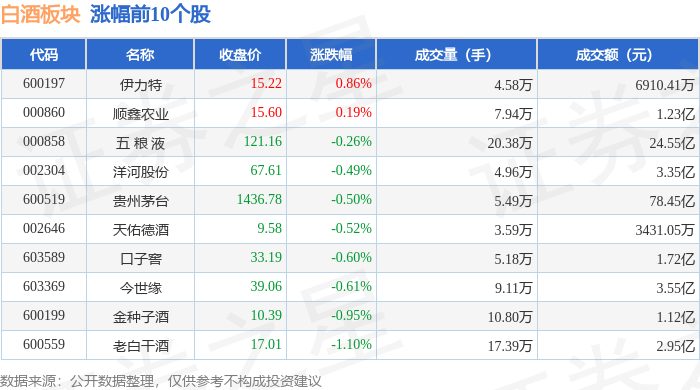
华创证券:白酒双节表现基本符合节前预期 渠道库存微弱去化、供需紧平衡
智通财经网· 2025-10-09 08:29
Core Viewpoint - The overall performance of the liquor industry during the holiday season is expected to decline by approximately 20%, aligning with pre-holiday expectations, although there are some positive indicators in specific segments [3][5]. Group 1: Liquor Sales Performance - Liquor sales showed marginal acceleration about a week before the holiday but gradually slowed down afterward, with an overall expected decline of around 20% [3]. - High-end products, particularly from Moutai and Wuliangye, demonstrated good turnover, while mid-range products like Wuliang Chun and Honghua Lang saw double-digit growth in certain regions [3][4]. - Demand for large gatherings remains relatively strong, with positive growth reported in Jiangsu, Henan, and Sichuan, particularly in the mid-price range [3]. Group 2: Regional Performance - Performance varies significantly by province, with Henan, Shandong, and Sichuan showing slightly better-than-expected results, while other regions like Hunan and Anhui met expectations with declines of over 20% [3][4]. - Feedback from various regions indicates that while some areas experienced a decline, the overall performance was not as poor as initially anticipated [3]. Group 3: Channel Inventory and Pricing - Channel inventory is experiencing slight depletion but remains at a high level, with a balance between incoming and outgoing shipments expected to continue into Q4 2025 and H1 2026 [5]. - Pricing remains stable with slight increases, although there is anticipated downward pressure in the coming months due to seasonal factors and promotional activities [5]. Group 4: Company Strategies and Market Dynamics - Companies are generally reducing their promotional spending, focusing more on consumer-end products rather than channel products, with a notable shift towards secondary products [6]. - Despite reduced spending, leading brands are still managing to increase their market share in specific segments, indicating a competitive market landscape [6]. - The overall collection and shipment progress for companies is lagging by over 10% compared to last year, with some brands maintaining their targets while others are struggling [6]. Group 5: Investment Recommendations - The current liquor cycle is seen as entering a bottoming phase, with recommendations to focus on companies with lower performance risks, those expected to confirm performance bottoms, and those undergoing significant transformations [7]. - Specific companies such as Guizhou Moutai and Shanxi Fenjiu are highlighted as priority investments due to their resilience [7]. - Attention is also drawn to companies like Yanghe and Jiuzi Li Du, which are undergoing changes that could lead to future growth [7].

需求边际修复,供给持续出清:白酒行业双节动销反馈
Huachuang Securities· 2025-10-09 04:43
Investment Rating - The report maintains a "Recommendation" rating for the liquor industry, expecting the industry index to outperform the benchmark index by more than 5% in the next 3-6 months [22]. Core Viewpoints - The liquor industry is experiencing a marginal recovery in demand while supply continues to clear out, with expectations of a 20% year-on-year decline in sales during the holiday period [5][6]. - High-end products like Moutai and Wuliangye are showing better turnover, while mid-range products are performing relatively well in certain regions [5]. - The report suggests prioritizing investments in companies with stable performance, those undergoing significant transformation, and those with quality products that are clearing out inventory [5]. Industry Basic Data - The liquor industry consists of 20 listed companies with a total market capitalization of 31,219.12 billion [2]. - The circulating market value stands at 31,214.28 billion [2]. Relative Index Performance - The absolute performance of the liquor industry over the past 1 month, 6 months, and 12 months is -4.0%, -6.4%, and -15.6% respectively [3]. - The relative performance compared to the benchmark index is -7.2% over 1 month, -24.9% over 6 months, and -31.1% over 12 months [3]. Sales Performance Insights - During the holiday period, liquor sales are expected to decline by approximately 20%, aligning with pre-holiday expectations [5]. - High-end gifting demand has improved slightly before the holidays, while mid-range business group purchases are still under pressure [5]. - Regional performance varies, with provinces like Henan, Shandong, and Sichuan showing slightly better-than-expected results [5]. Brand Performance - Moutai and Wuliangye are performing well, while other brands are experiencing significant declines in sales [5][6]. - The report highlights that brands like Gujing and Jiuzi are expected to confirm performance bottoms and drive growth through market share [5]. Channel and Inventory Insights - Channel inventory is slightly decreasing, with supply and demand remaining in a tight balance [5]. - The report anticipates that Q4 will focus on inventory digestion, with price stability expected despite some downward pressure [5]. Investment Recommendations - The report recommends focusing on companies with low performance risk, those confirming performance bottoms, and those undergoing deep transformations [5]. - Specific companies highlighted for investment include Moutai, Fenjiu, and Gujing, with a focus on dividend yield for Wuliangye and monitoring the performance of Laojiao [5].
A股午评:沪指时隔逾10年再站上3900点!黄金、有色金属、半导体板块爆发
Ge Long Hui· 2025-10-09 03:44
Market Performance - On the first trading day after the holiday, A-shares saw a strong performance with the Shanghai Composite Index rising by 1.24%, surpassing the 3900-point mark for the first time in over 10 years [1] - The Shenzhen Component Index increased by 1.75%, while the ChiNext Index rose by 1.77% [1] - The total trading volume in the Shanghai and Shenzhen markets reached 17.269 billion yuan, an increase of 3.571 billion yuan compared to the previous day, with 3200 stocks rising across the market [1] Sector Highlights - The international gold price broke the 4000 USD mark, leading to significant gains in the gold and non-ferrous metal sectors, with stocks like Chifeng Jilong Gold Mining and Sichuan Gold hitting the daily limit [1] - The controlled nuclear fusion concept saw strong performance, with stocks such as Guoguang Electric and Hanhua Welding Technology also hitting the daily limit, following key breakthroughs in China's nuclear fusion device construction [1] - The semiconductor sector experienced a surge, with companies like Zhaoxin Semiconductor and Huahong Semiconductor reaching historical highs [1] - Rare earth permanent magnet stocks collectively rose, with Antai Technology hitting the daily limit and other companies like Jinkeli Permanent Magnet and Zhongkuang Resources increasing by over 8% due to export controls on related rare earth items [1] Underperforming Sectors - The film and cinema sector faced declines, with Huace Film and Television dropping over 12% and other companies like Hengdian Film and China Film hitting the daily limit down, as the 2025 National Day box office fell short of last year's figures [1] - The liquor sector also saw declines, with Gujing Distillery and Huangtai Liquor both dropping over 3% [1] - The real estate sector experienced widespread declines, with Shen Shen Fang A hitting the daily limit down and Zhangjiang Hi-Tech dropping over 9% [1]




中国白酒追踪 - 黄金周期间销售依然疲软;宴会需求成唯一增长支柱-China Spirits Tracker_ Sales remained weak during Golden Week; banquet demand as the only growth pillar
2025-10-09 02:00
Summary of China Spirits Tracker Conference Call Industry Overview - The report focuses on the **China Spirits Industry**, particularly during the **Golden Week holiday season** which includes the National holiday and Mid-Autumn festival - Sales momentum for liquor consumption remained weak year-over-year (YoY) in key regions such as **Hunan, Anhui, and Henan** [1][1][1] Key Insights - **Banquet Demand**: Banquets are identified as the only growth pillar for spirits brands, outperforming other consumption scenarios during the holiday season, especially in **Jiangsu** and **Henan** provinces [1][1][1] - **Gifting Demand Decline**: There was a notable decline in gifting demand, with high-premium moon cakes (priced over Rmb500) market share dropping to approximately **1.8%** in 2025 YTD from **7.2%** in 2023. Pre-festival sales of moon cakes decreased by over **45%** YoY [1][1][1] - **Retail Sales Performance**: Overall retail sales of key enterprises in retail and catering increased by **3.3%** in the first four days of Golden Week, compared to a **6.3%** increase during the Labor Day holiday in 2025 [1][1][1] Regional Sales Performance - **Anhui**: Retail-end sales likely declined by **20%-30%** during the double holiday, with banquet sales still in a YoY downward trend [1][1][1] - **Jiangsu**: Retail-end sales likely decreased by over **20%** YoY, although banquet sales outperformed other consumption scenarios [1][1][1] - **Henan**: Holiday retail-end sales likely saw a **10%-15%** YoY decline, with banquet sales possibly remaining flat [1][1][1] - **Sichuan**: Retail-end sales may decrease by **20%** YoY, with gift-sending/business-related sales down by **20%-40%** YoY [1][1][1] - **Hunan**: Pre-festival shipment volumes for major brands like Feitian Moutai and Wuliangye saw declines ranging from **12% to 31%** YoY [1][1][1] Brand Performance - **Moutai**: - Feitian sell-through remained flat YoY, while non-standard SKUs saw a decline of over **20%** YoY [1][1][1] - Wholesale prices for original case Feitian Moutai decreased from **Rmb1,810** to **Rmb1,780** [1][1][1] - **Wuliangye**: - 1618 and Wuliangchun performed positively YoY, while common Wuliangye sell-through declined by **10%-15%** YoY [1][1][1] - **Laojiao**: Guojiao sell-through declined by over **25%** YTD YoY in some regions [1][1][1] Pricing Trends - Post-festival, wholesale prices for key upper-premium SKUs like Feitian Moutai and Common Wuliangye trended weaker compared to pre-festival prices, marking the weakest performance in the past five years [1][1][1] - Channel inventory levels remained stable, with Wuliangye and Laojiao at less than **2 months** and **3 months** respectively, while Gujing faced high inventory pressure [1][1][1] Additional Developments - **New Retail Initiatives**: - Waima opened its first offline store in **Chongqing**, offering upper-premium spirits brands [1][1][1] - I-Moutai launched insta-delivery services, supporting intra-city delivery in as fast as **30 minutes** [1][1][1] - **Sales Performance in Zhejiang**: Wuliangye management reported stable performance in weddings and celebratory banquets in the Zhejiang market [1][1][1] Conclusion - The China Spirits industry is currently facing challenges with weak demand trends, particularly in gifting and general consumption, while banquet demand remains a critical growth area. Brands are adjusting their strategies in response to changing consumer behaviors and market conditions.
白酒中秋国庆跟踪电话会
2025-10-09 02:00
Summary of the Conference Call on Baijiu Sales During the Mid-Autumn Festival and National Day Industry Overview - The overall sales of baijiu during the Mid-Autumn Festival and National Day were lower than last year, with high-end brands like Moutai and Wuliangye experiencing smaller declines due to gift-giving demand. The price range of 300-600 RMB saw the fastest decline, exceeding 30% [1][3]. - Online channels diverted some sales from offline, leading to a significant drop in offline distributor channels [1][4]. Key Points on Sales Performance - **Sales Disparity**: Sales performance varied significantly across different price ranges. High-end brands like Moutai and Wuliangye had smaller declines, while the 300-600 RMB price range saw the most significant drop [3][4]. - **Regional Performance**: In Jiangsu, sales were down compared to last year, with Yanghe focusing on inventory reduction and price increases. Guoyuan performed relatively well, with a decline of less than 10% [2][8]. - **Inventory Levels**: Jinshiyuan's inventory exceeded three months, while other brands like Guoyuan had larger terminal inventories, leading to price reductions for some products [10][6]. Brand-Specific Insights - **Yanghe**: Prices for core products increased, but social inventory remained high. The overall return rate was about 55%, which is a decline compared to last year [8][6]. - **Guoyuan**: The company aims for a return rate of over 90% by the end of November, with some products seeing a 20% increase in returns compared to last year [9]. - **Wuliangye**: The company implemented price control measures, allowing distributors to sell at higher prices, which helped stabilize prices around 810-815 RMB [32][33]. - **Luzhou Laojiao**: The brand's market performance was poor, completing only 55% of its annual target, with a focus on maintaining high prices for its high-alcohol products [34][35]. Consumer Behavior and Market Trends - **Shift to Online Sales**: Consumers are increasingly turning to online purchases, with some stores reporting a 50% increase in online sales, although overall sales remain dominated by offline channels [16][22]. - **Sales Channels**: There is a notable differentiation in sales performance among smoke shops, with those maintaining good customer relationships experiencing smaller declines [5][22]. Future Outlook - **Inventory Management**: The current inventory reduction cycle is expected to last longer, with a risk of 10%-30% of terminal stores potentially closing if the market does not recover by the Spring Festival [27]. - **Overall Market Trends**: The overall sales situation is projected to decline by about 15% in 2025 compared to the previous year, with significant challenges in the mid-range and low-end segments [31][25]. Conclusion - The baijiu industry is facing significant challenges with declining sales across various price segments, increased online competition, and inventory management issues. High-end brands are somewhat insulated from these trends, but overall market performance remains weak.