GUJING(000596)

Search documents
当老师傅遇上AI 酒业“十五五”路径划定
Bei Jing Shang Bao· 2026-02-24 17:03
Core Viewpoint - The joint issuance of the "Guidance on Quality Improvement and Upgrading of the Brewing Industry (2026-2030)" marks the beginning of a high-quality development path for China's liquor industry, focusing on enhancing raw material supply, technological innovation, and optimizing industry structure [1] Group 1: Upstream Development - The guidance emphasizes the shift from a "procurement mindset" to a "planting mindset" in the liquor industry, highlighting the importance of strengthening raw material supply and cultivation bases [2] - Key tasks include promoting the cultivation of specific brewing raw materials such as sorghum, barley, and wine grapes, and encouraging collaboration between universities, research institutions, and enterprises for high-yield, flavor-rich varieties [2][3] - The construction of raw material bases will focus on quality precision and customized varieties, leveraging biotechnology to meet diverse flavor needs [3] Group 2: Intelligent Manufacturing - The guidance prioritizes the "promotion of intelligent transformation," indicating that smart brewing will enhance traditional techniques rather than replace them [4] - Support for AI applications in various production processes aims to improve efficiency and quality control, with initiatives for smart manufacturing solutions and infrastructure development [4][5] - Companies like Wuliangye and Gujing Gongjiu are already implementing advanced technologies, such as 5G networks and AI decision-making models, to enhance production efficiency and accuracy [5] Group 3: Downstream Channel Innovation - The guidance encourages innovation in sales models, promoting a shift from traditional wholesale to brand agency and chain operations, as well as the development of new retail formats like community e-commerce and live streaming [7] - The liquor industry's immediate retail market is projected to exceed 50 billion yuan in 2024, with a growth rate of over 35%, indicating a significant shift in consumer purchasing behavior towards instant delivery [7] - Companies are increasingly adopting direct-to-consumer strategies through live streaming and community marketing, reducing reliance on traditional distribution networks [8] Group 4: Cultural and Cross-Industry Integration - The guidance supports the integration of brewing culture into various lifestyle products, indicating a broader cultural value of liquor beyond just consumption [8] - The emphasis on "brewing industry +" suggests a focus on cross-industry collaborations and the creation of original intellectual properties [8]

中国白酒追踪器_2026 年农历新年零售销售略好于预期;茅台、五粮液领衔的超高端品类表现强劲-China Spirits Tracker_ 2026 LNY retail sales slightly better than expected; Resilient super premium with Moutai-Wuliangye
2026-02-24 14:16
Summary of Key Points from the Conference Call Industry Overview - The conference call focuses on the **Chinese spirits industry**, particularly during the **2026 Lunar New Year (LNY)** period, highlighting retail sales trends and brand performances. Key Insights and Arguments 1. **LNY Consumption Sentiment**: - Pax mobility during the LNY holiday increased by approximately **9% year-over-year (yoy)**, with a total of **5.3 billion** trips recorded during the Chunyun window from February 2 to 20 [1] - Strong homecoming flows led to robust on-premise activity, with daily average sales of key retail and catering enterprises rising by **10.6% yoy** over the first two holiday days and **8.6% yoy** in the first four days [1] 2. **Retail Trends**: - Overall spirits retail demand declined by **10-15% yoy**, influenced by a high base from 2025, but the trend stabilized compared to the decline seen during the Mid-Autumn festivals [2] - Super-premium brands like **Moutai** and **Wuliangye** showed resilience, with **Feitian** sell-through up by **10-20%+ yoy** and **Common Wuliangye** recovering to near 2024 LNY volumes [2] 3. **Brand Performance**: - **39-degree Wuliangye** achieved double-digit retail sales growth, while **Fen wine's Bofen** and regional brands like **Yingji's Dongcang 6** performed well due to banquet trends [2] - Mass-market SKUs priced under **RMB 300** per bottle outperformed, particularly those under **RMB 100**, which saw positive retail growth [2] 4. **Pricing Trends**: - Wholesale prices for super-premium brands trended stronger, with **Feitian original case** wholesale price increasing by **RMB 160-195/bottle** year-to-date [2] - Significant pricing pressure was observed for SKUs priced between **RMB 600-800**, with **Junpin Xijiu** wholesale price dropping below **RMB 600** [2] 5. **Post-LNY Factors to Monitor**: - The trajectory of wholesale prices into the Lantern Festival slack period, especially for super-premium SKUs [2] - Retail channel replenishment orders over the next two weeks as holiday sell-through data becomes clearer [2] - Distributor prepayment progress, which is currently slower than the pace seen in 2025 LNY, except for Moutai, which is at **35-40%** [2] Additional Important Insights 1. **Regional Performance**: - Regions like **Sichuan** and **Henan** showed relative resilience, with retail sales down approximately **10%**, driven by super-premium brands amid banquet and gifting demand recovery [7] - **Anhui** mass-market products under **RMB 200** performed solidly due to banquet demand, with a **15% yoy decline**, which was better than pre-LNY expectations [7] 2. **Consumption Scenarios**: - Banquet and family-gathering occasions drove incremental volume, while gifting remained strong only for top-tier brands [8] - Commercial and government-related consumption remained at a structural low, putting sustained pressure on mid-tier brands [8] 3. **Wholesale Price Summary**: - Original case **Feitian Moutai** wholesale price increased by **RMB 10** to **RMB 1,700**, while **Common Wuliangye** and **Guojiao 1573** prices remained stable [9] 4. **Market Dynamics**: - The spirits market is experiencing a **dumbbell trend**, favoring super-premium and mass-market segments while the upper-mid segment remains weak [2] 5. **Valuation and Risks**: - The report outlines various valuation methodologies and key risks for major companies in the spirits sector, including potential regulatory changes and competition dynamics [45] This summary encapsulates the critical insights from the conference call, providing a comprehensive overview of the current state and trends within the Chinese spirits industry during the 2026 Lunar New Year period.



食品饮料行业:春节走访:五省白酒动销跟踪反馈
GF SECURITIES· 2026-02-24 02:48
Group 1 - Industry Investment Rating: Buy [2] - Previous Rating: Buy [2] - Report Date: February 24, 2026 [2] Group 2 - Core Viewpoint: The report summarizes feedback from six liquor distributors across five provinces regarding the sales performance of liquor during the Spring Festival, indicating a narrowing decline in sales of famous liquor compared to the Mid-Autumn Festival. The C-end scenarios, such as banquets, performed well with an upgrade trend, while B-end scenarios are still recovering [6][9][14] - Feedback from Henan liquor distributors indicates that Moutai and Wuliangye are leading in sales, with Moutai's return rate exceeding 35% and Wuliangye's at 30%. There is a trend of consumers concentrating on famous liquor across different price ranges [6][9] - In Shandong, Fenjiu is performing well in the mid-range segment, with a reported sales growth of approximately 8% during the Spring Festival [10] - In Anhui, the wedding market showed strong performance, particularly in the 200 CNY price range, which is experiencing growth [11] - Jiangsu distributors reported a mixed performance, with strong sales at both ends of the market but weakness in the mid-range, indicating a systemic price-driven volume increase [13] - In Sichuan, overall sales volume is expected to decline by 8% and sales amount by 15%, with personal and gift consumption performing better than expected [13] Group 3 - Investment Recommendations: For liquor, the sector is expected to enter a new development cycle in 2026 after four years of adjustment. Key recommendations include Luzhou Laojiao, Shanxi Fenjiu, Shede Liquor, Guizhou Moutai, Jianshe Liquor, and Gujing Gongjiu. For consumer goods, the industry is expected to see a moderate price increase in 2026, with opportunities in new products and channels. Key recommendations include Anjoy Food, Lihua Food, Angel Yeast, Yanjing Beer, Qianhe Flavor Industry, Dongpeng Beverage, New Dairy, Guoquan, and Tianwei Food [14]



26年春节消费趋势解读专题:春节消费开门红:总量增长,结构分化



GUOTAI HAITONG SECURITIES· 2026-02-24 02:32
Investment Rating - The report rates the industry as "Buy" [5] Core Insights - The 2026 Spring Festival consumption exceeded expectations, with service consumption leading the growth, driven by a significant increase in dining and travel demand [2][7] - The report highlights a notable recovery in the travel sector, with an expected total of 9.5 billion people traveling during the Spring Festival, marking a historical high [10][12] - The report emphasizes the importance of quality and experience in consumer spending, with a shift towards premium products and services [7][19] Summary by Sections 1. Spring Festival Consumption Trends - The Spring Festival holiday from February 15 to 23, 2026, saw a "good start" in consumption, with key retail and dining enterprises reporting a 10.6% increase in average daily sales compared to the same period in 2025 [10][22] - The first four days of the holiday recorded an 8.6% increase in average daily sales for key retail and dining enterprises compared to the previous year [10][19] - Government initiatives, including a 20.5 billion yuan fund for consumer subsidies, significantly boosted consumer spending [11][10] 2. Baijiu (Chinese Liquor) Market - The Baijiu market showed signs of improvement, with a narrowing decline compared to previous major holidays, although brand differentiation became more pronounced [27][30] - High-end Baijiu brands like Moutai and Wuliangye continued to lead the market, with a focus on price elasticity and rational consumer behavior [27][30] - The report identifies three key changes in the Baijiu market: increased importance of personal consumption, a more relaxed approach from manufacturers regarding sales targets, and improved channel sentiment [30][31] 3. Snack and Food Market - The snack market is expected to benefit from an extended peak season, with a longer preparation and sales cycle compared to 2025 [33][34] - Offline channels, particularly membership-based supermarkets and discount stores, are performing better than online channels, with significant growth in sales during the holiday period [34][35] - The report notes a diversification in snack offerings, with strong performance in high-quality nut gift boxes and innovative packaging strategies enhancing brand visibility [35][36]
食品饮料行业周报-春节跟踪:茅五和部分中低端价格带超预期增长,汾酒整体表现平稳
China Post Securities· 2026-02-24 01:25
Industry Investment Rating - The industry investment rating is "Outperform the Market" and is maintained [2] Core Viewpoints - During the Spring Festival, national catering and retail consumption showed steady growth, with holiday consumption potential continuing to be released. According to the Ministry of Commerce, the average daily sales of key retail and catering enterprises during the first four days of the Spring Festival in 2026 increased by 8.6% compared to the same period in 2025 [5][19] - The performance of Moutai and Wuliangye, as well as some mid-to-low-end price segments, exceeded expectations, while the overall performance of Fenjiu remained stable [15][19] Summary by Relevant Sections 1. Weekly Viewpoints - Moutai and mid-to-low-end liquor sales during the Spring Festival showed growth, while sub-premium liquor continued to face pressure. Moutai's repayment progress slightly exceeded the same period last year, and Wuliangye's repayment progress remained stable [15][6] - The mid-to-low-end liquor segment is expected to achieve double-digit growth during the Spring Festival, while high-end liquor sales are under pressure [15][6] 2. Industry Performance - The food and beverage sector experienced a decline, with the Shenwan Food and Beverage Industry Index (801120.SL) dropping by 2.51% during the week of February 9 to February 14, ranking 29th among 30 Shenwan primary industries [20] - All sub-sectors within the food and beverage industry saw declines, with meat products, health products, and baked goods experiencing relatively smaller drops [20] 3. Key Company Announcements - Luzhou Laojiao announced that the number of restricted stock units eligible for release is 1,962,814 shares, accounting for 0.1333% of the company's total share capital [29] - Miaokelan Duo signed a memorandum with SADAFCO to explore the market for children's cheese snacks in Saudi Arabia [29] 4. Important Industry News - The Ministry of Commerce announced anti-subsidy measures for EU companies, with rates ranging from 7.4% to 11.7%, effective from February 13, 2026 [31] - Kangshifu launched a new product, Kangshifu Ice Red Tea Energy, entering the energy drink market [31] 5. Industry Chain Data Tracking - As of February 10, 2026, wheat prices were 2,510.8 RMB/ton, up 6.45% year-on-year, while pork prices were 18.08 RMB/kg, down 11.63% year-on-year [34][36]

酒价内参2月24日价格发布 总价小幅回落分化走势延续
Xin Lang Cai Jing· 2026-02-24 01:17
Core Insights - The article discusses the recent trends in the Chinese liquor market, particularly focusing on the retail prices of the top ten liquor products, which showed a slight adjustment after a period of high prices [1][4]. Price Trends - As of February 24, the total retail price for a package of the top ten liquor products was 9,258 yuan, a decrease of 2 yuan from the previous day [1][4]. - Among the top ten products, six saw price increases while four experienced declines. The most notable increase was for the premium Moutai, which rose by 8 yuan per bottle, surpassing the 2,400 yuan mark [1][4]. - Other products that increased in price include Xijiu Junpin (+4 yuan), Guojiao 1573 (+3 yuan), and several others that saw minor increases of 1 yuan [1][4]. - Conversely, the Yanghe Dream Blue M6+ dropped by 10 yuan, marking its fourth consecutive decline, while Feitian Moutai and Gujing Gonggu 20 both decreased by 4 yuan [1][4]. Market Analysis - Major foreign investment banks, including Goldman Sachs, Morgan Stanley, and UBS, have released reports indicating a structural differentiation in the liquor industry due to weak consumption during the Spring Festival and inventory pressures [3][6]. - Goldman Sachs suggests that the liquor industry is more likely to experience a bottoming out rather than a full reversal, with high-end liquor showing relatively stable performance during the Spring Festival [3][6]. - UBS notes that the industry is in a "K-shaped recovery" phase, with Moutai implementing channel and pricing strategies to restore sales, although competition in the high-end segment is intensifying [3][6]. - Morgan Stanley observes that inventory pressures among mainstream liquor companies are easing, and demand from banquet and dining channels is expected to support a sequential improvement in the industry [3][6]. - Overall, foreign institutions believe that the recovery in the liquor industry is characterized by "high-end stability and layered recovery," with a focus on demand improvement and price stability for leading brands in the second half of the year [3][6].
从“历史经典产业”到“传统优势民生产业”,新五年酿酒产业提质发展
Soochow Securities· 2026-02-24 00:45
Investment Rating - The report maintains an "Accumulate" rating for the beverage industry, indicating a positive outlook for investment in this sector [1]. Core Insights - The report emphasizes the transition of the brewing industry from a "historical classic industry" to a "traditional advantageous livelihood industry," highlighting its importance in cultural heritage and economic development [4][9]. - The "14th Five-Year Plan" outlines specific goals for the brewing industry, including the establishment of over three trillion-level traditional advantageous wine production areas and more than ten hundred-billion-level specialty brewing industrial parks by 2028 [10][12]. - The report identifies a shift in the industry towards digitalization, green practices, and internationalization, with leading companies actively pursuing these transformations [18][20]. Summary by Sections 1. Development of the Brewing Industry - The brewing industry is recognized as a traditional advantageous industry, playing a crucial role in cultural transmission and regional economic development [9]. - The "Guidance on Quality Improvement and Upgrading of the Brewing Industry (2026-2030)" outlines a clear path for high-quality development, focusing on adapting to market changes [9][10]. - The report details a comprehensive plan with 21 key tasks across seven dimensions, including enhancing raw material supply, promoting technological innovation, and transforming business models [17][18]. 2. Investment Recommendations - The report suggests that while traditional beverages like baijiu, beer, and yellow wine are well-established, emerging categories such as fruit wines and craft beers present new opportunities [21]. - It recommends focusing on companies like Kweichow Moutai, which is expected to stabilize and recover in valuation, along with other notable brands such as Gujing Gongjiu and Luzhou Laojiao [22].

酒价内参2月22日价格发布 青花郎六连阳强势领跑
Xin Lang Cai Jing· 2026-02-22 01:14
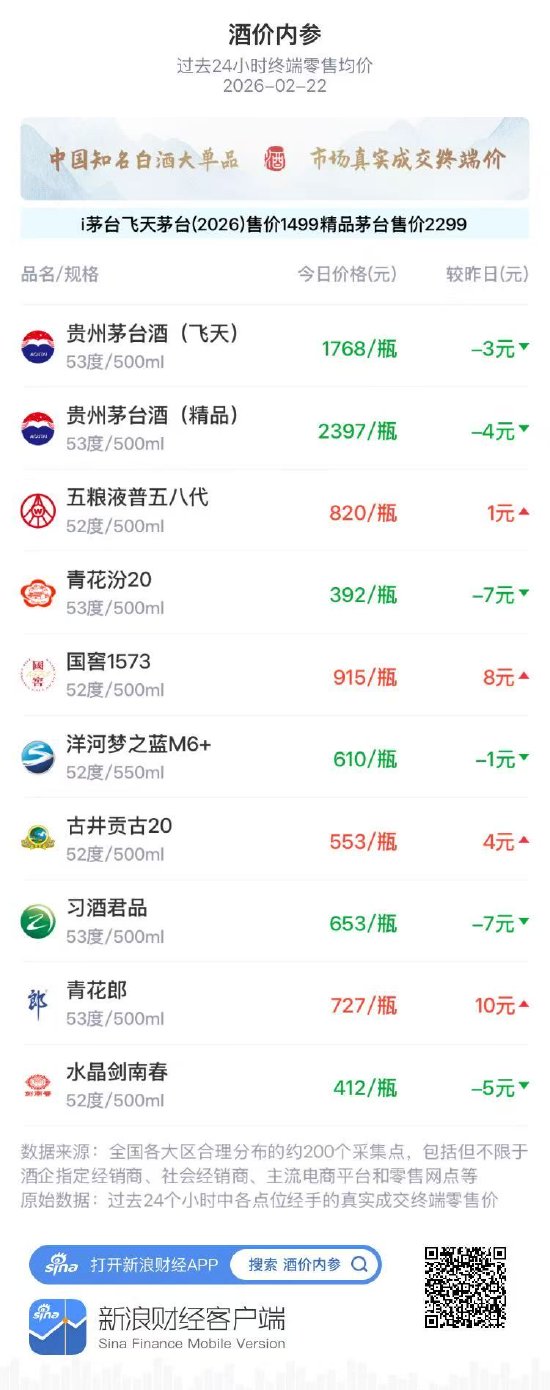
Core Insights - The article discusses the recent trends in the Chinese liquor market, particularly focusing on the retail prices of the top ten liquor products, which showed a mixed performance with six products declining and four increasing in price [1][6]. Price Trends - The overall retail price for a package of the top ten liquor products is 9,247 yuan, a decrease of 4 yuan from the previous day [1][6]. - Among the price increases, Qinghua Lang rose by 10 yuan per bottle, marking its sixth consecutive increase; Guojiao 1573 followed with an 8 yuan increase; and Gujing Gong 20 increased by 4 yuan [1][6]. - On the downside, Xijiu Junpin and Qinghua Fen 20 both dropped by 7 yuan per bottle, indicating ongoing inventory pressure in the mid-range segment; other declines included Shujin Jianan Chun down by 5 yuan, and both Jingpin Moutai and Feitian Moutai down by 4 yuan and 3 yuan respectively [1][6]. Market Dynamics - The data for the "Liquor Price Reference" is sourced from approximately 200 collection points across various regions, including designated distributors, social distributors, e-commerce platforms, and retail outlets, aiming to provide an objective and traceable market price [4][9]. - The introduction of new sales channels for Moutai products has begun to influence their market prices, with Feitian Moutai priced at 1,499 yuan and Jingpin Moutai at 2,299 yuan [4][9]. Industry Trends - A report published on the 21st highlighted seven core development trends in the liquor industry, including price polarization, the rise of mass consumption as a market stabilizer, and the emergence of new retail formats [4][9]. - The report also noted that the price range of 100-300 yuan is becoming a market necessity, and that traditional liquor stores are undergoing significant transformations [4][9].

酒价内参2月21日价格发布 总酒价创三个月新高
Xin Lang Cai Jing· 2026-02-21 01:09
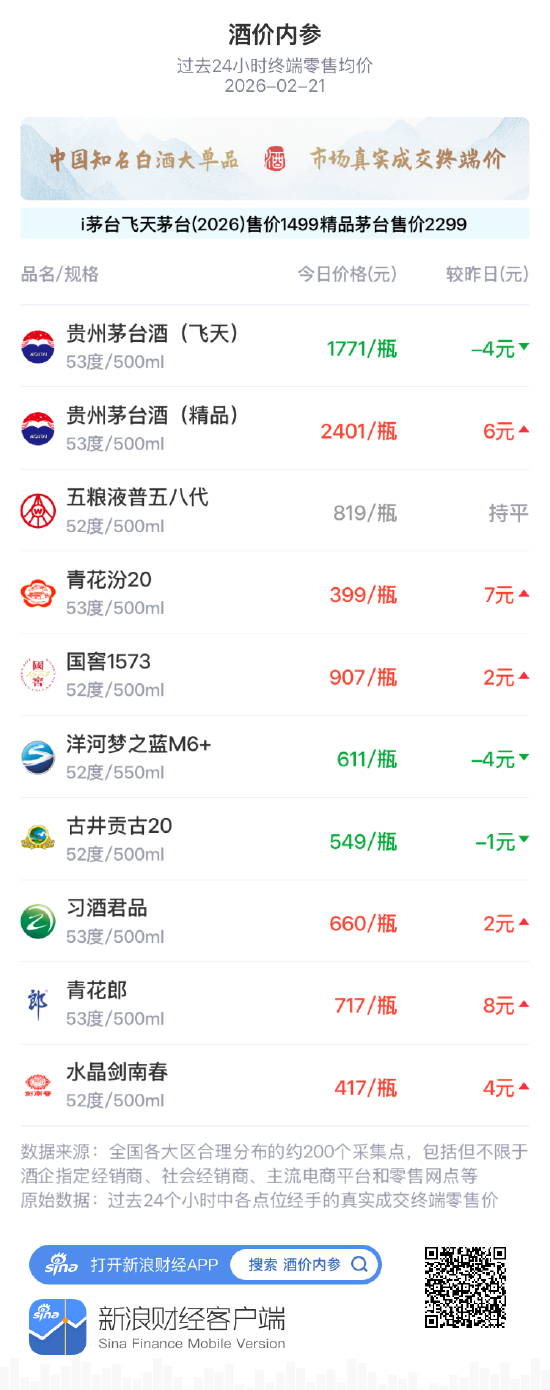
Core Insights - The article highlights the launch of "Wine Price Reference" by Sina Finance, which provides real-time data on the retail prices of major Chinese liquor brands, indicating a dynamic market with price fluctuations and trends [1][4]. Price Trends - The average retail price of the top ten Chinese liquor products reached 9,251 yuan on February 21, marking a 20 yuan increase from the previous day and the highest in three months [1][6]. - Among the ten products, six saw price increases, three decreased, and one remained stable. The strongest performer was Qinghua Lang, which rose by 8 yuan per bottle, continuing a five-day upward trend [1][6]. Individual Product Performance - Specific price changes include: - Qinghua Fen 20 increased by 7 yuan to 399 yuan per bottle [2][7]. - Premium Moutai rose by 6 yuan to 2,401 yuan per bottle [2][7]. - Crystal Jian Nan Chun increased by 4 yuan to 417 yuan per bottle [3][8]. - Both Flying Moutai and Yanghe Dream Blue M6+ decreased by 4 yuan to 1,771 yuan and 611 yuan per bottle, respectively [2][7]. - Gujing Gong Gu 20 saw a slight decrease of 1 yuan to 549 yuan per bottle [7]. Market Dynamics - The market is characterized by a rotation of product performance, indicating a stable yet differentiated growth pattern [1][6]. - The introduction of new sales channels for Moutai, with prices set at 1,499 yuan for Flying Moutai and 2,299 yuan for Premium Moutai, has begun to influence market prices significantly [4][9]. Consumer Behavior - A survey conducted regarding Moutai consumption during the New Year revealed that 43.85% of participants reported having Moutai at home this year compared to last year, indicating a positive trend in consumer sentiment towards Moutai [5][9].
酒价内参2月20日价格发布 市场稳步上扬整体价格再创年内新高
Xin Lang Cai Jing· 2026-02-20 01:06
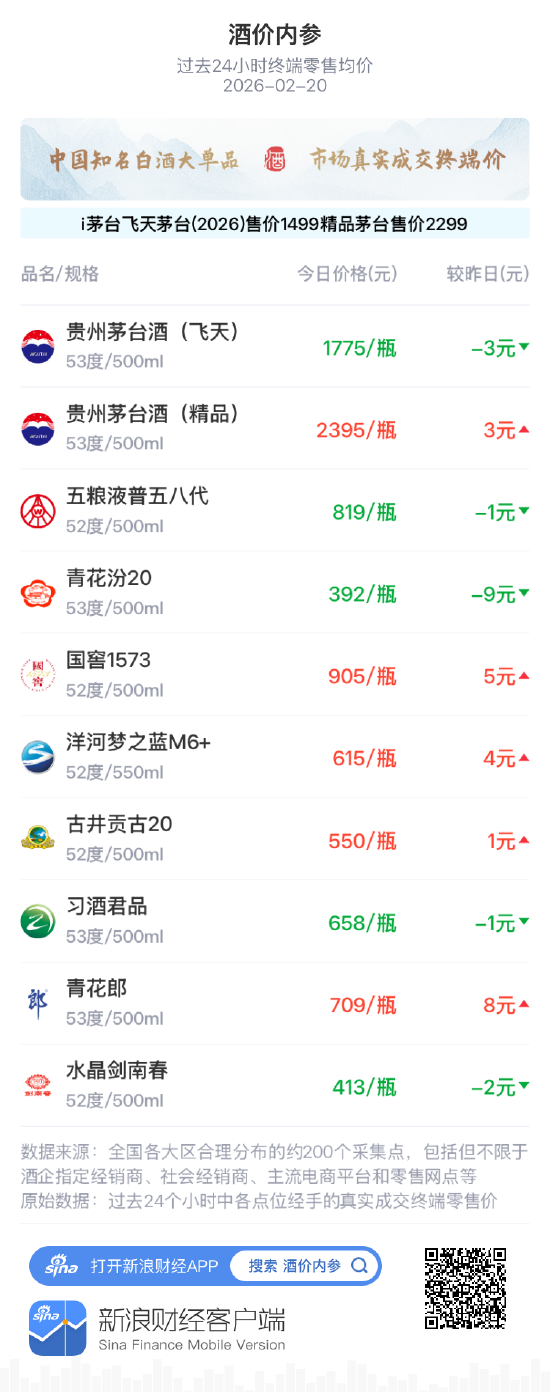
Core Insights - The core viewpoint of the article highlights the steady increase in the retail prices of China's top ten liquor products, with the total price reaching a record high since 2026, indicating a bullish market sentiment [1][7]. Price Trends - The average retail price of the top ten liquor products rose to 9,231 yuan, an increase of 5 yuan from the previous day, marking the highest level since 2026 [1][7]. - The market exhibited a balanced pattern with five products increasing in price and five decreasing [1][7]. - Notable price increases included Qinghua Lang, which rose by 8 yuan per bottle, and Guojiao 1573, which increased by 5 yuan per bottle [1][7]. Product Performance - Qinghua Lang led the price increases for the fourth consecutive day, while Guojiao 1573 returned to 905 yuan per bottle [1][7]. - Other products that saw price increases included Yanghe Dream Blue M6+ (up 4 yuan) and premium Moutai (up 3 yuan) [1][7]. - Conversely, Qinghua Fen 20 experienced the largest decline, dropping 9 yuan to 392 yuan per bottle [1][7]. Market Dynamics - The data for "Wine Price Reference" is sourced from approximately 200 collection points across various regions, ensuring a comprehensive and objective representation of market prices [5][10]. - The report from iResearch indicates that the white liquor market is undergoing significant changes, with a shift towards family gatherings and self-consumption, moving away from business banquets [6][10]. - The rise of female consumers in the liquor market is notable, with brands like Jinjiu and Wuliangye seeing significant growth in female users [6][10].